Bunratty Destruction1332 CE
In 1332, Ireland’s lordship faced acute political and social strain. Sir William de Bermingham was executed in Dublin after politically charged conspiracy proceedings, while his son Walter was released. Thomond forces destroyed Bunratty Castle, whereas Anthony de Lucy recovered and garrisoned Arklow. Hostages seized castles at Limerick and Nenagh, exposing fragile authority; civic action restored Limerick. Raids, rivalries and warfare affected Munster, Leinster, Connacht and Ulster. Disease and exceptionally expensive wheat compounded hardship after famine. Edward III’s planned expedition was abandoned for Scotland, weakening government and leading to Lucy’s replacement by John Darcy. Richard FitzRalph’s Oxford chancellorship illustrated Irish connections.
Dateline
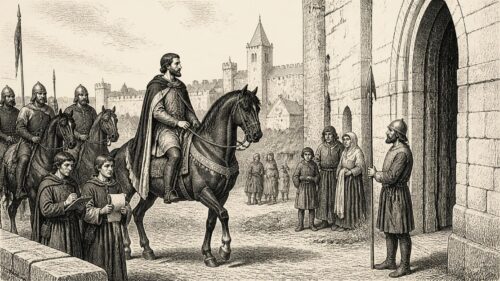
In 1332, authority in Ireland was measured less by formal titles than by whether a lord could keep a castle, command a town, protect a road or carry a prisoner to Dublin. The year brought a striking sequence of events across the lordship: the execution of William de Bermingham, the destruction of Bunratty Castle in Thomond, a renewed royal hold on Arklow, and outbreaks of violence at Limerick and Nenagh. These were not isolated disturbances. Together they exposed the limitations of government from Dublin, the strength of regional lordships, and the enormous pressure placed upon communities already affected by scarcity and disease.
A Knight Hanged in Dublin
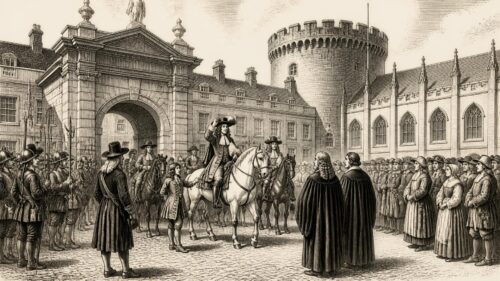
The most firmly dated political event was the execution of Sir William de Bermingham, lord of Carbury and a former deputy justiciar. He was hanged at Dublin in July: the surviving legal and administrative evidence supports 11 July, while the chronicle associated with Friar John Clyn gives 10 July. This small discrepancy is worth preserving, because it shows why exact medieval dates must be handled with care. What is clear is that the execution was public, exceptional and controversial. Clyn’s annal calls Bermingham an able and noble soldier whose death was widely lamented; a later Anglo-Irish obituary mourned him in even more extravagant language.
Bermingham’s fall emerged from a struggle between the Dublin administration and some of the greatest Anglo-Irish landholders. In February and March 1332, juries at Clonmel and Limerick indicted him in connection with alleged conspiracies said to have aimed at making Maurice fitz Thomas FitzGerald, earl of Desmond, king in Ireland. Such accusations should not be treated as a straightforward record of an actual plot. Modern scholarship stresses the political character of the proceedings and the weakness of some of the claims. The inquiries nevertheless reveal a government determined to punish magnates who had resisted royal direction, retained disputed grants, maintained armed followings and formed powerful local alliances.
Anthony de Lucy, the English-born justiciar, had arrested William and his son Walter at Clonmel earlier in the year. They were moved to Dublin Castle on 19 April, joining an alarming cluster of prisoners connected with Munster politics, including Desmond and Henry de Mandeville. William was executed, his estates were forfeited, and Walter was released. The differing fates of father and son suggest not a broad purge but a calculated assertion of royal justice against one particularly troublesome figure. Yet an execution could not remove the networks of kinship, tenancy, military service and local influence on which the Bermingham power rested.
Bunratty Lost, Arklow Retaken
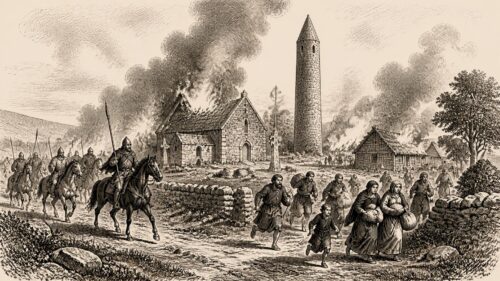
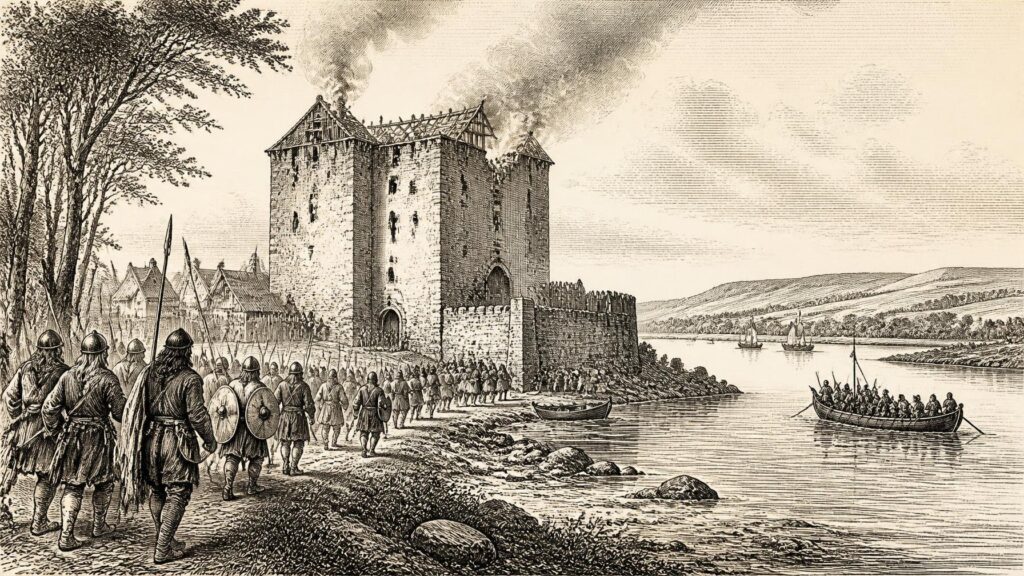
July also saw the destruction of Bunratty Castle by the Irish of Thomond. The contemporary annal does not safely permit a more precise day, nor does it name every leader involved; it is best understood as a Thomond success against a strategic Anglo-Irish outpost on the Shannon estuary. Bunratty had long stood at the meeting point of competing claims: those of the de Clare inheritance, the earls of Desmond and Ulster, and the Gaelic rulers of Thomond. Its loss mattered because castles were not merely military buildings. They were centres from which rents could be collected, supplies stored, justice claimed and routes watched. Their destruction announced that territorial authority could not simply be maintained by a grant from the king or an entry on an administrative roll.
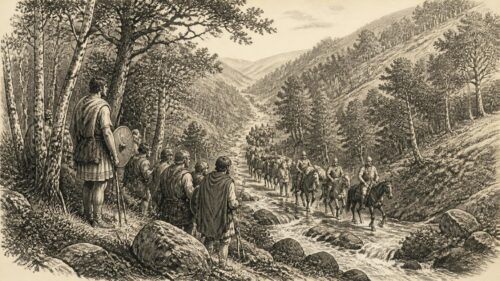
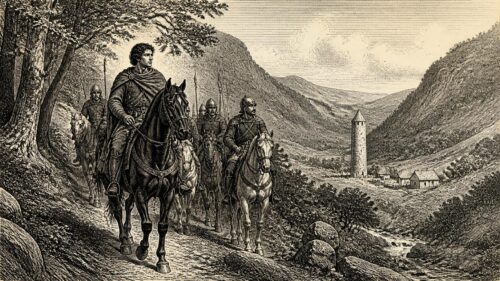
At the opposite end of the island’s English-held territories, Lucy recovered Arklow Castle in County Wicklow from Irish occupiers, repaired it and placed a garrison there. This was a real achievement, but it was also revealing. The government’s success consisted of recovering and refortifying a single coastal strongpoint. Arklow guarded a route between Dublin and the unstable Leinster marches, where the O’Tooles, O’Byrnes and other communities could use mountains, woods and river valleys to challenge incursions. The episode illustrates the patchwork character of the lordship: royal officials could exert force in a chosen place, but securing the surrounding countryside was another matter.
Elsewhere, the sources record violence in terms that are brief but telling. Brian O’Brien and MacCarthy were defeated in Munster by an English force, though the annal does not identify the battlefield or give a date. The castle of Lyons was burned by an O’Toole force. These notices should not be inflated into a single island-wide war. Rather, they show several overlapping conflicts: contests over lordship in Munster, pressure on the Leinster frontier, and disputes within the settler aristocracy which could draw Gaelic rulers, towns and church institutions into wider confrontations.
Castles, Hostages and Towns
Two episodes in the mid-west make the fragility of lordly security especially plain. At Limerick, hostages held in the castle killed its governor and seized the fortress. The citizens then stormed the castle and killed the captors. At Nenagh, hostages likewise took possession of the castle; its gates were burned before the stronghold was recovered, though in that case the hostages were saved. Neither account gives enough detail to reconstruct the negotiations or grievances behind these actions. But both show that hostage-taking was not a ceremonial formality. It was a coercive instrument of politics, binding communities and rulers through the threatened bodies of captives.
The active part played by Limerick’s citizens is equally important. Medieval Irish towns were not passive prizes for lords to win or lose. Their inhabitants had corporate interests in trade, fortification, food supply and public order. A castle seized beside an urban centre endangered all of these. The citizens’ assault on Limerick Castle therefore demonstrated civic capacity as well as loyalty to the existing political order. It also hints at the hard consequences of military insecurity for craftspeople, merchants, servants, clergy and families living within the town’s walls or relying on its market.
Conditions for ordinary people were made worse by disease and dearth. Clyn records an illness called the mauses, said to have passed through all Ireland and to have afflicted people of every age. The term cannot responsibly be equated with a modern diagnosis. It should not be called plague: the Black Death would not reach Ireland until the late 1340s. What can be said is that contemporaries perceived a widespread and serious sickness. The annal also records an extraordinarily high Christmas price for a peck of wheat, twenty-two shillings. Whether that figure reflected a particular market or an annalist’s emphasis on extreme scarcity, it conveys the strain placed upon households dependent on purchased grain.
This hardship followed the famine reported for 1330 and 1331. It is tempting to turn scattered notices into a neat national narrative of hunger, epidemic and revolt, but the evidence does not justify such certainty. Regional experience varied. Still, the conjunction of costly wheat, reported disease, damaged castles, raiding and disrupted authority helps explain why political conflict carried such immediate social weight. In an agricultural society, the loss of cattle, stores, labour, safe access to a market or a harvest could rapidly become a crisis.
Connacht and Ulster Rivalries
Gaelic and Hiberno-Norman politics beyond the Dublin administration continued on their own terms. The Annals of Ulster record the capture of Seán Ó hEaghra by the son of the earl, followed by the plundering of his followers. They also note reciprocal cattle raids between the sons of Domnall and the descendants of Maurice Sugach FitzGerald. Such entries are concise, but cattle-raiding was a serious form of warfare and economic pressure, affecting wealth, status and the ability to support dependants.
The same annals report that William Burke devastated all of western Connacht, while the son of the earl and the Clanricarde Burkes inflicted killings, raids and burnings in return; peace was then made between the Burkes. The date belongs securely to the annalistic year, but the chronology of campaigning within it is not detailed. The important point is that the de Burgh world was not a united colonial bloc. Its branches competed for land, clients and precedence, drawing Gaelic neighbours into shifting coalitions. The later Annals of the Four Masters add a defeat at Berna-an-mhil suffered by Tomaltach Mac Dermot and Mac William against the earl’s son and Tomaltach Mac Donnchadha, and record the death by starvation in captivity of Walter de Burgh at a new castle in Inishowen. These notices preserve valuable regional memory, though they were compiled centuries after the events and should be read alongside nearer contemporary sources.
The death of William Gallda Mac Geoghegan, lord of Cenél Fiachach, was another reminder that succession and continuity mattered as much as spectacular battles. Lordship rested upon households, clientage, cattle, land, learned advisers and the ability to dispense hospitality. When a ruler died, rivals could test an heir’s position; when a castle fell, a whole local system of extraction and protection could be shaken.
A King Who Did Not Come
Ireland’s difficulties had prompted Edward III to plan a personal expedition. Preparations were substantial enough for the proposed journey to influence politics on both sides of the Irish Sea. But in September 1332 the king abandoned the Irish expedition as events in Scotland transformed his priorities. The victory of Edward Balliol’s supporters at Dupplin Moor in August and Balliol’s subsequent installation as king of Scots drew royal attention northwards. For Ireland, the result was consequential: a highly advertised intervention by the king himself did not happen.
Lucy’s position weakened in this altered setting. He was removed from office and returned to England. On 30 September John Darcy was appointed justiciar, although he did not begin active service in Ireland until February 1333; Thomas de Burgh acted as deputy from December. The distinction matters. An appointment on parchment was not the same as a new governor immediately commanding in Dublin. The transition left government dependent on deputies, local co-operation and the willingness of magnates to accept settlement.
There was, amid the turmoil, a notable Irish connection to wider learning. Richard FitzRalph of Dundalk, already a doctor of theology, was confirmed as chancellor of the University of Oxford on 30 May 1332. His appointment did not alter conditions in Ireland directly, and it would be misleading to make it a national cultural turning point. Yet it shows that Irish-born scholars could move through the institutions of the English-speaking ecclesiastical world, even while Ireland itself lacked a durable university. FitzRalph’s later career as archbishop of Armagh would make him one of the foremost Irish churchmen of the century.
Thus 1332 was not a year with one decisive Irish battlefield or settlement. It was a year of exposed weaknesses: a knight executed in Dublin, a castle destroyed in Thomond, fortified places recovered or seized, disease and dear grain, and a royal expedition abandoned before it crossed the sea. The lordship endured, but it did so through contested local bargains rather than through the commanding arrival of a king.
Source References
Hover over a number to see the source. Select it to open the source.

- [1] Annales Hiberniae
- [2] TEI Header for Annalium Hiberniae Chronicon ad annum MCCCXLIX
- [3] Annala Uladh: Annals of Ulster otherwise Annala Senait, Annals of Senat
- [4] Annals of the Four Masters, Annal M1332
- [5] Annales Breves Hiberniae
- [6] An Attempted Escape from Dublin Castle: The Trial of William and Walter de Bermingham, 1332
- [7] Bermingham, William de
- [8] Darcy, Sir John
- [9] FitzGerald, Maurice fitz Thomas, First Earl of Desmond
- [10] FitzRalph, Richard
- [11] Lucy, Anthony
- [12] Bermingham, Walter
- [13] Pembridge, John
- [14] Tax Grant Details: Fifteenth and Tenth, 1332
- [15] Edward II and Ireland (in Fact and in Fiction)
- [16] Chronicon seu Annales Hibernici ab Anno 1264 ad Annum 1332, 15th Century
- [17] Annales Hiberniae
- [18] Report of the Deputy Keeper of the Public Records and of the Keeper of the State Papers in Ireland
- [19] Plantagenet Ireland
- [20] List of Published Texts at CELT
- [21] Latin Texts at CELT
- [22] Annals of Dublin from 1173 to 1500
- [23] Materials for the History of the Franciscan Province of Ireland, A.D. 1230–1450
Primary Sources
- Annales Hiberniae
- TEI Header for Annalium Hiberniae Chronicon ad annum MCCCXLIX
- Annala Uladh: Annals of Ulster otherwise Annala Senait, Annals of Senat
- Annals of the Four Masters, Annal M1332
- Annales Breves Hiberniae
- An Attempted Escape from Dublin Castle: The Trial of William and Walter de Bermingham, 1332
- Bermingham, William de
- Darcy, Sir John
- FitzGerald, Maurice fitz Thomas, First Earl of Desmond
- FitzRalph, Richard
- Lucy, Anthony
- Bermingham, Walter
- Pembridge, John
- Tax Grant Details: Fifteenth and Tenth, 1332
- Edward II and Ireland (in Fact and in Fiction)
- Chronicon seu Annales Hibernici ab Anno 1264 ad Annum 1332, 15th Century
- Annales Hiberniae
- Report of the Deputy Keeper of the Public Records and of the Keeper of the State Papers in Ireland
- Plantagenet Ireland
- List of Published Texts at CELT
- Latin Texts at CELT
- Annals of Dublin from 1173 to 1500
- Materials for the History of the Franciscan Province of Ireland, A.D. 1230–1450