Ormond Earldom1328 CE
In 1328 Ireland endured crop damage, illness, destructive winds and scarcity, recorded across annalistic traditions. Political authority remained fragmented: William de Burgh returned to his Ulster inheritance, while royal orders sought to restrain magnates and an attempted Scottish-Irish peace meeting failed. De Burgh, Connacht and Thomond allies suffered defeat against Brian Bán Ó Briain; violence also killed John de Bermingham, earl of Louth. Obituaries reveal losses to legal, ecclesiastical and musical culture, amid church factionalism. On 2 November Edward III created James Butler earl of Ormond, granting Tipperary’s liberty and strengthening royal influence through territorial, judicial and commercial patronage networks.
Dateline
In 1328 Ireland was caught between hard weather, local war and attempts to restore political order. The year’s evidence is unusually rich but uneven: Irish annals preserve terse reports from Connacht, Thomond, Meath and Oriel, while English and colonial records illuminate decisions taken at court and in Dublin. Together they show no single Ireland governed from one centre. Rather, lordships, kingships, church jurisdictions and military followings overlapped, negotiated and fought across the island.
A Damaged Year
The most widely framed experience of 1328 was environmental distress. Annála Connacht records repeated thunder and lightning which damaged “the fruit and produce of all Ireland”; its grain was said to have grown “white and blind”. The phrase should not be pressed into a modern diagnosis, but it plainly conveys crop failure or seriously impaired harvests. The same annal reports a general illness called slaedán, a sickness lasting three or four days in each victim and bringing sufferers close to death. It does not identify the disease, so it cannot responsibly be equated with a particular modern infection.
A further entry reports an “intolerable” summer wind and scarcity of both food and clothing. That pairing is revealing. Food shortage was an immediate danger to households dependent on their own crops, rents in kind and local markets; a shortage of clothing points to pressure on wider household resources as well, whether wool, cloth, hides or the means to obtain them. These notices do not provide prices, mortality totals or a harvest yield. Yet they establish that contemporaries understood 1328 as a year in which weather, illness and material want travelled beyond one locality. The Annals of Ulster preserve closely corresponding notices, although the surviving manuscript’s chronological heading compresses events into the years 1325–8. The agreement between the annals strengthens the case for connecting this crisis to 1328, while warning against excessive precision about its season or duration.
The Young Earl Returns
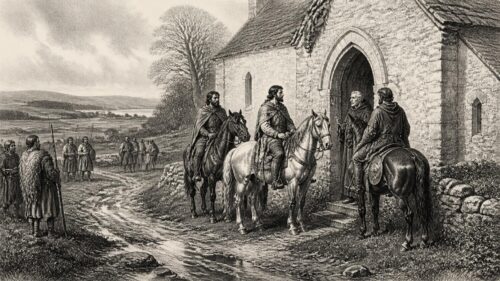
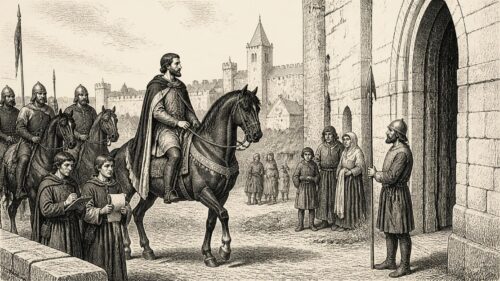
Political uncertainty was especially acute in the vast de Burgh inheritance. William de Burgh, earl of Ulster and lord of much of Connacht, was only about sixteen in 1328. His grandfather, Richard “the Red Earl”, had died in 1326; William had inherited an earldom whose authority had been badly weakened by the Bruce wars and by the ambitions of his own kinsmen. In May 1328 Edward III knighted the young earl in England. He attended the royal–Scottish dynastic wedding at Berwick in July, following the Treaty of Northampton, before travelling towards his Irish lordship.
The Connacht annalist marks his arrival simply: “the Brown Earl” came to Ireland that year. The colour-name, an tIarla Donn, distinguished William within the heavily interconnected de Burgh family. His return was more than a family homecoming. Tenants, administrators and rival relatives needed to know whether the heir could exercise personal lordship. The evidence suggests that he could not rely on inherited prestige alone. Even before he arrived, the English crown was trying to restrain magnates in Ireland. On 28 June it sent orders to John de Bermingham, earl of Louth, Arnold le Poer, Walter de Burgh, James le Botiller, Maurice fitz Thomas and John fitz Robert le Poer: they were not to gather armed men, invade lands or break the peace, on pain of forfeiture. Such a command was not proof that each recipient had begun a specific war in 1328; it was, however, an official acknowledgement of a dangerous political atmosphere.
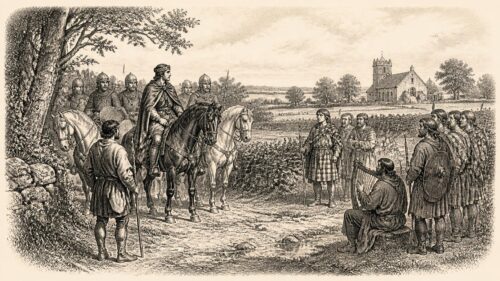
A colonial chronicle also records an attempted Anglo-Scottish accommodation at the northern edge of the island. Robert Bruce, king of Scots, accompanied William de Burgh towards Ulster, and Scottish magnates were reported at Carrickfergus. They sent word that they would meet the Irish justiciar and council at Greencastle to make peace between Ireland and Scotland. The meeting did not take place: the officials failed to come, and the Scots returned home after 15 August. This was a striking reversal of the armed Scottish interventions of the previous decade. Yet it was not a comprehensive peace settlement for Ireland. Its failure also illustrates the gap between diplomatic intention and an administration able to assemble its representatives at a contested frontier.
Thomond’s Unsettled Kingship
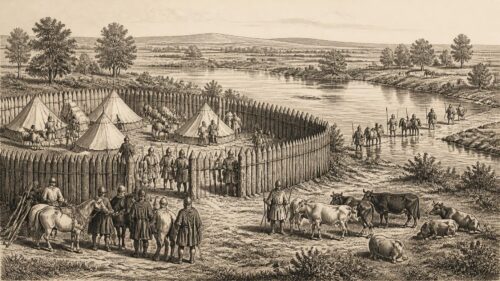
William’s return was quickly entangled with affairs far from Ulster. The annals state that the earl gathered a large force against Brian Bán Ó Briain. With him were Toirdelbach Ó Conchobair, king of Connacht, and Muirchertach Ó Briain, described as king of Thomond and of the rest of Munster. The coalition itself matters as much as the encounter: an Anglo-Irish earl, a Connacht king and a rival claimant within the Ó Briain world could cooperate when their interests aligned.
Brian Bán defeated them. Conchobar Ó Briain was killed, along with eighty people described as both noble and ordinary. The annalist praises Conchobar’s appearance and generosity, calling him fit to be king of Ireland: a conventional but meaningful signal of lost political potential. The sources give neither a secure battlefield location nor a day for this defeat. Later tradition separates or duplicates elements of the campaign, so it is safer to treat the record as evidence of a major 1328 reverse for the coalition rather than to impose a precise modern battle-name upon it.
Conflict continued across the western lordships. Walter de Burgh raided Connacht, plundering officers of Toirdelbach Ó Conchobair. At Áth Cinn Locha Deichet, Walter and Gilbert Mac Goisdelbh met Máelruanaid Mac Diarmata, his son Tomaltach, Tomaltach Mac Donnchada and Clann Mhaoilruanaid; the meeting became a defeat for Walter’s side. Elsewhere, kinsmen killed one another in contests which the annals connect explicitly to revenge. These entries make clear that “conference”, hostage-taking, raiding and battle were not separate worlds. They were overlapping methods through which authority, compensation and land were pursued.
Violence in the Lordship
The killing of John de Bermingham, earl of Louth, exposed the insecurity of even the greatest colonial lords. The annals say that he was treacherously slain by his own people, identified as the English of Oriel, with many English and Irish killed beside him. Bermingham had been a prominent figure since the defeat of Edward Bruce in 1318 and had held high office in the Irish administration. His death therefore removed a magnate with experience, local connections and military standing. It also undercuts any simple opposition of “English” and “Irish”: the account attributes the killing to an English community in Oriel, while stressing that victims included both Gaels and foreigners.
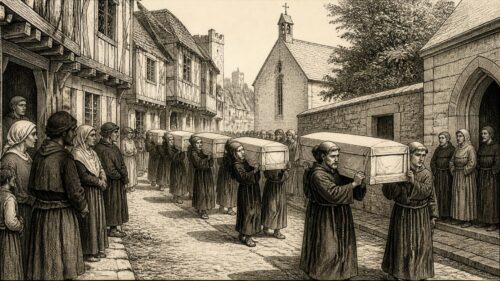
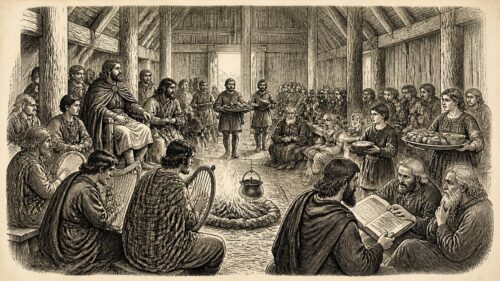
Among those killed was Máelruanaid Mac Cerbaill, called Gilla Caech, whom the annals celebrate as the foremost player of the timpán, a stringed instrument, in Ireland and Scotland. His brother also died in the same violence. The elaborate obituary is a reminder that a lordly entourage could include accomplished professional musicians, and that warfare destroyed cultural as well as political capital. The survival of his name, instrument and reputation owes much to annalists who considered artistic mastery worthy of record beside the fall of earls and kings.
Law, Learning and Church Connections
Another notable death was that of Muiris Ó Gibealláin. The Connacht annalist describes him as Ireland’s chief master of old and new law, specifying civil and canon law, and as a learned philosopher, poet and practitioner of Ogham lore. He was a choral canon connected with Tuam, Elphin, Achonry, Killala, Annadown and Clonfert, and served as official and general judge of the archdiocese. This was not a narrow clerical career. His obituary reveals a learned world in which Latin legal expertise, ecclesiastical office, poetry and inherited forms of Irish scholarship could belong to one individual.
The church’s links extended well beyond Ireland. Tomás Ó Mellaig, bishop of Annadown, died at the papal court. His death abroad does not tell us why he was there, but it demonstrates that a small western diocese was connected to the curia. Meanwhile, the colonial church was embroiled in a major political-religious controversy. Arnold le Poer, a powerful magnate, faced an accusation of heresy from Richard de Ledrede, bishop of Ossory. In the annal sequence for 1328 he was detained in Dublin Castle pending parliament, while Roger Outlaw, prior of the Hospital of St John at Kilmainham and former justiciar, underwent a formal public clearing of the same charge. No accuser came forward against Outlaw, and he was purged. The episode shows doctrinal allegation operating amid factional politics; it should not be reduced to either sincere religion or mere political invention.
A New Earldom
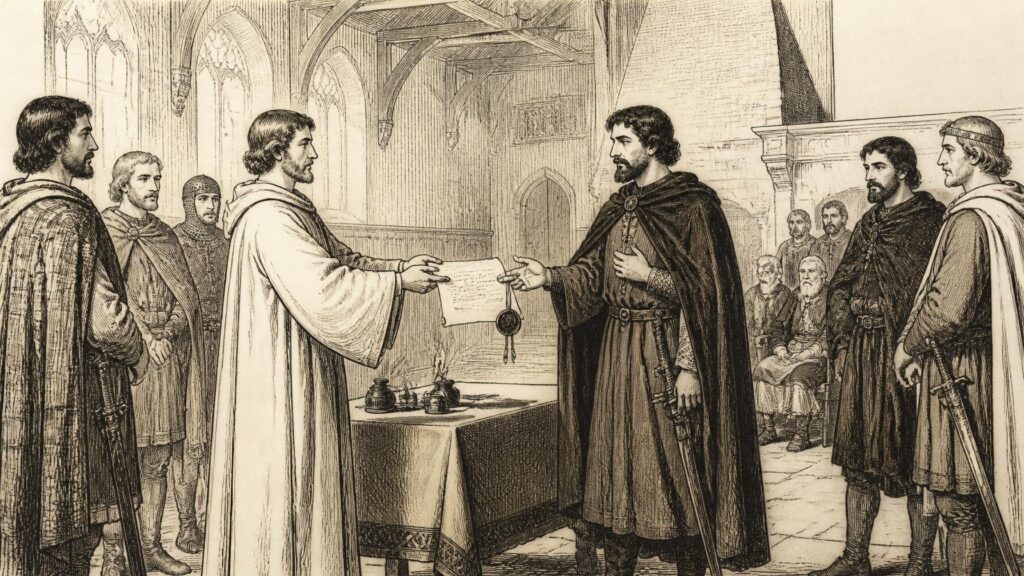
The clearest securely dated constitutional development came late in the year. On 2 November 1328 Edward III created James Butler earl of Ormond. The award elevated a leading Anglo-Irish family whose hereditary office as chief butler was tied to royal service and the wine trade. A related royal record concerning the Butler claim to prisage shows the practical commercial background: the family asserted an ancient right to take two tuns of wine, at fixed payment, from wine ships arriving at Dublin, Drogheda, Waterford, Cork and Limerick. The earldom therefore rested not only on ceremony but on access to revenues, ports, lordship and royal favour.
James was also granted the liberty of Tipperary, giving his lordship a durable territorial foundation in the southern midlands. Its significance lay in delegation: liberties allowed a great lord wide judicial and administrative authority within a defined area, though not independence from the crown. In a year marked by failed meetings, magnate feuds and food scarcity, the Ormond patent represented an effort by the regime around the young Edward III to bind a strategically placed Irish lord more closely to royal power.
Thus 1328 was not merely a prelude to later crises. Its dated acts and contemporary reports show an island under strain but still densely connected: Connacht kings joined an Ulster earl’s army; Scottish diplomacy reached Carrickfergus; a bishop died at the papal court; legal learning linked several western dioceses; and royal patronage created an earldom that would shape Irish politics for centuries. Against that high politics stood the year’s most immediate reality for many people: damaged crops, sickness, wind and scarcity.
Source References
Hover over a number to see the source. Select it to open the source.
- [1] Annála Connacht, Annal 1328
- [2] Annála Connacht
- [3] Annals of the Four Masters, Annals 1322–1331
- [4] Annals of the Four Masters, Volume 3
- [5] The Annals of Ulster, Year U1325 (covering 1325–8)
- [6] Annales Hiberniae
- [7] Burgh, William de — Dictionary of Irish Biography
- [8] Butler, James — Dictionary of Irish Biography
- [9] Bermingham, William de — Dictionary of Irish Biography
- [10] FitzGerald, Maurice fitz Thomas — Dictionary of Irish Biography
- [11] Burgh, Richard de — Dictionary of Irish Biography
- [12] Mandeville, Henry de — Dictionary of Irish Biography
- [13] ‘Geographical loyalty’? Counties, palatinates, boroughs and ridings
- [14] Mapping and measuring the impact of the Bruce invasion
- [15] ‘Devices made by magic’: an attempted escape from Dublin Castle in 1332
- [16] Irish Exchequer Payments, 1326–1446
- [17] Registrum de Kilmainham 1326–1350
- [18] A History of the Franciscan Order in Ireland, Carrick-on-Suir
- [19] A History of the Franciscan Order in Ireland
- [20] Annals of the Four Masters, Irish text, 1322–1331
- [21] Annals of Loch Cé, Irish text
- [22] The Red Book of Ormond
Primary Sources
- Annála Connacht, Annal 1328
- Annála Connacht
- Annals of the Four Masters, Annals 1322–1331
- Annals of the Four Masters, Volume 3
- The Annals of Ulster, Year U1325 (covering 1325–8)
- Annales Hiberniae
- Burgh, William de — Dictionary of Irish Biography
- Butler, James — Dictionary of Irish Biography
- Bermingham, William de — Dictionary of Irish Biography
- FitzGerald, Maurice fitz Thomas — Dictionary of Irish Biography
- Burgh, Richard de — Dictionary of Irish Biography
- Mandeville, Henry de — Dictionary of Irish Biography
- ‘Geographical loyalty’? Counties, palatinates, boroughs and ridings
- Mapping and measuring the impact of the Bruce invasion
- ‘Devices made by magic’: an attempted escape from Dublin Castle in 1332
- Irish Exchequer Payments, 1326–1446
- Registrum de Kilmainham 1326–1350
- A History of the Franciscan Order in Ireland, Carrick-on-Suir
- A History of the Franciscan Order in Ireland
- Annals of the Four Masters, Irish text, 1322–1331
- Annals of Loch Cé, Irish text
- The Red Book of Ormond