Cuinche’s Night Assault1280 CE
In 1280 Ireland saw conflicts exposing authority. In Thomond, Thomas de Clare’s attempt to establish a castle at Cuinche, near Quin, was devastated by a night attack led by Tairdelbach and Domnall Ó Briain; de Clare escaped to Bunratty, though Quin was completed later. In Connacht, Áed Muimhnech Ó Conchobair was killed during dynastic struggle, and Cathal Ó Conchobair gained kingship. Máel Sechlainn Ó Conchobair was ransomed for 400 cattle and 20 horses, illustrating livestock’s political value. Annals noted deaths of churchmen and Desmond barons. Together, these events reveal contested lordship, resilient Gaelic power, dynastic rivalry, and embedded religious institutions.

Dateline
A Year of Local Wars
The evidence for 1280 places Ireland’s most dramatic struggles in two very different regions: Thomond in the west of Munster and Connacht farther north. It was not a year in which one authority governed the whole island. Gaelic kingships, Anglo-Irish lordships, church houses and towns each possessed their own interests, connections and armed followings. The surviving annals are selective rather than comprehensive, but their entries reveal a political world in which control of a fortification, the capture of a kinsman or the death of a baron could alter the balance of power.
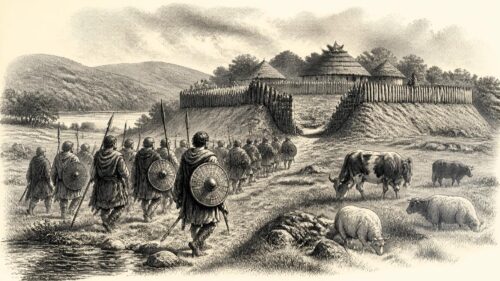
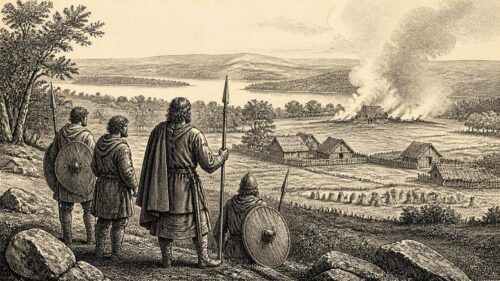
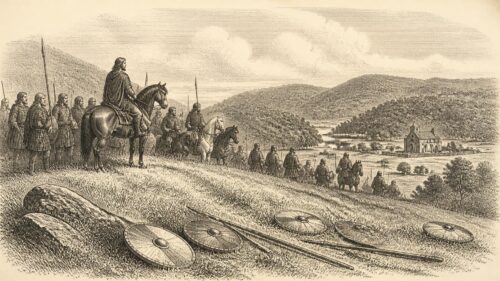
The clearest event in Thomond is recorded by the Annals of Inisfallen. In 1280 Thomas de Clare began a castle at Cuinche, generally identified with Quin, east of present-day Ennis. Before it was secure, Tairdelbach and Domnall, sons of Tadc Ó Briain, attacked de Clare by night. The annalist says that de Clare narrowly escaped to Bunratty and that his force, including barons, knights and fighting men, was destroyed. The account is vivid, even reporting that the number of corpses and their smell made the site inaccessible for a long time. Such language should not be treated as a numerical battlefield report, but it leaves no doubt that the annalist understood the defeat to have been severe.
The castle-building itself is firmly connected with 1280 by that annal, although other evidence warns against imagining an entirely new settlement appearing in a single season. Thomas de Clare had received the lordship of Thomond from Edward I in 1276, but the grant was aspirational unless it could be enforced among the rival branches of the Ó Briain dynasty. Bunratty, on the Shannon estuary, was his principal base. Cuinche lay inland, on routes between the lower Shannon country, Limerick and central Thomond. A stone castle or substantial fortified court there would have extended his reach into territory where local Gaelic leaders, especially the Mac Conmara kindred, remained powerful.
Thomas de Clare’s Dangerous Project
De Clare was not simply a private adventurer. A younger son of the Clare earls of Gloucester, he was an experienced royal servant and magnate. In or about 1280 he sat on the king’s Irish council alongside the justiciar, Robert de Ufford. The year therefore joined local warfare in Thomond to the institutions of the English lordship of Ireland. Royal authority could supply legal title, military backing and political support; it could not make conquest automatic. The night attack at Cuinche shows the limits of documents and grants when men on the ground could strike a building force before its new stronghold had become defensible.
Later biographical evidence associates 1280 with an expedition into Thomond led by Ufford and Theobald Butler, in which de Clare participated or was supported. It is reasonable to see this as part of the same contest over de Clare’s projected lordship, but the exact sequence of campaign, construction and ambush cannot safely be reconstructed from the surviving notices. The Annals of Inisfallen give the starkest version of the raid; administrative and later narrative material instead shows continued royal commitment to de Clare’s position. What can be said securely is that the Cuinche project had not been abandoned: Quin was completed as a fortified centre in the following year.
For people living nearby, a castle was more than a military symbol. Its construction required timber, stone, carts, food, animals and labour, whether obtained through lordly dues, paid arrangements or coercion. It also promised a permanent garrison and a new place from which rents, services and judicial claims might be exacted. These are likely consequences of such a project, not details directly recorded for individual inhabitants of Quin in 1280. The immediate military outcome, however, is unusually clear: the local resistance could still inflict a punishing defeat upon an Anglo-Irish lord backed by the crown.
A Connacht Kingship Overturned
In Connacht, the Annals of Loch Cé and the later Annals of the Four Masters preserve a closely matching account of dynastic upheaval. Áed Muimhnech Ó Conchobair, son of Fedlimid and grandson of the celebrated Cathal Crobhderg, was king of Connacht when conflict broke out between him and the descendants of Muirchertach Muimhnech Ó Conchobair. Áed was killed at Coill an Daingin, ‘the wood of the fortress’. On the same day Máel Sechlainn, son of Magnus Ó Conchobair, was captured.
This was not an anonymous skirmish on a remote frontier. It was a struggle within the ruling dynasty for the provincial kingship. After Áed’s death, Cathal, son of Conchobar Ruad and grandson of Muirchertach Muimhnech, was made king by the Connachtmen. The wording matters. Inauguration did not mean modern-style election by a uniform population, but recognition by the political interests able to establish a king: leading kin groups, military supporters, churchmen and regional powerholders. Cathal’s accession demonstrates that kingship in Connacht remained negotiable and contested, even where descent from earlier rulers supplied a claim.
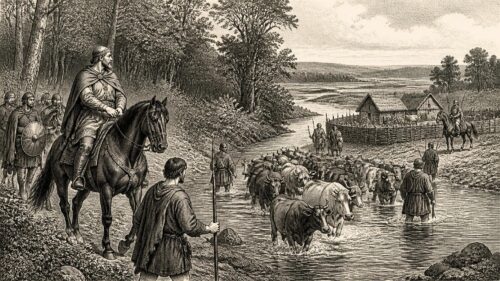
Máel Sechlainn’s ransom is one of the most revealing particulars in the record. Ó Domhnaill secured his release for 400 cows and 20 horses. The entry does not identify this as a normal tariff, so the figure should not be converted into a general price list. Yet it plainly shows the centrality of livestock to high politics. Cattle represented movable wealth, nourishment, status and the resources with which a lord could reward dependants; horses carried military and aristocratic value. A ransom of this scale also shows the reach of Ó Domhnaill influence beyond Tír Chonaill. Captivity could draw neighbouring dynasties into Connacht’s internal disputes and turn a battlefield victory into a wider diplomatic transaction.
The annalists also record the deaths of two local leaders, Máel Sechlainn Ó Gormlaigh, chief of Cenél Moen, and Conchobar Ó Gormlaigh, slain by the people of Telloch Modharáin. The notice is brief and its location is less securely identifiable than the principal Connacht struggle. Still, it is a useful reminder that a provincial succession crisis coexisted with lesser conflicts among local lordships. Ireland in 1280 was not divided simply between ‘Gaelic’ and ‘English’ interests: disputes within Gaelic dynasties were as capable of producing violence as contests involving the lordship’s magnates.
Churches, Abbeys and Remembered Lives
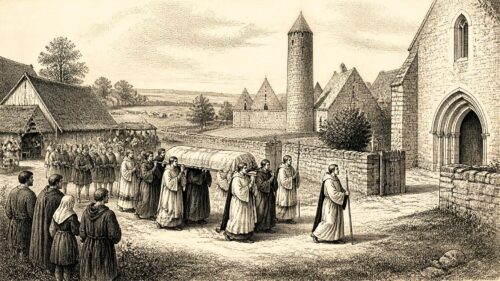
Political conflict did not exhaust the year’s recorded business. John Ó Laidigh, bishop of Killala, died in 1280, as did Matthew, son of Magnus Ó Conchobair, abbot of Boyle. Their deaths appear in the Connacht-centred annals beside the struggle for kingship. This juxtaposition is significant. Bishoprics and monasteries were spiritual institutions, but they were also landholders, employers, hosts to travellers and custodians of learning. The death of a bishop or abbot could therefore matter to regional society as well as to the church.
Boyle Abbey, a Cistercian house in north Connacht, stood within the political landscape of the Ó Conchobair family; its abbot’s patronymic was noted because lineage mattered in ecclesiastical as well as secular life. Killala, on the north Mayo coast, was an old episcopal centre whose bishop linked local communities to the wider diocesan and papal church. The sources do not supply a full account of either succession in 1280, and it would be unsafe to invent one. What they do show is that annalists considered the passing of these officeholders worthy of preservation amid warfare and kingship.
In southern Munster the same annal that reported Cuinche also marked the deaths of David de Barry and John de Cogan, both described as great and noble barons of Desmond. Their deaths did not, in the surviving entries, receive an attached battle or inheritance narrative. Nevertheless, their inclusion indicates the continuing importance of Anglo-Irish aristocratic families in the south. The Barry and Cogan lordships rested on landed power, networks of tenants and military service, and their leading men belonged to the political society in which de Clare’s Thomond venture was being pursued.
What 1280 Reveals
The year’s evidence is uneven, and it is important not to pretend otherwise. No surviving source permits a detailed national account of harvests, household routines, women’s work, shipping or urban markets in 1280. Nor is there a securely dated general environmental crisis attached to this year. But the events that are recorded are unusually revealing. At Cuinche, castle construction met determined local resistance; in Connacht, a king was killed and replaced; a prisoner’s freedom was bought with cattle and horses; and churches and baronial families registered consequential deaths.
These were not isolated episodes. They demonstrate the characteristic pressures of late thirteenth-century Ireland: ambitious expansion by the English crown’s servants, resilient Gaelic political structures, rivalry within dynasties, and religious institutions embedded in regional society. In 1280 no single victory settled those pressures. De Clare survived the disaster at Cuinche, while Cathal Ó Conchobair secured recognition in Connacht. Yet both developments rested on fragile arrangements of force, allegiance and wealth. The year is best remembered not as a neat turning point, but as a sharply documented moment when fortresses and kingships alike proved vulnerable.
Primary Sources
- Annals of Inisfallen, Part 80
- Annals of Inisfallen: Irish Text, Part 80
- Annals of Loch Cé, Part 12
- Annals of Loch Cé: Irish Text, Part 12
- Annals of the Four Masters, Part 11
- Annals of the Four Masters: Irish Text, Part 11
- Annals of Ulster otherwise Annala Senait, Annals of Senat
- CELT Project: Annals of Ulster otherwise Annala Senait, Annals of Senat
- CELT Project: Annals of Loch Cé
- Clare, Thomas de
- Barry, John de
- Thomas de Clare, named 1250 to 1442
- Calendar of the Close Rolls Preserved in the Public Record Office, Edward I, 1279–1288
- English Rule in Ireland, c.1272–c.1315
- Quin Report: Archaeological Testing at Quin, County Clare
- Parish of Quin by Conchubhar Ua Briain
- The Earthworks and Castle of Bunratty, Co. Clare by Thomas Johnson Westropp
- Exploring the Irish Annals
- The Chronology and Sources of the Early Irish Annals
- Interpretation of Celestial and Environmental Phenomena in the Irish Annals
- Medieval Irish Chronicles Reveal Persistent Volcanic Forcing of Severe Winter Cold Events, 431–1649 CE