Cill Mór’s Burning1226 CE
In 1226, Connacht remained unstable after Cathal Crobderg Ua Conchobair’s death, as his son Áed faced dynastic rivals, neighbouring lords and changing English policy. Killings, attacks on houses, captivity and local feuds across Connacht, Breifne and Iar-Chonnacht exposed fractured authority. Henry III ordered Geoffrey de Marisco to demand Connacht’s surrender from Áed, advancing Richard de Burgh’s interests despite opposition among colonial magnates. Cathal Ua Raigillig destroyed Cill Mór castle, illustrating the vulnerability of frontier strongholds. Deaths of bishops, nobles and Cong’s learned erenagh also marked the year, while religious houses preserved learning, patronage and dynastic commemoration amid wider ongoing conflict.
Dateline
In 1226, Ireland’s most consequential developments lay in Connacht and its northern and eastern approaches. The annals record no single battle that transformed the island, but they do preserve a concentrated sequence of killings, seizures, captivity and the destruction of a castle. Together, these notices show how precarious authority had become after the death in 1224 of Cathal Crobderg Ua Conchobair, long-standing king of Connacht. His son Áed held the kingship, yet his position was threatened by rival branches of the Ua Conchobair family, ambitious neighbouring dynasties and a changing policy at the court of Henry III.
A Province Without Settlement
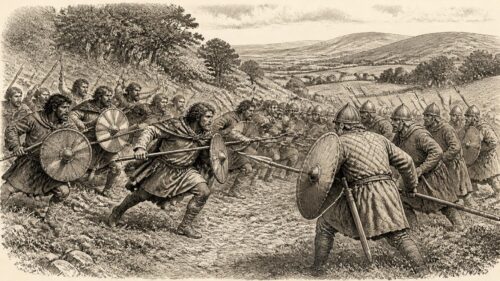
The context was not calm. In 1225, Connacht had already suffered a destructive contest involving the sons of Ruaidrí Ua Conchobair, Áed Ó Néill of Tír Eógain, Anglo-Norman forces and allies from Thomond. The Annals of Ulster’s description of the preceding year is unusually bleak: people had been devastated, and the season was so disordered that corn was still being cut after St Brigit’s Day, 1 February, while ploughing was under way at the same time. That evidence belongs to 1225, not 1226, but it establishes the damaged landscape into which the new year opened.
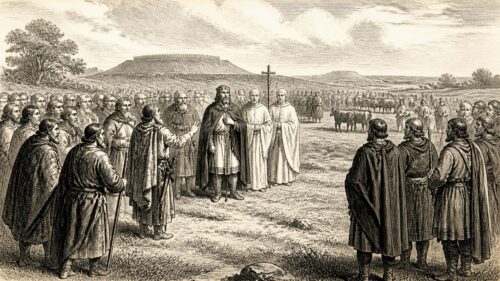
In 1226, the leading immediate issue was not whether Connacht was independent of English royal power, but who could command the province and on what terms. Kingship in Gaelic Ireland rested on lineage, military followings, client relationships, hostage-taking and public recognition; it was not automatic inheritance. Áed, son of Cathal Crobderg, had a powerful claim, but so did the descendants of his kinsman and predecessor Ruaidrí. Local rulers such as the Mac Diarmata, Ua Flaithbertaig, Ua Dubda and Ua Gadhra families were not merely bystanders. Their support, defections and private feuds could change the balance of a provincial struggle.
The year’s deaths make that instability visible. Tigernán, son of Cathal Mic Carráin and a member of the wider Ua Conchobair kindred, was killed by Donnchad Ua Dubda and his sons. The Annals of Connacht calls him a rígdhamna, a man of royal eligibility, and praises his hospitality and martial ability. Such language was conventional, but it also indicates the political weight carried by his death. A killing within or around a royal dynasty removed not simply an individual but a possible future claimant and the network attached to him.
Royal Policy Changes Course
A development dated securely to late June altered the wider framework of the Connacht conflict. Geoffrey de Marisco was reappointed justiciar of Ireland in June 1226, replacing William Marshal. The justiciar was the king of England’s chief governor in Ireland, responsible for royal administration, revenue, justice and military policy. Marshal had supported Áed Ua Conchobair against those seeking to exploit the succession crisis. The return of de Marisco coincided instead with the advance of Richard de Burgh’s claim to Connacht.
The change was expressed with striking directness in a royal patent of 30 June 1226. Henry III ordered Geoffrey de Marisco to summon Áed, son of Cathal, formerly king of Connacht, to surrender the land of Connacht, said in the document to have been forfeited by Áed’s father. This was not a record of a completed conquest. It was an assertion of royal right and an instruction to the king’s governor. Nevertheless, it threatened to turn a contested Gaelic kingship into a problem of dispossession under English royal authority.
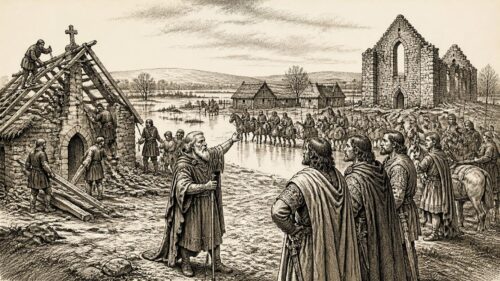
That policy was contested even within the colonial political world. William Marshal, lord of Leinster and the outgoing justiciar, opposed the new direction; his allies resisted de Marisco’s access to royal strongholds. In August, de Marisco complained to Henry III about opposition among the king’s subjects in Ireland. Thus the crisis was not a simple contest between ‘Irish’ and ‘English’. It involved rival royal servants, magnates of settler descent, Gaelic rulers and families whose interests crossed the Shannon frontier. Connacht’s future was being argued over in royal letters and castles as well as in raids and local violence.
Houses Taken, Men Captured
The annalists’ close-grained notices reveal how political pressure reached households. Domnall, son of Ruaidrí Ua Flaithbertaig, was killed after the house in which he was staying was attacked and seized by the sons of Muirchertach Ua Flaithbertaig, acting with Fedlimid, Áed Ua Conchobair’s brother. The Annals of Ulster says that Domnall and a kinsman were killed and burned in the attack; the Annals of Connacht laments that a potential king of western Connacht was left without land or patrimony. A house was a place of residence, lordship, hospitality and protection. Its violent capture was therefore both a personal assault and a public political statement.
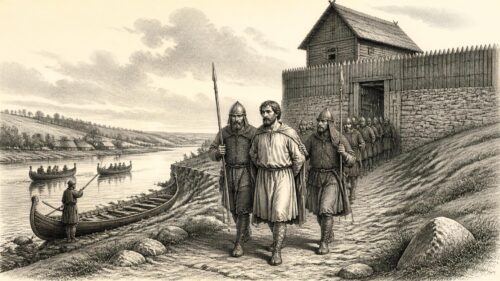
Another Ua Flaithbertaig, Áed, was captured by Áed Ua Conchobair and delivered into the hands of the ‘Foreigners’, the annalists’ usual term for the Anglo-Norman or English settlers and royal administration. This transfer is important. Prisoners and hostages were valuable instruments of power, but handing a regional captive to outside authorities also advertised an alliance. It suggests that Áed Ua Conchobair was seeking support beyond his own followers while attempting to constrain rivals in Iar-Chonnacht, the territory west of Lough Corrib.
Violence extended beyond the chief contestants. Ferghal Ua Taidc, called an Teaghlaigh or ‘of the household’, a leading officer in Cathal Crobderg’s household, was killed by Donnsléibe Ua Gadhra, king of Sliabh Lugha. The Annals of Connacht also places the death of a son of Cathal in this encounter. Muirghius Mac Diarmata was killed during the year. On Lough Allen, Áed, son of Domnall Ua Ruairc, was killed by Cathal Ua Raigillig and Conchobar, son of Cormac Ua Máelruanaid. These incidents should not be imagined as one coordinated campaign: the sources do not say that they were. Yet their distribution across Connacht, Breifne and the lake borderlands shows a political world in which armed retinues could strike rivals at residences, on roads and beside waterways.
Cill Mór’s Destroyed Castle
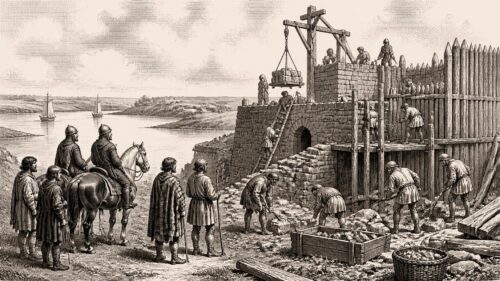
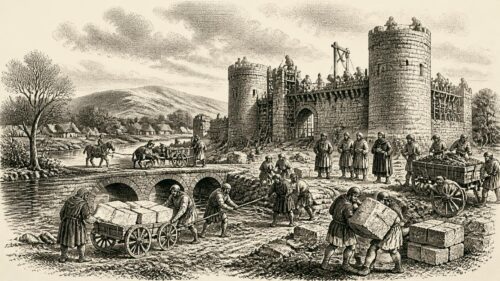
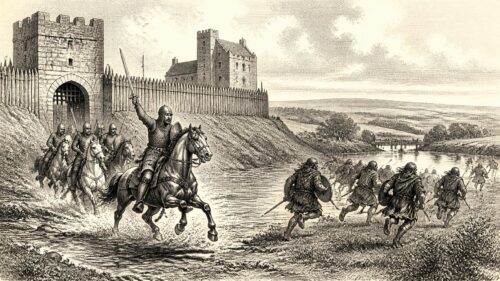
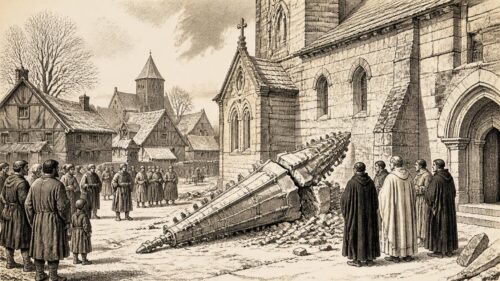
The most tangible event of 1226 was the destruction of the castle of Cill Mór by Cathal Ua Raigillig. The Annals of Ulster says it was razed; the Annals of Connacht says it was burned. The difference cautions against claiming more than the evidence permits, but both accounts agree that the stronghold was put out of action. Whether timber, earthwork, stonework or a combination predominated cannot be established from these brief entries alone. What matters is that a castle was not merely a military building. It was a node of lordship: a defended base, a store for supplies, a place from which tribute and movement might be controlled, and an assertion that a ruler intended to remain.
Cathal Ua Raigillig’s action belongs to the hardening frontier politics of east Connacht and Breifne. Strongholds had become central to the interaction of Gaelic lords and Anglo-Norman power, whether built, held, besieged, burned or dismantled. The fall of Cill Mór did not settle the region; rather, it demonstrated that no fortification was secure when its local political support failed or an enemy could bring sufficient force against it.
Church, Learning and Commemoration
Conflict did not erase religious and intellectual life. Connmac Ua Tarpa, bishop of Luighne, died in 1226, while the Annals of the Four Masters also records the death of Donnchad Ó Máel Eóin, known as Donum Dei, bishop of Meath. Episcopal deaths mattered because bishops were administrators, landholders and political intermediaries as well as spiritual leaders. Their succession could affect the balance between local churches, secular patrons and the wider reforming structures of the Irish church.
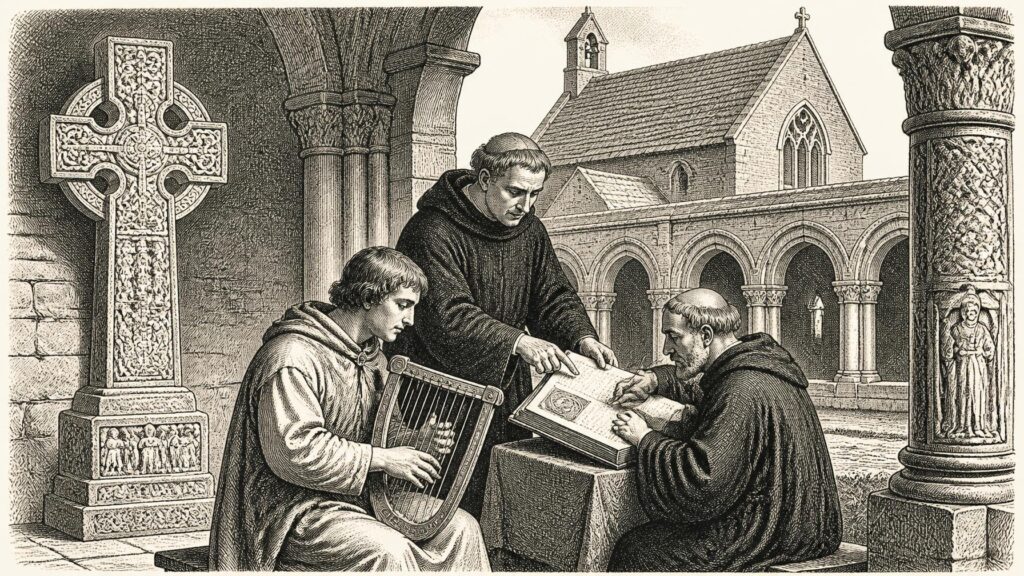
The death at Cong of Áed, son of Donn Ua Sochlacháin, offers a rare and vivid glimpse of learned accomplishment. He was erenagh, or hereditary ecclesiastical steward, of Cong, and the Annals of Connacht praises him as a master of chant, correct liturgical practice, harp tuning, poetry, engraving and writing. Its tribute should not be read as a modern curriculum, but it is powerful evidence for the breadth of skills expected in a major ecclesiastical community. Cong’s Augustinian house, rebuilt and embellished in the early thirteenth century, was a place where worship, craft, manuscript culture, music and aristocratic patronage met.
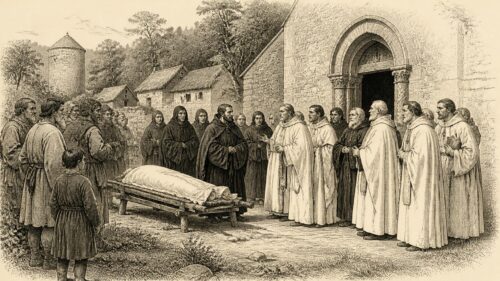
Nuala, daughter of Ruaidrí Ua Conchobair and queen of Ulaid, also died at Cong and was honourably buried in the church of its canons. Her burial links Connacht’s former high-kingly family to an important religious house and to Ulster through marriage. Medieval monasteries and canonical communities were places of prayer, but they were also chosen sites of dynastic memory. Burial there proclaimed connections which warfare could not wholly dissolve.
A Year of Fractured Authority
1226 was therefore a year in which power was simultaneously local and international. A castle was destroyed at Cill Mór; houses were taken; contenders and household officers were killed; a regional captive entered English custody; and bishops, a queen and a celebrated churchman died. At the same time, Henry III’s government moved to deny Áed Ua Conchobair’s title to Connacht and to favour Richard de Burgh’s interests. The year did not conclude the struggle. It made its stakes clearer: control of Connacht would depend on who could combine local allegiance, armed strength, fortified places and recognition from the king across the Irish Sea.
Primary Sources
- The Annals of Ulster
- Annála Connacht
- Annals of the Four Masters, Volume 3 English Translation
- Marisco, Geoffrey de
- Burgh, Richard de
- O'Connor (Ó Conchobair), Áed
- O'Connor (Ó Conchobair), Fedlimid
- Ua Conchobair, Cathal Mór Crobderg
- Ua Conchobair, Ruaidrí
- Marshal, William
- Butler (le Botiller, fitz Walter, Pincerna, Walter), Theobald
- Inspeximus of a Patent of Henry III to Geoffrey de Mariscis, Justiciar of Ireland, 30 June 1226
- Cong Augustinian Abbey and Monks Fishing House
- School of the West
- A Community in Competition: The Barons of Leinster in Thirteenth-Century Ireland
- From Kingdom to Colony: Framing the English Conquest of Ireland
- The Pope, a Knight and a Bishop on the Edge of Christendom: The Politics of Exclusion in Thirteenth-Century Ireland
- The de Verdun Family in England, Ireland and Wales, 1066–1316: A Study
- Late Medieval Leinster: The De Lacy Lordship of Meath and the Marcher Lordships of Ireland, 1172–1541, Volume 2
- Reading the Rolls: Geoffrey de Mariscis
- National Monuments Service: Monument Class and Scope Notes
- Historic Environment Viewer