Amlaíb’s Dublin Return952 CE
In 952, Amlaíb Cuarán was expelled from York and, according to Irish tradition and modern scholarship, returned to Dublin, redirecting his ambitions towards Ireland. His arrival followed Dublin’s recent raids, disease and political disruption, and unsettled his alliance with Congalach Cnogba, king of Tara. Domnall son of Donnchad, Clann Cholmáin heir to Tara, died, weakening a rival midlands dynasty; Flann ua Cléirig of southern Connacht also died. Ferdomnach of Clonmacnoise and Glendalough, alongside other ecclesiastical leaders, died. Dublin remained a thriving maritime trading centre using mixed forms of wealth, not yet its own coinage. No securely dated Irish battle occurred.
Dateline
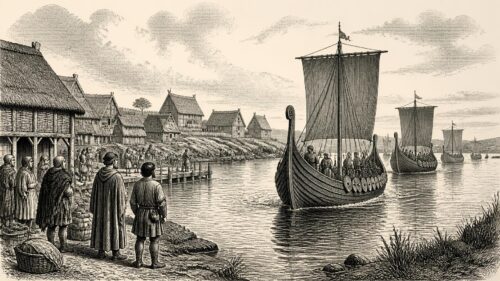
The Irish evidence for 952 is not dominated by one great battle or royal assembly. Instead, it records a series of deaths among kings, heirs and ecclesiastical leaders, while events across the Irish Sea transformed Dublin’s political prospects. That combination makes the year important. Amlaíb Cuarán, the Hiberno-Norse ruler who had spent much of the 940s competing for York, was expelled from Northumbria in 952. Modern reconstructions place his return to Dublin in the same year, though no Irish annal supplies a day, landing-place or narrative of his arrival. His renewed presence marked a decisive reorientation: Dublin’s king could no longer look to York as an additional throne to be held, however precariously, but had to pursue power principally in Ireland.
The annals must be handled with care. The Annals of Ulster place their entry under U952 but identify it as “AD 951 alias 952”, reflecting a known chronological offset in this stretch of their record. The Annals of Inisfallen, Chronicon Scotorum and the Annals of the Four Masters preserve overlapping but not identical notices. It is therefore safest to treat the deaths and political change as belonging to the annalistic year conventionally equated with 952, while avoiding invented dates within the year.
York Lost, Dublin Reclaimed
Across the sea, the Anglo-Saxon Chronicle records that the Northumbrians expelled King Anlaf—Amlaíb Cuarán—and accepted Eric, son of Harald, in 952. The notice is brief, but its implications for Ireland were considerable. York had been a coveted and volatile prize: a rich, strategically placed city whose Scandinavian and Anglo-Scandinavian rulers were enmeshed in the politics of northern England, the Irish Sea, Scotland and Dublin. Amlaíb had ruled there before, had lost it, and had returned. His second expulsion ended that latest attempt.
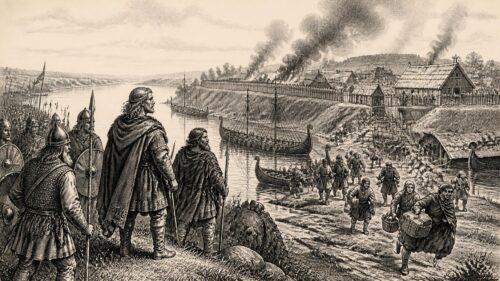
Irish historical tradition and modern scholarship associate 952 with his return to Dublin. Yet this should not be pictured as an uncontested homecoming. Dublin had its own rulers, interests and factions; only the previous year, its foreigners under Gofraid son of Sitriuc had devastated Kells and other churches, taking captives, livestock, horses, gold and silver. The same annalistic sequence reports serious illness among Dublin’s foreigners: an outbreak termed leprosy, alongside dysentery. Medieval diagnostic labels do not map neatly onto modern diseases, but the record plainly conveys a significant health crisis. By 952, Amlaíb was returning to a port polity that had recently shown formidable military reach but had also suffered disruption and loss.
His position was inseparable from that of Congalach Cnogba, king of Tara and leading ruler of Brega. Congalach and Amlaíb had been allies against rivals in the later 940s. Dublin forces had helped Congalach survive the challenge of Ruaidrí Ua Canannáin in 950, while Congalach had previously intervened in Dublin’s internal affairs. Their interests now overlapped uneasily in the approaches to Dublin and north Leinster. The tension did not yet produce a securely dated confrontation in 952, but Amlaíb’s return altered the balance on which their alliance had rested. Within four years, the partnership would collapse violently.
An Unsettled Centre
The death of Domnall son of Donnchad was the year’s most consequential internal Irish loss. The Annals of Ulster call him rígdamna Temrach, “heir designate of Tara”: a man entitled to contend for the pre-eminent kingship associated with Tara. Chronicon Scotorum identifies him as the father of Máel Sechnaill, later one of Ireland’s most powerful kings. The Annals of Inisfallen, by contrast, describes him as king of the Déisi or Mide. These variant labels are not a reason to dismiss the notice; they reveal the layered character of early medieval authority, in which a ruler’s local kingdom, dynastic standing and wider eligibility for supremacy could all matter.
Domnall belonged to Clann Cholmáin, the dominant branch of the southern Uí Néill in Mide. His father, Donnchad Donn, had held Tara until his death in 944. But succession was not automatic. The decade after Donnchad’s death saw close kin competing for Mide while Congalach, from the rival Síl nÁedo Sláine dynasty of Brega, successfully advanced his own claim to Tara. Domnall’s death in 952 removed a plausible Clann Cholmáin claimant at precisely the moment when Congalach’s power was at its height.
This did not mean that Mide had become politically irrelevant. Its central position, fertile lands and connections to major churches made it indispensable to any would-be overking. But the year underlines how precarious its ruling house had become. Domnall’s son Máel Sechnaill was still young; the later restoration of Clann Cholmáin greatness lay ahead, not within the evidence for 952 itself. For contemporaries, the immediate fact was a vacancy in a contested dynastic landscape.
Another royal death, that of Flann ua Cléirig, king of southern Connacht, shows that uncertainty was not confined to the midlands. Annalists give him a succinct obituary rather than a narrative of conflict, so neither the circumstances of his death nor the exact succession should be invented. Nevertheless, the loss of a regional king mattered in a country where political authority was exercised through personal lordship, kin networks, military followings and control of tribute. Connacht, Mide, Brega, Leinster, Munster and the northern Uí Néill lands were not provinces governed from a single capital. They were fields of negotiation and rivalry, joined by waterways, roads, ecclesiastical estates and hostage-taking as much as by fixed frontiers.
Abbeys, Offices and Memory
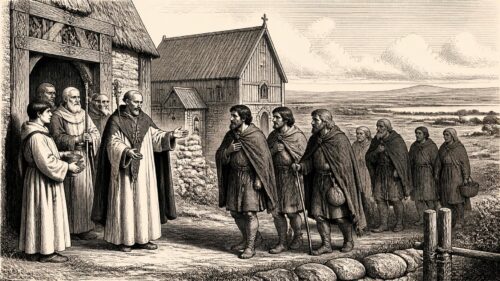
The annals for 952 are especially revealing about the standing of churches. Ferdomnach, successor of Ciarán and abbot of Clonmacnoise, died. His career had linked two exceptional religious centres: he had led Clonmacnoise from 943 and had also become head of Glendalough in 950. The pairing was politically meaningful. Clonmacnoise stood beside the Shannon at a major north–south river route and east–west overland crossing; Glendalough lay in Leinster, in a region under pressure from Dublin and neighbouring powers. Ferdomnach’s dual abbacy reflected an agreement of unity between the two foundations and the value of institutional alliances in an age of competing kings.
His death was not merely an internal monastic matter. Major churches were communities with tenants, dependants, landed resources, craft activity, hospitality obligations and learned personnel. Their leaders had to defend privileges, cultivate patrons and negotiate with kings. Clonmacnoise was a centre of learning, trade and craftsmanship as well as worship; its riverside setting connected it to travellers and exchange across the island. The death of its abbot therefore represented a change in the leadership of a substantial religious and economic community.
Other obituaries extend the map. Scannal, superior of Domnach Sechnaill, and Flann, superior of Druim Cliab near modern Drumcliff, died according to the Annals of Ulster. The same annal notes Flann son of Máel Fiachrach, superior of Mag eter di Glais, and an anchorite called Céile, remembered by the striking epithet “the leper”. The Annals of Inisfallen add Orthanach, abbot of Ros Cré. Such notices are brief, but they show an ecclesiastical world dispersed across Ireland, with local churches retaining identities, offices and networks worthy of record.
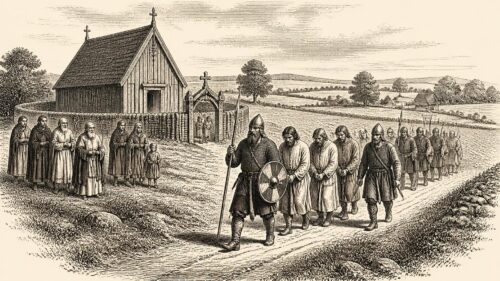
They also caution against a simplistic division between a “Gaelic” church and a wholly external Viking world. Violence against churches was very real, as the previous year’s attack on Kells demonstrates. Yet Dublin’s inhabitants included settlers and families, craftspeople, traders and rulers participating in Irish political alliances. Amlaíb himself had been baptised during an earlier English settlement, although baptism alone cannot tell us how he practised religion or how others regarded him. In 952, churches remained both sacred places and institutions embedded in the practical politics of lordship.
A Maritime Economy, Not a Coined Kingdom
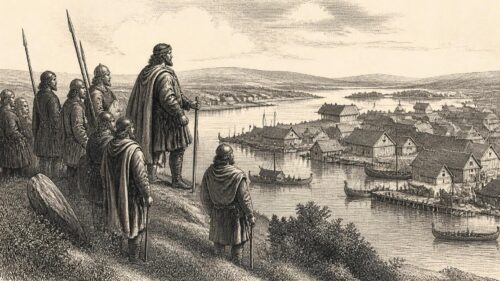
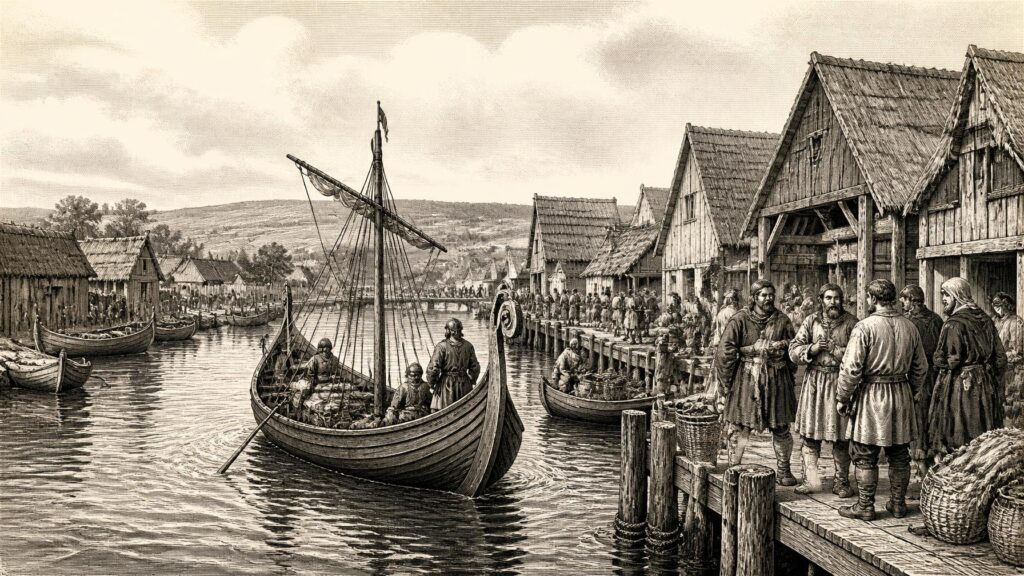
Dublin’s renewed importance rested on more than royal pedigrees and ships of war. Archaeology reveals a busy Viking-Age town of timber houses, workshops, paths, property boundaries and waterfront activity. Craftspeople worked wood, iron, leather, textiles, amber and precious metals; mariners connected the settlement to Britain, the Irish Sea and wider European routes. Weighing equipment, silver hoards and imported objects show commercial habits that differed in scale and texture from those of many inland lordships.
It would be wrong, however, to imagine a modern cash economy. Dublin did not begin striking its own silver pennies until around 997 or 998, decades after 952. In Amlaíb’s time, silver by weight, bullion, foreign coin, livestock, tribute, food renders and captives could all be forms of wealth or exchange. The vast plunder reported from Kells in 951—people, cattle, horses, gold and silver—makes that mixed economy painfully visible. The urban port did not replace rural Ireland; it depended upon, profited from and competed with the agricultural and ecclesiastical hinterlands around it.
What the Year Does—and Does Not—Show
No securely dated Irish battle is recorded for 952 itself. The Annals of Ulster do note a victory by “foreigners” over forces described as Scots, Welsh and Saxons, but provide no location, commanders or direct Irish setting. It belongs to the wider insular context of the year, not to an identifiable battle in Ireland. Likewise, there is no basis for assigning a particular raid, harvest, weather event or building project to 952 merely because such things occurred in nearby years.
What can responsibly be said is substantial enough. Amlaíb’s expulsion from York and return to Dublin redirected a major ruler’s ambitions towards Ireland. Congalach’s supremacy stood high but was vulnerable; the death of Domnall of Clann Cholmáin deepened the instability of the midlands. The passing of Ferdomnach and other ecclesiastical leaders altered institutions that linked worship, learning, landholding and politics. In that sense, 952 was a hinge year: quiet in the annals beside some bloodier years, but crucial in setting Dublin and the Irish Sea world on a new course.
Primary Sources
- The Annals of Ulster
- Chronicon Scotorum, Part 104
- Annals of Inisfallen, Part 51
- Annals of the Four Masters, Volume 2
- Amlaíb (Óláfr) Cuarán
- Congalach Cnogba
- Ferdomnach
- Donnchad Donn
- Ua Néill, Domnall
- Amlaíb (Óláfr Godfridsson)
- The Anglo-Saxon Chronicle
- York Lost And Dublin Reorientated: Amlaíb Cúarán, 941–980
- Vikings in Early Medieval Ireland: Church-Raiding, Politics and Kingship
- Viking
- 950–1450: Vikings, Normans and Medieval Mints
- Clonmacnoise, County Offaly
- Clonmacnoise Visitor Guide
- The Irish Sea and the Atlantic Trade in the Viking Age
- Agriculture, Settlement and Society in Early Medieval Ireland
- The Irish Church, 800–c.1050
- Early Medieval Archaeology Project
- Everyday Life in Viking-Age Towns: Social Approaches to Towns in England and Ireland, c. 800–1100
- The Slave Markets of the Viking World: Comparative Perspectives on an ‘Invisible Archaeology’