Céile’s Last Pilgrimage929 CE
In 929, sparse annalistic evidence illuminates Ireland’s political, ecclesiastical and maritime connections. Céile, successor of Comgall of Bangor, died on pilgrimage in Rome on 14 September, demonstrating Irish links with Latin Christendom. Donnchad Donn, king of Tara, led an armed expedition against Muirchertach mac Néill at Liathdruim, apparently without a recorded battle. A fleet appeared on Lough Corrib, reflecting the strategic significance of inland waterways. Death notices for Tuathal, bishop and scribe, and Fínnechta, Ciarraige Luachra king, anchorite and counsellor, reveal intertwined religious learning, institutional authority and regional lordship. Differing annalistic dates require interpretation across competing manuscripts and chronological systems.
Dateline
For Ireland in 929, the surviving record is unusually revealing precisely because it is so spare. There is no securely dated island-wide battle, harvest failure or royal inauguration to dominate the year. Instead, the principal annalistic notices follow people in motion: a celebrated Irish churchman dies at Rome; a king of Tara leads an armed expedition against a northern rival; a fleet appears on Lough Corrib; and senior ecclesiastics and regional leaders pass from the scene. Taken together, these entries show an Ireland whose political and religious life extended far beyond any single kingdom or monastery.
The evidence also requires care with dates. The Annals of Ulster label their entry as U929 but note an ‘AD 928 alias 929’ discrepancy, a feature of their internal chronology rather than a reason to move the events casually elsewhere. The later Annals of the Four Masters place what is evidently the Liathdruim expedition several years earlier. Modern historical writing conventionally discusses the Ulster annal under 929. The Annals of Inisfallen, compiled in the south-west, supplies a short but independent set of notices for that calendar year. Such differences are a reminder that annals are not diaries: they are carefully maintained historical records, copied and reshaped over generations, whose chronological systems must be compared rather than simply merged.
A Pilgrim Dies in Rome
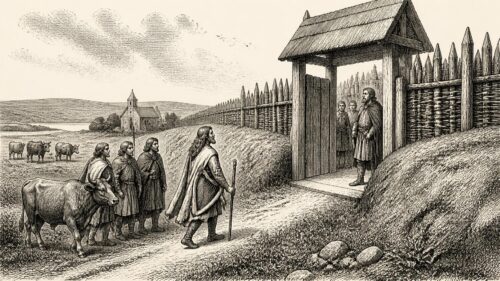
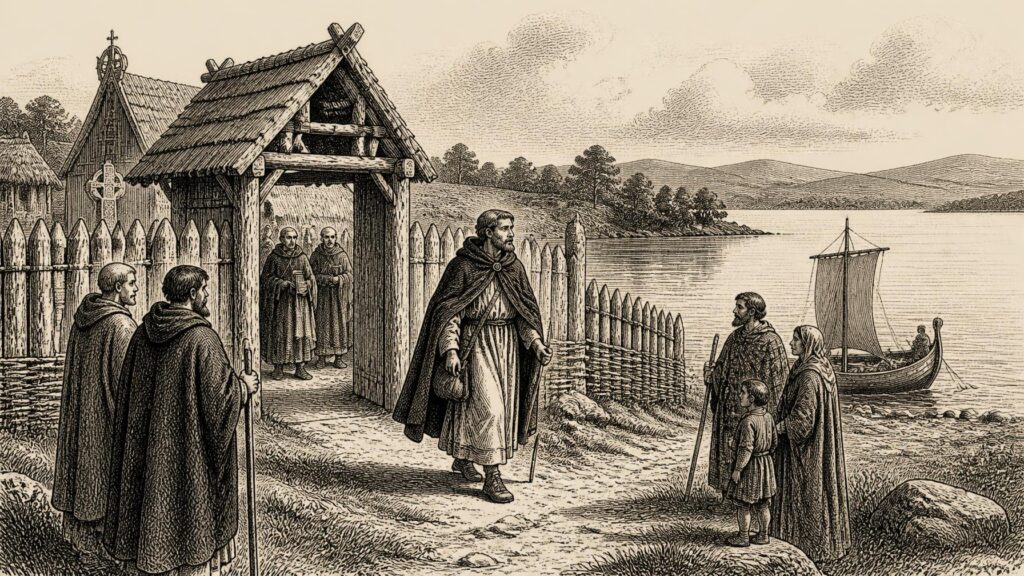
The most precisely dated event is the death in Rome of Céile, successor of Comgall of Bangor. The Annals of Ulster record that he died happily on pilgrimage on 14 September, the eighteenth day before the Kalends of October, aged fifty-nine. His titles are striking. He was a scribe, an anchorite and an ‘apostolic doctor of all Ireland’. The language is honourific rather than a modern job description, but it leaves no doubt that Céile was regarded as a man of learning, religious authority and island-wide standing.
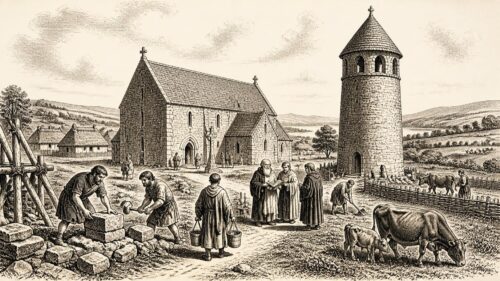
His connection with Bangor, on the southern shore of Belfast Lough, mattered. A ‘successor of Comgall’ was not simply a parish priest; he belonged to the ecclesiastical lineage attached to one of Ireland’s most influential early monasteries. Such offices carried spiritual prestige, landed resources and relationships with lay rulers. The annals had already noted Céile’s departure on pilgrimage in the preceding entry. His death at Rome in 929 therefore provides rare, firm evidence for the completion of an Irish journey to the heart of Latin Christendom.
Rome was distant, but it was not beyond the Irish horizon. Clerics, scholars and penitents travelled between Ireland, Britain and the Continent, using routes dependent on shipping, hospitality, religious houses and political protection. Céile’s itinerary is unrecorded, and it would be irresponsible to invent one. Yet the fact that an Irish annalist preserved both his pilgrimage and his precise death-date shows how important such a journey was to his community. Rome represented apostolic authority, relics, learning and the spiritual weight of the universal Church. Céile’s death abroad was thus an Irish event, not merely a private ending far from home.
The notice was marked with a commemorative verse calculating the years from Christ’s birth to Céile’s holy death. Its survival reveals a culture in which chronology, Latin-Christian learning and vernacular poetry could meet in a compact annalistic memorial. Scribes did more than list casualties and kings: they selected deaths that expressed the intellectual and devotional stature of the Irish church.
Liathdruim and Rival Kingship
In the same year, Donnchad Donn, son of Flann Sinna, led an expedition to Liathdruim ‘against Niall’s son’. The latter was Muirchertach mac Néill, son of the former king of Tara Niall Glúndub and a leading prince of Cenél nÉogain in the north. Donnchad held the kingship of Tara and exercised the paramount authority conventionally styled the high-kingship of Ireland. That title did not mean direct government of a united state. Its force depended on alliances, ceremonial precedence, hostages, tribute, military capacity and the willingness of powerful regional dynasties to recognise the king’s claims.
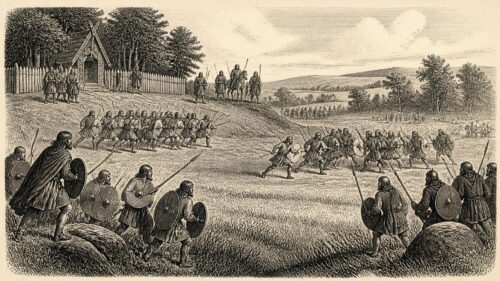
The terse wording of the Ulster annal says only that Donnchad made an expedition. A verse attached to the notice casts him as a formidable, brown-haired warrior while warning that an angry opponent awaited him at Liathdruim. It is political poetry, not a battlefield report. Crucially, the source does not say that a battle occurred. The later Four Masters explicitly states that Donnchad and Muirchertach separated without fighting or bloodshed, although its chronology places the episode under a different year. The safest conclusion is that 929 saw a serious armed confrontation or demonstration of strength, but not a securely attested battle.
The episode illuminates a deeper contest within the Uí Néill world. Donnchad belonged to Clann Cholmáin of Mide, the dominant southern branch; Muirchertach belonged to the northern Cenél nÉogain. Both drew authority from descent, military followings and connection to important ceremonial places. Muirchertach was not yet securely king of Ailech in 929, but his standing was substantial enough for Donnchad to march against him. Their rivalry was also a family affair. Muirchertach would marry Donnchad’s daughter Flann, probably as part of the accommodation eventually reached between their competing interests. That marriage cannot safely be assigned to 929 itself, but it explains why an armed standoff need not have ended in open war.
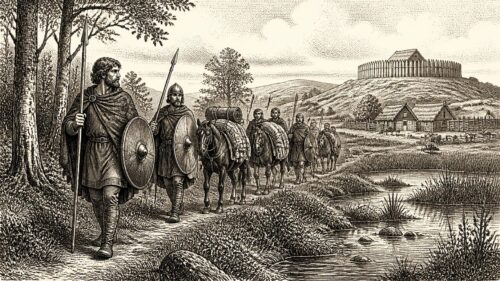
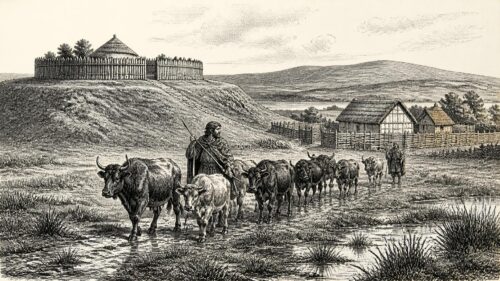
For ordinary communities, an expedition of this kind was never abstract. A royal host needed food, cattle, guides, boats where waterways intervened, and places to camp. Even when no pitched battle followed, the arrival of armed men could impose heavy demands on the districts through which they travelled. The language of raiding and hosting in Irish sources reflects a political economy in which control over people, livestock and produce was inseparable from claims to kingship.
A Fleet on Lough Corrib
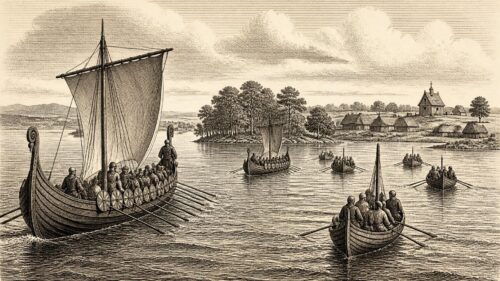
The Annals of Ulster also note simply: ‘A fleet on Loch Oirbsen in Connacht.’ Loch Oirbsen is Lough Corrib. No commander, destination or outcome is supplied. The entry must not be inflated into a named raid, nor does it prove that every vessel belonged to Scandinavian forces. Nevertheless, it records a striking presence on one of the west’s major inland waterways. A fleet on Lough Corrib could affect island communities, lakeside settlements and routes connecting Connacht’s interior to the sea through Galway Bay.
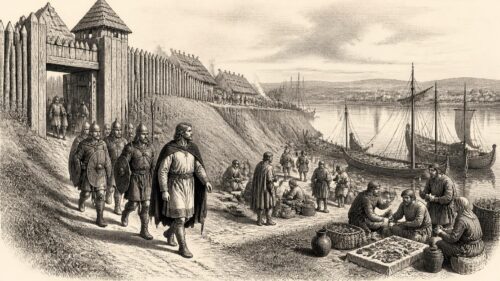
Its significance becomes clearer when set against the immediate, securely dated background, without treating that background as an event of 929. The 920s had seen Scandinavian fleets operating on Irish lakes and rivers, while the ports of Dublin, Limerick and Waterford were political and commercial centres as well as military bases. The sea and inland waters were therefore not edges of Irish society but channels through it. Ships could carry raiders and captives, but also merchants, livestock, supplies, news, clerics and diplomatic parties. The 929 notice preserves the fact of a fleet; the wider evidence explains why such a fact was noteworthy.
Churchmen and Regional Authority
Two further deaths bring the year’s ecclesiastical and regional structures into view. Ulster records the death of Tuathal son of Aenacán, scribe and bishop of Dám Liac, modern Downpatrick, and Lusca, modern Lusk. He was also steward of Patrick’s community south of ‘the Mountain’, an annalistic phrase whose precise territorial implication is not certain. What is clear is that one man could hold responsibilities across more than one church and within the wider Patrician federation associated with Armagh. In a landscape not organised into later dioceses, authority frequently clustered around churches, saints’ cults, learned personnel and inherited institutional rights.
The Annals of Inisfallen record the death of a learned bishop named Tuathal in Leth Cuinn, the traditional northern half of Ireland. This may refer to the same man, but the sources do not provide enough detail for certainty. Read cautiously, the paired notices show how reputation could travel between regional annalistic traditions. They also underline the standing of scribes. Literacy was not an ornament added to religious life: it enabled the copying of scripture and law, the keeping of genealogies, the preservation of agreements and the annual recording of deaths, raids and successions.
In Munster, Inisfallen commemorates Fínnechta son of Laegaire. He was both king of Ciarraige Luachra, in the Kerry–north Cork region, and ‘chief anchorite of Ireland’ as well as chief counsellor of Mumu. The combination is revealing. An anchorite was expected to pursue intense religious devotion, but this did not remove him from society. Fínnechta’s obituary presents ascetic reputation, local kingship and political counsel as compatible forms of distinction. His death was important to the political culture of Munster as well as to its church.
An Ireland of Connections
Thus 929 is not best understood as a quiet gap between larger dramas. Its surviving notices expose the workings of early medieval Ireland at several scales. Céile’s death in Rome connected Bangor and the Irish church to the apostolic city. Donnchad’s expedition to Liathdruim demonstrated that the high-kingship rested on contested power rather than settled unity. The fleet on Lough Corrib shows the strategic importance of inland waters. The deaths of Tuathal and Fínnechta reveal church offices, scholarship, asceticism and regional lordship woven together.
The year’s small archive is therefore its value. It does not license a grand narrative of conquest or catastrophe. Instead, it allows a more accurate picture: Ireland in 929 was a society of many kingdoms and ecclesiastical communities, linked by roads, lakes, sea routes, kinship and writing, and still capable of looking all the way to Rome.
Primary Sources
- The Annals of Ulster
- CELT Project: The Annals of Ulster
- Annals of Inisfallen
- Part 48 of Annals of Inisfallen
- Annals of the Four Masters, Part 3
- CELT Project: Annals of the Four Masters
- Chronicon Scotorum, Part 99
- Annals of Tigernach: Bibliographic and Editorial Information
- List of Published Texts at CELT
- Muirchertach na Cochall Craicinin
- Historical Truth or Literary Embellishment? Uncovering the Voices of Historical Queens in Medieval Irish Sources
- Traveling Monastic Paths: Mobility and Religion at Medieval Irish Monasteries
- The Vikings in Ulaid
- The Vikings in Ninth-Century Ireland: Sources and Settlements
- Vikings in Scotland and Ireland
- Vikings in Early Medieval Ireland: Church-Raiding and Politics in the Later Ninth Century
- The Literature of Medieval Ireland, 800–1200: From the Vikings to the Normans
- Early Christian Monasteries
- Early Irish Monasticism
- Early Monastic Churches
- Churches and Ecclesiastical Enclosures
- Patrician and Early Christian Architecture