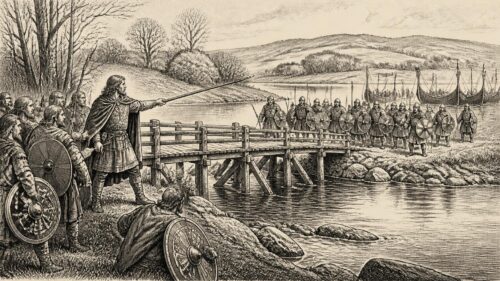
Ragnall Leaves Loch Dá Chae918 CE
In 918, Ragnall ua Ímair, king of the dark foreigners, left Waterford Harbour with jarls Oitir and Gragabai, joining an Irish-Sea campaign that culminated in the inconclusive battle of Corbridge on the Tyne. Their force showed the Uí Ímair dynasty’s links between Ireland and Britain. In Ireland, Niall Glúndub of Tara continued warfare with Dublin’s Sitriuc Cáech, while Máel Mithig of Brega unsuccessfully sought Scandinavian assistance. Annals also recorded deaths of church leaders, scholar Dainél and Kildare’s abbess Muirenn. Evidence reveals political instability, maritime connections and ecclesiastical continuity, but records no harvest, famine or everyday events. Annalistic dating remains uncertain.
Dateline
The evidence for 918 is unusually revealing precisely because it is narrow. Ireland’s annalists did not preserve a general chronicle of weather, harvests, markets or household life for this year. Instead, the Annals of Ulster set down a sequence of deaths, a continuing war around Dublin and Brega, and the departure of a major Scandinavian force from Waterford Harbour. Taken together, those notices show an island whose political balance remained unsettled after the Scandinavian return of 917. They also show that Ireland was not on the edge of events: fleets raised or based on its coasts were shaping the struggle for power across the Irish Sea.
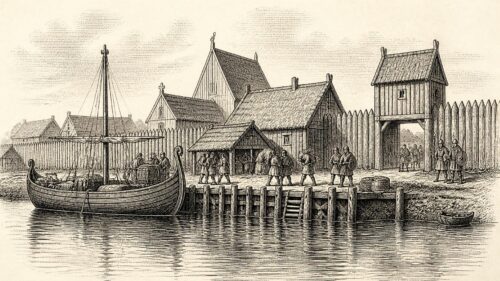
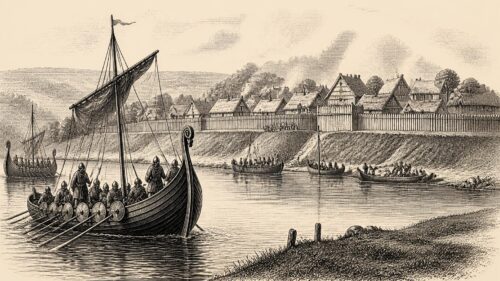
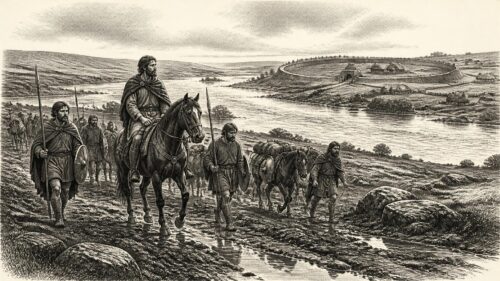
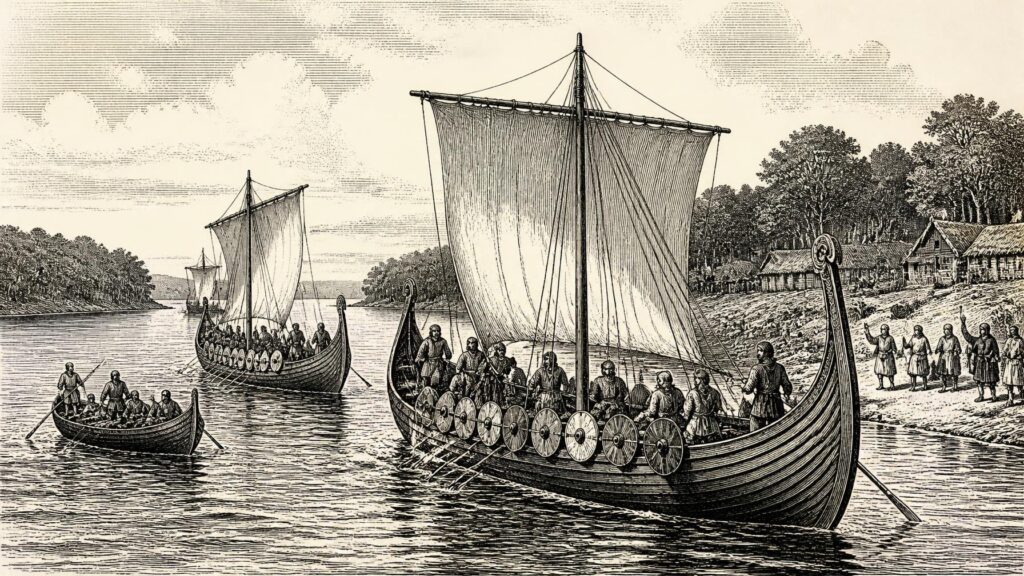
The year’s largest securely connected development was Ragnall ua Ímair’s departure from Loch Dá Chae, generally identified with Waterford Harbour. Ragnall, whom the annalist calls king of the “dark foreigners”, left Ireland with the jarls Oitir and Gragabai. This was no anonymous raiding party. It was a force led by members of the Uí Ímair, the Scandinavian dynasty whose fortunes bound Dublin, Waterford, western Britain and northern England together. The wording is important: the annal does not say that Scandinavian power vanished from Ireland, only that Ragnall and this particular following left. Sitriuc Cáech, another grandson of Ímar, remained a decisive presence in Irish affairs.
An Irish-Sea Campaign
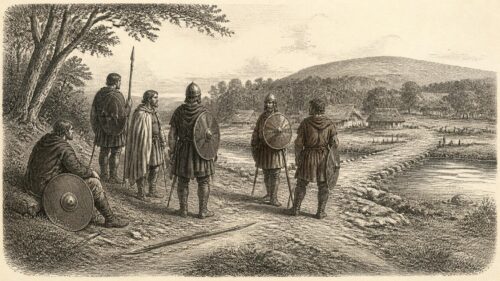
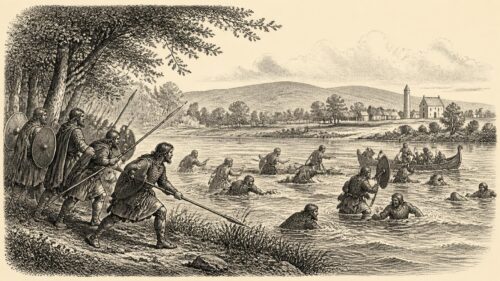
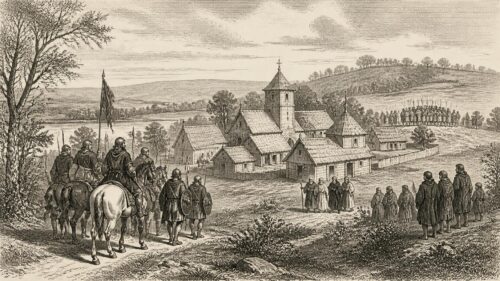
After leaving Ireland, Ragnall’s force encountered the men of Alba on the River Tyne in northern England. Modern historians normally identify the encounter with the battle conventionally called Corbridge, in Northumberland, in 918. The Annals of Ulster offers a striking tactical outline. Ragnall’s men formed four divisions: one with Gofraid, another with the two jarls, a third containing younger nobles, and a concealed division under Ragnall himself. The Scots initially drove back the three formations they could see and killed Oitir and Gragabai. Ragnall then struck their rear from ambush. Fighting ended with nightfall, and the annalist does not claim a neat or total victory for either side.
That account deserves to be read with care. It supplies no numbers, no exact day and no reliable basis for reconstructing every manoeuvre on a modern map. Yet it firmly establishes the scale and sophistication of the enterprise: commanders coordinated several bodies of troops, while a reserve or ambush force could decide the second phase of an encounter. Gofraid’s presence also matters. He was already part of the same Uí Ímair political world that connected the Scandinavian settlements of Ireland to ambitions in Britain; his later career would bring him to the kingship of Dublin.
For Ireland, the battle’s importance lay in the movement of people, ships and authority rather than in a change of frontier at Corbridge. Ragnall had recently been central to the Scandinavian resurgence at Waterford, while Sitriuc had regained Dublin in 917. His removal northward freed neither the Irish kings nor the Dublin Scandinavians from conflict. Instead, it demonstrates how a maritime dynasty could operate on both sides of the Irish Sea, shifting armed followings between Irish harbours, the western seaways and northern Britain. The death of Æthelflæd, the celebrated ruler of Mercia, is also entered by the Ulster annalist in the same year. Although not an Irish event, it underlines the wider political changes among the powers with which Irish and Scandinavian rulers had to reckon.
War Without a Recorded Battle
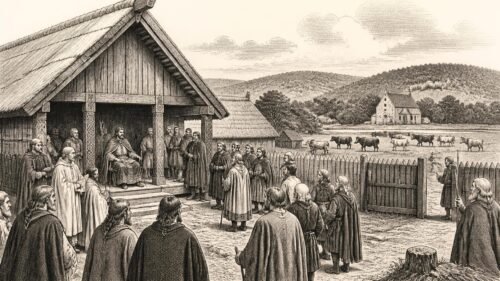
Within Ireland itself, the annal gives a concise but consequential notice of “warfare between Niall son of Áed, king of Temair, and Sitriuc grandson of Ímar”. Niall Glúndub, of Cenél nÉogain in the Northern Uí Néill, had succeeded to the kingship of Tara after Flann Sinna’s death in 916. Sitriuc was the Uí Ímair leader associated with the renewed Scandinavian hold on Dublin. The entry does not record a battle, treaty, raid or place-name; none should be invented. It does, however, confirm that the contest was active during 918, not merely a retrospective consequence of the campaigns of 917 or a prelude to the disaster that would overtake Niall in September 919.
The struggle cannot sensibly be reduced to an opposition between an Irish kingdom and foreign intruders. Kingship in early medieval Ireland rested on regional alliances, hostages, tribute, military followings and control of strategically valuable routes, while Scandinavian rulers could recruit, trade, settle and ally locally. Dublin’s renewed occupation gave Sitriuc access to the Liffey estuary and an urban, maritime base. Niall’s authority depended on the willingness of northern and midland dynasties to follow him. The following year’s battle of Áth Cliath, in which Niall and many allied rulers were killed, shows how grave the stakes were; but it must remain future context, not an event of 918.
One small annalistic notice makes the local pressures clearer. Máel Mithig son of Flannacán, king of Cnogba in Brega, “went over to the heathens” in an attempt to defend northern Brega from heathens, and the effort did not help him. The phrase is awkward, and the translator marks part of it as uncertain, but its central point is plain enough: a ruler of Brega sought an accommodation involving Scandinavian forces because he faced Scandinavian danger. This was not a stable binary world. A regional king might bargain with one armed group in hopes of containing another, or seek protection that proved worthless. Northern Brega, close to Dublin and the Boyne approaches, was exposed to the consequences of warfare between larger powers.
Abbesses, Bishops and Remembered Knowledge
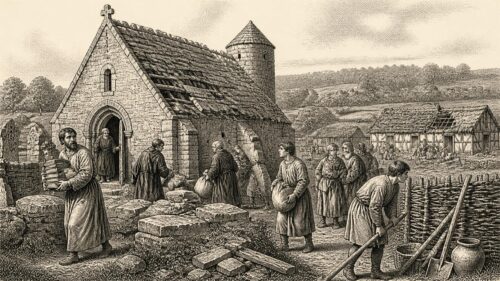
Military affairs occupy much of modern attention, but the annals’ other notices reveal the continuing weight of ecclesiastical communities. Máel Eóin, described as both superior and bishop of Ros Cré, died, as did Éicnech, superior of Ára Airthir. Their paired titles are a reminder that church leadership was not arranged in a simple modern diocesan hierarchy. A major church could be led by an abbot or superior whose community possessed religious authority, land, dependants and political connections, while bishops performed sacramental and pastoral functions within overlapping networks.
Dainél of Cluain Coirpthe was commemorated as a remarkable keeper of historical learning. The phrase does not allow us to identify a surviving manuscript written by his hand or to describe a particular schoolroom in 918. It does show, however, that custody of the past was an acknowledged office of value. Genealogies, precedents, saints’ traditions and records of kingship were practical as well as intellectual resources: they helped communities articulate rights, rank and memory. His death represents the loss of an individual expert within a learned culture that still depended heavily on trained people, oral transmission and manuscript copying.
Most striking is the death of Muirenn daughter of Suart, abbess of Cell Dara, or Kildare. Her notice is independently preserved in Chronicon Scotorum. Kildare was one of Ireland’s most prestigious churches, associated with Brigit and with a long tradition of female leadership. Calling Muirenn an abbess does not make her a modern-style ruler of a separate women’s convent; early Irish ecclesiastical offices could be embedded in powerful kin groups and could oversee substantial communities and resources. Nevertheless, the annalist’s decision to name her demonstrates that the holder of Kildare’s senior office mattered beyond the immediate locality. No source securely records the circumstances of her succession in this calendar year, so the proper conclusion is limited: her death created a significant vacancy, not a documented crisis.
What the Year Does Not Say
It would be tempting to fill the gaps with a dramatic account of famine, rebuilding or universal Viking devastation. The surviving evidence does not warrant that. The Annals of Inisfallen, whose southern Irish coverage is particularly valuable for many periods, gives no event beyond its calendrical heading for 918. Nor do the sources provide a reliable record of a harvest, prices, epidemic or environmental disaster in Ireland for this year. Everyday life nevertheless continued in landscapes of farms, cattle, small settlements, ecclesiastical estates and river or sea routes. Archaeology shows that tenth-century Dublin was already a place of houses, workshops, craft production, exchange and maritime activity, not simply a fortress of raiders; but those are broad conditions, not transactions datable to 918.
Chronology also needs caution. The Ulster entry carries a dual dating formula, “AD 917 alias 918”, reflecting the difficulties created by differing annalistic year reckonings. Later compilations can place related material under different year headings. For this article, the departure of Ragnall and the Tyne battle are treated as 918 because that is the conventional modern dating supported by comparative scholarship, while the battle of Áth Cliath belongs to 919. Such distinctions matter: a year-by-year history should make uncertainty visible rather than compress consecutive crises into one convenient story.
Thus 918 was a year of movement rather than resolution. Ragnall’s fleet departed Waterford Harbour for a hard-fought northern campaign; Niall Glúndub and Sitriuc Cáech remained at war; a king of Brega discovered the limits of a Scandinavian accommodation; and leading churchmen, a learned custodian and Kildare’s abbess passed from the record. Ireland’s political and religious institutions endured, but they did so in a connected Irish-Sea world where a decision at a harbour could quickly alter the possibilities of kings in Dublin, Tara, York and Alba.
Primary Sources
- The Annals of Ulster, Year U918
- The Annals of Ulster, Year U917
- The Annals of Ulster, Year U919
- Chronicon Scotorum, Annals CS918–CS919
- Chronicon Scotorum
- Annals of Inisfallen, Annals AI910–AI929
- Annals of the Four Masters, Volume 2
- Ragnall
- Niall Glúndub
- Sitriuc Cáech (Sigtryggr)
- Donnchad Donn
- Flann Sinna
- Muirchertach na Cochall Craicinin
- The reign of Constantine II: Scotland and the Irish Sea region, c. 900–c. 943
- The Battles at Corbridge
- Vikings in Ireland
- The Fragmentary Annals of Ireland
- Fragmentary Annals: Manuscript History
- Viking
- Early Medieval
- Clonmacnoise, County Offaly – National Monuments Service
- Clonmacnoise Visitor Guide
- Irish School of Illumination, c. 650–1100