Clonmacnoise’s Stone Church909 CE
In 909, Flann Sinna, king of Tara, and Colmán Conaillech sponsored a stone church and sacristy at Clonmacnoise, whose surviving north wall attests early Irish monumental masonry. Situated beside the Shannon, the foundation served a populous religious and lay settlement while displaying royal power, ecclesiastical wealth and political connections. The nearby Cross of the Scriptures similarly linked Christian teaching with patronal commemoration. Following Flann’s victory at Belach Mugna in 908, his ally and son-in-law Cerball of Leinster died, prompting dynastic change. Annals also note regional rulers’ and churchmen’s deaths, cattle disease, and killings in Brega. Some battles remain insecurely dated.
Dateline
A Recorded Building Campaign
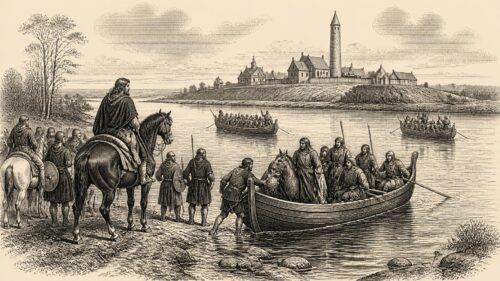
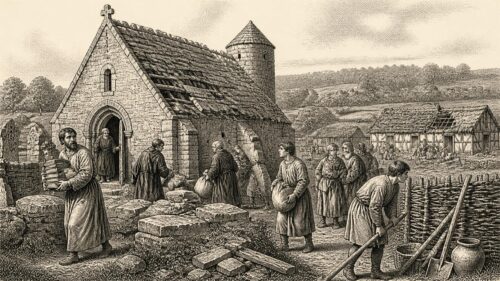
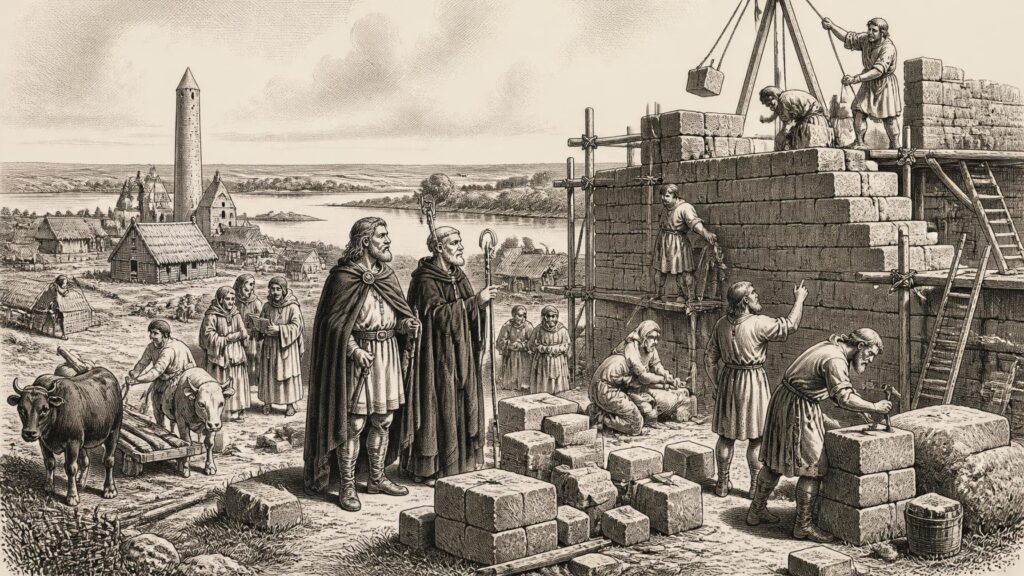
The most substantial Irish development securely attached to 909 was not a battle but a building. Chronicon Scotorum records that the oratory, or stone church, of Clonmacnoise was made by Flann son of Máel Sechnaill—Flann Sinna, king of Tara—and Colmán Conaillech. Modern examination of the surviving fabric supports the importance of that notice: much of the earliest work survives in the north wall of the church now conventionally called the Cathedral. The building was of brown sandstone, with deep antae—projecting side-walls at the gable ends—and putlog holes left by the scaffolding. It was a striking investment in durable masonry at a time when many Irish churches and domestic buildings were still timber.
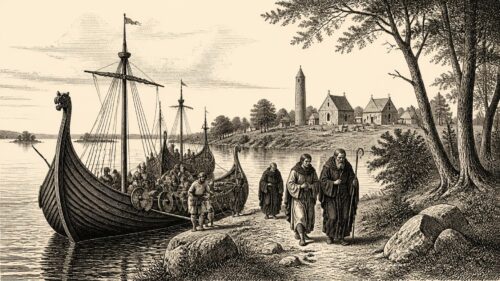
The word ‘Cathedral’ can mislead if it suggests a later medieval bishop’s church standing complete in 909. The present ruin incorporates major rebuilding and embellishment from subsequent centuries. What belonged to the campaign of 909 was a comparatively plain but imposing stone church and sacristy. Even so, the decision to build in stone mattered. It made a religious and political statement on a principal route through the island, beside the Shannon and the esker road that crossed it. Clonmacnoise was not an isolated retreat. Its position linked north and south, east and west; its community drew pilgrims, tenants, traders, craftspeople, scholars and royal patrons.
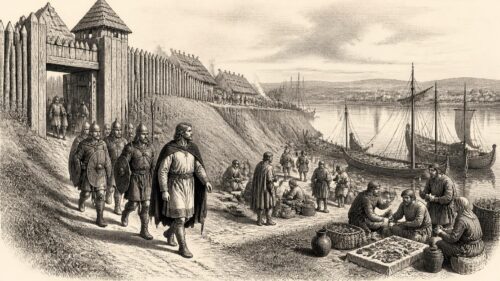
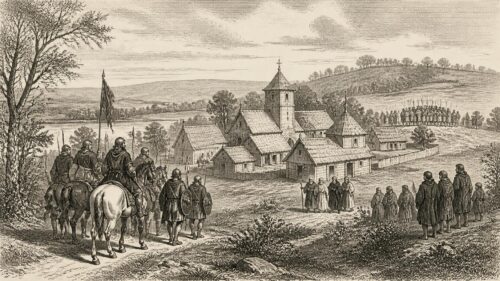
Archaeology and the surviving landscape help to recover something of its character. The ecclesiastical enclosure contained churches, graves and carved monuments, but also a substantial lay settlement whose timber houses have mostly vanished. In 909, therefore, the new stone church rose amid a busy mixed community rather than in a silent precinct occupied only by monks. River traffic, livestock, food renders and visiting parties would have sustained the settlement. The monument represented spiritual devotion, but it also advertised the resources, labour organisation and political connections available to its patrons.
Flann and Colmán
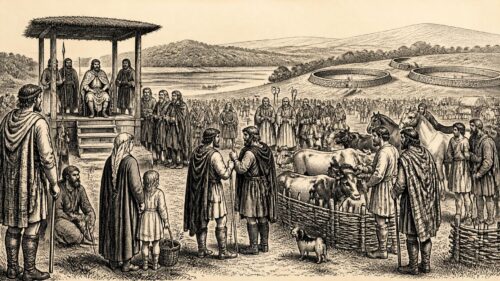
The partnership was politically meaningful. Flann Sinna had held Tara, the pre-eminent kingship claimed by the Southern Uí Néill, since 879. His authority was influential but neither universal nor uncontested: Ireland consisted of many provincial and local kingdoms, with overkings securing obedience through alliance, hostage-taking, patronage and armed force. Clonmacnoise lay near the boundary of Meath and Connacht, a strategically useful location for a ruler based in the midlands. Its connection with Flann’s dynasty had strengthened during the ninth century, and royal benefaction could bind an important church more closely to the political order of Meath.
Colmán Conaillech, the other named patron, was simultaneously associated with Clonmacnoise and Clonard. His position illustrates the reach of leading churchmen and the way major foundations were linked by personnel as well as devotion. Monastic communities were centres of worship and learning, but they also controlled land, retained skilled workers, received gifts and mediated between kings. A ruler’s support for a church did not make that church merely an arm of government. Rather, both sides gained: Flann acquired prestige, prayer and a durable public memorial; the community acquired material backing from the strongest ruler in its region.
The Cross of the Scriptures, positioned west of the church, belongs closely to this moment, though its precise sequence in relation to the building cannot be fixed beyond doubt. Its damaged inscriptions have been reconstructed as naming Colmán and Flann, while a lower carved scene may show an ecclesiastic and a warrior together holding a pole or stake. The cross’s biblical panels, including scenes of the Crucifixion, Last Judgement and Christ in the Tomb, made Christian teaching visible in stone. Yet its patronal inscription also ensured that royal and ecclesiastical names endured within that sacred setting. The church and cross together demonstrate that early medieval Irish artistic culture was not confined to manuscripts: it was monumental, public and closely entwined with rulership.
After Belach Mugna
The project followed a decisive realignment in southern politics. In September 908, Flann, Cerball son of Muirecán of Leinster, and Cathal son of Conchobar of Connacht defeated the Munster army at Belach Mugna, near modern Castledermot. Cormac son of Cuilennán, king-bishop of Cashel and an acclaimed scholar, was killed. That victory removed Flann’s most formidable southern rival. It is reasonable to see the 909 church as part of the confidence and patronage made possible by that success, but the annals do not explicitly say that it was built as a thank-offering for the battle. The connection is an historical interpretation, not a recorded motive.
Cerball’s death in 909 nonetheless changed the balance again. The Annals of Ulster and Chronicon Scotorum agree that the Leinster overking died of illness; the latter preserves a short elegiac verse praising him as generous, steadfast and one to whom Tara was obedient. Such verse is conventional praise, but the repeated notice confirms the political weight of his passing. Cerball was Flann’s ally and son-in-law through his marriage to Flann’s daughter Gormlaith. He had helped expel the Hiberno-Scandinavian rulers from Dublin in 902 and had fought beside Flann at Belach Mugna.
His death did not transfer Leinster automatically to his own son. The provincial overkingship passed to Augaire son of Ailill, from the rival Uí Muiredaig lineage. This was a reminder that dynastic inheritance in Ireland was competitive rather than strictly primogenitural. Adult male relatives from different branches could advance claims, and succession altered alliances as much as it settled them. Gormlaith’s later marriage to Niall Glúndub of Cenél nÉogain would eventually create another dynastic bridge between powerful houses, but that belongs to the years after 909 and should not be treated as an event dated to this one.
Deaths Across the Provinces
The annals also record the deaths of Mugrón son of Sochlachán, king of Uí Maine, and Béc grandson of Lethlabar, king of Dál Araidi. Uí Maine, in the Connacht midlands, and Dál Araidi, centred in parts of what is now County Antrim and neighbouring districts, were both significant regional powers. Their rulers’ deaths underline a central feature of the year: political change occurred in several provinces at once, even when the surviving record preserves no account of the negotiations, rivalries or inaugurations that followed.
A further notice reaches beyond Ireland but remains relevant to its western-sea world: Cadell son of Rhodri, ruler in Wales, died in 909. Irish, Welsh, Scottish and Scandinavian politics were connected by travel, raiding, exile, intermarriage and ecclesiastical networks. The annalists’ decision to include Cadell’s death shows that the Irish political horizon extended across the Irish Sea. At the same time, it would be wrong to infer a specific Irish intervention in Welsh affairs in this year; the entry establishes awareness, not a recorded expedition or alliance.
At Armagh, Cumuscach son of Ailill, described as the household-steward, died. The office points to the administrative machinery required by a major ecclesiastical settlement: churches needed people to manage estates, food, hospitality, dependants and stored goods. The Annals of the Four Masters additionally place the deaths of several church leaders in 909, including Tibraide, bishop of Cluain Eidnech; Máel-Maedóc, abbot of Druim Mór; Litheach, abbot of Cluain Eidnech; and Máel Caisil, abbot of Mungret. These notices are sparse, but collectively they reveal a landscape dense with institutions whose leadership was important enough to enter historical memory.
Cattle Disease and Local Violence
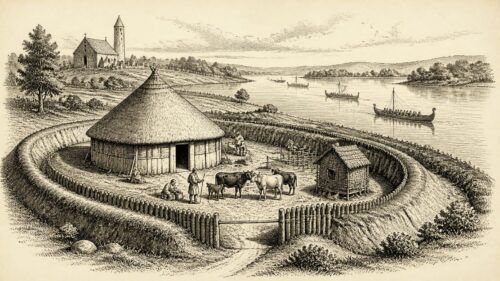
The Annals of Ulster record simply ‘a murrain of cows’. The entry gives no duration, regions affected or number of animals lost, so those details cannot responsibly be supplied. Nevertheless, cattle were fundamental stores of wealth and sources of milk, meat, hides, manure and draught power; herds also mattered in tribute, compensation and political display. A cattle disease therefore had consequences beyond the farmstead. It threatened household subsistence, the revenues of churches and kings, and the capacity of communities to meet obligations. The annalist’s brevity should not be mistaken for triviality.
Violence of a more targeted kind occurred in the north-east. Amalgaid son of Congalach, heir-designate of Brega, and Innéirge son of Máel Téimín, described as a religious layman, were beheaded by the Conaille of Muirthemne. The account neither explains the quarrel nor identifies a wider campaign. Its wording is important, however: Amalgaid’s designation as tánaise, an acknowledged successor, shows that succession itself could make a man vulnerable; Innéirge’s religious standing did not prevent his killing. The episode brings the year down from royal church-building and provincial politics to the dangerous realities of lordship on a contested local frontier.
What Cannot Be Firmly Dated
The Annals of the Four Masters, compiled centuries later from earlier materials, assign two further clashes to 909: a victory by Niall Glúndub over Connachtmen at Gulban Guirt, in which Máel Cluiche son of Conchobar was killed, and a battle in which Máel-mithig son of Flannacán and Donnchad Ua Máel Sechnaill defeated Leinster forces led by Lorcán son of Dúnchad and Fogartach son of Tolarg. These are valuable traditions, but they are not corroborated under 909 by the nearer annalistic witnesses used here. Modern scholarship places Niall’s recorded Connacht campaigns in neighbouring years. They should therefore be presented as later annalistic attributions to 909, not as securely fixed events of this calendar year.
That caution is especially necessary because Irish annals employ different chronological systems and sometimes preserve shifted year-numbers. The evidence for 909 is strongest where independent annalistic notices and surviving material remains converge: the deaths of Cerball, Mugrón and Béc; the cattle murrain; the killings in Brega’s orbit; and above all the stone church at Clonmacnoise. In that convergence lies the year’s enduring image: amid fragile successions, disease and local violence, a king and an abbot committed wealth and labour to a building whose early walls still stand beside the Shannon.
Primary Sources
- Chronicon Scotorum, Annal CS909
- The Annals of Ulster, Year U909
- Fragmentary Annals of Ireland
- Annals of the Four Masters, Annal M909
- Annals of the Four Masters, English Translation and Edition
- The Annals of Inisfallen (MS. Rawlinson B. 503)
- Cerball
- Flann Sinna
- Niall Glúndub
- Gormlaith
- Sitriuc Cáech (Sigtryggr)
- Clonmacnoise, County Offaly
- Clonmacnoise: Office of Public Works Visitor Guide
- Cross of the Scriptures, Clonmacnoise, Co. Offaly
- Cross of the Scriptures
- High Crosses
- The Irish Annals: their genesis, evolution and history
- CELT: Corpus of Electronic Texts, Irish Texts
- The Annals of the Four Masters
- The Annals of Inisfallen to Go on Public Display in University College Cork
- Recording the Past: The Annals of Inisfallen and the Making of Irish History
- The Annals of Inisfallen