Rhodri’s Irish Refuge877 CE
Dateline
A Year of Flight and Rival Fleets
In 877, Ireland stood at the centre of a volatile Irish Sea world. The most striking notice for the year is not an Irish battle or royal assembly, but the arrival of an overseas king in flight: Rhodri son of Merfyn, ruler of the Britons, came to Ireland to escape the Dubgaill, or “dark foreigners”. The wording of the Irish annals is brief, but its implications are considerable. A king from Gwynedd and the wider Welsh political sphere could seek safety across the sea, while Scandinavian rivalries reached from Dublin and northern Ireland into Wales, Northumbria and beyond.
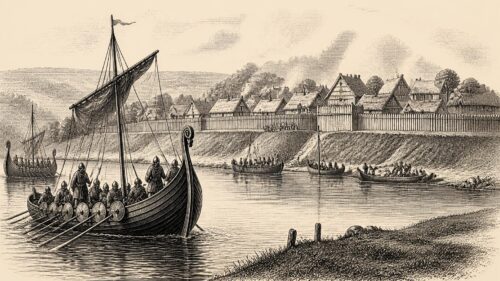
The same annalistic cluster records a clash at Loch Cuan, generally identified with Strangford Lough in modern County Down. There, groups termed the “fair heathens” and “dark heathens” fought, and Albann, leader or king of the latter, was killed. The encounter is conventionally dated to 877 and is usually understood as a naval engagement, though the annal itself simply calls it a battle at the lough. Together, Rhodri’s refuge and Albann’s death reveal an Ireland connected to conflicts that cannot be contained within its shores.
Yet 877 was not solely defined by Scandinavian affairs. Notices from Armagh, Clonmacnoise, Sláine and smaller Irish kingdoms show the routines and vulnerabilities of power in an early medieval society: ecclesiastical succession, the deaths of prominent churchmen, a killing within the political elite, and the passing of local rulers. The surviving record is fragmentary and elite-centred, but it permits a view of Ireland as a landscape of many authorities, linked by rivers, coasts, monasteries, kinship and warfare.
Dating the Evidence
The year requires a little care. Irish annals were compiled and copied over centuries, and their chronological systems do not always align exactly with a modern calendar. Chronicon Scotorum places Rhodri’s arrival and the battle at Loch Cuan under 877. The corresponding entries appear in the Annals of Ulster under its annal-number U877, although that manuscript sequence carries an internal Christian-era calculation of 876. Modern historians and comparative annalistic databases conventionally cite these events as 877. No source supplies a day or month for either Rhodri’s arrival or the battle, so neither can responsibly be dated more precisely.
This is also a reminder that the annals are not diaries. Their terse entries preserve what particular ecclesiastical communities judged worth recording: royal deaths, church succession, violence, unusual natural phenomena, and major movements of armed groups. Silence does not prove that ordinary life was quiet, prosperous or unchanged. It means only that the surviving record does not describe it.
Rhodri Crosses the Sea
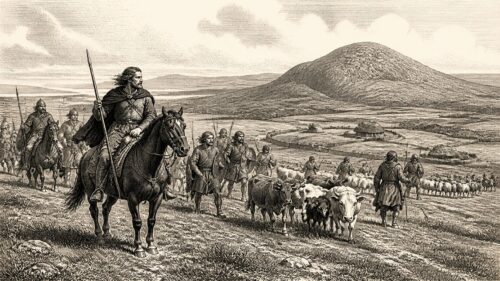
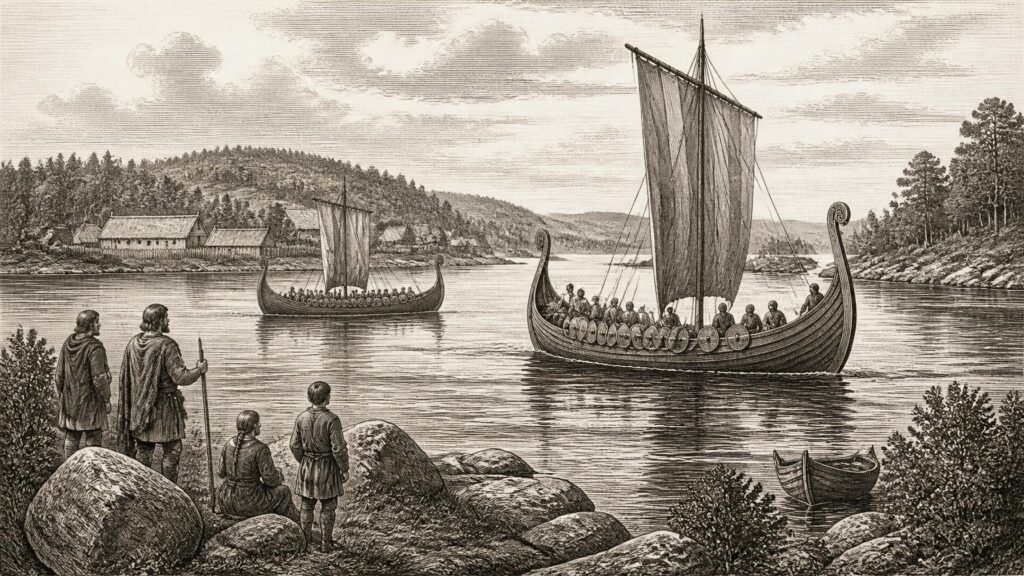
Rhodri son of Merfyn was the powerful ruler later remembered as Rhodri Mawr, “Rhodri the Great”. His dominions in Wales made him a significant figure in the western seaways. In 877, however, the annalist depicts him not as a victorious monarch but as a refugee: he “came in flight” to Ireland from the dark foreigners. The formula is important. It indicates a real reversal, sufficiently serious for a king to leave his own territory and seek protection or temporary shelter overseas.
Ireland was a logical refuge. The sea between eastern Ireland and Wales was not a hard frontier but a travelled corridor. Kings, clerics, traders, raiders and migrants used it, and political news travelled with them. Welsh and Irish rulers had long-standing religious and dynastic connections, while Scandinavian fleets made the same waters a zone of danger and opportunity. Rhodri’s arrival therefore demonstrates both the violence of the moment and the practical reach of Irish hospitality, diplomacy and maritime communications.
The annal does not identify where Rhodri landed, which Irish ruler received him, how long he stayed, or whether he brought a household, warriors or ecclesiastics. Those are tempting questions, but the evidence does not answer them. Nor should his flight be converted into a claim that Ireland was politically united behind him. In 877, the island was divided among provincial overkings, lesser dynasties, church federations and Scandinavian powers. The significance of the notice lies precisely in its restraint: a foreign king could enter this complicated political world, but the annalist did not record the terms of his reception.
Albann’s Fall at Loch Cuan
The battle at Loch Cuan was the year’s clearest military event with a direct Irish setting. The annals say that “fair heathens” fought “dark heathens” and that Albann, chief or king of the dark group, fell. These labels are conventional annalistic categories, not trustworthy descriptions of appearance or simple ethnic identities. They probably distinguished competing Scandinavian-led forces and their shifting alliances. They should not be treated as evidence for two permanently separate peoples called the Fair and Dark Vikings.
Albann is commonly identified with Halfdan Ragnarsson, the Scandinavian war-leader associated with the Great Army in England and with York. That identification is widely accepted but not absolutely demonstrable from the Irish wording alone; the annal names Albann, not Halfdan. Likewise, later historical reconstruction commonly associates the opposing force with Bárid mac Ímair, a leading ruler in Dublin, but the surviving entry does not name the victor. What is firm is that Albann was an important leader and that he was killed in a clash at Strangford Lough.
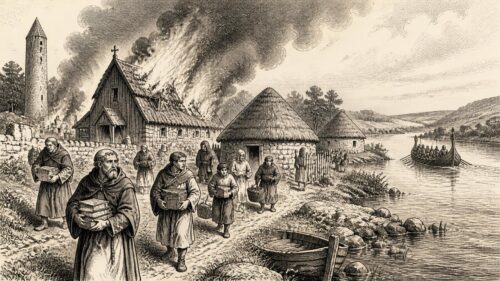
The location mattered. Loch Cuan opened into the Irish Sea and lay near routes connecting the coast of Ulster with Man, western Scotland, north Wales and the Irish settlements around Dublin. Control of sheltered waters, ships and landing places mattered for movement, raiding, trade, tribute and communication. A battle there was thus more than a local skirmish. It was part of a contest over maritime influence in the northern Irish Sea.
The immediate background belongs to the years before 877. Albann had entered the Dublin political struggle in 875, while Áed Findliath, king of Tara, opposed his attempt to establish power and supported Dublin interests hostile to him. That context helps explain why Albann’s defeat was consequential, but it should not be mistaken for an annalistic report of a new intervention by Áed in 877. The sources do not state that an Irish royal army fought at Loch Cuan, nor do they provide numbers, tactics or a detailed aftermath.
Kingship Beyond Tara
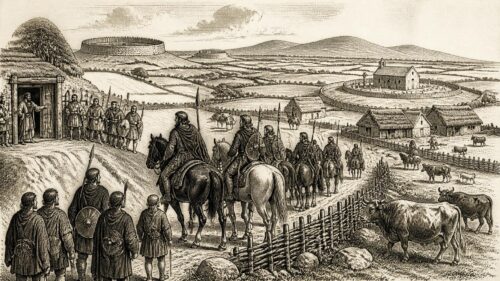
Áed Findliath, of the northern Uí Néill, remained king of Tara in 877. “King of Tara” represented a paramount claim within the Uí Néill political order, not rule over a centrally administered Irish state. His authority depended on alliances, military pressure, tribute, hostages and recognition from regional rulers. Dublin’s Scandinavian leadership could be ally, enemy or both at different moments; Irish politics did not divide neatly between “Irish” and “Viking” sides.
At a smaller scale, the annals record the death of Sochartach son of Brócán, chief of Uí Chormaic, and that of Cathalán son of Cernach, king of Fir Chúl. These notices preserve the political importance of local lordships, even where the sources give no narrative of succession. The death of a ruler could open disputes over land, clientship, cattle, church patronage and military leadership. But the annals do not tell us whether either death led to conflict, so such outcomes must remain possibilities rather than asserted events.
They also record that Donnchad son of Aedacán, grandson of Conchobor, was “deceitfully killed” by Flann son of Máel Sechnaill. The charge of deceit signals a moral judgement as well as a political killing. Flann was a member of Clann Cholmáin, the southern Uí Néill dynasty with powerful interests in Mide. His later attainment of the kingship of Tara lay still in the future: Áed Findliath did not die until 879. For 877, the entry should be read as evidence of violence within aristocratic competition, not as proof that Flann already controlled Ireland.
Churches, Learning and Succession
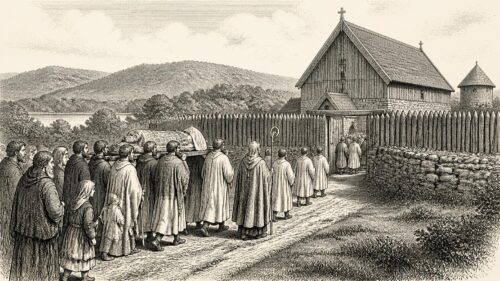
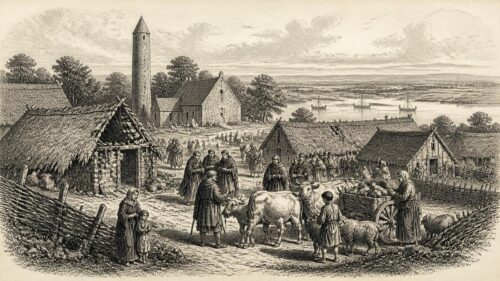
The year’s ecclesiastical notices show how deeply church institutions were embedded in political and social life. At Cluain Moccu Nóis, now Clonmacnoise on the Shannon, Eógan and Máel Tuile grandson of Cuanu, described as abbots, “fell asleep in peace”. The phrase marks an approved Christian death, in contrast to the vocabulary of killing used for secular rivals. Clonmacnoise was far more than an isolated religious retreat. Its position near major land and river routes made it a centre of worship, learning, craftsmanship, exchange and political influence, with a substantial lay community around its ecclesiastical core.
The loss of two abbots in one year was therefore significant for institutional continuity, though the annals do not explain whether they held office jointly, consecutively, or over associated communities. Máel Tuile is identified in Chronicon Scotorum as belonging to the Luigne of Connacht, a detail that illustrates how major churches drew leaders from powerful kindreds across regions. Monasteries held land, received patronage, employed artisans and scribes, hosted travellers, and maintained links with royal families. Their leadership was consequently a matter of public as well as devotional importance.
At Ard Macha, Armagh, Ainmire replaced Máel Coba as abbot or superior. Armagh was one of Ireland’s pre-eminent ecclesiastical centres, closely associated with the cult and authority of Patrick. A change in its leadership mattered to church networks extending far beyond the settlement itself. The annal records succession without scandal or conflict; that restraint may itself suggest an orderly transition, but it cannot prove that no negotiation took place.
Another notice marks the death of Máel Brigte, bishop of Sláine. Sláine, in the Boyne valley, stood within a densely settled and politically important part of the island. Its bishop’s death, like the changes at Clonmacnoise and Armagh, underlines the extent to which religious offices structured local authority. Such offices were held within a society where clerical and aristocratic families often overlapped, and where churches could preserve literacy, legal memory, relics and political legitimacy.
An Island in the Irish Sea
For most people in Ireland, 877 was lived through seasonal farming, livestock management, food production, household labour, local exchange, religious observance and obligations to kin and lord. The annals do not describe those routines directly. They do, however, point to the institutions that shaped them: local kings who extracted support and led fighting men; monasteries that owned land and attracted dependants; and coasts and waterways that carried merchants, pilgrims and armed fleets alike.
The events securely connected with this year give 877 its distinctive character. Rhodri’s refuge showed Ireland as a place within an interconnected western seaboard rather than an isolated island. The battle at Loch Cuan exposed the deadly rivalry of Scandinavian factions operating in Irish waters. Meanwhile, successions and deaths in Armagh, Clonmacnoise, Sláine and lesser kingdoms demonstrate the continued resilience of Irish political and ecclesiastical structures. The record is sparse, but it is enough to show a society in which local life endured while the seas around it became a theatre of international conflict.
Primary Sources
- The Annals of Ulster, Part 447
- The Annals of Ulster, Part 448
- Chronicon Scotorum, Part 90
- CELT Project: Chronicon Scotorum
- CELT Project: The Annals of Ulster
- The Annals of the Four Masters, Part 71
- The Annals of Tigernach
- The Annals of Inisfallen (MS. Rawlinson B. 503)
- Vikings in Irish Chronicles, 794–902: Introduction
- Vikings in Irish Chronicles, 794–902: Data
- Albann (Halfdan)
- Áed Findliath
- Flann Sinna
- Máel-Sechnaill
- Rhodri Mawr ('the Great') (died 877), king of Gwynedd, Powys, and Deheubarth
- The Vikings in Ninth-Century Ireland: Sources and Settlements
- Vikings in Ireland and Scotland
- Clonmacnoise Monastic Site
- High Crosses
- Exploring the Irish Annals
- Annals of Inisfallen to Go on Public Display in University College Cork
- Fragmentary Annals of Ireland