Muiredach’s Sliab Monduirn Raid875 CE
In 875, Muiredach son of Bran led Leinster’s army on a rapid destructive raid to Sliab Monduirn in the Armagh region, demonstrating provincial rivalry without proving a specific target. Annals also record deaths of prominent churchmen at Clonmacnoise, Kildare, Ferns, Tallaght, Lusk and Glendalough, whose offices combined religious leadership, learning, property and political connections. Across the Irish Sea, Picts suffered heavily against the Dubgaill, while Oistín, son of Dublin-associated Viking ruler Amlaíb, was killed. These fragmentary notices reveal interconnected warfare, ecclesiastical succession and maritime Scandinavian power, rather than a unified Ireland or detailed national narrative. The evidence cautions against invention.
Dateline
The year conventionally known as 875 in the Irish annals brings a sharply focused glimpse of a country in which political violence, ecclesiastical authority and the Irish Sea world were closely intertwined. The surviving notices are brief, and their dating systems are complicated: the heading of the Annals of Ulster carries its own computistical year-numbering. Yet historians conventionally place the entries discussed here in 875 CE. They record one exceptionally rapid Leinster raid, a cluster of deaths among leading churchmen, and news from northern Britain with direct consequences for the Viking leadership connected to Dublin.
A Leinster Army at Sliab Monduirn
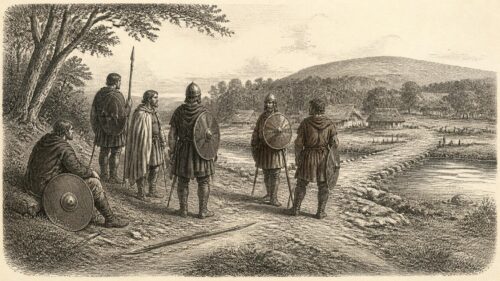
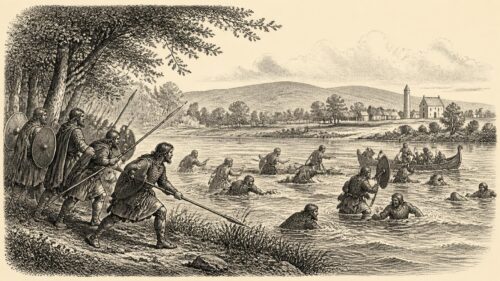
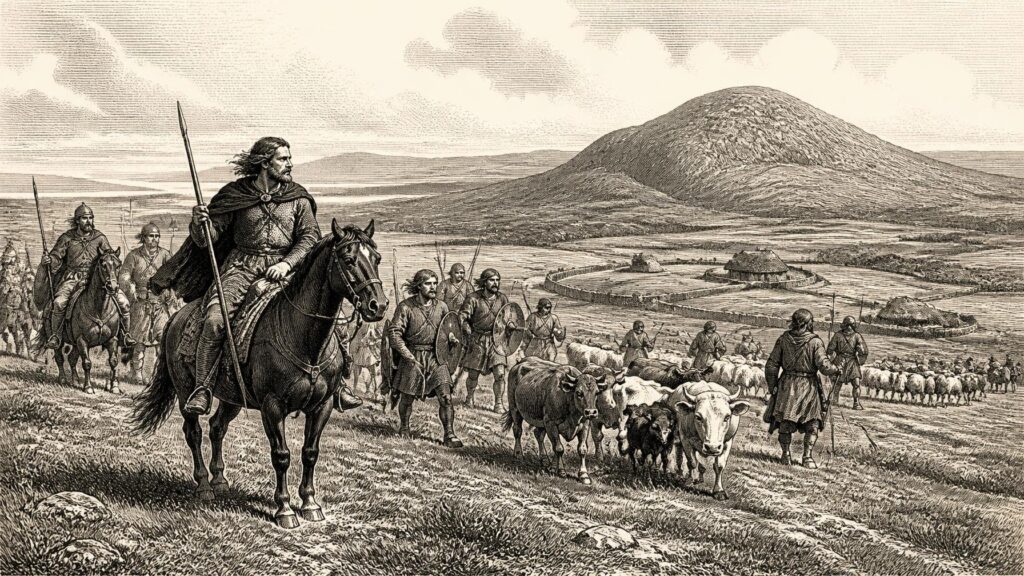
The most active Irish event recorded for the year was a military expedition by Muiredach son of Bran. The annal says that he led “the army of the Laigin” in laying waste the country as far as Sliab Monduirn, before returning to his own territory before evening. Sliab Monduirn is generally located in the Armagh region, well north of Leinster. The report therefore presents an ambitious incursion across political boundaries, undertaken by a force substantial enough to be called the army of an entire province.
Its compressed wording matters. “Laying waste” was a conventional annalistic description, but it should not be flattened into an invented set-piece battle. The source does not name an opposing commander, list the dead, or tell us precisely what was destroyed. In early medieval Irish warfare, however, a successful raid could mean the seizure of cattle, food stores and captives, the burning of structures, and the destruction of crops or supplies. The claim that the force was home before evening emphasises speed: this was not a conquest or occupation, but a punitive, extractive strike whose effectiveness depended on mobility.
Muiredach belonged to the Uí Dúnlainge, the dominant Leinster royal kindred. He was not yet the established overking of Leinster; that position would come only late in his life, in 884–85. In 875 he was nevertheless clearly a leader capable of mobilising Leinster’s armed following. The expedition also belongs to a wider pattern of rivalry between Leinster and the Uí Néill dynasties that dominated the midlands and north. Áed Findliath, of the northern Cenél nEógain, had held the kingship of Tara since 862. The annal does not explicitly state that Muiredach’s raid targeted Áed or that it was retaliation for a particular attack. It is safer to see it as evidence of continued competition over status, resources and influence across Ireland, rather than to impose a motive the record does not supply.
Church Leaders and Institutional Change
If the Leinster raid shows the reach of secular lordship, the death notices show the density of ecclesiastical power. The Annals of Ulster group together Maengal, designated tanist or heir apparent of Clonmacnoise; Robartach son of the Artificer, bishop of Kildare, described unusually as an “excellent scribe” and as superior of Cell Achad; and Lachtnán son of Mochtigern, another bishop of Kildare and superior of Ferns. The grouping is no mere obituary column. Each death could entail the transfer of office, land, dependent communities, learning and political connections.
Clonmacnoise, on the Shannon, was one of Ireland’s major monastic centres and a place of exceptional strategic as well as religious importance. Its riverine position linked the midlands to routes reaching north, south and west. Maengal’s title indicates that he was the recognised successor within its ecclesiastical hierarchy, although the notice does not say whether he had actually become abbot before his death. His loss may have required a fresh negotiation of succession among the community and its patrons. In an Irish church organised through powerful local institutions rather than a simple modern diocesan structure, such appointments mattered greatly.
Robartach’s obituary is especially revealing. To call a bishop an excellent scribe was to identify a learned specialist whose work could include copying sacred texts, producing legal or historical material, maintaining liturgical books, and preserving the written resources on which a great church depended. The ninth century was a period in which major Irish ecclesiastical centres remained centres of book production and scholarship, even after decades of Viking attacks and political disruption. Robartach’s offices at Kildare and Cell Achad also demonstrate that influence could be exercised through more than one religious house. Ecclesiastical rank, literacy and institutional leadership were mutually reinforcing forms of authority.
The notice of Lachtnán similarly connects Kildare with Ferns in south-east Leinster. Kildare was a prestigious foundation associated with Brigit and deeply enmeshed in Leinster politics. Ferns was another important Leinster church, and Lachtnán’s combined titles point to networks of personnel and patronage extending across the province. The annals do not tell us how these offices were acquired or who succeeded him. What can responsibly be said is that the deaths of Robartach and Lachtnán created vacancies at institutions whose resources and prestige made their leadership politically significant.
Deaths Across the Dublin Region
Three further obituaries locate the year’s ecclesiastical changes within and around the Dublin–Leinster zone. Mac Óige, superior of Tallaght, and Máel Bennachta, bishop of Lusk, are said to have “fallen asleep in peace”, while Fechtnach, abbot of Glendalough, died. The peaceful formula is significant chiefly as an annalistic contrast to violent deaths, not as proof that their communities were free from danger. It tells us that these men were not recorded as slain or carried off in warfare.
Tallaght, Lusk and Glendalough lay in markedly different landscapes. Tallaght stood on the approaches to Dublin and was associated with a renowned ecclesiastical community. Lusk, in north County Dublin, was another established church settlement within a region exposed to seaborne movement and the power of Dublin’s Scandinavian rulers. Glendalough occupied a sheltered Wicklow valley, but its mountain setting did not remove it from the political and economic world of Leinster. Its abbot led not an isolated retreat but a religious community with land, dependants, visitors and relationships with regional dynasties.
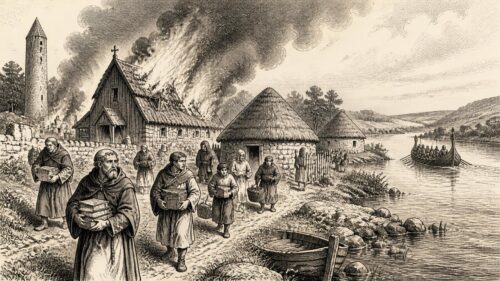
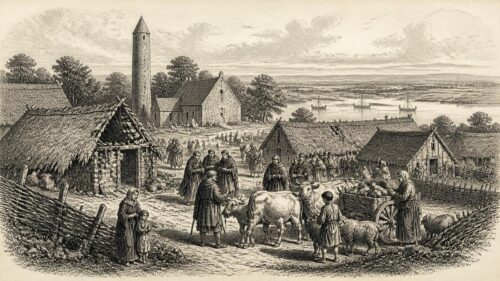
These notices offer a corrective to an image of ninth-century Ireland composed only of raids. Monasteries were places of prayer, burial, hospitality, farming, craft and instruction; their communities included clerics, scribes, tenants, labourers and lay patrons. Their spiritual prestige attracted gifts, while their wealth and stored produce could make them targets. The year 875 does not preserve details of harvests, weather or prices, so no particular environmental crisis can be assigned to it. Its evidence instead illuminates the human infrastructure through which religious houses endured: succession, literacy, local leadership and connections between settlements.
Violence Beyond the North Channel
The Irish annalist also recorded two events in northern Britain that were directly relevant to Ireland’s Viking age. First came an encounter between Picts and the Dubgaill, conventionally rendered “Dark Foreigners”, in which the Picts suffered a great slaughter. The entry does not identify the battlefield, commanders or the precise meaning of the label in ethnic terms. Modern readers should resist treating “Dark” and “Fair” foreigners as straightforward national categories: annalists used such terms in changing political contexts.
More consequentially, Oistín, son of Amlaíb, “king of the Norsemen”, was deceitfully killed by a man named Albann, conventionally identified by scholars with Hálfdan. The source gives no location and does not say that this killing occurred in Ireland. Its Irish relevance lies in kinship and power. Amlaíb had been one of the leading Viking rulers associated with Dublin, and his partnership with Ímar had projected force across Ireland and Britain. As recently as 871, the annals reported Amlaíb and Ímar returning to Dublin from Britain with two hundred ships and captives drawn from Angles, Britons and Picts. Ímar’s death was entered in 873 with an exceptionally grand title, king of the Northmen of all Ireland and Britain.
By 875, then, the political world linked to Dublin was not a settled dynasty but a contested maritime network. Oistín’s killing deprived Amlaíb’s family of a potential leader, while the slaughter of Picts shows that Scandinavian conflict in northern Britain remained intense. Neither notice proves that Dublin itself changed hands in 875, and no such claim should be made. They do show why events across the sea could affect Irish politics: fleets, rulers, captives, wealth and rival claimants moved through the same Irish Sea routes.
A Year of Connected Centres
In 875 Ireland was not politically unified, but neither was it disconnected. Muiredach’s lightning raid joined Leinster to the northern borderlands; clerical deaths linked Clonmacnoise, Kildare, Ferns, Tallaght, Lusk and Glendalough in a map of religious authority; and the killing of Oistín connected Dublin’s Viking leadership to war in Britain. Archaeology confirms the broader setting. Dublin and other ninth-century Scandinavian-founded sites were becoming places of settlement, manufacture and exchange as well as warfare, while major monasteries functioned as large lay-and-clerical communities within rural landscapes.
The year’s evidence is fragmentary, and that limitation is part of its value. It does not permit a richly detailed national narrative, nor does it justify filling silence with imagined battles, buildings or royal plans. It does permit a clear conclusion: in one calendar year, Irish provincial warfare, the succession of learned churchmen and Irish Sea Viking rivalries were all active parts of the same historical world.
Primary Sources
- The Annals of Ulster, Year U875
- The Annals of Ulster, Irish Text, Year U875
- The Annals of Ulster: Editorial and Translation Information
- Chronicon Scotorum
- Chronicon Scotorum, Annals 873–877
- Vikings in Irish Chronicles, 794–902: Data
- The Vikings in Scotland and Ireland in the Ninth Century
- The Vikings in Ninth-Century Ireland: Sources and Settlements
- Prosopographica Glindelachensis: The Monastic Church of Glendalough and its Community
- Glendalough Monastic Site and Visitor Centre
- Clonmacnoise Monastic Site
- High Crosses
- Irish School of Illumination, c. 650–1100
- Dublin City Urban Archaeology Survey: Preliminary Report
- Dublin City Urban Archaeology Survey, 1988
- Woodstown Working Group Final Report
- County Wicklow Urban Archaeology Survey
- Bran
- Bran Ardchenn
- Irish Texts at CELT
- Translated Texts at CELT
- The Vikings in Early Medieval Ireland: Church-Raiding, Politics and Kingship