Cenn Fáelad Takes Cashel861 CE
Dateline
For Ireland, 861 is a year best approached through a small number of sharply focused annalistic notices rather than a continuous national narrative. The surviving records do not permit a day-by-day reconstruction, and their year-numbering sometimes differs between compilations. Yet several entries securely associated with this year illuminate the pressures shaping Irish political life: a change of ruler at Cashel, contention in the midlands involving Áed son of Niall and foreign allies, a victory claimed for the high king Máel Sechnaill, and the continued importance of royal assemblies. Together they show an island governed not by a single settled state, but by overlapping kingships, ecclesiastical centres, kin-groups and military partnerships.
A King at Cashel
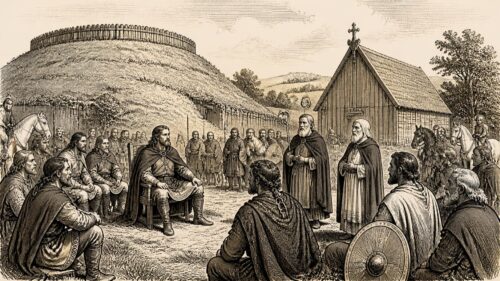
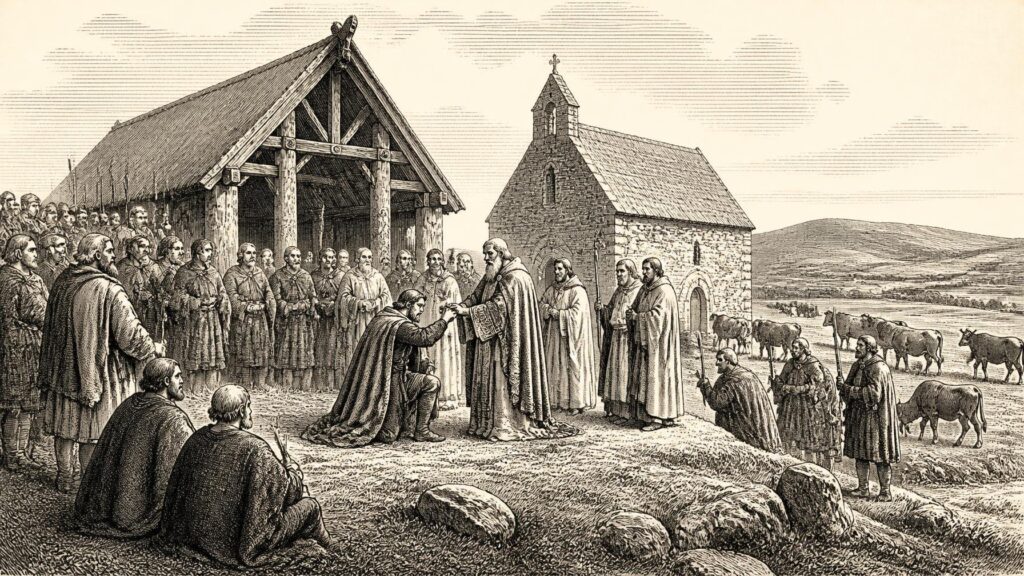
The most unequivocal Munster notice comes from the Annals of Inisfallen: Cenn Fáelad, grandson of Mugthigern, “took the kingship of Caisel”. This is a firmly year-dated succession in that chronicle, though it supplies neither a month nor an account of how the transfer was achieved. Caisel, later Cashel, was the principal royal centre associated with the Eóganacht rulers of Munster. Its kingship carried claims to superiority across a large and politically diverse province, but such claims depended on the cooperation, submission or coercion of many lesser peoples and dynasties.
Cenn Fáelad’s accession should not be imagined as the simple occupation of a fixed national capital. Early medieval Irish kingship was personal and territorial. A ruler’s authority rested upon descent, clientship, tribute, hostage-taking, military following and recognition at assemblies. Cashel was a potent royal and ecclesiastical place, but the kingship named after it was a network of relationships extending beyond the rock itself. The annal’s concise wording therefore records a substantial political fact without revealing the negotiations, rival claims or local conflicts that may have preceded it.
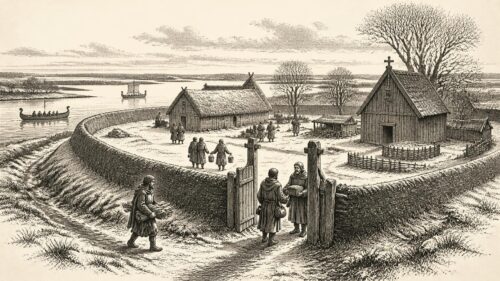
Later entries identify Cenn Fáelad as both king of Cashel and abbot of Imlech Ibuir, the important church centre at Emly. That later description should not be projected too confidently back onto 861 as proof that he already held both offices. It does, however, place his accession in a world where leading families could exercise influence through both royal and ecclesiastical institutions. Munster’s politics cannot be separated from its churches: monasteries held land, received patronage, preserved learning and offered rulers prestige as well as practical links across the province.
Mide Under Pressure
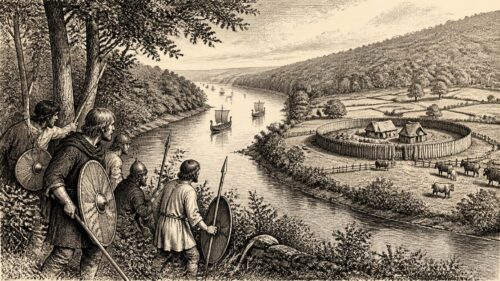
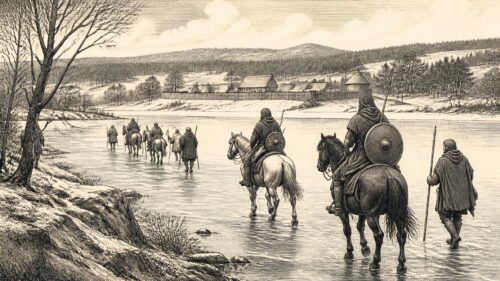
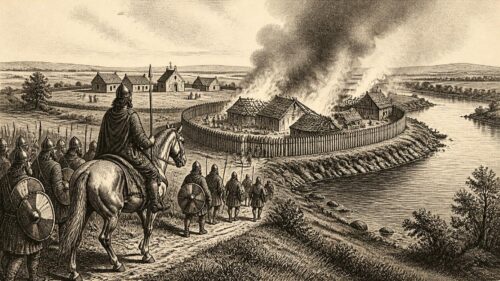
In the central plain, the year’s notices reveal a more immediate contest. Chronicon Scotorum records that Mide was invaded by Áed Finnliath, son of Niall Caille, “with foreigners”. The parallel Annals of Ulster preserves the same essential notice, although its internal chronological heading is offset from modern calendar reckoning. The agreement between the traditions makes the invasion a strong element of the year’s history; the identity, number and motives of the foreign contingent remain unstated.
Áed was king of Ailech in the northern Uí Néill sphere and a serious rival to Máel Sechnaill mac Máel Ruanaid, the reigning king over Ireland. In 861 Máel Sechnaill was still alive and ruling. His death belongs to the following year, dated by the annals to 30 November 862, after which Áed succeeded to the overkingship. It is therefore misleading to describe 861 as the first year of Áed’s high kingship, even though the later Annals of the Four Masters places such a statement under its entry for 861. That compilation preserves valuable traditions, but its chronology for this period cannot simply be treated as contemporary calendar dating.
The Mide expedition is important precisely because it shows Áed challenging the existing political order before his eventual accession. The phrase “with foreigners” demonstrates that Scandinavian forces could be drawn into Irish struggles as allies, auxiliaries or partners in plunder. It does not tell us that Áed commanded them, that they were mercenaries in a modern sense, or that a durable alliance had been made. The annal offers only the result visible to its writer: an armed incursion into the territory ruled from Tara and surrounding Mide.
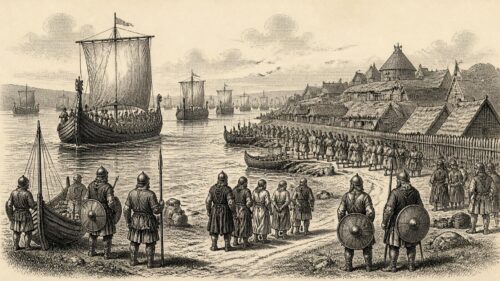
Chronicon Scotorum also credits Máel Sechnaill with a victory at Druim dá Maige over the foreigners of Dublin. No date within the year, troop numbers or tactical description survives. Nor is it safe to attach a detailed modern map to the place-name. Even so, the entry matters. Dublin was by this point a major Scandinavian power-base on the Irish Sea, and the annalist’s specific identification of its foreigners distinguishes them from the unnamed foreign force said to have accompanied Áed. The two notices may belong to a connected season of conflict, but the evidence does not prove that they describe one campaign.
Foreigners and Irish Politics
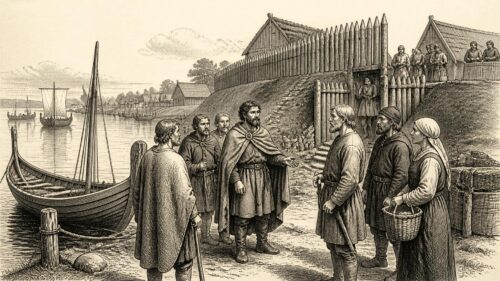
The term usually translated as “foreigners” was a contemporary Irish category, not a precise ethnic census. It could refer to Scandinavian-led groups whose crews, followers and local connections need not have been culturally uniform. Amlaíb and Ímar were prominent rulers among the Dublin foreigners in the 850s and 860s, but neither is named in the securely aligned notices for the Mide invasion or the battle of Druim dá Maige. Their prominence in the wider decade should not be used to assign them automatically to every Viking activity of 861.
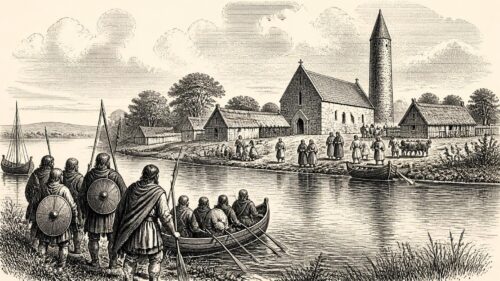
What can responsibly be said is that Dublin’s sea-borne military capacity had become inseparable from Irish politics. Ships allowed raiders and allies to move along coasts, rivers and estuaries; a base at Dublin gave its leaders access to the Irish Sea world as well as to the wealthy east midlands. The high king’s victory indicates resistance rather than helplessness. Irish rulers could defeat Scandinavian forces, bargain with them, employ them against rivals, and suffer from their raids in the same period. The division between “Irish” and “Viking” was consequently real in the language of the annals, but it did not dictate a simple division into permanent opposing camps.
Ráigne’s Royal Assembly
A different kind of political activity appears in the Fragmentary Annals of Ireland, which places the holding of the óenach of Ráigne under 861 and credits it to Cerball mac Dúngail, king of Osraige. The notice is brief, and the surviving Fragmentary Annals are a later, incomplete and strongly narrative collection; their date should therefore be used with care. Nonetheless, it preserves an important reminder that power was displayed not only through raids and battles, but also through public gatherings.
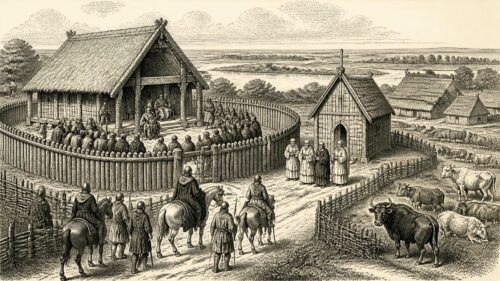
An óenach was an assembly and fair. Such occasions could combine market exchange, legal business, proclamation, entertainment, sporting contests and the public recognition of rank. The record does not itemise what was bought or judged at Ráigne in 861, so claims about particular goods, customs or ceremonies would be speculation. But the act of holding an óenach itself was politically meaningful. It advertised a ruler’s ability to draw people together, maintain a recognised meeting-place and uphold the peace required for exchange and adjudication.
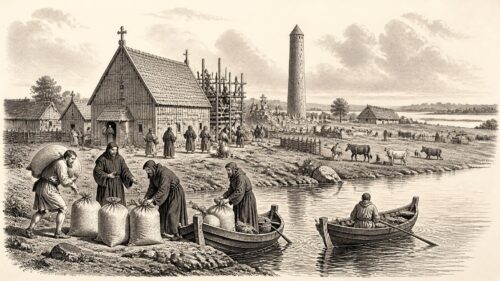
For ordinary households, this institutional world mattered as much as high politics. Most people lived through farming, livestock keeping, craft production and obligations to local lords and churches. A raid into Mide, a battle involving Dubliners or a new ruler at Cashel could alter demands for food, cattle, labour, shelter and military service. Conversely, an assembly created a temporary concentration of buyers, sellers, litigants and dependants. The sources do not describe daily life in 861 directly, but their notices point to the ways warfare, lordship and exchange pressed upon it.
Queenship, Penance and Record
The year also contains a quieter but revealing obituary. Gormlaith, daughter of Donnchad, described as “queen of the Irish”, died after repentance. The annal gives no fuller biography, but its wording joins royal status to a Christian ideal of penitential death. This was not merely private devotion. In an Ireland where churches shaped literacy and commemoration, repentance could be an important part of the public memory of an elite life. The notice also reminds us that queenship, marriage and kinship were integral to political order, even when the annals leave women’s actions far less fully recorded than those of kings and warriors.
Monastic and church communities made the survival of these fragments possible. Their annals were not neutral administrative reports: they selected events relevant to their patrons, regions, religious concerns and inherited historical frameworks. That selectivity explains both their value and their limits. There is no securely dated record here of a harvest, epidemic, great storm or building project. Silence cannot prove that none occurred; it means only that the surviving notices for 861 direct attention elsewhere.
An Irish Sea Horizon
The Annals of Inisfallen additionally note the death of Domnall son of Alpín, king of Alba. The entry is not an Irish political event in itself, but its inclusion shows that Irish chroniclers watched affairs across the North Channel. Ireland and Alba were connected by sea routes, ecclesiastical ties, dynastic contacts and the movements of Scandinavian fleets. News from Alba could matter to Irish readers because the same maritime world carried pilgrims, clerics, warriors, captives and traders between the two islands.
Thus 861 was not a year of one decisive national transformation. It was a year in which regional authority was renewed at Cashel, the midlands were contested, Dublin’s foreigners figured in both alliance and war, and Cerball’s assembly demonstrated the ceremonial side of kingship. The evidence is fragmentary, but its pattern is clear: Ireland’s political landscape remained competitive, connected and resilient, with churches and assemblies providing essential structures alongside armed power.
Primary Sources
- The Annals of Inisfallen: Annal AI861
- CELT Project: Annals of Inisfallen
- The Annals of Ulster: Year U861
- The Annals of Ulster: Year U862
- CELT Project: The Annals of Ulster
- Chronicon Scotorum: Annals CS860–CS864
- CELT Project: Chronicon Scotorum
- Fragmentary Annals of Ireland: Annals FA280–FA282
- Fragmentary Annals of Ireland: Annals FA301–FA308
- CELT Project: Fragmentary Annals of Ireland
- Fragmentary Annals: Manuscript History
- Annals of the Four Masters: Annals M857–M866
- CELT Project: Annals of the Four Masters
- Vikings in Irish Chronicles, 794–902: Introduction
- Vikings in Irish Chronicles, 794–902: Bibliography
- The Vikings in Ninth-Century Ireland: Sources and Settlements
- The Vikings in Ninth-Century Ireland: Sources and Settlements (full text)
- Vikings in Ireland and Scotland
- Viking Ireland: Afterthoughts
- Irish Texts at CELT