Forbflaith’s Last Year775 CE
In 775, Irish annalistic evidence records deaths of ecclesiastical and learned figures, including Scannal, Maicníad, Augustin, Adarchu and Forbflaith, abbess of Clonbroney, alongside a battle at Uilleann Guaire that killed Flann son of Cellach and Scannlán son of Fínnechta. Dates and details remain uncertain because medieval annalistic chronologies differ. The year also saw Donnchad Midi, king of Tara, devastate Munster, demonstrating coercive but limited overlordship. These notices reveal interconnected political, religious and intellectual communities, in which churches held economic and social authority, women could lead religious houses, and rural households locally sustained kingdoms and monasteries through labour, rents, and service.
Dateline
For Ireland in 775, the surviving record is unusually revealing precisely because it is so spare. A later annalistic compilation preserves a cluster of deaths: Scannal, described as abbot and successor of Cainnech; Maicníad, abbot of Dún Lethglaise, modern Downpatrick; Augustin of Bangor; the learned man Adarchu; and Forbflaith daughter of Connla, abbess of Cluain Brónaigh, or Clonbroney. It also records a battle at Uilleann Guaire, in which Flann son of Cellach and Scannlán son of Fínnechta were killed. These notices do not offer a continuous narrative, but together they expose a country whose political, religious and learned networks were dense, local and consequential.
What Can Be Dated Securely?
The events conventionally assigned to 775 must be handled with care. Irish annals preserve invaluable early material, but their surviving manuscripts and later compilations differ in their year-numbering and in the arrangement of entries. The Annals of the Four Masters, compiled in the seventeenth century from earlier materials, explicitly places the deaths of Scannal, Maicníad, Augustin, Adarchu and Forbflaith, and the battle of Uilleann Guaire, under 775. It is the fullest source for this calendar year. The Annals of Ulster preserve related eighth-century material but demonstrate the chronological difficulties: the headings in this section do not always align straightforwardly with a modern calendar. Modern scholarship therefore reconstructs dates by comparing annals, regnal sequences and chronological data rather than treating every medieval heading as mechanically exact.
That caution matters especially for warfare. Uilleann Guaire is named, and two men are said to have fallen there; neither the location nor the contestants’ wider affiliations are supplied in the surviving entry. It would be irresponsible to turn that small notice into a known campaign, to identify the place with confidence, or to claim that either casualty was a king. What can be said is that the battle belonged to the familiar pattern of early medieval Irish conflict: armed encounters between neighbouring kindreds or rival political interests, significant enough for the deaths of named men to enter historical memory.
Donnchad’s Southern Pressure
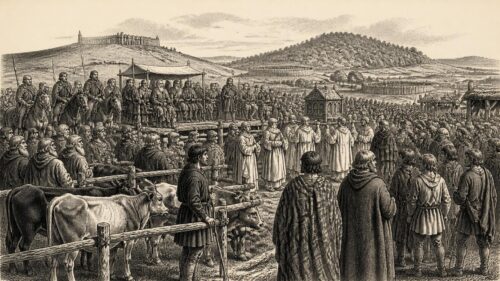
The broader political setting was dominated by Donnchad mac Domnaill, Donnchad Midi, of Clann Cholmáin, the leading southern Uí Néill dynasty of the midlands. By 775 he had emerged as king of Tara in the sense used by contemporary Irish political culture: not ruler of a unified territorial state, but a pre-eminent overking whose authority had to be asserted through alliances, military expeditions, hostages and control of strategic centres. His power rested above all in Mide, but its consequences reached far beyond it.
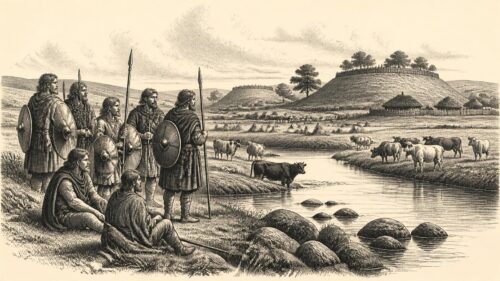
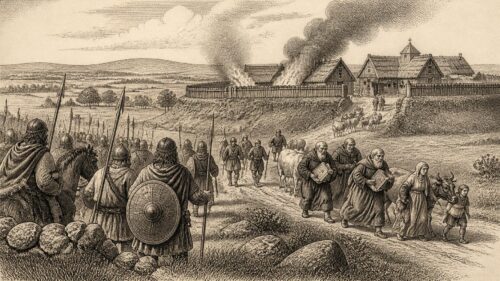
A modern biographical reconstruction, drawing on the annals, assigns a destructive expedition by Donnchad into Munster to 775. The Ulster record says that he caused great devastation in Munster and that many Munstermen fell. It does not identify a single pitched battle, specify the route, list the victims or tell us what settlement followed. The language nevertheless makes clear that this was not a ceremonial progress. Devastation meant the coercive damage of a hosting: pressure on people, livestock, food stores and estates, intended to compel submission and demonstrate superiority. Such an expedition was a reminder that royal power was exercised through movement as well as residence. Kings travelled with armed followers, while local rulers judged whether resistance, negotiation or accommodation offered the least dangerous course.
Donnchad’s position should not be mistaken for uncontested national government. His family had secured an important advantage within the southern Uí Néill, but rival dynasties in Brega, Leinster, Munster and the north retained their own rulers and ambitions. The political map was a patchwork of kingdoms, client peoples and ecclesiastical territories. A king of Tara could make a formidable claim to supremacy without commanding permanent institutions across the island. The events associated with 775 instead show authority being made visible by a campaign, and its limits revealed by the need for repeated action.
Abbeys, Churches and Leadership
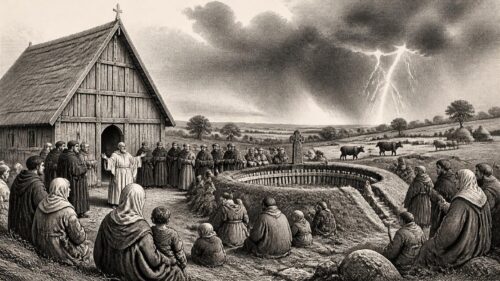
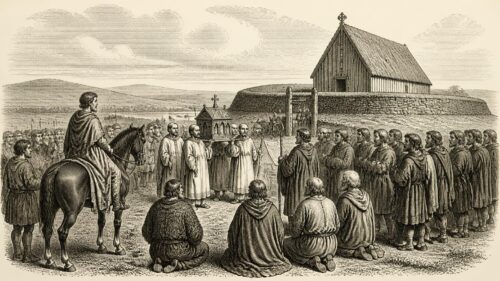
The obituaries give the year a different centre of gravity. Scannal was remembered as successor of Cainnech, a title that placed him within the institutional inheritance of a major saintly foundation. Maicníad’s death connected the year to Dún Lethglaise, later Downpatrick, while Augustin’s linked it to Bangor on the shore of Belfast Lough. These were not isolated places of prayer. Early Irish ecclesiastical communities were centres of worship, burial, education, landholding, hospitality, craft production and exchange. Their leaders could be drawn from powerful families and their churches were entangled with the rivalries of kings.
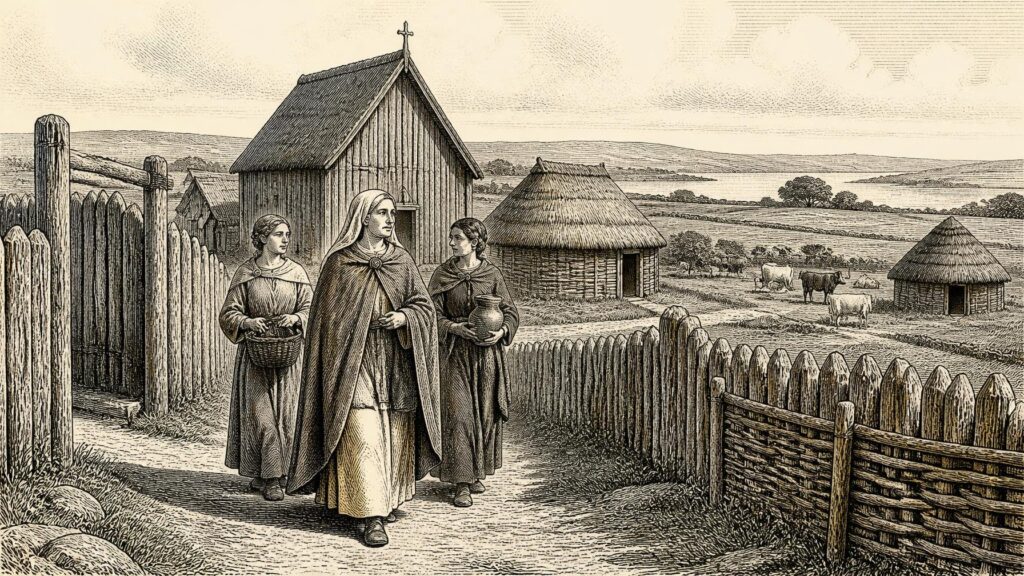
The death of Forbflaith, abbess of Clonbroney, is especially important. Her brief obituary is firm evidence that a woman headed a recognised religious community in 775. Nothing in the entry tells us the size of Clonbroney, the precise extent of its lands or the details of Forbflaith’s career; those silences should be respected. Yet the title banabb, abbess, was not ornamental. It signals office, authority and succession. In an Ireland where kinship and religious patronage overlapped, an abbess could stand at the meeting point of a local community, its landed resources, its spiritual obligations and the status of the family connected with its foundation.
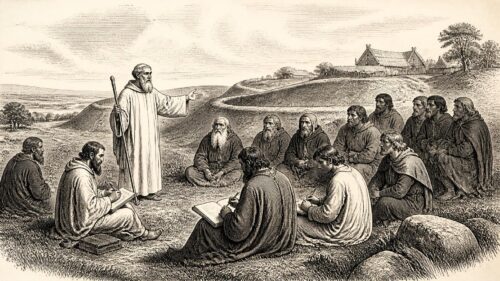
Adarchu is called a “wise man”, a conventional but meaningful annalistic designation for a learned figure. The term does not allow us to decide whether he was chiefly a scholar, poet, judge, teacher or ecclesiastic. It does show that learning itself was a recognised form of standing. Ireland’s literate culture was sustained in and around churches, where Latin Christian books, vernacular genealogies, law, poetry and computistical learning could circulate. Annalists rarely describe the lessons, writing materials or labour behind that world. Their decision to preserve the death of a learned man nevertheless hints at a community for which intellectual reputation had public value.
Everyday Landscapes Behind the Notices
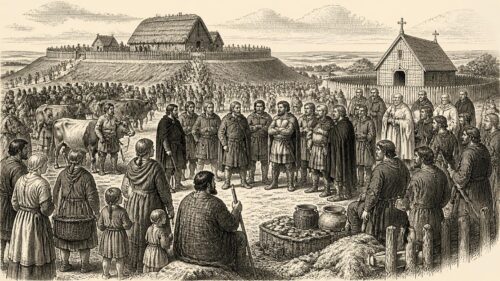
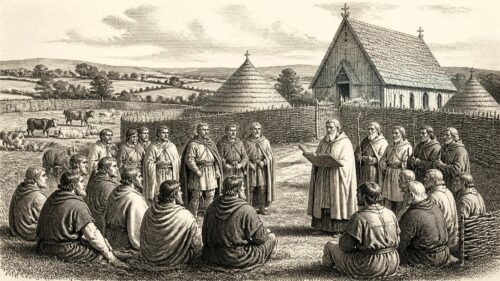
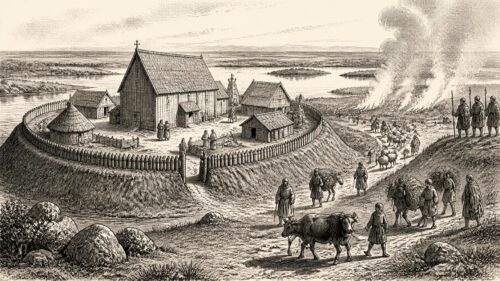
Most inhabitants of Ireland in 775 do not appear by name. They lived chiefly in dispersed rural settlements, including enclosed farmsteads now known as ringforts, and depended on mixed agriculture, cattle and seasonal labour. The year’s political violence and ecclesiastical deaths would have mattered to them not as distant abstractions but through obligations of food-rent, hospitality, military service and protection. A royal hosting could disrupt cultivation and seize movable wealth; a change of abbot or abbess could affect the management of church lands and the local networks that supplied a religious settlement.
Monasteries did not replace this rural world; they were embedded in it. Their enclosures marked sacred and controlled space, yet they also drew in tenants, craftsmen, pilgrims, students and visitors. The named communities of Bangor, Downpatrick and Clonbroney belonged to a wider landscape in which churches and secular households relied on one another. The evidence does not permit a claim about a harvest, weather crisis or epidemic in 775. It does permit a more modest conclusion: the institutions recording death and conflict were rooted in the working countryside that made both kingship and religious life possible.
A Year of Names
Thus 775 is not a year to be inflated into a single national turning point. Its most securely assigned notices preserve named losses, a poorly documented battle and the political shadow of Donnchad’s southern campaign. But their concentration is revealing. Flann and Scannlán died in conflict; Scannal, Maicníad, Augustin, Adarchu and Forbflaith disappeared from religious and learned communities. In the gaps between those names lies the larger Ireland of the eighth century: many competing lordships, powerful churches, female as well as male office-holders, and ordinary households whose work sustained both monastery and king.
Primary Sources
- Annals of the Four Masters, Part 60
- Annals of the Four Masters
- The Annals of Ulster
- TEI Header for The Annals of Ulster
- Annals of Inisfallen, Part 33
- Annals of Inisfallen
- The Annals of Tigernach
- Annals of Tigernach: Document Details
- Chronicon Scotorum
- Donnchad Midi
- Donnchad mac Domnaill: (733–797), high-king of Ireland
- Home Page for Dr. Daniel P. McCarthy
- The Chronology and Sources of the Early Irish Annals
- Chronological Synchronisation of the Irish Annals
- Religious Orders
- Glendalough
- Ireland’s Historic Churches and Graveyards
- Church of the Rath, Killeshandra, County Cavan
- Saint Moling’s Millrace, St Mullins, County Carlow
- Archaeological Excavations: The Robing Room, Bishop’s Palace, Kilkenny