Forggus’s Double Law744 CE
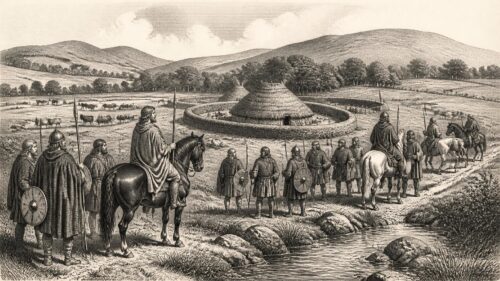
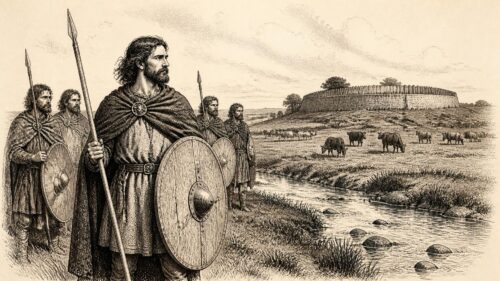
In the political moment around 744, Irish annals record regional deaths, warfare and the close alliance of kingship and church authority. Ardgal, king of Éile, died, while bishops and ecclesiastical leaders including Laidcnén of Saigir and Colmán of Lesán were killed. Conflicts claimed Conchobor of Uí Fhidgente and other elites, and the Déisi defeated Corcu Mo-Druad. Most significantly, Forggus son of Cellach, Uí Briúin king of Connacht, jointly enforced the laws of Saints Ciarán of Clonmacnoise and Brénainn of Clonfert, securing ecclesiastical rights through royal power. Differing annalistic chronologies place much of this cluster in 743 or 744. Sources differ.
Dateline
In 744 CE, Ireland’s surviving annalistic record presents a hard, compact picture: rulers and churchmen died or were killed; small kingdoms fought; and Forggus son of Cellach, king of Connacht, simultaneously enforced the laws of two saints, Ciarán and Brénainn. Yet the year requires care. The relevant sequence is entered as 744 in the Annals of Tigernach, while the parallel entry in the Annals of Ulster bears the annal-number U744 but is internally synchronised there to AD 743. Medieval Irish annals do not always preserve a modern calendar with mechanical precision. The events below therefore belong firmly to the political moment around 744, but only the death of Ardgal, king of Éile, is independently entered under 744 in the Annals of Inisfallen. The most important development was not a decisive battle: it was the public joining of royal power to ecclesiastical authority in Connacht.
A Year With Uneven Dates
The annals are invaluable precisely because they preserve names, places and actions which would otherwise be lost. They are also terse records copied and reshaped over generations, with divergent chronological systems. It would be misleading to turn every entry grouped beneath an annal-number into an event whose day, month and even calendar year are beyond doubt. For 744, the responsible approach is to distinguish the death of Ardgal of Éile, recorded by the Munster-centred Annals of Inisfallen, from the larger cluster preserved by the Tigernach–Ulster tradition. That cluster reveals the tensions of the mid-eighth century even where its precise modern dating is uncertain by about a year.
Ardgal’s death mattered because Éile occupied an important zone between the midlands and Munster, broadly centred on territory later associated with north Tipperary and neighbouring districts. The annal gives neither cause of death nor successor. That silence is typical: kingship was local, dynastic and competitive, and an obituary need not mean a peaceful transfer. Still, the record shows that even comparatively small overkingdoms were recognised within an island-wide habit of political memory. Ireland in 744 was not a single kingdom. It was a mosaic of regional dynasties, each dependent on kinship, clientship, land, cattle and the capacity to protect followers.
Forggus and the Saints’ Laws
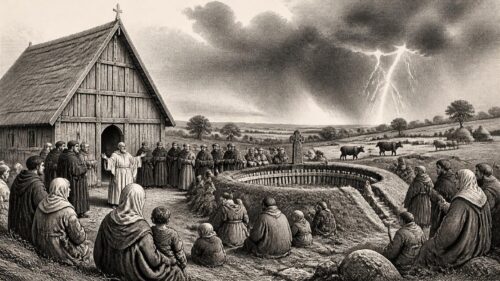
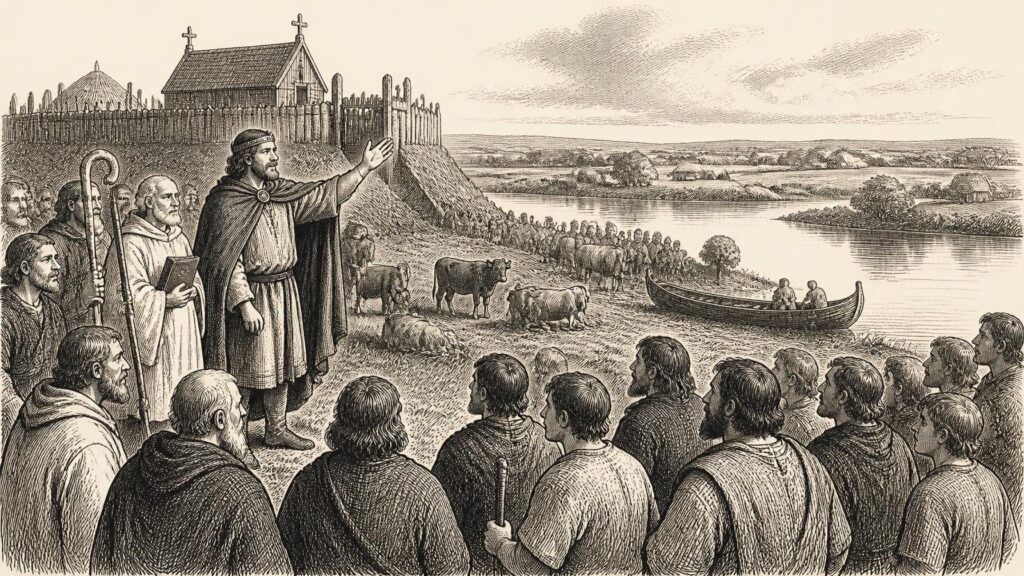
The most striking notice associated with this year states that the law of Ciarán, “son of the wright”, and the law of Brénainn were imposed together by Forggus son of Cellach. Forggus was king of Connacht, from the Uí Briúin dynasty. Ciarán was the founding saint of Clonmacnoise on the Shannon; Brénainn was Brendan of Clonfert, whose principal church lay further west in the Shannon corridor. Their joint appearance is highly significant. Two major ecclesiastical communities, connected by river routes and by their claims to land, people, sanctuary and tribute, were being upheld through royal action.
“Law” here should not be imagined as a surviving statute book passed by an assembly in the modern sense. No text of a 744 code of Ciarán and Brénainn survives. In early medieval Irish usage, a saint’s law could mean the formal extension or enforcement of a church’s protected order: its rights, immunities, claims on dependants, and penalties for offences against it. Such enactments could be proclaimed with ceremony and backed by a king’s force. They gave practical expression to the saint’s authority in the living world. The annal’s emphasis on simultaneity suggests a deliberate, public settlement rather than two unrelated devotional acts.
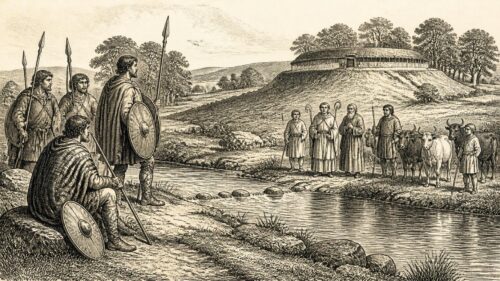
The political calculation is plain enough, even though the negotiations themselves are unrecorded. Forggus strengthened his position by associating himself with revered saints and influential churches. Clonmacnoise and Clonfert, in turn, gained royal backing for their interests across Connacht and the central riverlands. This was diplomacy conducted within Ireland: not a treaty between foreign states, but an agreement between a king, ecclesiastical households and the communities whose labour and resources sustained them. Religious prestige was a resource of government, while royal protection was a resource of religion.
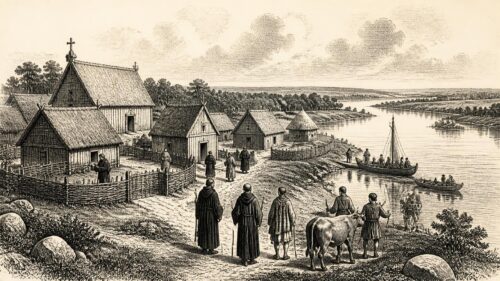
The choice of Ciarán and Brénainn also points to the importance of the Shannon. Rivers, lakes and routeways connected otherwise dispersed settlements. Clonmacnoise stood near a major crossing of the Shannon and the east–west roads of the central plain; Clonfert belonged to the same broad communications world. People, cattle, food renders, manuscripts, metalwork, clerics and messengers could move along these routes. The law therefore concerned more than sacred space. It helped regulate access to wealth and influence in a landscape where monasteries were large landed communities as well as places of worship.
Churchmen in a Violent Landscape
The protection proclaimed for two saints stands in sharp contrast to other entries in the same annalistic dossier. Laidcnén son of Doinennach, bishop and abbot of Saigir, was killed. Saigir, in the south-central region, was among Ireland’s old ecclesiastical foundations. The paired titles matter: an abbot and a bishop could be embedded in one religious community, and ecclesiastical office did not remove a man from dynastic politics or local violence. The source does not name Laidcnén’s killers or explain their motive. It would be irresponsible to invent a feud, a raid or a doctrinal quarrel. What can be said is that clerical rank offered no automatic security.
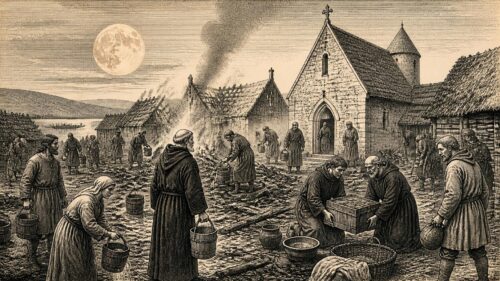
Colmán, bishop of Lesán in Uí Thuirtri, was likewise killed, apparently by members of the Uí Thuirtri themselves. This was in the northern sphere of Airgíalla and the lower Bann region. Two violent deaths of bishops or abbots, recorded beside a saints’ law, expose the double character of the church’s position. Churches possessed moral authority, learning, land and portable treasure; their leaders could serve as negotiators and custodians of kin memory. Those same assets made them participants in local struggles. The law of a saint was meaningful because sanctuaries, people and property could be violated.
The annals also commemorate Fergus son of Colmán Cutlach as an sapiens, “the learned”. No work can securely be attributed to him, and the word does not identify a particular school or profession. Yet the notice is important. It tells us that learning itself was a status worth recording alongside kings and warriors. Latin literacy, ecclesiastical scholarship, genealogical knowledge and legal expertise were not marginal accomplishments. They helped institutions preserve claims, draft or copy texts, commemorate the dead and make authority intelligible across generations.
Local Wars, Not One National Conflict
Several killings and battles underline how fragmented politics remained. Conchobor of the Uí Fhidgente fell in the battle of Cliú. The Uí Fhidgente were a powerful grouping in the wider Limerick region, and the entry indicates conflict in Munster’s north-western orbit, although it does not identify either the victor or the immediate cause. At Ailén dá Berrach, Dub dá Dos son of Murgal was killed. The annal supplies a place-name but too little context to turn the encounter into a national campaign. Cathal and Ailill, grandsons of Cellach of Cualu, were killed; Muirgius son of Ánluan was killed at Tuilén. These are reminders that elite kin groups could lose several members in abrupt, localised violence.
Further south-west, the Déisi destroyed Corcu Mo-Druad. The entry is emphatic, but “destruction” in annalistic language does not permit a precise reconstruction of casualties, settlement loss or permanent conquest. It does show a successful attack by one people upon another, probably involving the seizure of goods, the breaking of dependants’ allegiance and the assertion of territorial superiority. Cattle, food stores, hostages and control of agricultural land were likely to have been at stake, but the annal does not itemise them. This was not an Ireland at peace under a high king; it was an Ireland in which alliances and rivalries operated at many levels.
Domnall Midi’s Ambiguous Clerical Life
Another terse note says that Domnall “again entered clerical life”. He is generally identified as Domnall Midi of Clann Cholmáin, the new king of Tara after the defeat and death of Áed Allán in the preceding political crisis. The word “again” is revealing: the annals had already associated Domnall with clerical life before his rise to the wider kingship. It should not be read simply as abdication. Later records continue to show him exercising secular authority, and historians differ over whether such notices mean that he held a formal ecclesiastical office, adopted a penitential status, or combined royal and clerical roles in a way unfamiliar to modern categories.
Whatever its exact institutional meaning, the notice captures a central feature of elite society. A king could seek legitimacy through religious affiliation without becoming politically irrelevant. Conversely, churches benefited when powerful dynasties treated their saints, relics and learned personnel as assets requiring defence. Domnall’s ambiguous position in the midlands and Forggus’s enforcement of Ciarán’s and Brénainn’s laws in Connacht are thus closely related developments. Both show that kingship and church authority were intertwined, negotiated and sometimes overlapping.
Life Beyond the Annals
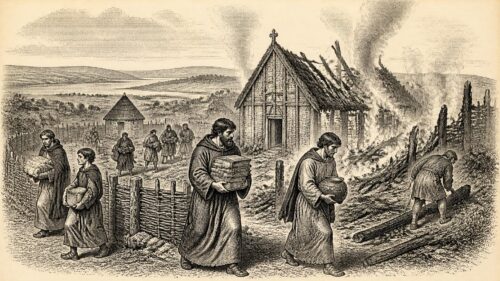
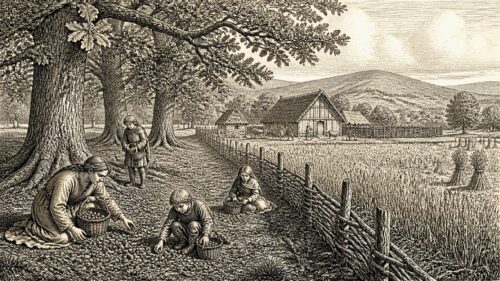
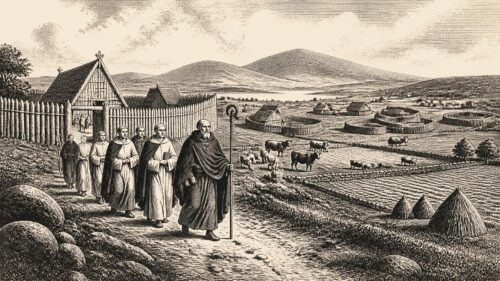
The annals say nothing specific about weather, harvests, overseas trade or a major epidemic in 744. Silence should not be converted into claims of prosperity or disaster. Most people lived in dispersed rural settlements, farming grain and keeping cattle, pigs and sheep. Monastic centres were not isolated cloisters in the later medieval sense: they contained clergy, tenants, craftspeople, visitors and dependants, with churches, workshops, storehouses and dwellings largely built of timber and earth. The stone churches and high crosses most visible today often post-date this moment, although Clonmacnoise’s substantial early medieval community was already established.
There is likewise no securely dated artistic object or manuscript that can be assigned to 744 itself. Nevertheless, the year’s record belongs to an age of sustained intellectual and artistic production. Ecclesiastical centres fostered copying, teaching, metalworking and stone-carving, while their connections with rulers made cultural activity possible on a larger scale. The entry for Forggus’s double law is therefore more than a pious detail. It shows the institutional framework that protected and mobilised the people, property and authority on which religious learning depended.
For all its brevity, 744 offers a vivid cross-section of early medieval Ireland: the death of a regional king in Éile; warfare in several provinces; the vulnerability of bishops and abbots; a learned man judged worthy of remembrance; and, above all, a Connacht king binding his authority to the saints of Clonmacnoise and Clonfert. The evidence does not support a single dramatic national narrative. It supports something more historically revealing: a society of many competing powers, held together by kinship, travel routes, churches and carefully asserted law.
Primary Sources
- The Annals of Ulster, Year U744
- The Annals of Tigernach, Annal T744
- Annals of Inisfallen, Annal AI744
- The Annals of Ulster: Document Details
- The Annals of Tigernach
- Annals of Inisfallen: Bibliographic Information
- Chronicon Scotorum: Document Details
- Chronicon Scotorum
- Domnall Midi
- Murchad Midi
- Sléibíne
- The Law of the Saints in Ireland
- Early Irish Monasteries and Their Dynastic Controls
- Clonmacnoise Visitor Guide
- Clonmacnoise Monastic Site
- High Crosses
- The Cross-Slabs of Clonmacnoise: Reassessing One of the Largest Collections of Early Medieval Carved Stone Monuments in Northwest Europe
- Early Christian Monasteries
- Early Monastic Churches
- Christian Ireland, Fifth to Eighth Centuries
- Early Irish Monasticism
- Irish School of Illumination, c. 650–1100
- Churches and Ecclesiastical Enclosures
- Patrician and Early Christian Architecture