Almuin’s December Reckoning722 CE
In 722, Fergal son of Máel Dúin, Cenél nÉogain ruler styled king of Ireland, invaded Leinster to enforce overlordship, tribute and hostages. On Friday 11 December, Leinster forces led by Murchad son of Bran Mút defeated and killed him at Almuin, or Allen, County Kildare, alongside many northern, Airgialla and midland allies. The battle exposed limits of Uí Néill power, intensified dynastic competition, and enhanced Leinster’s prestige without ending its internal divisions. Later saga embellished events, but annals confirm a major political rupture. Other notices record Máel Rubai’s death at Applecross, Feidlimid’s Iona leadership, and Bile of Alt Clut’s death.
Dateline
In 722 CE, the decisive Irish event was the Battle of Almuin, or Allen, fought between the forces of Leinster and an army led by Fergal son of Máel Dúin, the powerful Cenél nÉogain ruler styled king of Ireland in the annals. The Annals of Tigernach date the encounter to Friday, 11 December. Fergal was killed, along with an exceptional number of northern and midland kings and noble companions. Although the surviving records are terse, and later saga greatly enlarges the story, the battle was a genuine political rupture: a far-reaching Uí Néill attempt to impose authority on Leinster ended in catastrophic defeat on Leinster’s own ground.
A Record with Limits
The year is unusually well supplied with notices, but they must be handled with care. The principal annals preserve the battle, the deaths of Fergal and named allies, ecclesiastical obituaries, the death of Bile son of Elphin, king of Alt Clut, and the assumption of the principatus of Iona by Feidlimid. Their chronology has been studied closely, yet early Irish annalistic dating is not mechanically simple across every surviving compilation. The date of Almuin is nevertheless unusually explicit in the Tigernach record: the third Ides of December, a Friday.
Much fuller accounts appear in the later Fragmentary Annals of Ireland and in the saga Cath Almaine, “The Battle of Allen”. Those works preserve valuable traditions, names and political ideas, but they were compiled long after 722 and shape the defeat into a moral drama. Their striking casualty totals, speeches, prophecies and personal exploits should not be read as a contemporary battlefield report. What can securely be said is less theatrical, but historically substantial: Fergal invaded Leinster with a wide coalition, Leinster resisted successfully, and Fergal’s death changed the balance of power.
The Road to Allen
Fergal’s kingship had been built through forceful expansion. He belonged to Cenél nÉogain, a leading northern branch of the Uí Néill, and had extended influence among the Airgialla and over rival Uí Néill dynasties in the midlands. His position was not that of a monarch governing a unified territorial state. “King of Ireland” expressed a claim to pre-eminence exercised through alliances, military superiority, hostage-taking, tribute and the public submission of lesser kings. Such supremacy had to be repeatedly demonstrated.
Leinster was a crucial test. Its rulers controlled a populous and productive province, including the rich plains around the Liffey and the routeways between the midlands, Dublin Bay and the southern kingdoms. Fergal had already campaigned there. The annals place a devastating raid, the imposition of the bórama, and the taking of hostages in the preceding year. The term bórama is conventionally rendered as a cattle-tribute, but it carried a much larger political charge: it represented the disputed right of a northern ruler to exact submission and wealth from Leinster.
Later tradition explained the 722 campaign as Fergal’s attempt to revive an ancient tribute supposedly remitted by the saint Moling. That tradition is central to the saga’s meaning, and it shows how later writers understood the conflict. Modern scholarship is more cautious. The legendary tribute cannot simply be treated as an administrative tax revived on a known date. It is more credible that the dispute concerned tribute, hostages and an overlordship which Fergal expected Leinster to recognise, but which its rulers were unwilling to sustain.
The Leinster king named in the contemporary-style annal is Murchad son of Bran Mút, of Uí Dúnlainge. He was no passive provincial ruler. His earlier defeat by Fergal had not extinguished his capacity to assemble allies or defend Leinster. The political setting may also have favoured him: the Irish biographical tradition considers an alliance with Cathal son of Finguine, overking of Munster, likely, though the surviving annal for the battle does not explicitly record Munster’s presence. Whatever arrangements lay behind the campaign, Fergal’s advance met a coordinated Leinster response.
Friday at Almuin
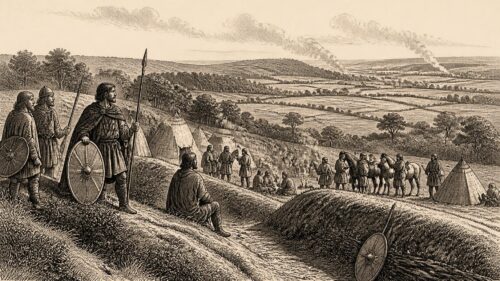
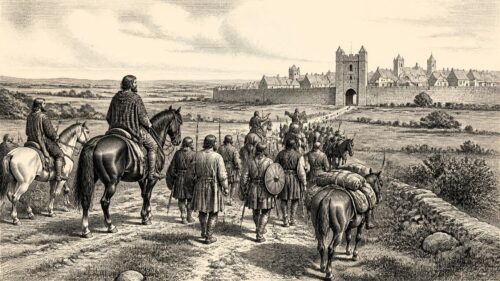
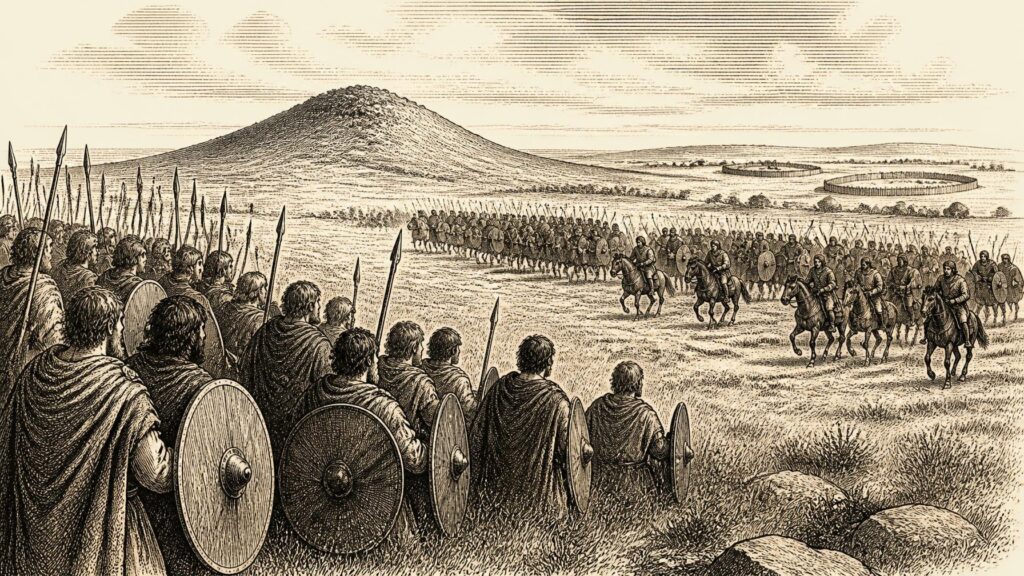
Almuin was the Hill of Allen, beside the Curragh in modern County Kildare. It was a place of older significance in Irish tradition and a strategically intelligible meeting ground: open country, major roads and the borderland between Leinster and the sphere in which Uí Néill power was asserted. The landscape should not be imagined as an empty plain. It was worked land threaded by settlements, enclosures, trackways, grazing and estates, with the movement of a large host placing immediate demands on food, fodder and local supplies.
The Annals of Tigernach call the contest a battle between Murchad, king of Leinster, and Fergal, king of Ireland. They then name Fergal and a formidable group of the dead: Forbasach, king of Cenél Bógaine; Conall Menn, king of Cenél Cairpre; figures from Airgialla and other northern peoples; and a number of southern Uí Néill rulers. This roll is one of the most revealing features of the entry. The loss was not merely that of a king and his household. It struck across the network of client-kings and allied dynasties on which his supremacy rested.
The same source says that 160 of Fergal’s companions died and gives a Leinster force of 9,000. A poem embedded in the annal speaks of 7,000 dead. Such numbers are best understood as literary and commemorative measures of overwhelming slaughter, not a modern muster roll. Yet the agreement of the traditions on the scale of disaster is meaningful. Fergal’s host was routed, and Leinster inflicted a defeat memorable enough to be retold for centuries.
Later accounts credit Murchad’s son Dúnchad with killing Fergal and add the south-Leinster ruler Áed son of Colcu among the victors. This may preserve authentic memories of important participants, but the precise attribution cannot be treated as firmly established. The secure point is that Fergal died at Almuin on 11 December 722, defeated by Leinstermen under Murchad’s leadership. A northern king who had recently extracted hostages from Leinster did not return from the province.
The Cost of a Failed Overlordship
For Leinster, victory did not create independence in any modern sense. The province remained divided among competing dynasties, and later kings of Tara could still intervene. But the battle stopped Fergal’s immediate project and demonstrated the limits of Uí Néill coercion. Murchad survived until 727, while his sons inherited both the prestige of Allen and the dangers of Leinster’s contested succession. The victory was therefore an achievement for a coalition, not the end of provincial rivalries.
For Cenél nÉogain, the consequences were immediate but not final. Fergal’s son Áed Allán succeeded within the northern dynasty and later became king of Tara. The family’s future prominence should not obscure the shock of 722. Fergal had drawn together northern, Airgialla and midland interests; Almuin removed him and many men whose local authority made that coalition possible. In the short term, the high-kingship passed not to his son but to Flaithbertach son of Loingsech of rival Cenél Conaill. The defeat thus sharpened competition within the wider Uí Néill world.
The campaign also illuminates everyday burdens that annals rarely spell out. Cattle were wealth, food, tribute and a means of rewarding followers. Hostages were living guarantees of political obedience. A king’s claim to superiority could bring requisitions, military service and danger to ordinary households whose grain, animals and labour sustained armies. None of the sources allows a precise reconstruction of what villagers near Almuin experienced in December 722. It is nevertheless clear that elite conflict rested upon resources gathered from rural communities and that an invading army made political failure materially costly.
Churches Across the Sea
722 was not only a year of war. On 21 April, according to the annalistic date, Máel Rubai died at Applecross in western Scotland, in his eightieth year. He was an Irish churchman of Cenél nÉogain background, trained at Bangor, whose monastery at Applecross had become a major centre of religious life among northern Pictish territories. His death belongs directly to Irish history because Irish ecclesiastical communities, kin connections and saints’ cults crossed the North Channel and the Hebridean sea-lanes. Applecross was not an Irish colony in a simple sense; it was part of a Gaelic-speaking religious world extending beyond the island.
The annals also state that Feidlimid “held the principality of Iona”. The phrase is tantalising. Iona’s leadership had experienced an unsettled succession in the years after Adomnán’s death, and recent scholarship stresses that Feidlimid’s precise status remains uncertain. It would be unsafe to declare him straightforwardly the sole abbot. Even so, the notice shows that authority within the Columban federation mattered enough to be recorded alongside royal deaths and battles. Iona’s influence linked Irish churches, Scottish communities, scholarship, manuscripts, pastoral care and aristocratic patronage.
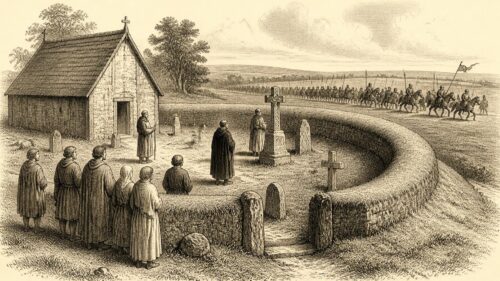
Several further ecclesiastical deaths were entered for 722, including clerics associated with Cell Delge, Devenish, Druim Cuilinn and Loch Gerg. Their brief notices are reminders that monasteries and churches formed a dense institutional landscape. They were places of worship, burial, hospitality, learning, landholding and writing. The annals themselves were sustained by such learned environments. Their attention remained overwhelmingly focused on kings, church leaders and major violence, but the survival of these entries demonstrates the social reach of ecclesiastical networks.
Beyond the Island
The death of Bile son of Elphin, king of Alt Clut, was also recorded. Alt Clut, centred on Dumbarton Rock, was a Brittonic kingdom across the Irish Sea world. Its inclusion does not prove a specific Irish intervention in its succession during 722. Rather, it confirms the breadth of the annalists’ horizon: Ireland’s political and ecclesiastical communities watched developments in western Britain, just as Irish-founded institutions such as Applecross and Iona connected people across the water.
Almuin consequently gives 722 its distinctive shape. It was a year in which a claim to island-wide supremacy met a determined provincial resistance; in which remembered tribute and immediate military power collided; and in which Irish religious life continued to stretch from local churches to the Scottish west. The battle’s later literary afterlife is important, but the underlying fact needs no embellishment. On a December Friday at Allen, Fergal’s campaign ended, and the political map of early medieval Ireland had to be renegotiated.
Primary Sources
- The Annals of Tigernach
- Part 722 of The Annals of Ulster
- Fragmentary Annals of Ireland, Part 9
- Fragmentary Annals of Ireland: Source Description
- Cath Almaine Sources
- Cath Almaine Text
- Fergal, Dictionary of Irish Biography
- Murchad, Dictionary of Irish Biography
- Dúnchad, Dictionary of Irish Biography
- Máel-rubai, Dictionary of Irish Biography
- Áed Allán, Dictionary of Irish Biography
- The Chronology and Sources of the Early Irish Annals
- Contested Succession at Iona (704–26)
- Early Mechanisms of Abbatial Succession: The Case of Iona (563–704)
- Bóroma: Extracts
- Bóroma Background Information
- Bóroma Sources
- The Leinster Tribute Feud
- The Battle of Allen in A Companion to Early Irish Saga
- Máel Ruba m Elganaig of Applecross
- Annals of the Four Masters, Part 55
- Annals of the Four Masters: File Description
- Irish Texts at CELT
- Exploring the Irish Annals