Feuds and Sanctuaries1041 CE
In 1041, Ireland remained politically fragmented despite Donnchad mac Briain’s claims to wider kingship. Leinster’s struggle between Murchad mac Dúnlainge and Uí Chennselaig brought raids, the death of Domnall Remur, Ferns’s burning, and Diarmait mac Maíl na mBó’s devastating retaliatory attack on Glenn Uisen. Rivalries also produced blinding, killings and sanctuary violations at Timahoe and Kildare, while assassinations, raids and battles disturbed Osraige, northern regions and Munster. Annals also record learned churchmen’s deaths, ecclesiastical organisation and church-building. Cattle raiding underpinned warfare and wealth, although farming, commerce and learning continued. The selective record portrays violence alongside resilient institutions, foreshadowing Diarmait’s dominance.
Dateline
The annalists who recorded 1041 opened with an unusually candid warning. Ireland’s events, they wrote, were too numerous—killings, deaths, raids and battles—for anyone to relate them all. What survives is therefore not a complete account of the year but a selection shaped by the interests of religious communities and learned compilers. Even so, the entries reveal a country in which provincial ambitions, local feuds and competition between royal lineages repeatedly spilled into ecclesiastical settlements.
A Divided Political Order
No ruler exercised undisputed authority throughout Ireland. Since the death of Máel Sechnaill mac Domnaill in 1022, the title and practical powers associated with the high-kingship had remained contested. Donnchad mac Briain, son of Brian Bóruma, ruled Munster and had claimed wider authority; an inscription commissioned for the shrine of the Stowe Missal styled him king of Ireland. His actual influence, however, depended upon alliances, hostages and military pressure, and varied considerably from region to region.
Donnchad’s effort to present himself as a Christian lawgiver belongs to the immediate background of the year. In 1040 he had issued an ordinance against theft, fighting and burdensome labour on Sundays. The measure was important enough for the Annals of Inisfallen to compare it with legislation attributed to the age of Patrick. Yet the violence recorded in 1041 demonstrates the limits of royal proclamations. Political power remained distributed among provincial kings, sub-kings, dynastic heirs, churches and local kindreds, each defending its own interests.
The Struggle for Leinster
The most consequential events occurred in Leinster. Its overkingship was disputed between Murchad mac Dúnlainge of the Uí Muiredaig branch of Uí Dúnlainge and the rising Uí Chennselaig dynasty represented by the brothers Domnall Remur and Diarmait mac Maíl na mBó. Their rivalry was not a simple provincial civil war: it drew in Osraige, Munster and several smaller Leinster peoples whose territories lay along strategically important roads and river valleys.
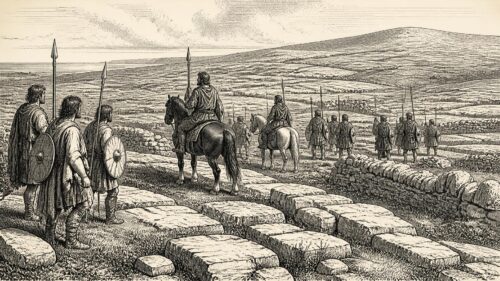
The annals place a Uí Chennselaig foray into Uí Bairrche in 1041. Murchad pursued the raiders and defeated them at Cell Mo Lapóic. Domnall Remur—Domnall “the Fat”—was killed with many of his followers. He was not merely another battlefield casualty. As an eligible successor to the Uí Chennselaig kingship and Diarmait’s brother, his death altered the dynasty’s leadership and gave Diarmait a personal as well as political reason to continue the struggle.
Murchad was supported by Donnchad mac Briain. The Annals of the Four Masters report that Ferns, an important Uí Chennselaig and ecclesiastical centre, was burned by Donnchad. Other annalistic evidence associates Murchad with the attack. Diarmait answered by striking at Glenn Uisen, now identified with Killeshin near Carlow, within Uí Bairrche territory. The settlement’s timber prayer-house or oak building was demolished, and the annals agree that about one hundred people were killed. They differ over the number and identity of those carried away—whether captives, cattle or both—so no single total should be treated as certain. The sources explicitly describe the attack as vengeance for Ferns and for Domnall Remur.
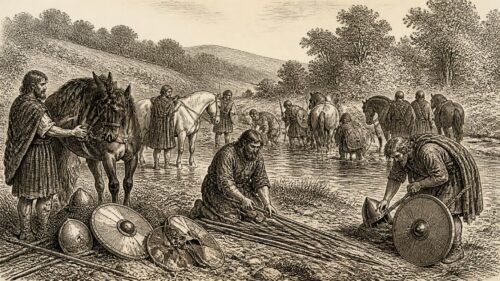
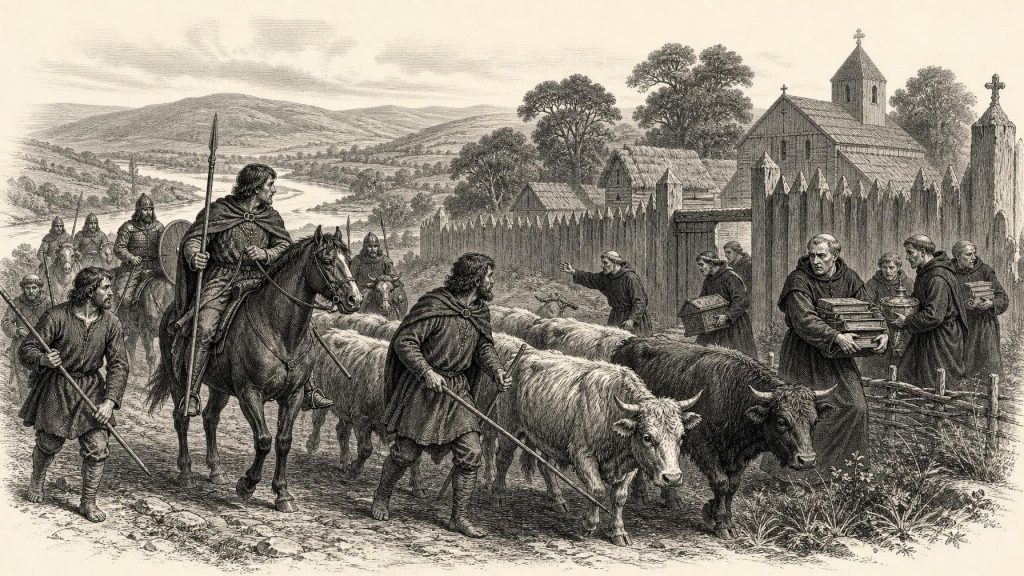
The destruction at Glenn Uisen shows how warfare was conducted. A raid could target livestock, inhabitants and buildings together, weakening an enemy’s resources while demonstrating that its protectors could not guarantee safety. Ecclesiastical settlements were not isolated from political society. They held land, cattle, food stores and valuables, sheltered dependants, and maintained close relationships with royal families. Consequently, attacking one could injure both a saint’s community and the dynasty associated with it.
Violence in Laois and Kildare
Other Leinster entries reveal similarly tangled contests. Fáelán Ua Mórda, king of Laois, was captured and blinded by Murchad mac Dúnlainge after first being delivered into his hands by Donnchad son of Áed. Blinding was a calculated political punishment: a serious physical blemish could disqualify a man from kingship while avoiding the immediate consequences of killing him.
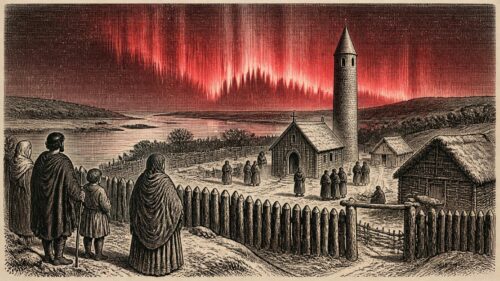
At the ecclesiastical settlement of Timahoe, identified in the annals as the house of Mochua son of Lonán, Cú Críche Ua Dúnlaing, another king of Laois, was killed with his son and his wife Cailleóc by a man called Mac Conáin. Mac Conáin was himself killed the following day by Ua Bróenáin. The annalist interpreted this swift retaliation as a miracle of Mochua. Such language expressed more than pious ornament: it asserted that violence within a saint’s precinct violated a sacred protection and would bring supernatural punishment.
Kildare, the great church associated with Brigit, also became a place of seizure and killing. Gilla Comgaill, a member of the extended Uí Dúnlainge royal family, was forcibly removed from Cell Dara and put to death. The Annals of Tigernach connect his fate with an earlier offence against Brigit’s successor, again presenting political vengeance as saintly justice. Two other dynasts, Donnchad and Glún Iarainn, were also killed at Kildare during the year. These episodes indicate that sanctuary remained a powerful ideal, but one rulers and armed kindreds were prepared to breach.
Osraige, the North and Munster
In Osraige, Muirchertach mac Gilla Pátraic, described as one of two kings, was treacherously killed by the Uí Chaellaide, people counted among his own political community. Osraige had recently reached exceptional power under Donnchad mac Gilla Pátraic, who had ruled much of Leinster before dying in 1039. Muirchertach’s assassination illustrates the instability that followed. The kingdom remained formidable, but its ruling house faced both internal division and continuing competition with Leinster dynasties.
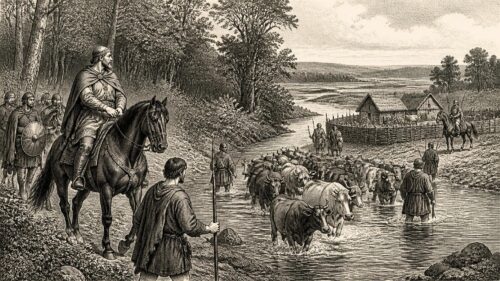
Northern Ireland was also marked by predatory campaigning. The Airgialla raided Conaille but were overtaken and defeated at Mag dá Chainnech. Elsewhere, a leader identified simply as Ua Néill entered Uí Echach Ulad and carried off a substantial prey. The wording emphasises livestock rather than territorial occupation. Raiding transferred wealth, punished resistance and tested claims of overlordship; it could also provoke the cycle of retaliation that dominates the year’s Leinster record.
The Annals of Inisfallen preserve a separate cluster of Munster events. Donnchad son of Muirchertach, king of Múscraige, died, while a battle among the Múscraige killed Muiredach son of Donnchad Ua hÁeda, a son of Cú Duilig and many others. Ua Ségda, king of Corcu Duibne in the south-west, was slain. These notices do not reveal a single coordinated rebellion against Donnchad mac Briain, but they show that rule over Munster did not eliminate disputes within its constituent kingdoms.
Churches and Learned Communities
Not every annalistic entry concerned warfare. Bethad son of Ainmire died in 1041. The Annals of Ulster call him chief ollam of Armagh and of Ireland, while Tigernach describes him as Armagh’s chief judge and “a flood of Ireland’s lore”. The variation reflects the overlapping worlds of poetry, history, law and ecclesiastical learning. An ollam was a scholar of the highest recognised grade, supported by patrons and entrusted with preserving knowledge central to institutional and dynastic prestige.
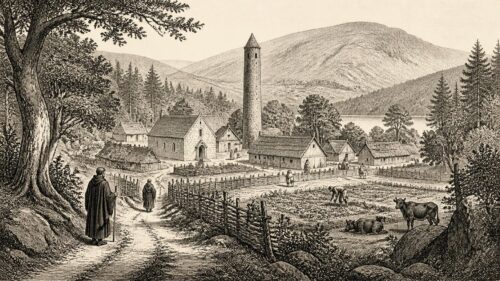
Several other learned churchmen died: Ua In Chánaige, lector of Armagh; Ua Taidc, lector of Kildare; Muiredach Ua Rebacháin, coarb of Mo Chutu; and Mac Laáin, coarb of Senán. A lector directed teaching and the study of texts, while a coarb claimed succession to a founding saint and normally controlled rights, lands and revenues attached to that saint’s community. Their recorded deaths are evidence of an active network of schools and hereditary ecclesiastical offices extending from Armagh and Kildare to Munster foundations.
A damaged entry in the Annals of Ulster states that a church at Clogher was built in honour of a saint, whose name is now lost from the text. The fragment cannot support a detailed reconstruction, but it provides a rare glimpse of building amid the year’s destruction. Timber churches and associated halls remained common, although stone construction was becoming increasingly visible at prosperous centres.
Livelihoods Behind the Raids
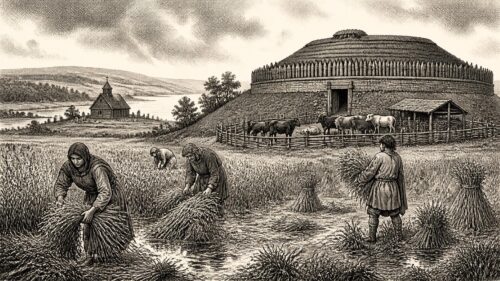
For most people, daily life centred on mixed farming, livestock and the obligations owed to local lords and churches. The repeated reference to “prey” chiefly means cattle, the most mobile and politically useful form of wealth. Herds supplied milk, meat, hides and status; they could be driven away rapidly and redistributed among warriors and supporters. Captives might also be taken for labour, ransom or enslavement. Crop cultivation, milling, woodland work and specialised crafts continued beyond the annalists’ view, except when armies burned fields or settlements.
Trade linked this rural economy to Dublin, Waterford, Limerick and other coastal centres. Dublin in particular remained a major manufacturing and commercial town with connections to Britain and continental Europe. No major Dublin event can be firmly assigned to 1041, so its role belongs to the year’s wider setting rather than its dated narrative. Silver, ornaments, pottery and other imports circulated alongside Irish agricultural produce, craftwork and human traffic.
The surviving record of 1041 is therefore one of fragmentation rather than general collapse. Kings continued to govern, churches taught students, craftspeople worked and communities farmed their land. Yet political competition repeatedly turned roads, cattle herds and religious enclosures into instruments or victims of war. Above all, Diarmait mac Maíl na mBó survived the death of his brother and the attack on Ferns. His response at Glenn Uisen foreshadowed the determination with which he would soon dominate Leinster and emerge as one of the most powerful Irish rulers of the eleventh century.
Primary Sources
- The Annals of Ulster: Year U1041
- The Annals of Ulster
- The Annals of Tigernach
- Annals of Inisfallen
- Chronicon Scotorum: Annal CS1041
- Chronicon Scotorum
- Annals of the Four Masters, Volume 2
- Annals of the Four Masters, Irish Text: Annal 1041
- Chronological Synchronisation of the Irish Annals
- The Chronology and Sources of the Early Irish Annals
- Domnall Remur
- Diarmait mac Maíl na mBó
- Murchad, Overking of Leinster
- Donnchad, Son of Brian
- Donnchad, King of Osraige and Leinster
- Ireland, Nationality and Kingship in the Eleventh and Twelfth Centuries
- Viking Collection
- National Museum of Ireland: Kildare Street Visitor Guide
- Timahoe Round Tower and Church
- High Crosses, c. 800–1150
- Aghadoe Monastic Site and Parkavonear Castle
- Clones Round Tower, Church and High Cross
- Killeshin and Other Sub-units of County Carlow
- Viking Ireland: Afterthoughts