The October Sea-Flood720 CE
In 720, Irish annals recorded a rainy summer, the death of Sínach of Inis Clothrann, and a great sea-flood in October. The wet season may have disrupted cereal growing, haymaking, travel and fodder supplies, although its effects varied by resources and status and cannot prove famine. Sínach’s obituary attests to an ecclesiastical community on Lough Ree, connected through the Shannon to estates, labour and exchange. Politically, the year lay between Fergal’s campaigns against Leinster, though no conflict is securely dated to it. The sea-flood, perhaps storm surge or tsunami, remains unlocated and unexplained, demonstrating environmental vulnerability and maritime connections alike.
Dateline
In 720 CE, Ireland’s annalists recorded three spare but striking notices: a rainy summer, the death of Sínach of Inis Clothrann, and a great sea-flood in October. None supplies the sort of detailed narrative that later historians might wish for. Yet together they bring the year into unusually sharp focus. They point to a wet agricultural season, to the continuing importance of an island church on Lough Ree, and to a maritime disturbance memorable enough to enter the shared annalistic record of Ireland and Iona. The evidence does not justify turning 720 into a year of general famine, nationwide devastation or political revolution. It does, however, show how weather, water, religious institutions and royal power met in the lived world of early medieval Ireland.
A Summer of Rain
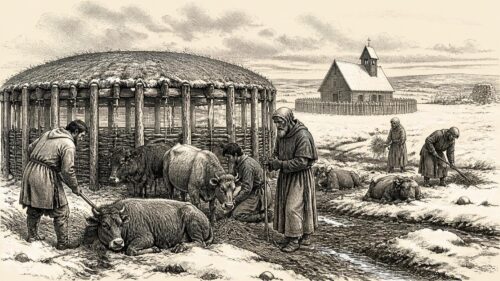
The most direct notice for the year is simply aestas pluvialis: “a rainy summer”. It is brief, but its preservation matters. Annalists did not normally note ordinary weather. A wet season had apparently become sufficiently exceptional, prolonged or consequential to deserve entry among deaths and political events. The phrase gives no indication of where in Ireland the rain was worst, whether it continued without interruption, or precisely what it did to crops and livestock. It therefore cannot be treated as proof of a failed harvest. Still, in a predominantly rural society, a notably wet summer was far from a trivial inconvenience.
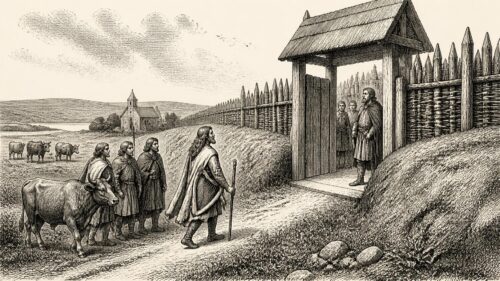
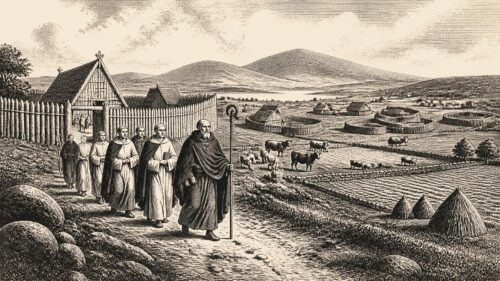
Most people lived in dispersed farming settlements: enclosed farmsteads, lakeside sites, crannógs and small clusters of buildings connected by tracks, waterways and seasonal routes. Cattle remained the chief store of movable wealth and a measure of status, but cereal cultivation was gaining greater prominence during the eighth century. Oats and barley were important crops, alongside wheat in suitable soils. Families had to manage grazing, dairying, ploughing, sowing, weeding, harvesting, drying grain, storing food and preparing winter fodder. Rain at the wrong time could flatten ripening cereals, delay haymaking, waterlog fields and complicate travel between settlements.
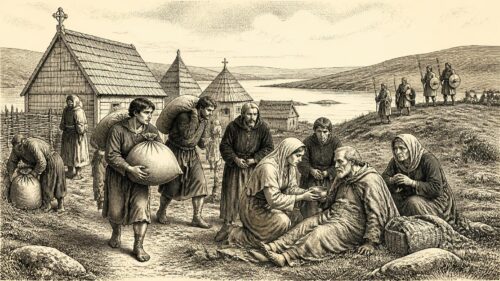
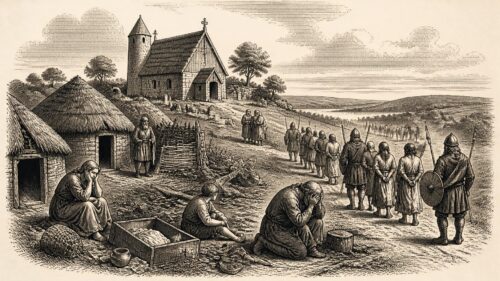
That does not mean that every household suffered equally. Well-drained land, access to labour, livestock holdings, stored grain and ties to powerful patrons could all soften hardship. Conversely, tenants, dependent cultivators and enslaved workers had fewer reserves when a season went badly. Early Irish legal material and archaeology alike reveal a society structured by rank, obligation and unequal access to land and cattle. The rainy summer of 720 should therefore be understood as a shared environmental condition with uneven human consequences, rather than as evidence for a single uniform Irish experience.
Sínach of Inis Clothrann
The annals also mark the death of Sínach of Inis Clothrann, usually identified with Inchcleraun, an island in Lough Ree on the Shannon. The formula says that he “fell asleep”, the conventional Christian language of an ecclesiastical obituary. It tells us neither his office nor his age, and it would be unsafe to call him an abbot without firmer evidence. A later compilation places his death on 20 April, but its chronology differs from the earlier annalistic tradition; the date of the day cannot responsibly be imposed upon 720. What is secure is that an ecclesiastic associated with Inis Clothrann was remembered in the record for this year.
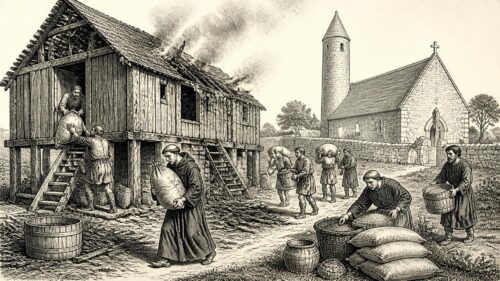
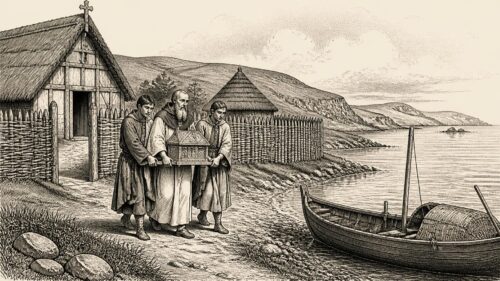
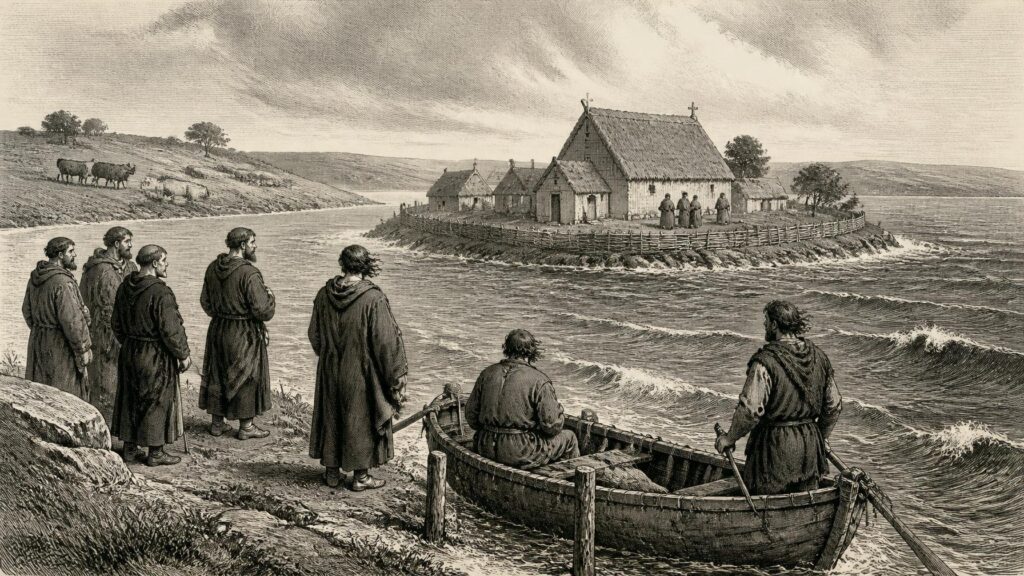
His notice illuminates the place of island churches within Ireland’s inland world. Lough Ree lay on the Shannon corridor, a major north–south route linking territories, churches and exchange networks. Islands offered a degree of separation and control, but they were not remote in the modern sense. Boats carried people, animals, food, timber, manuscripts, messengers and ecclesiastical visitors across lakes and along rivers. A religious settlement on an island depended on mainland estates and on the labour of surrounding communities; in return, it could offer worship, burial, learning, hospitality and a focus for local identity.
By 720, churches and monasteries were not detached refuges from secular life. They were landholders, employers, consumers and political partners. Their communities included clerics, students, craftspeople, tenants and dependants as well as those living a more strictly religious life. The scale of Sínach’s community cannot be recovered from his obituary, nor can its buildings be reconstructed for this particular year. Later surviving remains on Inchcleraun must not be projected straightforwardly backwards. Nevertheless, his death is a small but real sign of an ecclesiastical landscape in which important religious centres existed beyond the best-known houses of Armagh, Clonmacnoise, Kildare and Iona.
Royal Pressure Beyond the Entry
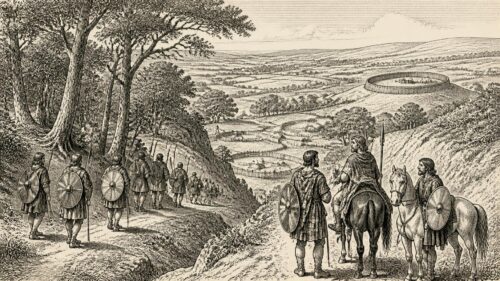
No battle, hosting or treaty is securely assigned by the principal annals to Ireland in 720 itself. This silence should not be mistaken for peace. The year fell amid fierce competition between provincial dynasties and among branches of the Uí Néill. Fergal son of Máel Dúin of Cenél nÉogain was king of Tara at this time, but “king of Ireland” in annalistic wording describes a claim to pre-eminence, not administration of a unified state. Authority was made and remade through personal alliances, military followings, hostage-taking, tribute, church connections and the ability to compel neighbouring rulers.
The immediate background was tense. In 719, the annals report repeated Uí Néill attacks upon Leinster, while Fergal’s contest with Leinster’s rulers formed part of his wider attempt to assert supremacy. Those raids belong to the previous year, not to 720, and should not be silently transferred across the calendar boundary. They nonetheless explain why the political atmosphere around 720 was fraught. In 721, according to the annals, Leinster would be ravaged again and hostages and cattle-tribute secured for Fergal; the disastrous battle of Allen, at which Fergal was killed, lay in 722. The quiet record for 720 stands between these clearly dated episodes.
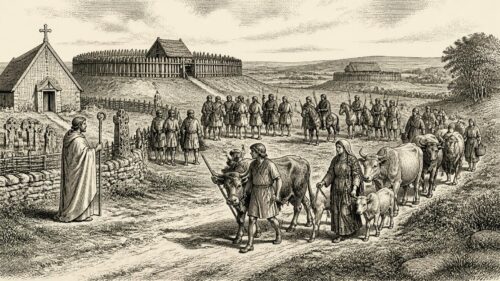
For ordinary communities, royal competition was experienced less through abstract ideas of sovereignty than through demands for food-renders, labour, lodging and military service. A king’s retinue had to be fed; cattle could be driven away as tribute or plunder; routes could be made unsafe when forces moved through them. A wet summer may have made those burdens more acute, but the sources do not state that it did so in 720. The responsible conclusion is narrower: environmental pressure and political pressure coexisted in a society whose resources were mobilised by kinship and lordship.
The Sea Breaks Forth
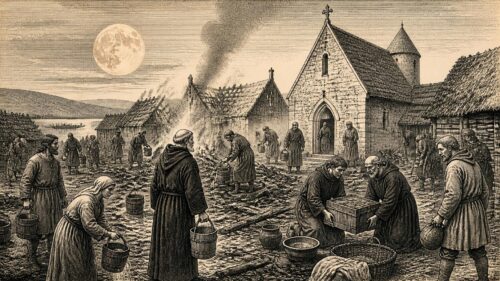
The most dramatic entry is the muirbrucht mór, a “great sea-flood” or violent bursting forth of the sea, recorded in October. The annals provide a month but no day, coast, death toll or description of damage. The word can suggest a sudden marine inundation, but it does not itself prove a tsunami. It could describe an extraordinary storm surge, severe coastal flooding, or another abrupt maritime event. The absence of a named Irish location is especially important: one cannot responsibly claim that a particular harbour, island or settlement was swept away.
Modern research has nevertheless treated the notice seriously. Because the relevant early annalistic material derives from a record associated with Iona, scholars have suggested that the October event may have been observed in the north-western Irish Sea world and have explored whether it could represent a seismic tsunami. This is a plausible research hypothesis, not an established identification. No confirmed Irish deposit has yet tied a tsunami conclusively to October 720, and the surviving annals preserve the event through later manuscript transmission. The safest wording remains that an exceptional sea disturbance was remembered in the Irish annalistic tradition.
Even without a fixed location, the entry reminds us that Ireland was never merely an inland island of petty kingdoms. Coasts, estuaries, sea-loughs and river mouths supported fishing, short-distance shipping, travel and contact with western Britain and the Hebrides. The sea brought opportunity as well as danger. Ireland’s religious, familial and political connections with Dál Riata and Iona made the waters between Ireland and Scotland a zone of routine communication. A startling maritime event in October would have mattered to sailors, fishing households, coastal farmers and religious communities alike, whether it was seen directly from an Irish shore or carried into Irish memory through those connected waters.
A Carefully Bounded Year
The evidence for 720 is thin, but it is not empty. The year can be placed securely within a period when Fergal’s northern Uí Néill kingship pressed hard upon Leinster, when churches helped organise the social and economic landscape, and when arable production was becoming more important alongside cattle-based wealth. Its firmly dated annalistic core is more modest: rain during the summer; the death of Sínach of Inis Clothrann; and a great sea-flood in October.
That modesty is valuable. It prevents later catastrophes from being pulled backwards into the year and prevents the sea-flood from acquiring imaginary victims and places. At the same time, it restores scale to the notices that survive. A wet growing season could affect the work of countless households. The death of one named churchman reveals a religious community embedded in the Shannon world. An unexplained surge of the sea shows that the natural environment could intrude suddenly upon Irish life and remain memorable for generations. In 720, the annals preserve not a grand national drama, but the weather, waters and institutions through which early medieval Ireland endured.
Primary Sources
- The Annals of Ulster
- TEI Header for The Annals of Ulster
- The Annals of Tigernach
- Part 12 of The Annals of Tigernach
- Chronicon Scotorum
- CELT Project: Chronicon Scotorum
- The Annals of the Four Masters
- Part 55 of Annals of the Four Masters
- A Seismic Tsunami in the Irish Annals, Recorded at Iona in October 720
- A Seismic Tsunami in the Irish Annals, Recorded at Iona in October 720
- Fergal
- Agriculture, Settlement and Society in Early Medieval Ireland
- The Archaeology of Livestock and Cereal Production in Early Medieval Ireland, AD 400–1100
- Early Medieval Farming and Food Production: A Review of the Archaeobotanical Evidence from Archaeological Excavations in Ireland
- Early Medieval Dwellings and Settlements in Ireland, AD 400–1100, Vol. 1: Text
- Early Medieval Ireland: Archaeological Excavations, 1930–2009
- Legal Position and Living Conditions of Peasants and Commoners in Early Medieval Ireland, c.680–c.1170
- Marriage in Early Ireland
- Women and the Law in Early Ireland
- Module 1: Transformation from Pre-Norman Monasticism to the Introduction of the Religious Orders into Ireland in the Twelfth Century
- Island Archaeology of the Early Medieval Irish Church
- Land Tenure and Farming in Early Medieval Kerry: A Survey of Field Systems in the Lough Currane Basin