Cellach Cualann’s Succession715 CE
In 715, annalistic notices, dated by modern synchronisation despite displacement in the Annals of Ulster, record political and ecclesiastical change across Ireland. Cellach Cualann’s death ended Uí Máil dominance in Leinster and enabled the rising Uí Dúnlainge, represented by Murchad son of Bran. Murchad’s hosting to Cashel demonstrated Leinster’s ability to project force into Munster, although no outcome is recorded. Murchad son of Diarmait, a Uí Néill king, was killed amid midland rivalry. Deaths of Armagh’s abbot Flann Febla, Ferns’s Bishop Cilléne, King Áed Dub, and the learned Flaithnia marked leadership losses, while rural agricultural society sustained these power networks.
Dateline
In 715 CE, Ireland’s annals place a cluster of deaths, a killing and a military expedition within a single politically consequential year. The evidence is concise rather than narrative: it does not supply speeches, motives, battle plans or a complete sequence of events. Yet the recorded death of Cellach Cualann, overking of Leinster, and the hosting of Murchad son of Bran to Cashel together mark a visible transfer of influence in the east and a new assertion of Leinster’s reach towards Munster. Other notices register the loss of kings, churchmen and a named learned man, reminding us that changes in power were felt across secular and ecclesiastical communities alike.
Dating a Sparse Record
The annalistic evidence needs handling with care. In the surviving Annals of Ulster, the entries appear under the annal-number U715 but carry an internal AD 714 heading, a result of chronological displacement in that text. The parallel Annals of Tigernach place the same notices in their 715 section, and modern synchronisation of the Irish annals assigns this group of events to 715 CE. That conclusion permits a responsible year-by-year account, but not false precision: none of the Irish deaths or the hosting is assigned a month or day. The sources record that these things occurred in the year, not when within it they happened.
The notices are characteristic of early Irish annals. They privilege kings, abbots, bishops and exceptional persons; they name a military movement without explaining its result; and they say little directly about cultivators, craftspeople, women, dependants or the material effects of a change in rulership. Reading them alongside archaeology and later historical analysis can restore some setting, but the distinction matters. The events below are firmly attached to 715; the wider descriptions of settlements, churches and political practice provide context rather than additional events.
The Death of Leinster’s Overking
The year’s most important recorded death was that of Cellach Cualann, king of Leinster. Cellach belonged to the Uí Máil, a dynasty associated with Cualu, the district around the later Glendalough and Bray area, and with the Glen of Imaal west of the Wicklow Mountains. He had ruled Leinster from the 690s and was the last member of Uí Máil to hold the provincial overkingship. His death therefore mattered beyond his own locality: it removed a ruler whose standing rested on dynastic ties, military capacity and the ability to command or negotiate with other Leinster peoples.
Cellach’s Leinster had not been a settled kingdom in the modern sense. Provincial kingship was an overlordship over numerous smaller peoples and rival dynasties, each with its own territory, churches and armed following. Cellach had previously faced pressure from southern Uí Néill interests to the north and rivalry within Leinster itself. His death in 715 did not mechanically hand power to a single heir. It opened an opportunity for competing lineages, above all the Uí Dúnlainge, whose later dominance of Leinster would endure for centuries. Thus an obituary entry records a structural political turning point: the end of Uí Máil’s provincial ascendancy.
Murchad son of Bran, of the Uí Dúnlainge, was well placed to profit. He was the son of Bran Mút, Cellach’s predecessor as king of Leinster, and was connected to Cellach’s household by marriage. Modern biographical work judges that Murchad cannot have claimed Leinster’s overkingship before 715. This is a reason to see the year not simply as one ruler’s death, but as a contested succession in which an established eastern dynasty regained the initiative. The sources do not describe an inauguration, a council or a battle for the kingship, so none should be invented; the political shift is inferred from the conjunction of Cellach’s death and Murchad’s subsequent prominence.
A Hosting to Cashel
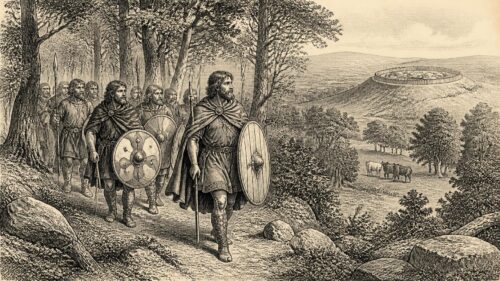
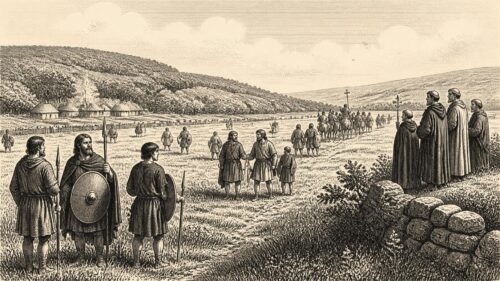
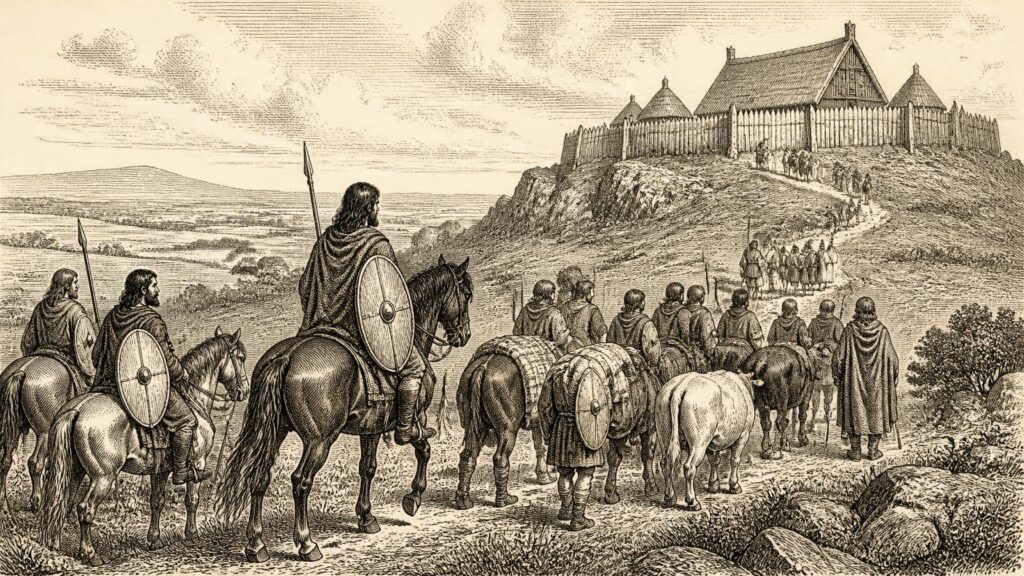
The annals’ only explicit military movement for the year is equally revealing: “the hosting by Murchad son of Bran to Cashel”. A hosting was the mobilisation and movement of an armed following, not necessarily a pitched battle. The entry does not say that Cashel was stormed, burned, occupied or forced to submit. It should therefore be understood as evidence of a Leinster expedition into Munster, and of Murchad’s capacity to gather men and project power, rather than as proof of a particular victory.
Its destination nevertheless carried weight. Cashel was a major royal centre in Munster, bound up with the authority of Munster’s Eóganacht dynasties. To lead a hosting there in the same year that Cellach died was an emphatic act. It may have advertised Murchad’s claim to lead Leinster, tested conditions in Munster, sought tribute or settlement, or pursued a more immediate quarrel now lost to the record. What can be said securely is narrower and more useful: in 715, a Leinster ruler made a military demonstration at one of the island’s principal royal places. The episode shows that provincial politics were not confined within provincial borders.
It also cautions against imagining a unified Ireland directed from one centre. Fergal son of Máel-dúin of Cenél nÉogain was then the leading Uí Néill king at Tara, while southern Uí Néill branches remained important in Brega and Mide. Munster, Leinster, Connacht, Ulaid and northern dynasties each contained further layers of competition. Kingship depended on personal relationships, hostage-taking, clientship, ecclesiastical patronage and the readiness to assemble a force. Murchad’s march towards Cashel was a practical expression of that political world.
Violence and the Uí Néill
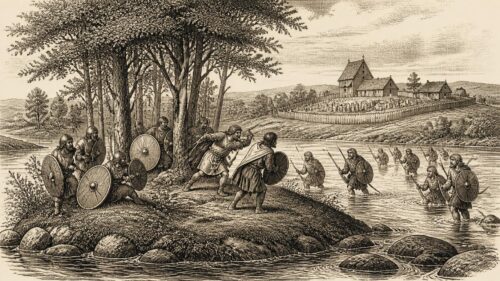
Another entry records the killing of Murchad son of Diarmait son of Airmedach Cáech, styled king of the Uí Néill. The Annals of Tigernach name his killer as Conall Grant grandson of Cernach. Later annalistic tradition identifies the victim more specifically with Clann Cholmáin, a powerful southern Uí Néill lineage based in the midlands. The title used in the nearer annal is itself important: it signals high rank within the broad Uí Néill political order, though it should not be casually converted into an uncomplicated, island-wide “high kingship”.
This killing demonstrates how fragile elite authority could be. Political competition did not only occur in formal battles between provinces. It could take the form of targeted slaying among rival kin-groups, with repercussions for clients, church allies and territories dependent on the dead ruler’s protection. There is no warrant for reconstructing the location or circumstances of Murchad’s death in 715. Still, its recording beside Leinster’s succession makes clear that the island’s central and eastern political landscape was unsettled at several levels at once.
Churches, Learning and Commemoration
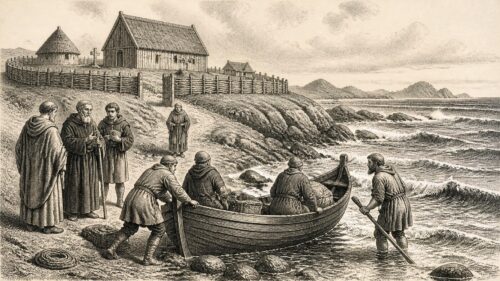
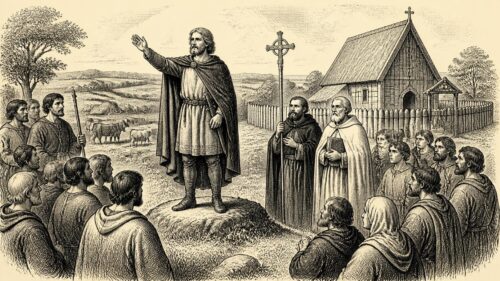
The same annal records the deaths of Flann Febla son of Scannlán, abbot of Armagh, and Bishop Cilléne, abbot of Ferns. Their paired commemoration is a reminder that major Irish churches were not detached from public life. Armagh, associated with Patrick, was an increasingly important ecclesiastical centre in the north; Ferns was a significant Leinster church. The titles “abbot” and “bishop” could overlap with roles of pastoral leadership, estate management, learning, diplomacy and representation for a religious community. Flann Febla’s death ended a long tenure traditionally dated from 688 to 715.
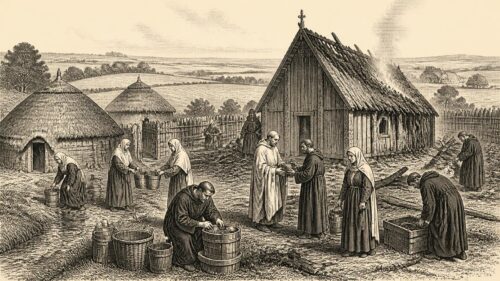
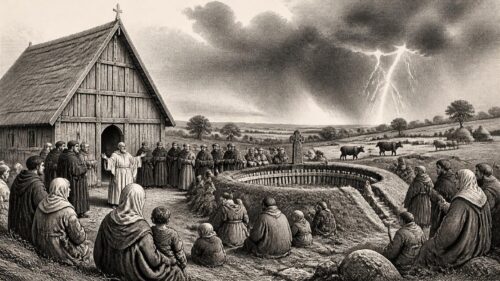
The notice of Cilléne also shows the reach of ecclesiastical organisation across Leinster at the moment its kingship changed hands. Churches drew support from land, labour, food renders and the patronage of local elites. Their communities included clerics and students but also workers, dependants and visitors. Archaeology confirms that early medieval ecclesiastical sites could be centres of habitation, farming, craft activity and ritual, not isolated stone-built monasteries of later imagination. In 715, the succession of leaders at Armagh and Ferns would have involved communities with real local resources and networks.
Two further deaths sharpen the point. Áed Dub, king of Uí Fhidgeinte in western Munster, died, while Flaithnia son of Colgu is called in sapiens, “the learned” or “the wise”. The annals give no surviving work by Flaithnia and do not define his office. Even so, the deliberate distinction is evidence that learning was a recognised form of status worth recording alongside kings and church heads. Latin literacy, Irish learning, genealogical knowledge, legal expertise and the calculation of the Christian calendar all had political as well as devotional value in this period.
Life Beyond the Notices
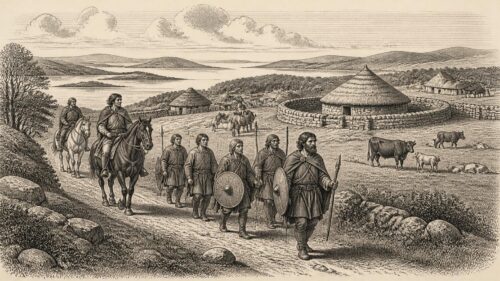
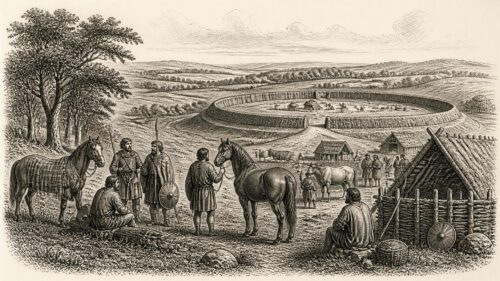
Nothing in the annals identifies a harvest failure, epidemic or climatic emergency specifically in 715 CE. It would be irresponsible to supply one merely because early medieval people were vulnerable to them. Most inhabitants instead lived in dispersed rural communities, often centred on enclosed farmsteads and linked to local churches and royal estates. Cattle were fundamental to food, dairying, status and exchange, while cereals also mattered greatly: archaeological evidence for corn-drying kilns, mills and pre-Viking plough technology confirms intensive work in the agrarian economy. Seasonal farming and animal care remained the foundation beneath the year’s recorded politics.
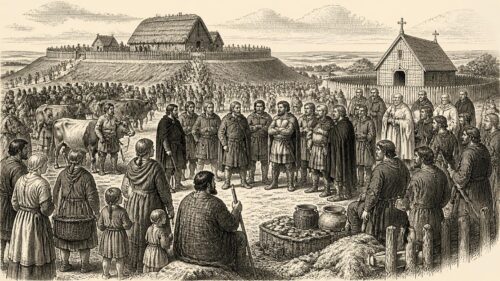
For ordinary households, the deaths of distant rulers may have mattered chiefly when they altered demands for food-renders, labour, military service or protection. A hosting such as Murchad’s required provisioning as well as armed men: cattle, grain, dairy produce, horses and skilled followers moved through networks controlled by households and local lords. Yet no source allows the numbers, route or burden of the Cashel expedition to be calculated. The responsible conclusion is that 715 reveals the uppermost layer of Irish society while pointing towards the agricultural and ecclesiastical systems that sustained it.
By year’s end, the immediate record leaves Ireland neither conquered nor transformed by a single decisive battle. Rather, it shows a redistribution of authority. Cellach Cualann’s death closed the era of Uí Máil leadership in Leinster; Murchad’s hosting to Cashel displayed Uí Dúnlainge ambition; the killing of a Uí Néill king exposed continuing rivalry in the midlands; and the deaths of Armagh’s abbot and Ferns’s bishop created ecclesiastical successions of their own. In a sparse but unusually concentrated annalistic year, politics, church leadership and learning were all visibly in motion.
Primary Sources
- The Annals of Ulster, Year U715
- The Annals of Tigernach
- CELT Project: The Annals of Tigernach
- Chronological Synchronisation of the Irish Annals, AD 488–722
- Annals of the Four Masters
- CELT Project: Annals of the Four Masters
- Annals of Inisfallen
- Chronicon Scotorum
- CELT Project: The Annals of Ulster
- Cellach Cualann
- Murchad
- Fergal
- Cathal
- Former Archbishops of Armagh
- Book V, Chapter 22: Bede’s Ecclesiastical History of the English People
- Easter Cycles and the Equinox in the British Isles
- How the Irish Helped to Work Out the Correct Way of Dating Easter
- How Did Early Church Sites Differ from One Another? A Comparative Approach within the Kingdom of Fir Maige, Ireland
- Theme and Variations: Christianity and Regional Landscapes in Early Medieval Ireland
- Technological Change in the Agrarian Economy of Early Medieval Ireland: New Archaeological Evidence for the Introduction of the Coulter Plough
- Water-Power as a Factor of Industrial Location in Early Medieval Ireland: The Environment of the Early Irish Water Mill
- Animals and the Economy of Medieval Ireland: A Zooarchaeological Analysis of the Faunal Remains from Caherconnell Cashel, Co Clare
- Conversion and Consolidation in Leinster’s Royal Heartland
- The Cambridge History of Ireland