Bangor Abbots667 CE
In 667, Ireland remained affected by the great mortality first recorded in 664. Annals associate the year with the deaths of four Bangor abbots, showing the epidemic’s impact on major religious institutions, though its nature and scale remain uncertain. Regional conflict continued: Eógan son of Crunnmael died at Áine, Bran Finn of the Déisi was slain, and the contested battle of Fertas belonged to the same period. Bishop Colmán, leaving Northumbria after Whitby, founded a church on Inishbofin with relics and monks. These events reflect a politically fragmented Ireland linked by active ecclesiastical and maritime networks.
Dateline
In 667 CE, Ireland was still living through the human consequences of a great mortality that had begun several years earlier. The clearest annalistic entry assigned to this year records a plague in which four abbots of Bangor—Berach, Cuimíne, Colum and Aedán—died. It also records fighting at Áine between the Araid and the Uí Fhidgeinti, in which Eógan son of Crunnmael was killed, and the slaying of Bran Finn, king of the Déisi of Munster. These brief notices are unusually revealing: disease could strike centres of authority as well as households; local warfare continued amid loss; and Ireland remained a landscape of many competing kingdoms rather than a unified state.
Dating a Difficult Year
The year must be handled with care. Irish annals are indispensable, but their surviving manuscripts were compiled later and their calendars do not always align neatly. Chronicon Scotorum and the Annals of Tigernach place the deaths at Bangor and the battle of Áine under 667. The Annals of Ulster, whose editorially restored chronology labels one heading as AD 667, instead place the continuing great plague, the battle of Fertas and Bishop Colmán’s voyage to Inis Bó Finne in that year. Other annal collections assign some of the same events to 665, 666 or 668. The secure conclusion is not that every notice happened on a precisely known modern date, but that 667 belongs to a tightly documented sequence of plague, warfare and ecclesiastical movement in the later 660s.
This distinction matters particularly for the epidemic. The annals describe it as mortalitas, a mortality or plague, and elsewhere call the wider outbreak buide Chonaill, usually rendered “Conall’s yellow plague”. The phrase preserves an early medieval name, not a medical diagnosis. Modern scholars debate how far the evidence may be connected with wider sixth- and seventh-century plague outbreaks, but the Irish record does not supply symptoms, transmission routes or reliable death totals. What can responsibly be said is that this was no isolated local illness. It had been recorded in Ireland from 664, took kings, abbots and learned churchmen, and was still important enough to frame the annals’ view of 667.
Loss at Bangor
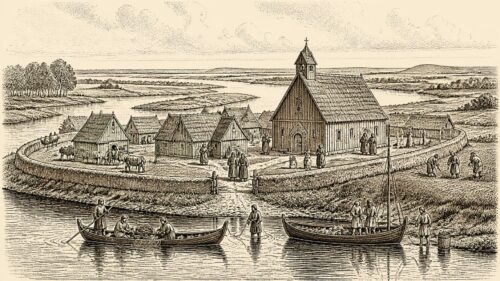
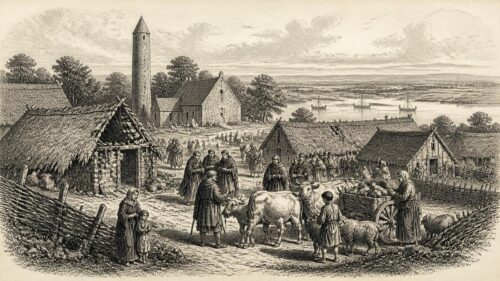
The deaths of Berach, Cuimíne, Colum and Aedán give the year its sharpest Irish focus. Bangor, on the southern shore of Belfast Lough in what is now County Down, was already a major monastery. It was part of a dense northern ecclesiastical world linking churches, kin-groups, minor kingdoms and sea routes across the Irish Sea. An abbot was not simply a secluded spiritual superior. He could be a manager of land, food supplies and dependants; a guardian of a saint’s cult and relics; a patron of worship, teaching and writing; and a figure through whom powerful families negotiated influence.
The annal does not explain whether the four men were simultaneously leading separate communities connected with Bangor, or whether the formula compresses a sequence of losses within its ecclesiastical network. Nor does it tell us how the community reorganised itself. Those silences are important. Four named abbots were memorable because their deaths were exceptional losses of leadership, but unnamed monks, tenants, labourers, children and neighbouring families may also have been affected in large numbers. The record allows no total. It does, however, show that the epidemic reached an institution capable of preserving the names of its dead.
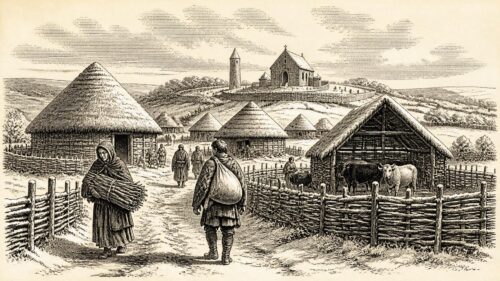
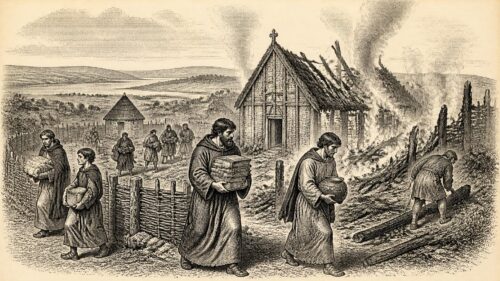
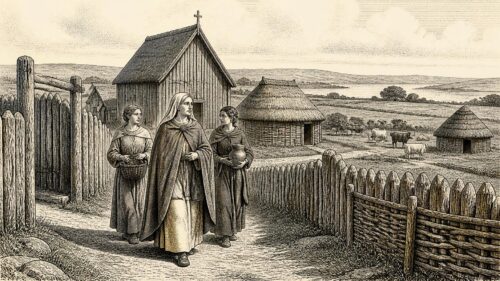
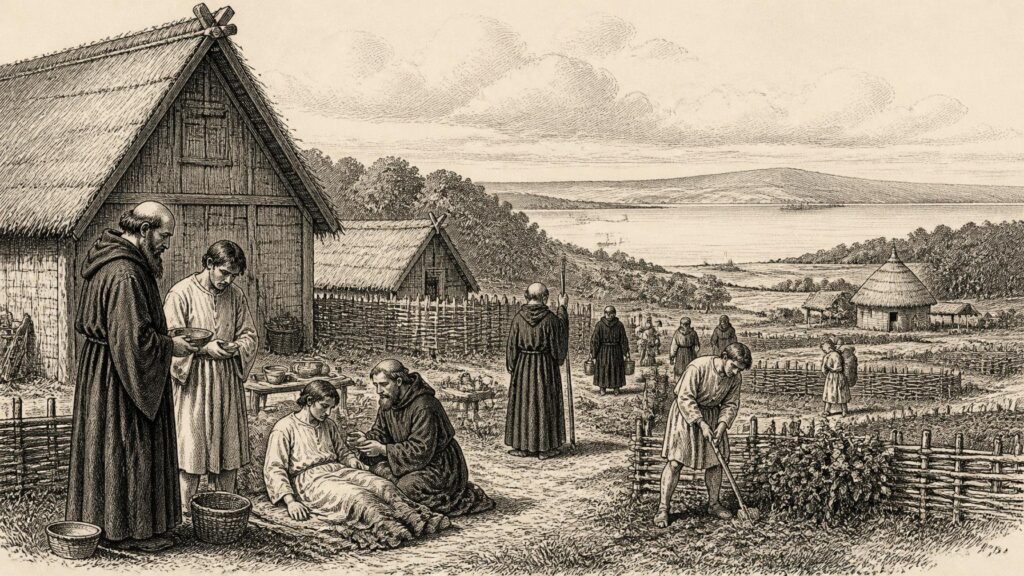
For Bangor’s inhabitants, illness would have endangered more than liturgical routine. A monastic settlement depended on people who worked fields, tended livestock, milled or dried grain, cooked, repaired timber buildings, maintained boats and supplied its guests. The archaeology of early medieval Ireland shows a strongly managed rural economy of enclosed farmsteads, livestock pens, crop fields, cereal-drying kilns and, from the beginning of the seventh century, watermills. Monasteries participated in that same productive landscape while organising it on a larger scale. There is no evidence for a particular harvest failure in 667, and it would be wrong to invent one; nevertheless, sustained mortality among workers and leaders alike could make ordinary provisioning and pastoral care more difficult.
Conflict at Áine
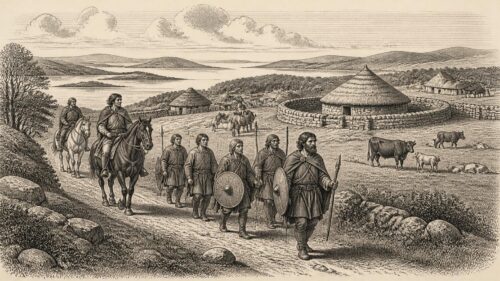
The battle of Áine demonstrates that plague had not suspended political competition. The annal says that the Araid fought the Uí Fhidgeinti and that Eógan son of Crunnmael fell. The Uí Fhidgeinti were an important people of northern Munster, associated broadly with parts of later County Limerick and adjoining districts. “Araid” is a difficult name in this context, and the terse entry does not establish the size of either force, the exact site of Áine, the cause of war, or which side won. Eógan’s death is the one firm outcome.
Even that limited report is significant. Early Irish kingship was layered: rulers held authority over relatively small peoples and territories, while stronger dynasties pursued wider overlordship through alliances, clientship, tribute, marriage and armed expeditions. Battles in the annals frequently record the death of a king or noble rather than a territorial settlement, because the removal of a leading man could itself alter local power. Áine should therefore not be inflated into a national campaign. It was a regional clash, but one occurring in a world where local outcomes shaped the balance among Munster’s numerous political communities.
The same year’s notice of Bran Finn, king of the Déisi of Munster, being slain reinforces that point. The Déisi were another Munster people, not an abstract province. The annal gives neither assailant nor location. It cannot prove that Bran Finn’s death was connected with Áine, and the two notices should not be joined into a single war merely because they stand under one annual heading. Together, however, they reveal a political order in which rulers remained vulnerable to violent removal even as disease weakened communities around them.
Ulster’s Contested Shore
A related event is conventionally placed in AD 667 by the restored chronology of the Annals of Ulster: the battle of Fertas between the Ulaid and the Cruithin, in which Cathasach son of Luirgéne fell. Other chronicles place it earlier, so its exact calendar position remains uncertain. Its setting was probably near modern Belfast, at or near a crossing associated with the River Farset and the Lagan. The parties were not modern ethnic nations. “Ulaid” here is generally understood as the Dál Fiatach-led interest, while the Cruithin included their powerful rivals, the Dál nAraide.
Whether fought in 665, 666 or 667, Fertas belongs to the immediate circumstances of 667 and helps explain the pressure on northern Ireland. Control of a ford or estuarine passage mattered for movement, local exchange and military access. Cathasach’s death was a gain for the opposing Ulaid interest, but it did not resolve the wider rivalry. Northern politics continued to turn on shifting dominance among dynasties that shared the same region, ecclesiastical connections and maritime horizons.
Colmán and the Western Sea
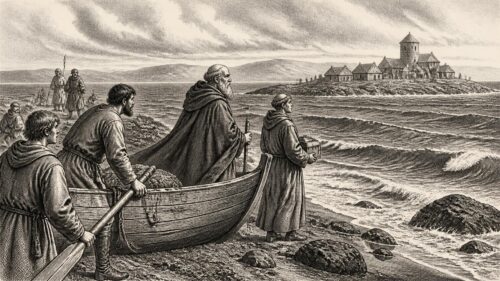
Another development firmly connected with this year is Bishop Colmán’s return to Ireland after the Synod of Whitby. Bede dates his settlement on Inis Bó Finne, Inishbofin off the coast of present-day County Galway, to 667; the Irish annals place the voyage under a neighbouring chronological heading. Colmán had been bishop of Lindisfarne and had defended the Iona-based Easter calculation at Whitby in 664. After the Northumbrian king accepted the Roman calculation, he left Britain, first returning to Iona and then crossing to the small Atlantic island west of Connacht.
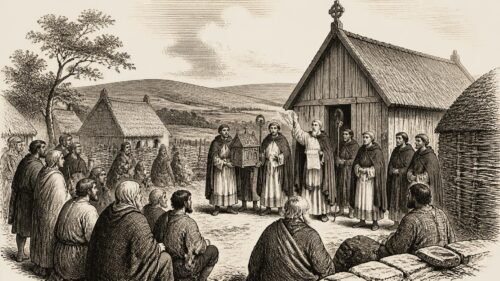
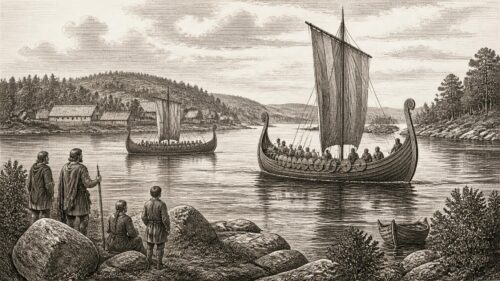
The annal’s wording is vivid: Colmán travelled “with the relics of the saints” and founded a church on Inis Bó Finne. Bede adds that he brought Irish monks from Lindisfarne and about thirty English monks trained in monastic life. This was not a flight from an isolated island to an isolated island. It was a movement through an Irish Sea religious network linking Northumbria, Iona, Connacht and the western seaways. Relics gave continuity and sacred authority to a transplanted community; trained monks carried habits of worship, learning and labour. The later foundation of Mayo for Colmán’s English followers lay ahead, not in 667 itself, but the Inishbofin settlement was its necessary beginning.
The Annals of Ulster also mention the voyage of the sons of Gartnait to Ireland with the people of Scí. The identities and circumstances are too obscure for confident reconstruction, but the entry confirms that Colmán’s crossing was not an exceptional breach of the sea. People, religious personnel, kin-groups and political refugees moved between Ireland and Britain. Sea travel was risky and weather-dependent, yet western and northern waters were routes of connection rather than hard frontiers.
A Kingdom Without a Single Centre
At the wider political level, Sechnassach son of Blathmac was ruling after the plague deaths of his father Blathmac and his uncle Diarmait in 665. Later tradition called rulers such as Sechnassach kings of Tara or kings of Ireland, but such language must not obscure the limits of their reach. His dynasty, Síl nÁedo Sláine of the southern Uí Néill, was prominent in Brega and the midlands. Yet the events linked with 667 occurred in Bangor, Fertas, Áine, Munster and Inishbofin without any annalistic indication that Sechnassach directed them. Ireland’s political reality was plural: ambitious overkings operated amid resilient provincial and local powers.
Thus 667 is best seen neither as a blank between better-known reigns nor as a year of a single decisive event. Its surviving record captures a society under strain but still active. Bangor lost four remembered abbots. A plague remained an organising fact of public memory. Kings and warriors died in regional conflicts. A displaced bishop founded a new Atlantic monastery, carrying relics and a mixed community across the sea. The evidence is fragmentary, but its pattern is clear: Ireland’s religious institutions, rural economies and rival kingdoms endured the epidemic’s pressure while continuing to reshape one another.
Primary Sources
- The Annals of Ulster
- Part 238 of The Annals of Ulster
- The Annals of Tigernach
- Chronicon Scotorum
- Part 64 of Chronicon Scotorum
- Part 64 of Chronicon Scotorum: Latin Text
- Part 49 of Annals of the Four Masters
- Part 3 of Fragmentary Annals of Ireland
- Ecclesiastical History of the English Nation, Book IV
- The Complete Works of Venerable Bede, Volume III
- Colmán
- Blathmac
- Blathmac
- Exploring the Irish Annals
- Chronological Synchronisation of the Irish Annals
- Early Medieval Dwellings and Settlements in Ireland, AD 400-1100: Vol. 1 Text
- The Archaeology of Livestock and Cereal Production in Early Medieval Ireland, AD 400-1100
- The Economy of Early Medieval Ireland
- The Plague and Its Consequences in Ireland
- Ireland in the Seventh Century: A Tour
- The Vikings in Ulaid
- Early Christian Saints of Inishbofin
- Saints in Scottish Place-Names: Colmán of Inis Bó Finne
- The Identification of Some Pestilences Recorded in the Irish Annals