Dairy Expansion
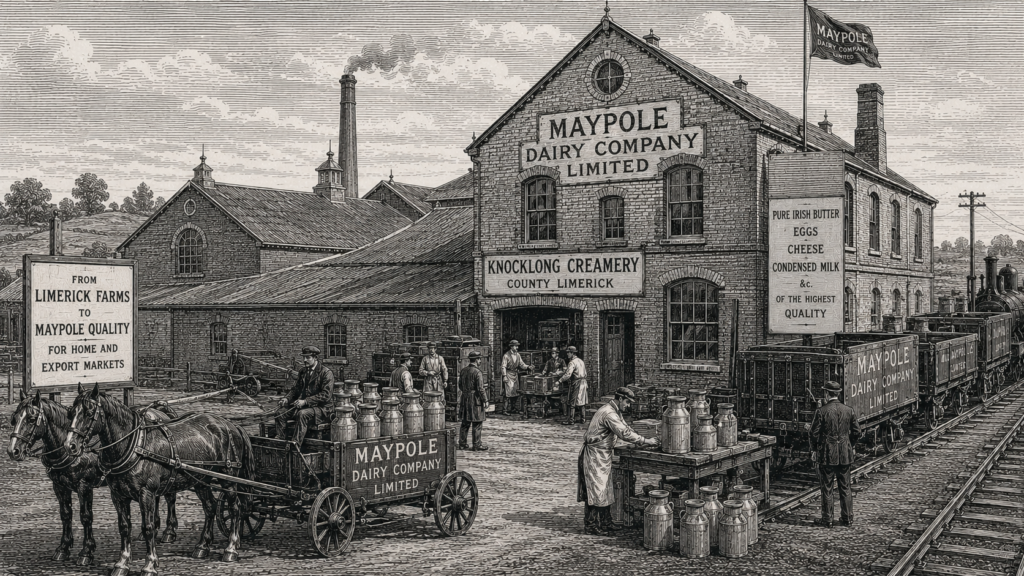
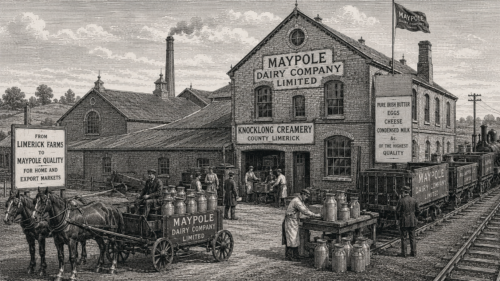
County Limerick’s dairy economy was changing rapidly around 1900 as the Maypole Dairy Company strengthened the connection between rural milk production and large-scale commercial retailing. At Knocklong, where the company had built a creamery during the mid-1890s, farmers delivered milk for mechanical separation and butter-making rather than producing every finished article within their own homes. The operation linked surrounding farms with a business selling provisions across Britain. For local suppliers, the creamery offered regular access to a wider market, while the company gained a dependable source of Irish butter for an expanding network of urban shops.
The Maypole enterprise had grown from the Watson family’s provision trade and became closely associated with affordable butter, margarine, tea, eggs and condensed milk. In 1898, the Maypole and Medova businesses were combined within a public company under the chairmanship of William George Watson. At that stage, the enlarged concern controlled 185 shops and seventeen creameries or butter factories in Britain and Ireland. County Limerick therefore formed part of a substantial commercial system in which rural production, central management and multiple-shop retailing were organised together to supply large numbers of working-class customers.
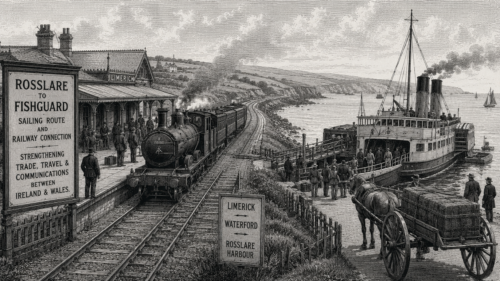
Knocklong’s creamery depended upon the daily labour of farmers, carters and factory employees. Milk had to reach the premises promptly, be tested and separated, and then be churned under controlled conditions before the butter was packed for transport. Creamery production encouraged greater uniformity than traditional household methods because milk from numerous farms could be processed with common machinery and supervision. Rail and road connections then allowed the finished produce to move beyond the district. A County Limerick farming community was consequently drawn into a chain extending from the cowshed and milk cart to provision counters in British towns.
Cleanliness and consistency became central to the Maypole company’s public identity. Its commercial success depended upon persuading customers that produce sold through hundreds of branches would possess a dependable standard regardless of where it had been made or purchased. This reputation required orderly factories, careful handling, suitable storage and disciplined retail service. Such claims should not be mistaken for proof that every creamery always achieved ideal conditions, but they reveal the standards the company wished customers and suppliers to associate with its name. Quality became both a practical requirement and a powerful form of advertising.
The growth of Maypole’s Limerick operations also reflected a wider contest over the organisation of Irish dairying. Proprietary companies purchased milk and controlled processing facilities, while emerging co-operative creameries sought to place ownership and profits in the hands of supplying farmers. Knocklong’s Maypole creamery belonged to the private corporate model and connected local agriculture to decisions made beyond the county. Its presence nevertheless provided employment, encouraged industrial butter production and demonstrated the increasing importance of machinery, transport and distant markets. By 1900, dairy farming in Limerick was becoming inseparable from the expanding commercial networks that carried Irish produce abroad.
- Mary O’Riordan, Butter: The Cream of County Limerick, Limerick City and County Council, p. 26; records that the Maypole Dairy Company built Knocklong Creamery around 1894–95 and that Cleeve’s purchased it in 1908.
- British Newspaper Archive, indexed contemporary report headed “Meeting at Knocklong,” concerning farmers supplying the Maypole Dairy Company’s factories; newspaper title and exact publication date remain unconfirmed in the available index.
- The Times, 12 June 1918, p. 8, Maypole Dairy Company advertisement emphasising shop cleanliness, coolness and service.
- Eoin McLaughlin and Paul Sharp, “Competition Between Organisational Forms in Danish and Irish Dairying Around the Turn of the Twentieth Century,” Business History, vol. 63, no. 2, 2021, pp. 314–341.
- Kathryn A. Morrison, “‘Shop-Coolness and Counter-Cleanliness’: The Legacy of the Maypole Dairy Co,” Building Our Past, 25 March 2016.