
Doneraile’s Single Reindeer
31,428 BCE is a notional date within Marine Isotope Stage 3, not a recoverable Irish year. Derryvree, County Fermanagh, preserves freshwater sediments between glacial tills, indicating a locally ice-free, periglacial wetland with tundra plants and animal life during a cold, unstable interval. Castlepook Cave, County Cork, contains remains of reindeer, mammoth, giant deer and predators, demonstrating a varied cold-stage fauna. A marked reindeer femur, dated broadly near this period, may record stone-tool carcass processing and Ireland’s earliest human trace. However, it proves neither settlement nor continuity. Later glaciation destroyed or buried evidence, leaving a fragmentary landscape archive for modern researchers.
View Record
Castlepook’s Stone-Scarred Femur
Around 31,429 BCE, a retrospective rather than precise date, Ireland lay within the unstable MIS 3 Ice Age environment. Castlepook Cave, County Cork, produced a reindeer femur bearing a deep stone-cut incision, possibly evidence that Upper Palaeolithic visitors processed a carcass. However, antiquarian recovery, carnivore activity and absence of associated tools or occupation deposits prevent claims of settlement. Cave faunas demonstrate reindeer, mammoths, giant deer, bears and hyaenas in productive open habitats. Derryvree sediments reveal treeless, wet tundra. Lower sea levels may have allowed crossings, but no migration evidence exists. Ireland was an ecologically variable frontier, later overwhelmed by glaciation.
View Record
Maguirebridge’s Inter-Till Muskeg
Around 31,430 BCE, Ireland lay within the climatically unstable Late Pleistocene, not a historically recoverable single year. Derryvree, County Fermanagh, preserves freshwater organic sediments between glacial tills, demonstrating an intermittently ice-free, treeless tundra and waterlogged muskeg landscape before renewed glaciation. Castlepook Cave, County Cork, produced remains of mammoth, reindeer, giant deer, predators and other cold-adapted fauna, although these represent deposits accumulated over long periods. A possibly stone-tool-marked reindeer bone suggests a brief Upper Palaeolithic human encounter, but sustained occupation remains unproven. Ireland was an ecologically viable yet shifting Ice Age frontier, shaped by advancing ice, lower seas and uncertain connections.
View Record
Awbeg’s Cave-Bone Archive
Around 33,000–34,000 calibrated years before present, Ireland lay in climatically unstable Marine Isotope Stage 3, with changing ice, coastlines and open habitats. Castlepook Cave, County Cork, preserves Ireland’s richest pre-Last Glacial Maximum vertebrate fauna, accumulated over millennia rather than representing one moment. Bones of mammoth, giant deer, reindeer, bear, wolf, hyaena, Arctic fox and lemmings demonstrate periodically viable cold-climate ecosystems. Radiocarbon dates require caution, especially for old collections. A modified reindeer bone may indicate human carcass processing about 33,000 years ago, but remains unconfirmed and cannot prove permanent settlement. No evidence establishes contemporary institutions, rituals, language, or sustained occupation there.
View Record
Castlepook’s Reindeer Claim
31,432 BCE is not a securely dated Irish event but falls within a broad Marine Isotope Stage 3 interval of unstable Ice-Age conditions. Derryvree sediments in Fermanagh show cold, open, locally wet, freshwater environments between glacial advances, although radiocarbon ranges cannot identify a particular year. Climate varied markedly, while advancing ice later destroyed or buried much evidence. Castlepook Cave in Cork preserves remains of mammoth-steppe and tundra animals, but its mixed, carnivore-affected deposits do not represent one contemporaneous fauna. A cut-marked reindeer bone may indicate brief Upper Palaeolithic human activity, yet no occupation, settlement, or social organisation is directly demonstrated.
View Record
Derryvree’s BIRM-166 Waters
Labelled 31,433 BCE, this remote horizon cannot represent a recorded Irish year. During Marine Isotope Stage 3, Derryvree, County Fermanagh, contained freshwater sediments between glacial tills, indicating a locally ice-free, treeless tundra-wetland with cold-adapted plants and insects. Crag Cave records intermittent milder phases within an unstable glacial climate. Castlepook Cave’s MIS 3 fauna included mammoth, reindeer, giant deer, hyaena and wolf, although dates and associations remain uncertain. A marked reindeer femur may show Upper Palaeolithic butchery, but does not prove settlement. No evidence supports polities, permanent communities or cultural institutions. The evidence instead documents dynamic, locally habitable Ice Age environments.
View Record
The Awbeg Tundra
Around 31,434 BCE, Ireland lay within a fluctuating Marine Isotope Stage 3 cold environment, although no event can be dated precisely to that year. Derryvree, County Fermanagh, preserves an inter-till wetland sequence showing locally ice-free, open tundra terrain with sedges, mosses, pools and cold-tolerant plants, rather than woodland. Castlepook Cave, County Cork, records a time-averaged fauna including reindeer, mammoth, giant deer and predators, indicating cold open country. A possibly stone-cut reindeer femur suggests brief human contact, but lacks secure archaeological context. No settled population, culture or institutions can be demonstrated from Ireland; later glaciation and inundation probably erased much evidence.
View Record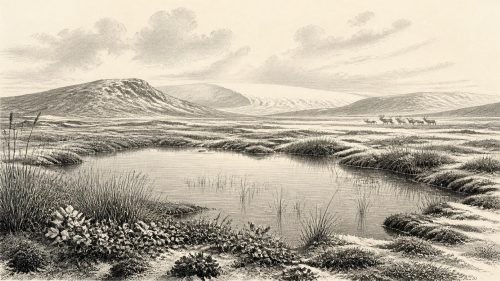
Derryvree’s Bogbean Season
Around 31,435 BCE, Ireland lay within the variable Midlandian cold stage, not a precisely reconstructable single year. Derryvree, County Fermanagh, preserves freshwater organic sediments between glacial tills, radiocarbon-dated broadly to 36,900–31,700 cal BP. Its bogbean, sedges, mosses and aquatic plants indicate treeless wet tundra with seasonal liquid water, rather than permanent ice or temperate woodland. Comparable deposits show changing local climates and ice limits. Cave fauna demonstrate that reindeer, mammoth, giant deer and predators occurred during overlapping Late Pleistocene phases, but not necessarily together. No securely dated human activity exists. Later ice expansion buried Derryvree and erased many older landscapes.
View Record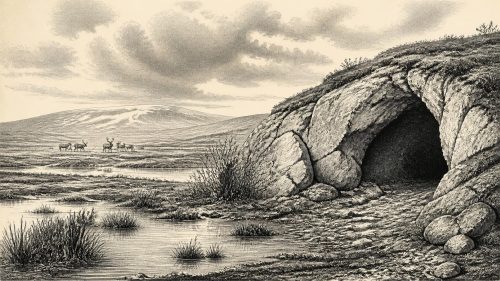
Doneraile’s Earliest Trace
At c. 31,436 BCE, Ireland cannot be described through annual events or human history, but through uncertain Late Pleistocene environmental evidence. Derryvree, County Fermanagh, preserves freshwater sediments between glacial tills, indicating episodically ice-free, cold, treeless wetlands with tundra plants during Marine Isotope Stage 3. Castlepook Cave near Doneraile contains remains of mammoth, reindeer, horse, bear, hyaena and other cold-stage fauna, although collections span long periods. A marked reindeer bone may indicate early human butchery, but sustained occupation is unproven. Dynamic ice, changing coasts and later erosion shaped intermittently habitable landscapes, while preventing reconstruction of societies, politics, settlement, or exact chronology.
View Record
Derryvree’s Tundra Insects
31,437 BCE is a modern label within a broad calibrated Late Pleistocene MIS 3 range, not a datable Irish year. At Derryvree, County Fermanagh, freshwater silts between glacial tills preserve mosses, sedges, aquatic plants and cold-adapted insects, indicating locally ice-free, open tundra-like wetland during fluctuating glaciation. Castlepook Cave, County Cork, contains MIS 3 fauna including reindeer, mammoth, giant deer, predators and other cold-stage species, demonstrating diverse open habitats. A marked reindeer femur may suggest human butchery, but lacks secure archaeological context and cannot prove occupation. No evidence supports contemporary Irish politics, settlements, beliefs or culture. The evidence records ice-age environments.
View Record