Doneraile’s Reindeer Butchery
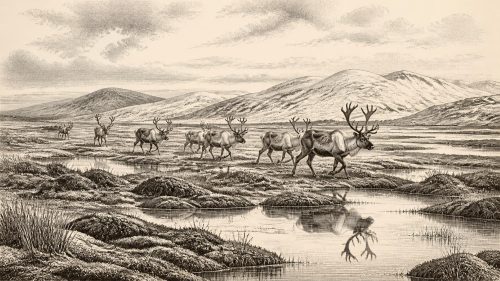
Around 31,621 BCE, a modern label within Marine Isotope Stage 3, Ireland experienced an unstable, cold Ice Age environment rather than a documented historical year. Derryvree sediments in Fermanagh record a locally ice-free tundra of wet hollows, sedges and mosses between glacial advances, while Crag Cave calcite demonstrates intermittent milder conditions. Castlepook Cave in Cork preserves mixed remains of mammoth, reindeer, giant deer and predators, indicating links with wider Eurasian fauna. A cut-marked reindeer femur may indicate exceptionally early human carcass processing, but its disturbed context prevents conclusions about settlement. No evidence supports permanent communities, agriculture, politics or named cultures.
View Record
BIRM-166 and Castlepook
31,622 BCE is not a datable Irish historical event but an imprecise modern label within Marine Isotope Stage 3. Derryvree, County Fermanagh, records organic freshwater sediments between glacial advances, indicating locally ice-free, treeless wetlands with mosses, sedges and pools. Greenagho and Crag Cave likewise demonstrate fluctuating climates rather than continuous ice cover. Castlepook Cave, County Cork, preserves reindeer, mammoth, horse and carnivore remains, evidencing an open, cold landscape supporting large mammals. A marked reindeer femur may indicate stone-tool butchery by humans about 33,000 BCE, but lacks secure context. Subsequent ice expansion probably erased or buried landscapes and traces of visits.
View Record
Birm-166’s Tundra Record
31,623 BCE is a label within a resolved Late Pleistocene interval, not an Irish year. Derryvree, County Fermanagh, preserves freshwater sediments between glacial tills, dated to encompass this horizon, indicating ice-free, periglacial tundra wetlands with pools, mosses, sedges and insects. Ireland was approaching, rather than experiencing, the Last Glacial Maximum. Castlepook Cave in north Cork contains cold-stage fauna, including mammoth, reindeer and predators, though deposits are mixed. A marked reindeer femur may indicate human carcass processing, but cannot prove settlement. Together, these sparse archives show fluctuating habitats, faunal connectivity and possible human presence, while excluding precise chronology or social narratives.
View Record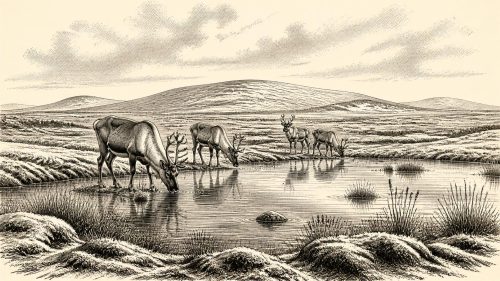
Maguiresbridge and Castlepook
Approximately 31,624 BCE, Ireland lay within the unstable Marine Isotope Stage 3 cold period, not a precisely identifiable historical year. Inter-till deposits at Derryvree, Greenagho and Hollymount in Fermanagh show episodes of ice-free freshwater tundra later overridden by glaciers. Plant and insect remains indicate open, treeless, periglacial environments, while fluctuating sea levels and ice complicated access to the island. Castlepook Cave in County Cork preserves bones of mammoth, reindeer, giant deer, bears, wolves and hyaenas, reflecting intermittent cold-adapted fauna. A possibly cut-marked reindeer bone suggests, but does not prove, Upper Palaeolithic human activity. No institutions or political history are known.
View Record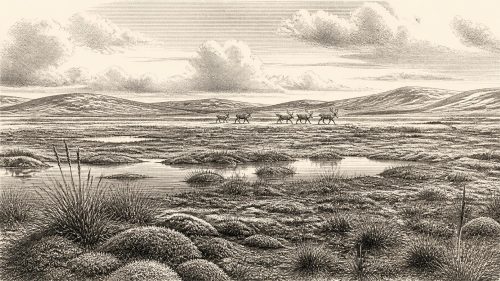
Sedges and Reindeer
31,625 BCE is not a date that can be recovered as a particular Irish year....
View Record
The Reindeer Limb at Doneraile
31,626 BCE is a modern label within Marine Isotope Stage 3, not a recorded Irish year. Evidence from Derryvree indicates cold freshwater, tundra and steppe-tundra habitats between glacial episodes, while Ireland probably comprised open ground, meltwater, frozen terrain and advancing ice. Castlepook Cave preserves a long, mixed animal record including mammoth, reindeer, giant deer and predators. A reindeer femur, dated about 33,000 years ago, bears possible stone-tool cut marks, suggesting but not proving brief Upper Palaeolithic human activity. No secure settlement, tools, hearths, burials or cultural identity are known. Ireland's past is defined by change, fauna and uncertain human passage.
View Record
Derryvree’s Buried Marsh
At the modern date 31,627 BCE, Ireland lay in the climatically unstable later Pleistocene, approaching the Last Glacial Maximum. Evidence is sparse and disrupted by later ice. Buried organic beds at Derryvree, County Fermanagh, indicate an ice-free interval with treeless, cold muskeg of mosses, sedges, herbs, dwarf willow and juniper. Castlepook Cave, County Cork, preserves remains of mammoth, hyaena, reindeer, giant deer and other fauna, indicating varied open habitats and links with wider Europe. A cut-marked reindeer femur may record human carcass processing, but cannot prove permanent settlement. No political, cultural or social history is recoverable; environmental change dominates here.
View Record
Maguirebridge’s Muskeg Pools
Around 31,628 BCE, a modern and necessarily imprecise label, Ireland lay in the fluctuating late Pleistocene MIS 3 interval, before the Last Glacial Maximum. Derryvree, near Maguiresbridge, preserves organic silts between glacial tills, showing an ice-free freshwater mosaic of tundra-like, largely treeless vegetation, insects and wet peaty ground. Castlepook Cave in Cork contains a chronologically mixed assemblage including mammoth, reindeer, giant deer and predators, demonstrating intermittent cold-stage animal communities. A marked reindeer bone may indicate brief Upper Palaeolithic human activity, but remains contested. Evidence cannot establish permanent settlement, routes, social life or events; later ice severely obscured much earlier landscapes.
View Record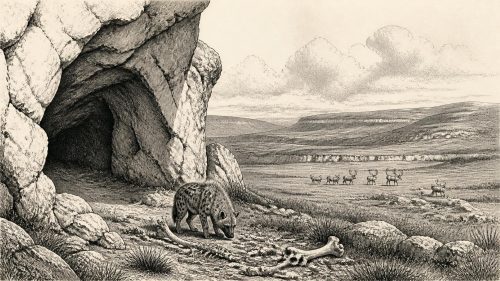
Awbeg’s Hyena Bonehouse
Around 31,629 BCE, Ireland lay in an early, uneven phase of last-glacial ice-sheet growth, with some regions retaining freshwater basins and open periglacial landscapes. Deposits at Derryvree and Greenagho show that parts of Fermanagh remained habitable for cold-adapted ecosystems before later glaciation. Castlepook Cave in County Cork yielded rich Late Pleistocene remains, including mammoth, giant deer, reindeer, bears and spotted hyenas. A roughly 33,000-year-old reindeer bone possibly bears stone-tool damage, suggesting a human visit, but no settlement evidence exists. Lower sea levels may have aided movement, though routes remain unknown. This period represents ecological richness, fragmentary evidence and advancing ice.
View Record
Castlepook’s Cave Fauna
Around 31,630 BCE, Ireland lay within an unstable Ice Age interstadial, before the Last Glacial Maximum but amid shifting ice margins, low seas and varied regional conditions. Cave remains at Castlepook, County Cork, document Late Pleistocene fauna including mammoth, reindeer, giant deer, bears, wolves and hyaenas, indicating episodic open, cold-steppe habitats, though not a single contemporaneous ecosystem. Buried sediments at Derryvree, County Fermanagh, reveal treeless periglacial wetlands with grasses, sedges, herbs and mosses. Human occupation remains unproven: a possibly cut-marked reindeer bone may suggest visitors, but lacks secure context. Later glaciation destroyed evidence, leaving changing environments rather than social history.
View Record