
Willow Beneath the Drumlin
Around 31,599 BCE, Ireland lay within the unstable Late Pleistocene climate of Marine Isotope Stage 3, approaching but preceding maximum glaciation. Derryvree, County Fermanagh, preserves freshwater sediments indicating cold, open tundra wetlands temporarily free from overriding ice. Ice-sheet advances later buried such deposits, leaving a fragmentary record. Castlepook Cave, County Cork, contains remains of reindeer, mammoth, giant deer, bears, wolves, foxes, lemmings and hyaenas, reflecting varied cold-stage ecosystems. A cut-marked reindeer bone may indicate human activity, but remains inconclusive. Lower sea levels altered regional geography and access. Evidence supports environmental reconstruction, not claims of permanent settlement, society or political history.
View Record
Derryvree’s Mountain Avens
Around 31,600 BCE, a modern label within later Marine Isotope Stage 3, Ireland experienced fluctuating glacial conditions before the Last Glacial Maximum. Derryvree, County Fermanagh, preserves freshwater sediments between tills, showing cold, treeless wetlands with arctic-alpine plants including mountain avens during an ice-free interval. Castlepook Cave, County Cork, contains remains of mammoth, reindeer, giant deer, predators and other cold-adapted fauna, though complex deposits limit certainty. A cut-marked reindeer femur may indicate Upper Palaeolithic butchery, but provides no proof of settlement. Ireland’s evidence chiefly records changing ice, habitats and animals; human presence at this remote date remains possible, contested and uncorroborated.
View Record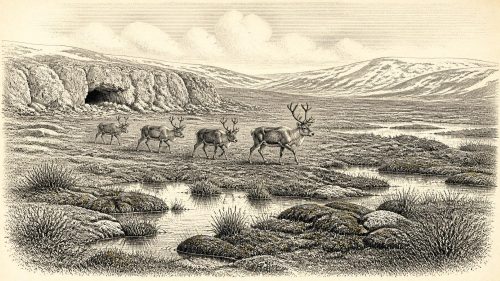
Castlepook’s Unresolved Reindeer
Approximately 31,601 BCE, Ireland lay in an unstable pre-maximum glacial phase, not beneath continuous ice. Evidence from Derryvree’s sediments indicates cold, treeless, waterlogged tundra supporting mosses, sedges, insects and patchy seasonal productivity between glacial advances. Castlepook Cave’s fauna, including mammoth, reindeer, giant deer and predators, demonstrates links with wider north-west European ecosystems, although cave deposits accumulated over long periods. A roughly 33,000-year-old reindeer femur possibly bears a stone-tool cut mark, suggesting brief human carcass processing. However, no secure settlement, tools or associated occupation survives. Changing ice, sea levels and later erosion obscured routes and evidence, leaving possible human presence unresolved.
View Record
Derryvree’s Sedge-Moss Interval
31,602 BCE is not a datable Irish event but falls within a broad Marine Isotope Stage 3 interval. Derryvree, County Fermanagh, preserves freshwater sediments between glacial tills, indicating open, wet, treeless terrain with sedges, mosses, plants and insects before later ice advance. Crag Cave speleothems show intermittent milder phases, while Castlepook Cave documents varied Pleistocene fauna, though from multiple episodes. A marked reindeer femur may indicate brief Upper Palaeolithic carcass processing, but cannot prove settlement or continuous occupation. Evidence reveals fluctuating regional environments, not an annually defined landscape, society or history; waters, vegetation, animals and ice are attested than people.
View Record
Birm-166’s Freshwater Window
31,603 BCE is not a recoverable Irish historical year but falls within Marine Isotope Stage 3, a climatically unstable Late Pleistocene period. At Derryvree, Fermanagh, freshwater silts and organic beds between two tills show that ice retreated locally, allowing tundra wetlands, pools, sparse vegetation and fauna before renewed glaciation. Greenagho and Crag Cave support episodic ice-free or milder conditions. Southern caves indicate reindeer, mammoth, hyaena and wolves, though dates and deposits are uncertain. A tool-marked reindeer bone from Castlepook may suggest a brief human visit, but cannot demonstrate settlement. Later ice sheets buried or destroyed much evidence, requiring cautious interpretation.
View Record
Derryvree’s Interstadial Basin
31,604 BCE is a modern label for a broad, uncertain Marine Isotope Stage 3 interval, rather than a recoverable historical year. At Derryvree, County Fermanagh, freshwater silts between glacial tills, radiocarbon dated broadly to 36,900–31,700 calibrated years BP, preserve evidence of a treeless, cold periglacial mosaic of pools, sedges, mosses, herbs and insects. Castlepook Cave, County Cork, records varied Ice Age mammals, though disturbed deposits and revised dates limit conclusions. A possibly cut-marked reindeer bone may indicate brief human activity, not settlement. Together, these archives show locally habitable environments between ice advances before renewed glaciation erased much evidence of occupation.
View Record
Mammoth Cave’s Unsettled Signal
Around 31,605 BCE, Ireland had no inhabitants or calendar, and evidence permits only broad reconstruction. During climatically unstable Marine Isotope Stage 3, expanding ice, lower sea levels and altered coastlines created cold, open, regionally variable environments. Derryvree sediments in Fermanagh preserve tundra-like wetland vegetation between glacial deposits. Castlepook Cave in Cork contains MIS 3 fauna, including mammoth, reindeer and predators, accumulated over long periods. A reported cut-marked reindeer femur, dated about 33,000 years ago, may indicate human carcass processing, but insecure context prevents proof of settlement. Later glaciation destroyed much evidence; surviving fragments demonstrate environmental change and plausible human visits.
View Record
Calcite, Tundra, and Castlepook
Around 31,606 BCE, Ireland lay within the climatically unstable MIS 3, before the later Last Glacial Maximum. Changing ice margins, lowered seas and uncertain land routes created a variable north-west European landscape. Derryvree sediments in Fermanagh indicate cold, treeless tundra-like wetlands with freshwater pools and seasonal freezing. Castlepook Cave preserves mixed remains of mammoth, deer, reindeer and predators, demonstrating diverse cold-stage fauna, though not a single contemporaneous community. Crag Cave calcite records milder interstadial episodes. A possibly cut-marked Castlepook reindeer bone may indicate brief human activity, but no secure settlement evidence exists. Later glaciation severely damaged Ireland's overall archaeological record.
View Record
Birm-166’s Freshwater World
31,607 BCE is an imprecise modern label within a Late Pleistocene range, not a recoverable Irish date. At Derryvree, County Fermanagh, organic freshwater silts, sealed between glacial tills, record an ice-free Middle Devensian interval before ice expansion. Pollen, plants, mosses and insects reveal cold, treeless, tundra-like wetland and open ground, with pools, sedges, grasses, juniper and herbs. Fragmentary cave fauna elsewhere, Castlepook, indicates northern animals including reindeer, mammoth, giant deer and hyaena, but not a simultaneous community. No secure evidence establishes human settlement; a possibly cut-marked reindeer bone suggests only unconfirmed, fleeting human activity. Derryvree preserves a rare environmental archive.
View Record
Castlepook’s Mammoth-Steppe
Around 31,608 BCE, Ireland formed a fluctuating Late Pleistocene frontier rather than a uniformly frozen island. Glaciers and open periglacial landscapes varied regionally as climate shifted. At Derryvree, County Fermanagh, freshwater deposits between till sheets preserve evidence of tundra-steppe vegetation, including sedges, herbs, mosses and aquatic plants. Castlepook Cave, County Cork, contains a mixed faunal record of mammoth, reindeer, giant deer, hyena, bear, wolf, Arctic fox and lemmings, reflecting links with wider Europe. A possibly cut-marked reindeer bone suggests brief Upper Palaeolithic human visits, but not settlement. Fragmentary evidence documents climate, water, ice and animal mobility before agriculture or monuments.
View Record