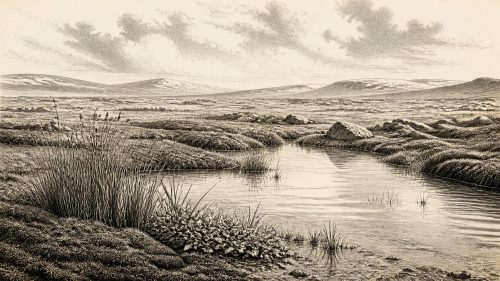
Derryvree’s Bogbean Waters
31,643 BCE is a modern notional date within Marine Isotope Stage 3, not an identifiable Irish event. During this volatile pre-Last Glacial Maximum period, Ireland’s ice, coastlines and habitats changed repeatedly, while lower sea levels sometimes enabled animal movement from Britain. At Derryvree, Fermanagh, freshwater sediments between glacial tills preserve pollen, bogbean, mosses, sedges and cold-adapted insects, indicating open tundra wetland during a broad interval. Castlepook Cave records diverse cold-stage fauna, but its disturbed deposits span millennia. A cut-marked reindeer bone suggests possible Upper Palaeolithic human activity, not settlement. Later glaciation erased much evidence, requiring cautious interpretation in every conclusion.
View Record
Maguirebridge’s Calibrated Tundra
Around 31,644 BCE, Ireland’s history is reconstructed from environmental evidence rather than a datable event. Derryvree sediments near Maguiresbridge, calibrated to 36,900–31,700 cal BP, show Fermanagh was temporarily ice-free, with freshwater, tundra-like vegetation and severe seasonal conditions. Castlepook Cave preserves remains of reindeer, mammoth, giant deer and other cold-climate animals, although its deposits represent multiple periods and were disturbed. A possibly cut-marked reindeer bone suggests transient Upper Palaeolithic hunters, but permanent settlement remains unproven. Ireland was approaching wider glaciation, which later erased much evidence. Climatic oscillations and advancing ice, not political or cultural events, define this uncertain deep-prehistoric central horizon.
View Record
Castlepook’s Carnivore Galleries
About 31,645 BCE, a modern label rather than a precise prehistoric date, Ireland lay in the unstable MIS 3 cold stage before the Last Glacial Maximum. Derryvree, County Fermanagh, preserves evidence of open, frost-affected wetland with tundra vegetation. Castlepook Cave, County Cork, yielded mammoth, giant deer, reindeer, bears, wolves, Arctic foxes, lemmings and spotted hyaenas, demonstrating diverse fauna but not a simultaneous community. A cut-marked reindeer femur may indicate transient human butchery, though no secure occupation evidence exists. Ice advances later erased much evidence. The period reveals changing environments and possible visits, not settled population, political history or human occupation.
View Record
Castlepook’s Single Cut
31,646 BCE is a retrospective label, not a datable Irish event, and evidence concerns the wider Late Pleistocene environment. Before the Last Glacial Maximum, parts of Ireland may have remained ice-free amid unstable, open habitats and lower seas. Castlepook Cave in County Cork preserves mixed faunal remains, including mammoth, reindeer, hyena and other cold-adapted species, spanning different periods. A reindeer femur dated roughly 33,000 years ago bears a possible stone-tool cut mark, suggesting hunters may have processed it. However, no associated settlement or tools exist. Castlepook therefore indicates possible intermittent human visits, while demanding cautious interpretation and further scientific research.
View Record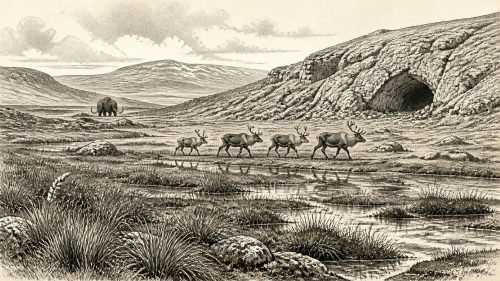
Hyenahall’s Mammoth Archive
Approximately 31,647 BCE, Ireland formed a climatically unstable, partly ice-free frontier during Marine Isotope Stage 3, rather than a recognisable island or society. Derryvree, County Fermanagh, preserves freshwater sediments between tills, indicating cold, open, wet tundra-like habitats before renewed glaciation. Castlepook Cave, County Cork, contains a long accumulated fauna including mammoth, reindeer, giant deer, hyaena and Arctic species, demonstrating ecological links with glacial north-west Europe. A marked reindeer femur, dated about 33,000 years ago, may indicate human butchery, but remains inconclusive. Later ice-sheet expansion eroded evidence. No settlement, polity, agriculture or continuous human occupation can be securely established for Ireland.
View Record
The Awbeg Cutmark Debate
31,648 BCE is a modern label for a fluctuating MIS 3 Ice Age environment, not a recoverable Irish historical year. Derryvree, County Fermanagh, preserves freshwater sediments between glacial tills, indicating locally ice-free, treeless wetlands and open periglacial vegetation during a broadly dated interval. Castlepook Cave, County Cork, contains a complex, repeatedly accumulated fauna including mammoth, reindeer, giant deer, bear and hyaena, but cannot represent a single contemporaneous community. A marked reindeer femur may indicate brief human butchery, yet remains inconclusive. No settlement, culture or economy is demonstrable. Changing ice, wetlands, animal movements and fragmentary evidence define this period in Ireland.
View Record
Fermanagh’s Birm-166 Deposit
Around 31,649 BCE, Ireland has no annual history, but Derryvree, County Fermanagh, preserves freshwater silts beneath later tills, broadly dated 36,900–31,700 cal BP. Mosses, sedges, grasses and insects indicate a cold, treeless, periglacial wetland during Marine Isotope Stage 3, before maximum ice-sheet expansion. The record demonstrates local ice-free conditions, not Ireland-wide climate or forest. Cave remains from southern Ireland show intermittent fauna including reindeer, mammoth, giant deer, predators and small cold-adapted mammals, though contexts are uncertain. Possible early human evidence remains unconfirmed; secure human activity is much later. No communities, institutions or cultural practices can be assigned to this period.
View Record
Castlepook’s Marked Femur
c. 31,650 BCE cannot be identified as a discrete Irish event, but falls within the climatically unstable MIS 3 interstadial landscape preceding the Last Glacial Maximum. Derryvree, County Fermanagh, preserves evidence of an ice-free, open tundra-like wetland interval, although its broad calibrated dates cannot pinpoint a year. Castlepook Cave, County Cork, contains MIS 3 fauna including reindeer, mammoth and predators, demonstrating cold-adapted animal movement. A marked reindeer femur may record stone-tool butchery and a brief human visit around 31,000 BCE. However, no associated tools, hearths, settlement, human remains or reliable route evidence exists; later glaciation severely damaged the archaeological record.
View Record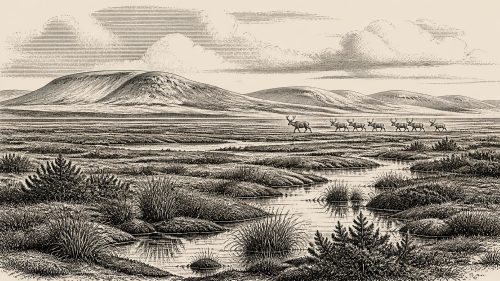
Mammoth Cave, Derryvree, and Ice
About 31,651 BCE, Ireland was not experiencing a datable historical year but a fluctuating Late Pleistocene interval within MIS 3. Organic deposits at Derryvree and Greenagho indicate local ice-free or withdrawn conditions before renewed glaciation, supporting cold open wetlands with grasses, sedges, juniper, mosses and insects. Castlepook Cave in Cork preserves remains of mammoth, reindeer, hyaena, bear and lemming, though accumulated deposits cannot define one ecosystem. A cut-marked reindeer femur may indicate Upper Palaeolithic carcass processing, but not settlement or permanent occupation. No evidence supports farming, monuments, political communities or regular trade. Expanding ice obscured this fragile, regionally varied landscape.
View Record
Crag Cave’s Thaw Windows
Around 31,652 BCE, Ireland lay within the climatically unstable Late Pleistocene, not a recorded historical world. Evidence is sparse and cannot demonstrate settlement, institutions or fixed events. Derryvree sediments indicate open tundra-like vegetation, wetlands and fluctuating conditions, while Crag Cave speleothems show intermittent liquid water in south-west Ireland during milder phases. Castlepook Cave fauna confirms repeated arrivals of mammals, including reindeer, mammoth, hyaena and bear, across changing routes. A marked reindeer bone may indicate human butchery about 33,000 years ago, but remains inconclusive. Ireland was a cold, shifting landscape, intermittently habitable for plants and animals, and possibly visited by people.
View Record