
Hyaena Land’s Faunal Network
31,664 BCE is a modern label for a late Marine Isotope Stage 3 horizon, not a datable Irish event. Environmental evidence from Derryvree and Crag Cave indicates fluctuating cold conditions, open tundra wetlands and episodically milder intervals. Castlepook Cave preserves a diverse, time-mixed pre-Last Glacial Maximum fauna, including mammoth, reindeer, giant deer, hyaena, wolves and lemmings, demonstrating ecological links with north-west Europe. Ancient DNA may extend this picture, though remains provisional. A marked reindeer femur may indicate Upper Palaeolithic butchery, but cannot prove settlement. Ireland lacked communities or institutions; human visits remain uncertain amid changing ice, sea routes and landscapes.
View Record
Castlepook’s Reindeer Mark
31,665 BCE is a modern label for an uncertain MIS 3 Ice-Age period, not a recorded Irish year. Before the Last Glacial Maximum, Ireland contained open, periglacial habitats and altered coastlines, connected environmentally with wider north-west Europe. Castlepook Cave, County Cork, preserves fauna including reindeer, mammoth, giant deer, hyaena, bear, wolf, Arctic fox and lemmings, accumulated through complex processes. A reindeer femur, dated about 31,000 BCE, bears a possible stone-tool incision, suggesting Upper Palaeolithic carcass processing. However, its old, unstratified context and absence of associated artefacts, hearths or settlements mean human occupation remains unproven. The evidence indicates possibility, not population.
View Record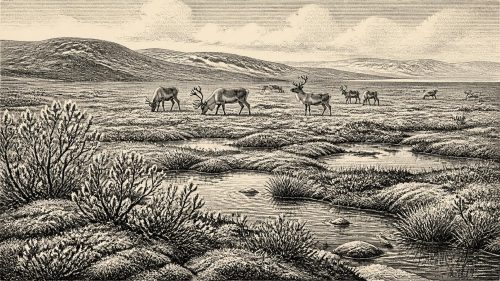
Greenagho’s Buried Lake
Labelled 31,666 BCE, this period belongs to the unstable later Marine Isotope Stage 3, not recorded history. Sediments beneath glacial till at Derryvree and Greenagho, County Fermanagh, preserve evidence of freshwater wetlands, cold-adapted vegetation and locally ice-free ground before expansion of the British–Irish Ice Sheet. Treeless landscapes contained sedges, mosses, dwarf willow and other plants suited to wet, open conditions. Castlepook Cave, County Cork, yields a complex pre-maximum fauna including mammoth, reindeer, giant deer, hyaena, bears and wolves. A possibly tool-marked reindeer bone suggests brief human activity, but cannot demonstrate settlement. Advancing ice later transformed habitats and destroyed earlier evidence.
View Record
The Maguiresbridge Interstadial
At approximately 31,667 BCE, Ireland lay in the climatically unstable Late Pleistocene, not a historical year with identifiable communities. Freshwater deposits beneath later glacial till at Derryvree, County Fermanagh, and Greenagho indicate ice-free local basins supporting tundra-steppe vegetation, pools, sedges, mosses, dwarf willow and juniper. Cave remains at Castlepook, County Cork, demonstrate varied cold-climate fauna, including reindeer, mammoth, giant deer and predators, though not all were contemporary. A possibly stone-cut reindeer femur may indicate brief Upper Palaeolithic human activity, but remains disputed and proves neither settlement nor hunting. Expanding ice buried, disturbed and erased evidence before the Last Glacial Maximum.
View Record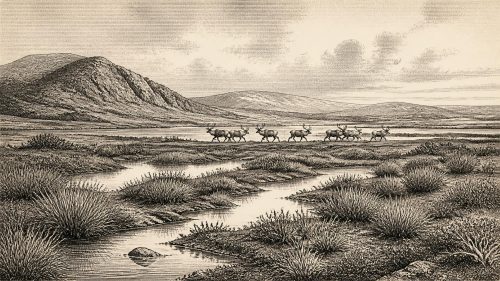
A Reindeer Femur at Castlepook
At the notional date of 31,668 BCE, Ireland experienced unstable cold conditions of Marine Isotope Stage 3, not a single recoverable historical year. Inter-till wetland deposits at Derryvree, County Fermanagh, show treeless, wet tundra habitats during an ice-free interval, though dating remains broad. Castlepook Cave, County Cork, preserves Late Pleistocene bones of mammoth, reindeer, giant deer, predators and other cold-adapted animals, accumulated over potentially separate episodes. A cut-marked reindeer femur may indicate human carcass processing around 33,000 years ago, but lacks associated tools or settlement evidence. Climate, ice advances and seas limited access, leaving no proof of occupation or continuity.
View Record
Sedges Beneath Fermanagh
Around 31,669 BCE, Ireland lay within the unstable later Marine Isotope Stage 3 of the Last Glacial Period, rather than a datable year. Freshwater sediments at Derryvree, County Fermanagh, indicate locally ice-free, treeless wetlands of sedges, mosses, herbs and shallow water, supporting cold-adapted life. Castlepook Cave, County Cork, records reindeer, mammoth, giant deer, predators and smaller mammals, though its deposits span multiple periods. Expanding ice increasingly reshaped and buried landscapes. Lower sea levels allowed animal access at times, but routes remain uncertain. No secure human settlement is known; a possibly cut reindeer bone offers only tentative evidence of Palaeolithic visitation.
View Record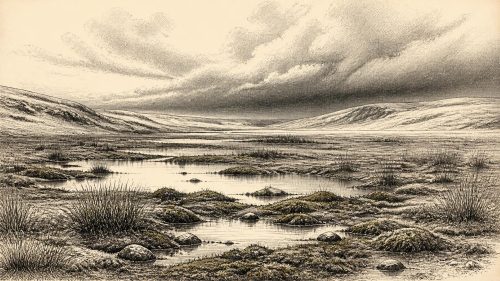
Derryvree’s Silted Pool
Although 31,670 BCE is a modern label rather than a precise Irish date, Derryvree, County Fermanagh, preserves organic freshwater sediments dated broadly to 36,900–31,700 cal BP. Trapped between glacial tills, they record a cold, treeless wetland landscape with pools, mosses, plants and insects during Marine Isotope Stage 3. Cave fossils elsewhere show that mammoth, reindeer and predators reached Ireland, but cannot be assigned to Derryvree or one moment. Ireland was increasingly affected by expanding ice, while lower sea levels did not guarantee easy migration routes. No secure human evidence exists until much later. Derryvree documents environmental change, not human history.
View Record
Derryvree’s Denekamp Wetland
Although labelled 31,671 BCE, this is not a precisely datable Irish year. During the climatically unstable Late Pleistocene, Derryvree in County Fermanagh preserved freshwater organic silts between glacial tills, demonstrating an ice-free wetland interval within episodic glaciation. Pollen, plants and insects indicate open, treeless, waterlogged vegetation under severe seasonal conditions. Castlepook Cave in north Cork records mammoth, reindeer, giant deer, predators and other cold-adapted fauna, showing intermittent north-west European ecological connectivity. A cut-marked reindeer femur may indicate human butchery, but no associated settlement or tools establish sustained occupation. Changing ice, sea levels and later erosion shaped landscapes and limited evidence.
View Record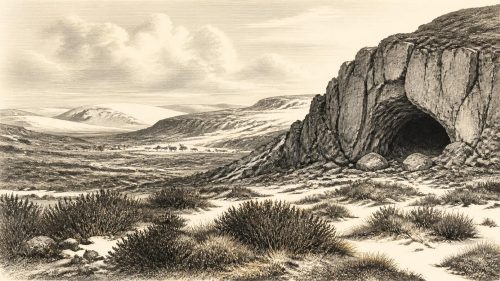
Castlepook’s Reindeer Incision
Circa 31,672 BCE, Ireland occupied a climatically unstable Late Pleistocene frontier, with open steppe-tundra, changing coastlines and uneven ice expansion. Castlepook Cave near Doneraile preserves a time-mixed fauna including mammoth, reindeer, giant deer, hyaena, Arctic fox and lemmings, showing intermittent cold-stage habitats. A reindeer femur, dated broadly to about 33,000 years ago, bears an incision interpreted as stone-tool butchery, suggesting an Upper Palaeolithic human visit. The evidence cannot establish a precise year, permanent settlement, identity, beliefs or social organisation. Any people were probably mobile foragers, while cave deposits require secure contexts, tools and sites to confirm Ireland’s earliest human presence.
View Record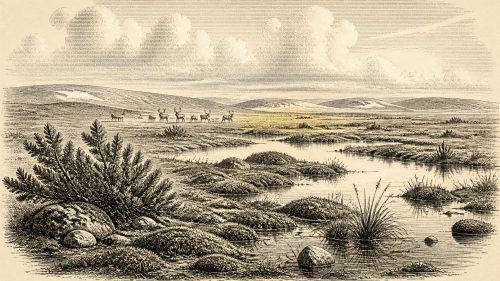
The Maguiresbridge Freshwater Lens
Circa 31,673 BCE, Ireland cannot be described through a dated event, but through a variable Marine Isotope Stage 3 environment. At Derryvree, near Maguiresbridge, freshwater silts between glacial tills preserve evidence of ice-free, treeless periglacial wetlands, with mosses, sedges, grasses, herbs and juniper. Castlepook Cave in Cork records mammals, including mammoth, reindeer, giant deer, bears, hyaenas, wolves and lemmings, across many millennia, demonstrating ecological links with north-west Europe. A marked reindeer bone may indicate human butchery, but remains contested. No settlements or social institutions are known. Together, these archives reveal dynamic, intermittently habitable landscapes, later overridden by advancing ice sheets.
View Record