
Denekamp Over Doneraile
31,697 BCE cannot be reconstructed as a discrete Irish historical year, but belongs to unstable MIS 3 conditions near the Denekamp Interstadial. Ireland lacked known polities, settlements, farming or securely documented communities, while low sea levels and shifting ice and sea routes complicated access. Derryvree deposits in Fermanagh indicate cold, treeless freshwater and periglacial environments between glacial advances. Crag Cave speleothems record episodic thaw and climatic fluctuation. Castlepook Cave preserves diverse Ice-Age fauna, though its mixed assemblage spans long periods. A marked reindeer femur may suggest brief human butchery, but cannot establish permanent occupation. Ice erosion and excavation limit interpretation.
View Record
Birm-166’s Sedge Record
31,698 BCE is a retrospective label, not a recoverable Irish year. Derryvree, County Fermanagh, provides calibrated evidence for ice-free conditions between roughly 36,900 and 31,700 years before present, preserved as freshwater organic silts between tills. Mosses, sedges, bogbean and insects indicate a cold, open periglacial wetland, amid climatically unstable MIS 3 conditions. Cave calcite and deposits elsewhere confirm episodic milder intervals and fluctuating ice. Castlepook Cave's disturbed fauna documents diverse cold-stage mammals, while a possibly cut-marked reindeer bone suggests, but cannot prove, human activity. No settlements, polities or trade are attested. Sediments instead reveal changing wetlands, fauna and advancing ice.
View Record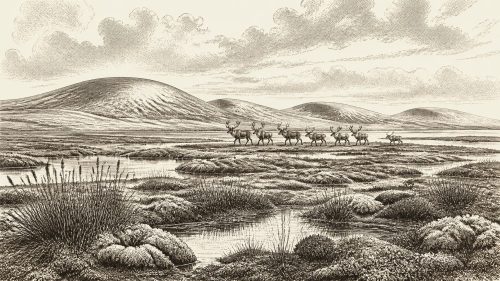
Derryvree’s Sedge Muskeg
Around 31,699 BCE, Ireland lay in the unstable cold of Marine Isotope Stage 3. Derryvree, County Fermanagh, preserves freshwater deposits beneath later glacial till, revealing treeless, sedge-rich, mossy wetlands and open tundra-like ground. Other northern sites indicate that some regions remained ice-free, though conditions varied and later ice advances reshaped the island. Castlepook Cave in County Cork contains remains of Ice Age mammals, including reindeer, mammoth and predators, but its mixed deposits cannot date species precisely. A marked reindeer bone may indicate brief human butchery, yet provides no proof of permanent settlement. Environmental evidence is stronger than evidence for people.
View Record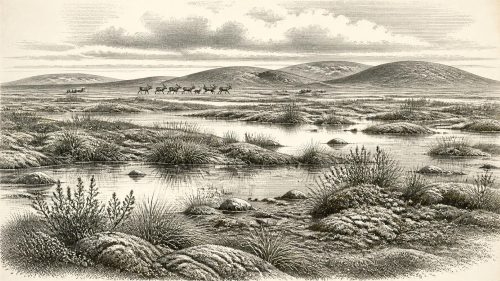
Derryvree’s Freshwater Beds
Derryvree’s freshwater sediments near Maguiresbridge provide a cautiously dated glimpse of Ireland during Marine Isotope Stage 3, within a calibrated range encompassing 31,700 BCE. Sandwiched between glacial tills, they indicate ice-free tundra wetland, with mossy vegetation, pools and animal life, rather than continuous ice cover. Greenagho offers comparable pre-maximum evidence. Castlepook Cave preserves mixed remains of mammoth, reindeer, giant deer, bears, hyaenas and other cold-climate fauna. A cut-marked reindeer bone may indicate Palaeolithic butchery, but cannot establish permanent settlement. Later ice destroyed much evidence. Ireland was environmentally variable, increasingly glacial, and possibly visited by mobile hunter-gatherers, though settlement remains unproven.
View Record
Doneraile’s Ice-Age Hinterland
At the approximate horizon labelled 31,701 BCE, Ireland lay within the cold, unstable later Marine Isotope Stage 3, with open, largely treeless habitats and changing coastlines. Castlepook Cave near Doneraile preserves Ireland’s foremost cold-stage mammal archive, including mammoth, reindeer, giant deer, hyaena, Arctic fox and lemmings, although disturbed, time-depth deposits prevent their coexistence being assumed. A marked reindeer femur may indicate Upper Palaeolithic butchery, yet provides no secure proof of settlement. As ice expanded towards the Last Glacial Maximum, erosion and reworking obscured earlier evidence. This period is understood chiefly through environmental remains, not political, cultural or social history alone.
View Record
Castlepook’s Mammoth Galleries
At the notional date of 31,702 BCE, Ireland lay within the climatically volatile Late Pleistocene, approaching extensive glaciation. Precise dating and ice coverage are impossible to establish, since later ice destroyed or buried much evidence. Castlepook Cave in County Cork preserves mixed MIS 3 deposits containing mammoth, reindeer, giant deer, bears, wolves, Arctic foxes, lemmings and spotted hyaenas, indicating cold, open habitats and links with European fauna. Carnivore activity complicates interpretation. A possibly cut-marked reindeer bone offers disputed evidence of human presence, but no securely dated settlements, tools or human remains exist. Castlepook demonstrates environmental change, habitation possibilities, and uncertainty.
View Record
Aghnadarragh’s Treeless Plain
Around 31,703 BCE, Ireland lay within the climatically unstable Late Pleistocene, as ice expanded before its later maximum. Later glaciation destroyed much evidence, but northern buried sediments preserve pollen, plants and beetles indicating treeless, cold grass-sedge tundra, wet hollows and Arctic-like conditions. Southern caves contain reindeer, giant deer, mammoth, bears, wolves and hyaenas, demonstrating changing habitats and animal movement. A cut-marked Castlepook reindeer bone may suggest transient human activity, but cannot prove settlement or occupation. Shifting seas and ice complicated access to Ireland. No evidence supports societies, trade or institutions. This period is understood through fragmentary deposits and radiocarbon ranges.
View Record
Mammoth Cave’s Thin Evidence
Around 31,704 BCE, Ireland lay within an unstable Late Pleistocene cold phase, not a precisely datable historical year. Evidence indicates varied, severe environments before maximum ice-sheet expansion. Derryvree, County Fermanagh, preserves freshwater deposits, tundra vegetation, insects and seasonal wet ground, while Crag Cave calcite suggests episodic liquid water. Castlepook Cave, County Cork, yielded mammoth, reindeer, giant deer, bears, hyaena and other fauna, demonstrating habitats for cold-stage animals. A marked reindeer femur may record butchery by Upper Palaeolithic people, but its disturbed context and uncertain interpretation prevent claims for settlement. No communities, artefacts, structures or institutions are securely known. Uncertainty endures.
View Record
Castlepook’s Unfinished Question
Around 31,705 BCE, Ireland lay within the unstable MIS 3 Ice Age, with lower seas, uncertain animal routes and changing periglacial environments. Derryvree sediments in Fermanagh indicate open tundra wetlands supporting cold-adapted plants and small animals, rather than forest or agriculture. Castlepook Cave in Cork preserves diverse fauna, including mammoth, reindeer, giant deer, bears, wolves, foxes, lemmings and hyenas, though its mixed deposits cannot reconstruct one community. A cut-marked reindeer bone may indicate an early human visit, but lacks secure archaeological context. No settlement, institutions or trade are evidenced. Dating and stratified excavation are needed to assess Ireland’s Palaeolithic presence.
View Record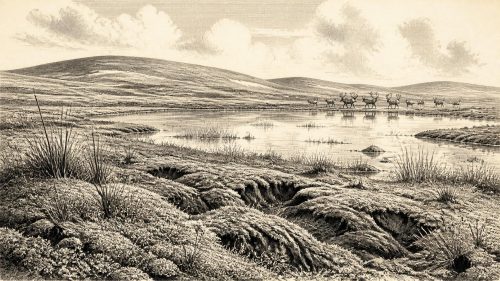
Hollymount Between the Tills
Although labelled 31,706 BCE, this period cannot be dated to a specific Irish year and belongs broadly to later Marine Isotope Stage 3. Freshwater sediments between glacial tills at Derryvree, Fermanagh, reveal treeless, tundra-like wetlands during fluctuating cold conditions, while Hollymount and Greenagho confirm varied non-glacial episodes. Castlepook Cave, Cork, preserves MIS 3 remains of mammoth, giant deer, reindeer, bear, hyena and other fauna, showing ecological links with Britain and Europe. Possible human modification of a reindeer bone suggests seasonal visits, but no secure occupation is known. Ireland’s record documents environmental change and animal life, not settlements, politics or culture.
View Record