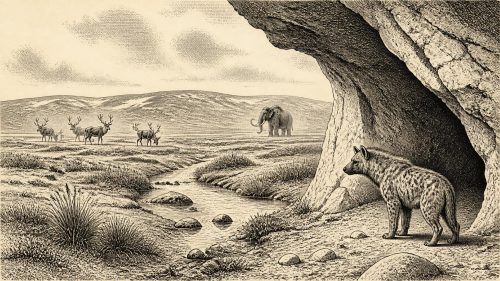
Hyenahall’s Open-Country Fauna
Labelled 31,707 BCE, this period in Ireland belongs broadly to fluctuating Marine Isotope Stage 3, rather than a precisely datable year. Sparse, disturbed evidence indicates that some open, cold landscapes supported mammoth, reindeer, giant deer, lemmings, Arctic foxes, wolves, bears and spotted hyaenas before extensive later glaciation. Castlepook Cave in County Cork accumulated bones over millennia and uniquely records Irish spotted hyaena, revealing overlapping animal activity rather than a single fauna. Fermanagh deposits confirm cold freshwater tundra conditions. A possibly cut-marked reindeer bone suggests human presence, but no secure evidence demonstrates sustained settlement, population, culture or institutions. Ice obscured evidence.
View Record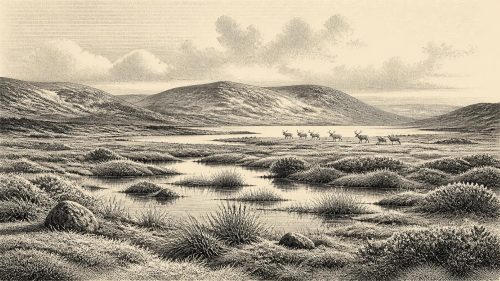
Crag Cave’s Interrupted Calcite
Around 31,708 BCE, Ireland was part of a climatically unstable Late Pleistocene landscape, not a place with a recoverable annual history. Derryvree sediments in Fermanagh indicate cold, open, waterlogged tundra-like habitats with mosses, sedges and northern insects during a broad period encompassing this date. Ice margins, sea levels and vegetation shifted repeatedly before the Last Glacial Maximum. Crag Cave stalagmites record intermittent milder phases, while southern caves preserve varied cold-stage mammals. Castlepook’s marked reindeer bone may indicate human processing, but lacks secure archaeological context. Evidence supports transient animal habitats and possible brief human visits, not settlement, society or political events.
View Record
Maguirebridge’s Frostbound Fen
Labelled 31,709 BCE only conventionally, this period in Ireland belongs to unstable Late Pleistocene Marine Isotope Stage 3, not a precisely datable event. Derryvree, near Maguiresbridge, preserves freshwater sediments indicating treeless, frost-prone tundra, wetland plants and enduring seasonal ecosystems. Castlepook Cave's bones, accumulated over millennia, document mammoth, giant deer, reindeer, hyaena and other cold-adapted fauna. A possibly stone-tool-cut reindeer femur suggests an early human visit or butchery, but proves neither settlement nor continuous population. Subsequent ice-sheet expansion reshaped and obscured evidence. Ireland was environmentally dynamic, ecologically active and sparsely documented, with claims about society, identity or politics unsupported by evidence.
View Record
The Cork Reindeer Mark
Around 31,710 BCE, a notional date within Marine Isotope Stage 3, Ireland experienced unstable cold conditions before the Last Glacial Maximum. Fossils and sediments show that intermittently accessible, open landscapes supported reindeer, mammoth, giant deer, predators and northern species. Castlepook Cave in County Cork preserves Ireland’s pre-glacial fauna collection, although its mixed, recorded deposits cannot establish contemporaneous communities. A reindeer femur, dated broadly to about 33,000 years ago, bears a possible stone-tool cut mark, suggesting but not proving brief human butchery. Without associated artefacts or habitation evidence, it cannot demonstrate settlement. The find nevertheless suggests a deeper Irish Palaeolithic past.
View Record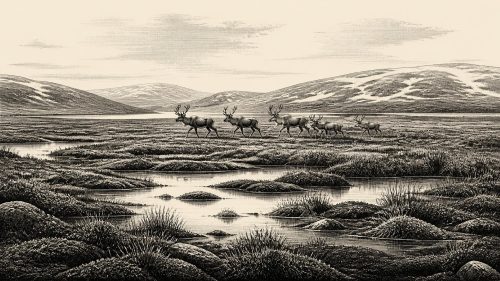
Doneraile’s Reindeer Question
Around 31,711 BCE, Ireland’s history can only be reconstructed through broad archaeological and environmental evidence. During unstable MIS 3 conditions, Derryvree in County Fermanagh preserved an ice-free, periglacial wetland with tundra vegetation. Castlepook Cave near Doneraile yielded remains of reindeer, mammoth, giant deer, hyaena and other Ice-Age animals, accumulated over extended periods. Revised dating places much fauna in MIS 3. A marked reindeer femur may record human carcass processing about 33,000 years ago, suggesting possible brief Upper Palaeolithic visits. However, no secure settlement, tools, hearths or social evidence survives. Ireland remained a changing cold landscape, not a recoverable historical society.
View Record
Derryvree’s Open-Water Interval
31,712 BCE is a modern label for a broad late Marine Isotope Stage 3 interval, not a recoverable annual date. At Derryvree, County Fermanagh, freshwater silts between glacial tills record an ice-free phase, supporting cold, open wetlands of mosses, sedges, grasses, insects and sparse shrubs. Comparable deposits and Kerry cave calcite demonstrate repeated climatic oscillations. Southern caves preserve mammoth, reindeer, giant deer, predators and other fauna, although dates and deposits require caution. No secure evidence establishes human settlement; a possibly cut reindeer bone suggests only a potential brief visit. Later British–Irish Ice Sheet expansion transformed and buried this periglacial landscape.
View Record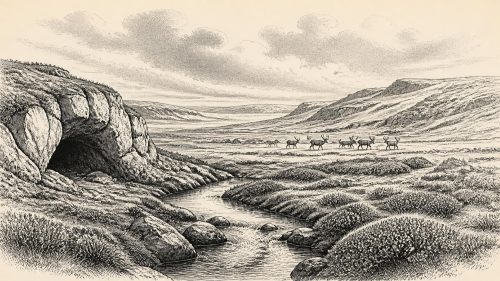
Castlepook’s Reindeer World
Castlepook Cave in north County Cork preserves Ireland’s richest known Late Pleistocene vertebrate archive, spanning roughly 45,700 to 19,950 years before present. During fluctuating Marine Isotope Stage 3, open, cold-adapted habitats supported reindeer, mammoth, giant deer, bears, hyaenas, wolves and lemmings, amid changing seas and growing ice. Cave deposits are disturbed and accumulate over long periods, preventing a precise reconstruction for 31,713 BCE. A reindeer femur bearing a possible stone-tool cut mark may indicate human butchery around 31,000 BC. However, no associated tools, hearths, occupation layers or settlement evidence exist. Castlepook therefore suggests possible brief human presence, not proven habitation.
View Record
Derryvree’s Drumlin Window
Around 31,714 BCE, Ireland lay within the climatically unstable Late Pleistocene, not a dated historical moment. Evidence from Derryvree, County Fermanagh, records an ice-free freshwater wetland of open, treeless tundra-like vegetation during later MIS 3, subsequently buried by glacial deposits. Castlepook Cave, County Cork, preserves a complex, long-lived fauna including mammoth, giant deer, reindeer, bears and hyaenas, but not a single contemporary community. A possibly tool-marked reindeer bone suggests tentative Upper Palaeolithic human activity, yet no settlement, tools or other secure assemblage confirms occupation. Changing ice, sea levels and erosion shaped connections and destroyed evidence, leaving ecological and geological history.
View Record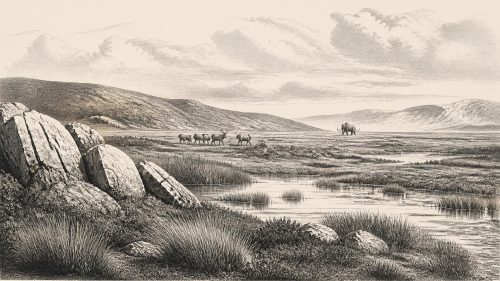
Cork’s Pleistocene Crossroads
Around 31,715 BCE, Ireland lay in the unstable Late Pleistocene before the Last Glacial Maximum, when climate, ice extent and coastlines changed. Evidence comes from animal bones, wetland sediments, pollen and glacial deposits, not historical records. Castlepook Cave in County Cork contained cold-adapted fauna; a reindeer femur bearing a possible stone-tool cut mark may indicate human carcass processing about 33,000 years ago. However, disturbed cave deposits and absent associated tools preclude claims of settlement. Derryvree and other inter-till sites reveal open tundra wetlands and regional environmental variation. Ireland may have hosted intermittent visitors, but sustained Upper Palaeolithic occupation remains unproven.
View Record
Castlepook’s Ambiguous Chopping Mark
Labelled 31,716 BCE, this period belongs broadly to Marine Isotope Stage 3, not a precisely datable Irish year. Fermanagh deposits at Derryvree and Greenagho indicate cold, ice-free freshwater wetlands during parts of the Late Pleistocene, before advancing ice sheets reshaped Ireland. Castlepook Cave in County Cork yielded Ice-Age fauna, including a reindeer femur with a possible stone-tool butchery mark. Though potentially early evidence of human activity, its old, poorly contextualised collection and lack of associated tools or occupation evidence prevent conclusions about settlement. Lower sea levels did not ensure access; animal and human movements remained uncertain. Later glaciation obscured evidence.
View Record