Image
16 July 2026
Thomond Gate
Thomond Gate Distillery stood beside the River Shannon from 1809 until 1919, forming an important part of Limerick’s industrial and distilling heritage. During the nineteenth century, the complex operated three copper pot stills and produced traditional Irish whiskey under several owners, including Stein Brown & Co. and Archibald Walker’s Limerick Distillery. These reconstructed scenes imagine the surrounding streets, workers, carts, buildings and towering chimneys during the distillery’s active years. Although production eventually ceased, the Thomond Gate name has been revived through an independent Limerick whiskey brand dedicated to preserving the memory and traditions of the original enterprise for future generations.
View ImageImage
10 July 2026
Marys Cathedral
AI-assisted archival reconstruction showing St Mary’s Cathedral, Limerick, viewed from the surrounding garden grounds. The image presents the cathedral tower, Gothic windows, mature trees, planted walks, benches, and landscaped foreground in a restored historical setting, preserving the atmosphere of the original source photograph while removing modern watermarking and visual damage.
View ImageImage
9 July 2026
Treaty Stone
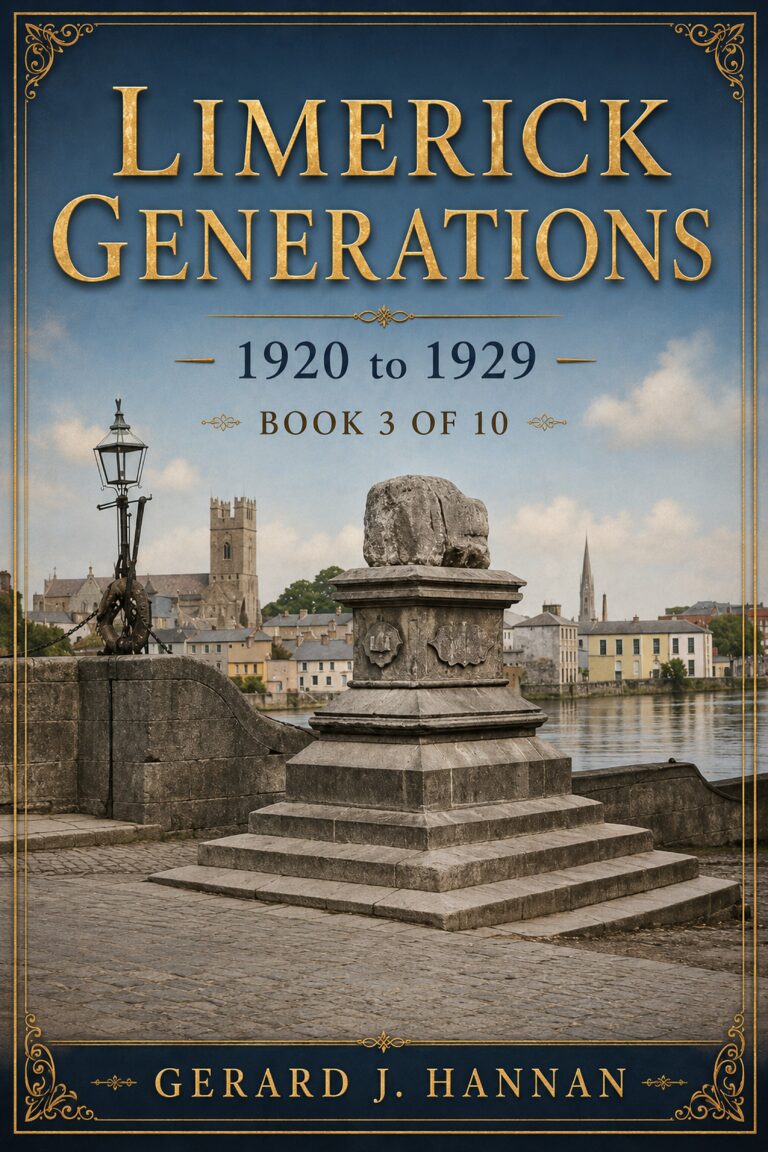
AI-assisted archival reconstruction showing the Treaty Stone on Thomond Bridge, Limerick, with the riverside castle buildings and historic bridge approach in the background. The scene presents the monument, cobbled roadway, bridge parapet, pedestrians, and horse-drawn traffic in a restored early twentieth-century setting, preserving the atmosphere of the original historical source image.
View ImageImage
16 July 2026
Thomond Gate
Thomond Gate Distillery stood beside the River Shannon from 1809 until 1919, forming an important part of Limerick’s industrial and distilling heritage. During the nineteenth century, the complex operated three copper pot stills and produced traditional Irish whiskey under several owners, including Stein Brown & Co. and Archibald Walker’s Limerick Distillery. These reconstructed scenes imagine the surrounding streets, workers, carts, buildings and towering chimneys during the distillery’s active years. Although production eventually ceased, the Thomond Gate name has been revived through an independent Limerick whiskey brand dedicated to preserving the memory and traditions of the original enterprise for future generations.
View ImageImage
10 July 2026
Marys Cathedral
AI-assisted archival reconstruction showing St Mary’s Cathedral, Limerick, viewed from the surrounding garden grounds. The image presents the cathedral tower, Gothic windows, mature trees, planted walks, benches, and landscaped foreground in a restored historical setting, preserving the atmosphere of the original source photograph while removing modern watermarking and visual damage.
View ImageArticle
19 June 2026
National Programme
The reunited Irish Parliamenme Rule, land reform and the restoration of an Irish legislature responsible for domestic affairs. The programme places constitutional self-government and the condition of tenant farmers at the centre of nationalist politics following years of damaging division. In Limerick city and county, supporters are expected to welcome a policy connecting representation at Westminster with demands concerning land purchase, evicted tenants and overcrowded rural holdings. The agreement gives John Redmond’s leadership a defined political purpose while allowing the United Irish League to organise popular support through local branches, conventions and public meetings. The nationalist movement entered the new…
Read ArticleArticle
24 June 2026
Artist Born
Harry Aaron Kernoff was born in London on 9 January 1900 into a Jewish family whose origins reached across eastern and southern Europe. His father, Isaac Kernoff, was a furniture maker of Russian-Jewish background, while his mother, Katherine, came from a Sephardic Jewish family. The household combined skilled craftsmanship with the experience of migration, placing the future artist within a world shaped by manual work, cultural inheritance and adaptation. Although born outside Ireland, Kernoff would become closely associated with Dublin and would eventually be recognised as one of the most distinctive visual chroniclers of Irish urban life during the twentieth…
Read ArticleArticle
24 June 2026
Difficult Ally
Tim Healy remained one of the most influential yet troublesome figures involved in the effort to reunite Ireland’s divided parliamentary nationalists during January 1900. A formidable barrister, experienced Member of Parliament and devastating political speaker, Healy possessed an authority that could not easily be ignored. He had opposed Charles Stewart Parnell during the leadership crisis of 1890 and subsequently quarrelled with leading anti-Parnellites, particularly John Dillon. By the end of the decade, Healy commanded his own following of MPs and local activists. Any credible agreement restoring nationalist unity therefore required his cooperation, even though many former colleagues distrusted his intentions…
Read ArticleArticle
25 June 2026
Mounted Volunteers
A Special Army Order issued at the beginning of January 1900 established the machinery for recruiting the Imperial Yeomanry, a volunteer mounted force intended for service in South Africa. The decision followed the British defeats of December 1899, when Boer commandos demonstrated the effectiveness of mobile riflemen operating across difficult country. Existing yeomanry units were invited to provide trained volunteers, while suitable civilians could also enlist for a limited period of overseas service. The new formation was organised as mounted infantry rather than conventional cavalry, emphasising movement, marksmanship and the ability to fight after dismounting.
Read ArticleArticle
19 June 2026
Royal Dublin
Queen Victoria arrived in Ireland today for what will become the final Irish visit of her long reign. The royal programme is centred principally upon Dublin, where streets, public buildings, railway approaches and the route towards the Viceregal Lodge have been extensively decorated. Crowds gathered at Kingstown and throughout the capital to witness the arrival and procession. Although Limerick is not included prominently in the itinerary, reports of the ceremonies are being followed closely throughout the city and county by loyalists, nationalists, soldiers’ families, clergy, merchants and political organisations. The Queen landed at Kingstown before travelling through Dublin in an…
Read Article