Article
26 June 2026
Militia Mobilised
The South African War entered everyday life in Limerick during 1900 when the Royal Limerick County Militia was embodied for extended military service. Since the army reforms of 1881, the historic county force had formed the 5th Battalion of the Royal Munster Fusiliers and maintained its local headquarters at Strand Barracks. Its mobilisation connected families throughout Limerick city and county with the wider demands of an imperial conflict. Although the battalion did not campaign against the Boers as a complete unit, its men undertook duties that released regular soldiers for service elsewhere.
Read ArticleArticle
22 June 2026
Creamery Rivalry
Local disputes are arising between co-operative creameries owned by milk suppliers and privately operated concerns seeking to retain control of established dairying districts. The rivalry is especially significant in County Limerick, where cattle, milk and butter provide income for farmers, labourers, carriers and merchants. Co-operative organisers argue that producers should collectively own the machinery through which their milk is processed and marketed. Private proprietors answer that independently managed businesses can offer efficient service without requiring farmers to invest capital, accept committee authority or assume responsibility for commercial losses. Competition centres upon the daily supply of milk. No creamery can operate…
Read ArticleArticle
25 June 2026
Roberts Arrives
Field Marshal Lord Roberts arrived at Cape Town on 10 January 1900 and assumed supreme command of British forces in South Africa. He travelled aboard the Dunottar Castle with Lord Kitchener, who became his chief of staff. Their appointment followed the defeats of “Black Week,” when British reverses at Stormberg, Magersfontein and Colenso exposed serious weaknesses in command, intelligence and battlefield preparation. Roberts received a formal welcome at the harbour, but the ceremony could not conceal the gravity of his task. British garrisons remained besieged, casualties were rising and reinforcements arriving from across the Empire required organisation.
Read ArticleArticle
20 June 2026
Land Dominates
The land question remains the dominant economic and social issue across rural Ireland, shaping political organisation, family security and relations between landlords and tenant farmers. In County Limerick, holdings vary greatly in quality and size, while rents, arrears, grazing land and the prospect of tenant purchase remain constant subjects of discussion. Earlier Land Acts granted greater protection and introduced limited purchase schemes, but they did not complete the transfer of ownership sought by many farmers. Rural households continue to measure political promises against the practical questions of who owns the soil, who works it and who benefits from its produce.
Read ArticleArticle
26 June 2026
Surrender Refused
Limerick formally entered a state of siege on 9 August 1690 when William III’s army moved from its camp near Cahirconlish and established itself before the city. William sent a summons demanding surrender to Alexandre de Rainier de Droué, Marquis de Boisseleau, the French officer entrusted with commanding the Jacobite infantry within Limerick. The decision placed the city’s inhabitants, soldiers and defences at the centre of the war following the Boyne. William expected the remaining Jacobite resistance to collapse, but Limerick’s position behind the Shannon and the presence of a substantial garrison offered the defenders a final opportunity to continue…
Read ArticleImage
16 July 2026
Treaty Stone
The Treaty Stone on Clancy’s Strand is traditionally believed to have served as the table upon which the Treaty of Limerick was signed on 3 October 1691. Concluded after the Siege of Limerick, the agreement ended the Williamite War in Ireland. Its military articles permitted Patrick Sarsfield’s Jacobite army to depart for France in the Flight of the Wild Geese, while the civil articles promised protections for Catholics. These promises were later undermined by the Penal Laws. Originally a mounting block outside the Black Bull Inn, the stone was placed on its decorated pedestal by Mayor John Rickard Tinslay in…
View ImageImage
10 July 2026
Memorial 1940s
On Sarsfield Bridge in 1940s Limerick, the 1916 Memorial rises proudly beside the roadway, enclosed by green iron railings and watched over by elegant lamps. Its pale stone pedestal supports bronze figures commemorating the Rising, their solemn poses lending dignity to the riverside setting. Trees line the background, softening the urban scene and framing the monument against a bright open sky. Pedestrians in period dress walk along the bridge, suggesting ordinary city life continuing around a place of remembrance. The image captures civic pride, republican memory, and the enduring presence of national history within Limerick’s daily landscape and local identity.
View ImageImage
10 July 2026
Barricades Limerick
At Thomond Bridge in Limerick in 1923, a soldier stands guard beside a rough barricade near the Treaty Stone, a symbolic landmark now overshadowed by civil conflict. The scene evokes the tense aftermath of the Treaty split, when Anti-Treaty IRA forces and pro-Treaty National Army troops fought for control of the city. Sandbags, timber, stone, and street debris suggest hurried urban fortification, while the soldier’s watchful posture conveys danger and uncertainty. The bridge becomes both military checkpoint and historic threshold, linking Limerick’s medieval memory with the bitter street warfare that marked the Irish Civil War in the city that summer.
View ImageImage
16 July 2026
Nua Ruins
The old church near Holycross, County Limerick, was recorded as a ruin by 1642. In 1679, Rachael Bourchier, Countess of Bath, restored the building, just one year before her death. Thereafter it became known as the New Church, or Teampall Nua in Irish, and served local Church of Ireland parishioners. A belfry was added during the restoration, giving the structure a distinctive profile. Although the church later fell out of use and returned to ruin, its surviving walls, arched openings and graveyard remain important reminders of seventeenth-century religious life and the long history of worship at this historic site today.
View ImageImage
15 July 2026
George Street
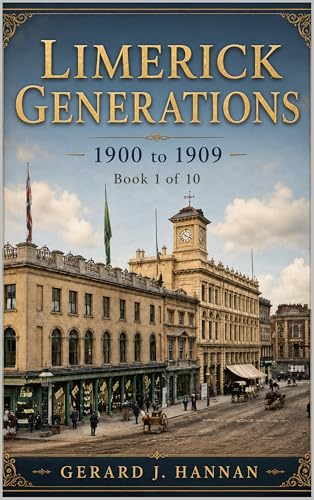
In 1900, George Street, now O’Connell Street, formed the commercial heart of Edwardian Limerick. Its broad thoroughfare was lined with elegant Georgian buildings, busy shops, hotels and offices, while horse-drawn carts, carriages and pedestrians filled the roadway. Street traders added colour and activity to the city’s principal avenue. Among its notable establishments were the Cruises Royal Hotel, MacMahon’s Temperance Hotel and respected merchants such as O’Mahony & Company. The street reflected Limerick’s growing prosperity at the opening of the twentieth century, combining refined architecture with energetic daily commerce and serving as a central meeting place for residents, visitors and travellers…
View Image