Political Exclusion(c.1690s)
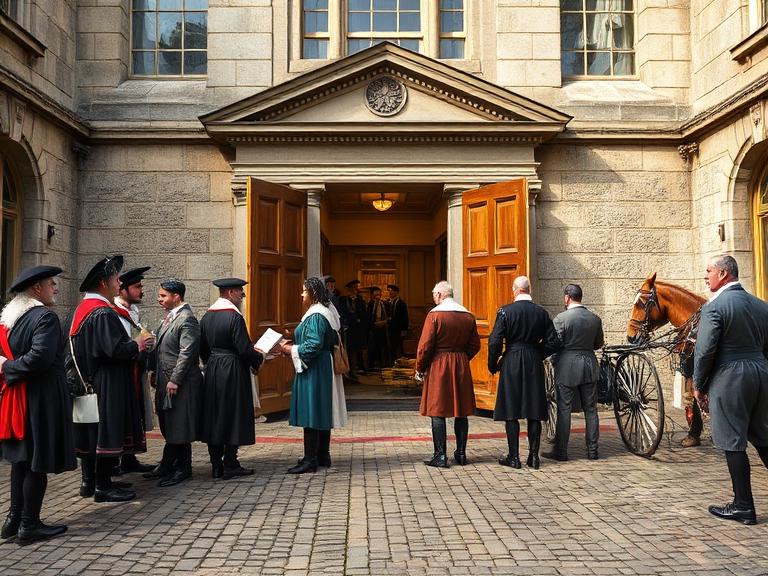
Limerick’s Catholic inhabitants surrendered in 1691 under articles promising access to trades, professions and privileges compatible with the settlement. Nevertheless, political authority became reserved for Protestants. Catholics in the treaty city could pay rates, conduct business and support municipal institutions while remaining excluded from Parliament, corporations and offices. This separation between obligation and representation shaped public life throughout the eighteenth century. Decisions affecting Limerick’s taxation, policing, property and administration were made within institutions Catholics could not equally enter. Political exclusion therefore converted religious identity into civic inferiority, limiting influence even where Catholic residents formed an active part of the community.
An English statute of 1691 required Irish peers and members of the House of Commons to take prescribed oaths and make a declaration against transubstantiation before sitting or voting. Catholics could not honestly satisfy those religious tests. The measure consequently removed them from parliamentary participation without expressly naming every individual. Similar requirements applied to barristers, attorneys and holders of ecclesiastical, civil or military employment. Refusal brought disabilities, including exclusion from office, Parliament, legal actions, guardianship, executorship and certain gifts. Public authority was thereby tied to declarations that transformed adherence to Catholic teaching into evidence of political unfitness within the kingdom.
The 1704 Popery Act extended this system through sacramental tests and the oath of abjuration. Officeholders were required to appear publicly, swear the prescribed oaths and receive communion according to the established Church of Ireland. Catholics were therefore excluded not because their conduct had demonstrated disloyalty, but because qualification demanded religious acts contrary to conscience. Municipal corporations, courts, military posts and administrative employment became increasingly Protestant preserves. In Limerick, this affected the institutions governing an important city whose Catholic population remained economically active. The law separated civic capacity from actual experience, education, property or loyalty, making conformity the decisive credential.
Voting rights were narrowed in stages. The 1704 legislation required Catholic electors to take allegiance and abjuration oaths, while a 1715 act demanded that those oaths be taken months before an election when challenged. In 1727, Catholics were denied votes in parliamentary and municipal elections altogether. Later election oaths also excluded Protestants married to Catholics or educating children as Catholics. Political disability therefore reached beyond individual worship into marriage and family education. The electorate was shaped to secure Protestant control, ensuring that Catholic property holders could contribute to society without possessing a voice in choosing those who governed it locally.
Parnell presented political exclusion as part of a broader penal structure that contradicted loyalty and public interest. Catholics were governed, taxed and punished under laws they had little opportunity to influence. Their exclusion also deprived institutions of capable landowners, merchants, lawyers and professionals whose participation might have strengthened administration. In Limerick, the imbalance was visible because a Catholic community lived beneath a corporation and parliamentary system controlled through religious tests. Political relief later became central to Catholic organisation precisely because property concessions alone could not restore equality. Until representation returned, citizenship remained incomplete, conditional and subordinate to the religious order.
Primary Sources
- An Act for the Abrogating of the Oath of Supremacy in Ireland and Appointing Other Oaths, 3 William and Mary, chapter 2, 1691.
- An Act for Enlarging the Time for Taking the Oath of Abjuration, 1 Anne, statute 2, chapter 21, 1702.
- An Act to Prevent the Further Growth of Popery, 2 Anne, chapter 6, 1704.
- An Act for the More Effectual Preventing Fraudulent Conveyances and Regulating Elections, 2 George I, chapter 19, 1715.
- An Act for the Further Regulating the Election of Members of Parliament, 1 George II, chapter 9, 1727.