
Carden’s Reindeer Femur31953 BCE
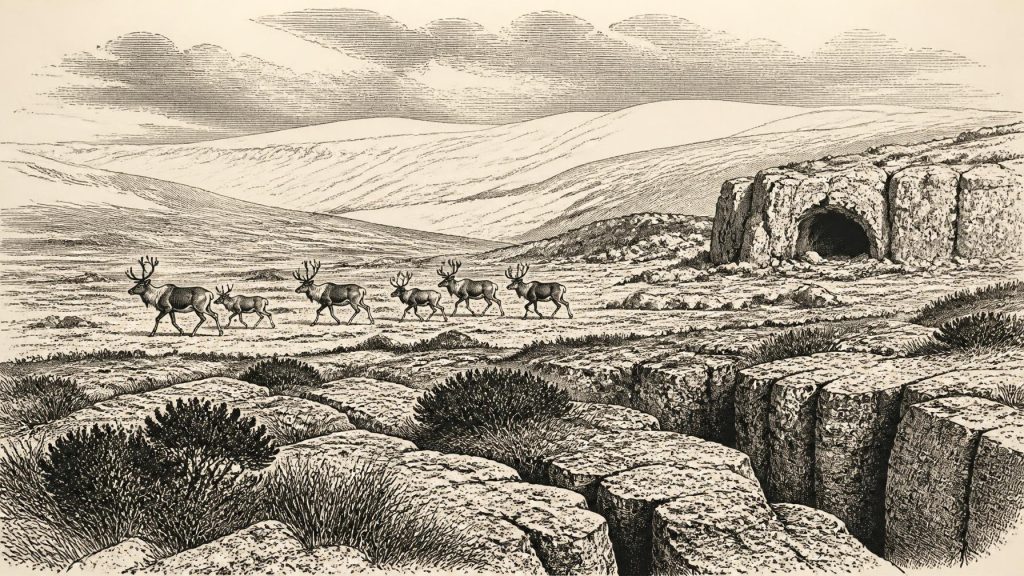
Around 31,953 BCE, Ireland lay within the climatically unstable later Ice Age, approaching expanded glaciation. Evidence from Castlepook, or Mammoth, Cave in County Cork confirms a diverse Marine Isotope Stage 3 fauna, including reindeer, mammoth, giant deer, bears, wolves and Arctic species. A reindeer femur, dated about 33,000 years ago, has a possible stone-tool butchery mark, perhaps indicating Ireland’s earliest human activity. However, disturbed cave deposits and lack of associated tools or habitation prevent conclusions about settlement. Ice later damaged much archaeological evidence. No local polities, warfare, art or culture can be established; human presence remains possible, fleeting and uncertain.
Dateline
The label 31,953 BCE is a modern chronological convenience, not a year that anyone in prehistoric Ireland could have named, recorded or experienced as a fixed calendar date. Archaeology cannot identify an event, a ruler or even a particular generation on the island in that single year. The responsible frame is therefore broader: around 33,900 calibrated years before present (cal BP, with “present” conventionally 1950), Ireland lay in the later part of Marine Isotope Stage 3, a climatically unstable phase of the last Ice Age and the long approach to the Last Glacial Maximum. Dates of this antiquity are generally expressed as ranges, because radiocarbon measurements require calibration and because cave deposits rarely preserve a simple, undisturbed sequence.
An Island in the Last Ice Age
This was not yet the peak of the last glaciation. The Last Glacial Maximum is conventionally placed later, broadly about 26,500–19,000 years ago, when the British–Irish Ice Sheet attained its greatest overall extent. Yet the cold world which would produce that maximum was already taking shape. Reconstructions of the British–Irish Ice Sheet indicate substantial expansion after roughly 31,000 years ago, with different sectors advancing at different times. The exact coverage of Ireland at any moment around 31,953 BCE remains uncertain: an ice sheet is not a static white blanket, but a changing system of snow accumulation, flowing ice, meltwater and shifting margins.
For that reason, it would be misleading to imagine either a wholly ice-covered island or a uniformly open, habitable landscape. Parts of Ireland may have supported cold-stage environments and animal populations before later ice overran or reshaped much of the land. Other areas may already have been affected by expanding ice. Subsequent glaciation matters greatly to the historical record. Moving ice erodes bedrock, transports sediments, buries older surfaces and destroys fragile traces such as hearths, campsites, footprints and scatters of stone tools. The striking scarcity of early archaeological sites in Ireland may therefore reflect both a very small human presence and the extraordinary difficulty of preserving or finding evidence from it.
What Castlepook Cave Can Tell Us
The most important evidence close to this horizon comes from Castlepook Cave, also known as Mammoth Cave, near Doneraile in north County Cork. The cave has yielded one of Ireland’s richest Pleistocene faunal collections. Research on its animal bones, together with re-dating using improved laboratory methods, has demonstrated that southern Irish caves preserve evidence of mammals living in Ireland during Marine Isotope Stage 3, well before the Last Glacial Maximum. The wider Irish Quaternary Fauna Project found that a varied mammal fauna colonised the island at intervals between at least about 45,000 and 20,000 years ago.
Castlepook’s collection includes remains attributed to reindeer, giant deer, woolly mammoth, brown bear, wolf, Arctic fox, mountain hare, lemmings and spotted hyaena. This list should not be treated as a photograph of a single day, season or even century. Fossils entered the cave over long periods, and carnivores, water, sediment movement and nineteenth- and early twentieth-century excavation disturbed the deposits. A cave can be a den, trap, refuge, drainage route and natural archive all at once. Individual bones are valuable evidence, but their original relationships are often difficult to recover.
One specimen has particular significance for a year-by-year account. A reindeer femur from Castlepook has been reported as dating to about 33,000 years ago and bears a deep mark interpreted by Ruth Carden as having been made with a sharp stone tool during butchery. County Cork heritage material consequently presents it as possible evidence of Palaeolithic hunters handling reindeer in the area around 31,000 BCE. If that interpretation is sustained, it would push Irish evidence for human activity dramatically earlier than the long-established post-glacial record.
But the limits of the claim are as important as its promise. The bone was recovered from an old cave collection rather than a modern excavation of an intact occupation surface. No securely associated hearth, dwelling, lithic assemblage, human burial or food-processing area of comparable age has yet been found at Castlepook. The radiocarbon result dates the death of the animal, not automatically the making of the mark, the place of killing or the duration of any human visit. The identification of a mark as a tool cut is a separate specialist judgement. Accordingly, the bone can responsibly be described as a potentially crucial trace of human butchery, not proof of a permanent settlement or continuous population in Ireland.
Animals, Habitat and Climate
The animal evidence nevertheless establishes something substantial: Ireland was not an empty abstraction before the great ice advance. Reindeer are well adapted to open, cold landscapes; lemmings and Arctic fox point towards severe conditions; while giant deer, brown bear, hyaena and mammoth indicate that the ecological picture changed through time and contained more than one habitat or climatic phase. In north-west Europe, Marine Isotope Stage 3 was marked by abrupt shifts between colder stadials and relatively milder interstadials. Conditions could alter over timescales far shorter than traditional historical periods.
It is safest to envisage a mosaic rather than a fixed national landscape. Open grassland, herb-rich steppe-tundra, sparse shrub cover, exposed ground and sheltered valleys may all have existed in changing proportions where land was ice-free. There is no basis for placing dense forest across Ireland at this date. Nor should modern Irish greenery be projected backwards: the familiar Atlantic landscape of broadleaf woodland, deep soils, bogs and settled fields belonged to much later environmental histories. The coastline was also unlike that of today. Global sea level was lower during the Ice Age, but local geography around Ireland was shaped as well by crustal movement and ice loading. Whether particular routes between Ireland, Britain and the continental mainland were passable at a given stage remains a complex palaeogeographical question, not a licence to assume an easy land bridge.
People: A Fleeting Possibility
If humans did process the Castlepook reindeer, they were almost certainly highly mobile hunter-gatherers rather than settlers in any modern sense. Their presence may have been brief: a hunting party, a carcass-processing episode, a seasonal movement along animal routes or an exploratory journey. Such possibilities are interpretations drawn from the nature of Upper Palaeolithic lifeways elsewhere in north-west Europe; they are not directly demonstrated in Ireland. We cannot identify their language, ancestry, community name, beliefs, clothing, boats, shelters or route of arrival from a single modified bone.
Even the word “economy” needs careful handling here. There is no evidence for farming, herding, pottery, metalworking, permanent fields, markets or long-distance trade within Ireland around this date. If people were present, subsistence would have depended on immediate access to wild plants, animals and raw materials, with hunting and scavenging both conceivable in an environment where predators also used caves. A stone edge capable of cutting bone would imply knowledge of lithic technology, but no tool can presently be tied securely to the Castlepook femur. Ireland’s older isolated finds cannot fill that gap, because some may have been carried by glacial ice rather than made or used on the island.
No Polities, No Recorded Conflict
There were no known Irish kingdoms, chiefs, tribal names, laws, diplomatic agreements or political institutions in 31,953 BCE. There is equally no Irish evidence for organised warfare. Predation, hunting and competition for shelter were facts of Ice Age ecology, but they should not be converted into stories of human conflict. A hyena-marked mammoth bone and a possibly cut-marked reindeer bone illuminate different processes affecting carcasses; neither reveals a battle, a frontier or a social hierarchy.
Religion, art and learning are similarly beyond direct recovery in Ireland at this point. Across Europe, Upper Palaeolithic communities made sophisticated tools, ornaments and art, but it would be methodologically unsound to transfer any particular tradition, cave imagery or ritual practice to Ireland without local evidence. No Irish cave art, figurative object, inscription or ceremonial structure has been securely dated to this period. The absence of such evidence is not proof that people lacked imagination, custom or knowledge; it is a reminder that archaeology must distinguish what is possible from what has been found.
The Meaning of This Date
31,953 BCE is important not because it contains a recoverable Irish event, but because it lies near a threshold in the island’s deep past. It belongs to a period when Ice Age animals demonstrably reached Ireland, when the island’s physical geography and climate were in flux, and when one Castlepook reindeer bone may preserve the earliest known sign of human activity. Future excavation, microscopic study of bone surfaces, refined radiocarbon calibration and reassessment of old museum collections may strengthen, revise or overturn that interpretation.
For now, the sound conclusion is deliberately modest. Around this notional year, at least some parts of Ireland supported cold-climate fauna within a changing Late Pleistocene environment. The island was moving towards more extensive glaciation, whose erosive force would later obscure much of the evidence. Human presence is possible and may be indicated by the Castlepook femur, but settlement, society and culture remain unproven. This is not a blank page in Irish history; it is a fragmentary one, read chiefly through ice, caves and animal bone.
Primary Sources
- Prehistoric Details | National Museum of Ireland
- The Irish Quaternary Fauna Project
- A Reconsideration of the Radiocarbon Dating of the Marine Isotope Stage 3 Fauna from Southern Ireland
- New Insights on the Fauna of Ireland's Younger Dryas and Early Holocene from Alice & Gwendoline Cave
- Growth and Retreat of the Last British–Irish Ice Sheet, 31,000 to 15,000 Years Ago: the BRITICE-CHRONO Reconstruction
- Dimensions and Chronology of the Last Ice Sheet in Western Ireland
- Trimlines, Blockfields and the Vertical Extent of the Last Ice Sheet in Southern Ireland
- Last Glacial Maximum Cirque Glaciation in Ireland and Implications for Reconstructions of the Irish Ice Sheet
- Late Pleistocene Chronostratigraphy and Ice Sheet Limits, Southern Ireland
- Oscillating Retreat of the Last British-Irish Ice Sheet on the Continental Shelf Offshore Galway Bay, Western Ireland
- Maximum Extent and Readvance Dynamics of the Irish Sea Ice Stream and Irish Sea Glacier Since the Last Glacial Maximum
- Radiocarbon Constraints on the Age of the Maximum Advance of the British–Irish Ice Sheet in the Celtic Sea
- Exposure-Age Constraints on the Extent, Timing and Rate of Retreat of the Last Irish Sea Ice Stream
- Timing and Pace of Ice-Sheet Withdrawal Across the Marine–Terrestrial Transition West of Ireland During the Last Glaciation
- Deglaciation, Earth Crustal Behaviour and Sea-Level Changes in the Determination of Insularity: A Perspective from Ireland
- Ireland: Submerged Prehistoric Sites and Landscapes
- The IntCal20 Northern Hemisphere Radiocarbon Age Calibration Curve (0–55 cal kBP)
- Heritage Artefacts of County Cork
- Ireland’s Earliest Settlers: Evidence for an Irish Palaeolithic
- The Antiquity of Man in Ireland