Carden’s Reindeer Cut Mark31957 BCE
Ireland around 31,957 BCE lay within Marine Isotope Stage 3, a cold, changing Late Pleistocene period lacking written history or proven settlement. Castlepook Cave in County Cork yielded reindeer and other cold-stage fauna. A marked reindeer femur, interpreted as stone-tool butchery, may indicate brief human presence, but lacks securely associated tools or occupation evidence. Radiocarbon dates require calibration and cannot establish an exact year. Cave deposits were disturbed, while later glaciers erased or rearranged much evidence. Growing ice eventually covered Ireland at the Last Glacial Maximum. The find suggests possible early, discontinuous contact, but future excavation and dating remain necessary.

Dateline
Modern calendar precision cannot be applied responsibly to Ireland in 31,957 BCE. This number is a convenient modern label, projected backwards into a world with no written calendars, states or recorded events. The evidence for this stretch of the Late Pleistocene is dated in broad scientific ranges, principally radiocarbon years calibrated to calendar years before present, and its resolution is usually centuries or millennia rather than a single year. The most useful setting is therefore not an imagined event in 31,957 BCE, but Ireland during Marine Isotope Stage 3, in the millennia before the Last Glacial Maximum.
At that time, the island’s later familiar landscape, communities and political history did not yet exist. The cautiously reconstructed story comes from cave bones, sediments, landforms, offshore cores and laboratory dating. These sources can show that animals lived in, or passed through, parts of Ireland; that glaciers later transformed the country; and that one remarkable bone may preserve a human trace. They cannot yet supply a continuous narrative of settlement.
Dating an Ice-Age Ireland
The date 31,957 BCE is close to, but should not be equated exactly with, claims concerning a reindeer bone from Castlepook Cave near Doneraile in north County Cork. County Cork heritage publications describe the fragment of reindeer femur as c. 31,000 BCE and identify a deep mark interpreted by zooarchaeologist Ruth Carden as having been made by a sharp stone tool during butchery. The wider Castlepook fauna includes animals whose radiocarbon determinations belong to the middle and later parts of the Late Pleistocene. Yet the precision implied by a single numbered year is illusory: radiocarbon results have errors, must be calibrated, and dates from older excavated collections require particular care.
Calibration matters because a radiocarbon age is not automatically a calendar age. Atmospheric carbon-14 changed through time, so laboratories and archaeologists use calibration curves such as IntCal20 to estimate ranges in calendar years. At great antiquity those ranges can be wide. Moreover, the date obtained establishes when an animal died, not necessarily when a mark was made or when any person visited a cave. In this article, dates are therefore expressed as approximate calibrated ranges where securely published, or as broad ‘c.’ estimates where the underlying claim is less fully documented.
The period belongs to the Upper Palaeolithic in the broad European archaeological sequence, but applying that label to Ireland must not imply a known Irish stone-tool industry, settlement tradition or population. No securely associated Upper Palaeolithic hearth, house, tool assemblage, burial or occupation surface has yet been recovered in Ireland for this early phase. Archaeologists can discuss the possibility of human activity; they cannot yet describe an established Palaeolithic society on the island.
Castlepook and the Human Question
Castlepook Cave is important precisely because it offers a rare, potentially transformative clue. The cave was excavated by the naturalist Richard Ussher and others in the early twentieth century, producing a substantial collection of Ice-Age animal remains. A new excavation in 2022, supported by the Royal Irish Academy, revisited the site and its complicated archaeological potential. Such work is necessary because antiquarian excavation often removed deposits without the stratigraphic recording now expected, while caves themselves are places where water, collapsing sediment, scavengers and carnivores can mix material from different times.
The cut-mark interpretation on the reindeer femur is plausible enough to merit serious attention, but it remains a very small piece of evidence. If the mark was made by a stone edge, it indicates that a person processed a reindeer either at or, perhaps more likely, away from the cave before the bone reached it. It does not demonstrate a hunting camp inside Castlepook, a permanent local population, or continuous occupation of Ireland. The absence of a stone tool found in secure association is especially significant. The responsible formulation is that the bone may record an early, brief human presence in Ireland during the Late Pleistocene.
This distinction is not a pedantic one. Ireland’s formerly accepted earliest human evidence was much later: a brown-bear kneecap with cut marks from Alice and Gwendoline Cave, County Clare, directly dated to roughly 12,810–12,590 calibrated years before present. Later research has strengthened its environmental context but also found that the cave sediments were repeatedly disturbed and much material had been transported into the cave. Those results demonstrate both the value and the limitations of Irish cave archives. A proposed human trace from around 31,957 BCE is exciting, but remains less securely contextualised than a conventional excavated site.
A Fauna Before the Maximum
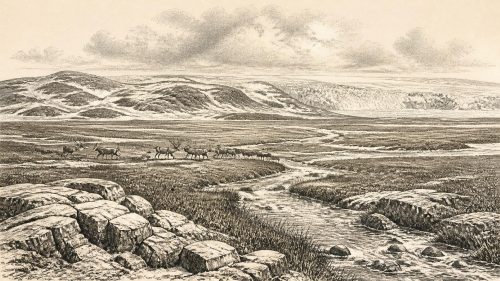
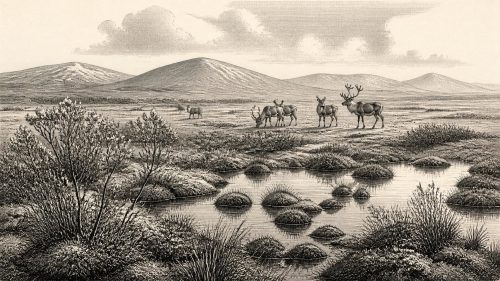
Long before the ice sheet reached its greatest extent, parts of Ireland supported a striking cold-stage fauna. Castlepook has yielded evidence for reindeer, woolly mammoth, giant deer, brown bear, wolf, Arctic fox, spotted hyaena and small cold-adapted mammals including lemmings. Not every species can be placed precisely in the same century, season or local habitat, and a cave assemblage is not a census of the countryside. Predators may have dragged prey into a den, while water and sediment could have moved bones. Nevertheless, the assemblage establishes that Ireland was connected to wider north-west European ecological processes and that sizeable grazing animals and their predators occurred here during milder or less ice-covered phases of the Late Pleistocene.
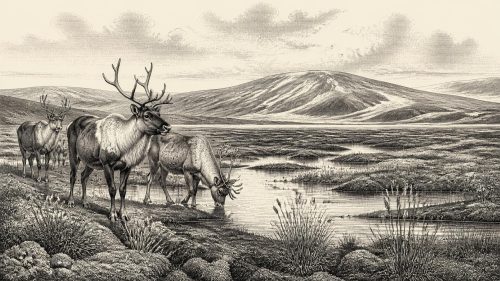
Reindeer are particularly evocative because their seasonal movements elsewhere in Ice-Age Europe made them important prey for mobile hunter-gatherers. That European comparison helps explain why a butchered reindeer bone would be meaningful, but it cannot fill the Irish evidential gap. There is no basis for claiming a named people, a language, an ethnic identity, a tribe, or an Aurignacian or Gravettian cultural affiliation for any possible visitors to Castlepook. Nor can the sparse material establish whether people arrived as a party following game, on an exploratory journey, or during repeated but separate visits.
The surrounding environment should not be imagined as Ireland’s modern green, hedged countryside. Vegetation and terrain shifted with climate, altitude, exposure and ice cover. Open, cold grassland, herb-rich steppe-tundra and sparse shrub vegetation would have supplied grazing in suitable areas, while limestone caves offered sheltered dens and traps for bones rather than straightforward homes. Large mammals imply productive grazing landscapes somewhere within the region, but their remains do not prove that every part of the island was similarly habitable. Coastal plains now drowned by post-glacial sea-level rise may also have held evidence that is inaccessible or destroyed.
Ice, Sea and Changing Ground
In the long view, this was an Ireland on the approach to profound environmental disruption. Reconstructions of the British–Irish Ice Sheet show major growth through the interval from about 31,000 to 15,000 years before present, with the maximum ice volume reached around 23,000 years ago. Research on Ireland’s shelf and mountains indicates that, at the Last Glacial Maximum, approximately 27,000–23,000 calibrated years before present, ice covered Ireland and extended over much of its continental shelf. That maximum lay thousands of years after the nominal year considered here, but it explains why early evidence is so fragile: later glacier ice eroded, buried and rearranged much of the older terrestrial record.
At c. 31,957 BCE, conditions were not uniform or static. The ice sheet grew and altered its margins over millennia, and scientific reconstructions are refined as new exposure dates, marine cores and landform mapping are added. It is safer to picture a cold, variable Atlantic fringe than a single frozen tableau. Sea levels were lower globally because water was retained in ice sheets, changing the extent of the continental shelf and coastlines. Even so, Ireland’s insular position was a major ecological constraint. It helped restrict the later recolonisation of plants and animals and would have presented a serious barrier to any human movement.
The physical legacy of these climatic transformations remains visible in Ireland’s U-shaped valleys, corries, streamlined bedrock, tills, eskers, drumlins and lake basins. Most were formed or strongly remodelled by later stages of the glaciation and deglaciation, not in one moment in 31,957 BCE. They are evidence of the processes that made the deep prehistoric past difficult to recover as much as they are reminders of the Ice Age itself.
No Polities, No Recorded Conflicts
Political affairs, diplomacy and organised warfare cannot be described for Ireland at this date because the evidence does not support them. There were no Irish kingdoms, no known territorial boundaries, no inscriptions and no historical actors. If people did reach the island, they would have lived in very small, mobile hunter-gatherer groups, as is broadly consistent with Upper Palaeolithic lifeways elsewhere in Europe. That is an informed comparative interpretation, not a fact demonstrated by an excavated Irish camp.
The same restraint applies to everyday life. A sharp cut on a reindeer bone, if anthropogenic, suggests knowledge of a cutting implement and the processing of animal tissue. It does not reveal how meat was shared, where people slept, whether they made clothing, or how long they remained. Fire, shelters, woodwork, hide-working, ornaments and hunting weapons may all have been used by comparable European populations, but none can responsibly be assigned to Ireland in this particular period without direct evidence.
Culture Beyond Recovery
There is likewise no Irish evidence from around this date for religious practice, ritual, art, teaching, music or formal exchange networks. Caves can easily invite romantic assumptions of sacred spaces or painted chambers, but Castlepook’s securely identified significance is palaeontological and archaeological, not evidence of Palaeolithic cave art or ceremony. The animals represented there may have been hunted, scavenged, preyed upon by carnivores or naturally accumulated in the cave system. Each possibility must be tested bone by bone.
Trade in the usual sense is equally beyond demonstration. There are no known imported artefacts or sourceable toolstones of this date from Ireland. Any human movement would have connected Ireland, however fleetingly, with the wider European world, but that is not proof of a durable exchange route. The fundamental economic relationship visible in the record is between large herbivores, predators, climate and changing habitat. If people were present, their subsistence depended on entering that ecological web rather than on farming, herding or commerce.
What Can Be Said
Ireland around 31,957 BCE was not yet a historical society but a changing Late Pleistocene environment at the Atlantic edge of Europe. The strongest evidence concerns fauna and climate: reindeer and other cold-stage animals occurred in Ireland during this broad era, while the British–Irish Ice Sheet was growing towards a later maximum that would dramatically reshape the land. The Castlepook reindeer femur offers a tantalising possible sign that humans encountered and butchered one of those animals. It deserves continued investigation, not unqualified certainty.
That measured conclusion is still consequential. It shifts attention from a simple story in which Ireland was first visited only after the last ice retreat to a more complex possibility of earlier, discontinuous human contact. Future excavation, microscopic study of the mark, new direct dates, sediment analysis and the discovery of securely stratified tools may confirm, qualify or overturn the present interpretation. For now, the most historically honest picture is of a sparsely evidenced Ice-Age Ireland: alive with animals, increasingly vulnerable to advancing ice, and perhaps briefly entered by people whose presence survives in no more than a single marked bone.
Primary Sources
- First Evidence of a Late Upper Palaeolithic Human Presence in Ireland
- New Insights on the Fauna of Ireland's Younger Dryas and Early Holocene from Alice & Gwendoline Cave
- A Reconsideration of the Radiocarbon Dating of the Marine Isotope Stage 3 Fauna from Southern Ireland
- The Irish Quaternary Fauna Project
- 2022:564 – Castlepook Cave, Castlepook South, Cork
- Archaeology Research Excavation Grant 2022: Castlepook Cave Final Report
- Heritage Artefacts of County Cork 2021
- The Mesolithic in Ireland: When Was It?
- The Colonization of Ireland: A Human Ecology Perspective
- Ireland: Submerged Prehistoric Sites and Landscapes
- Growth and Retreat of the Last British–Irish Ice Sheet, 31,000 to 15,000 Years Ago: The BRITICE-CHRONO Reconstruction
- Maximum Extent and Dynamic Behaviour of the Last British–Irish Ice Sheet West of Ireland
- Dimensions and Chronology of the Last Ice Sheet in Western Ireland
- Trimlines, Blockfields and the Vertical Extent of the Last Ice Sheet in Southern Ireland
- Deglaciation Chronology of the Donegal Ice Centre, North-West Ireland
- Stratigraphic and Palaeo-Geomorphological Evidence for the Glacial-Deglacial History of the Last British-Irish Ice Sheet in the North-Western Irish Sea
- Oscillating Retreat of the Last British-Irish Ice Sheet on the Continental Shelf Offshore Galway Bay, Western Ireland
- Quaternary
- Geology of Ireland
- The IntCal20 Northern Hemisphere Radiocarbon Age Calibration Curve (0–55 cal kBP)