Castlepook Reindeer Incision31974 BCE
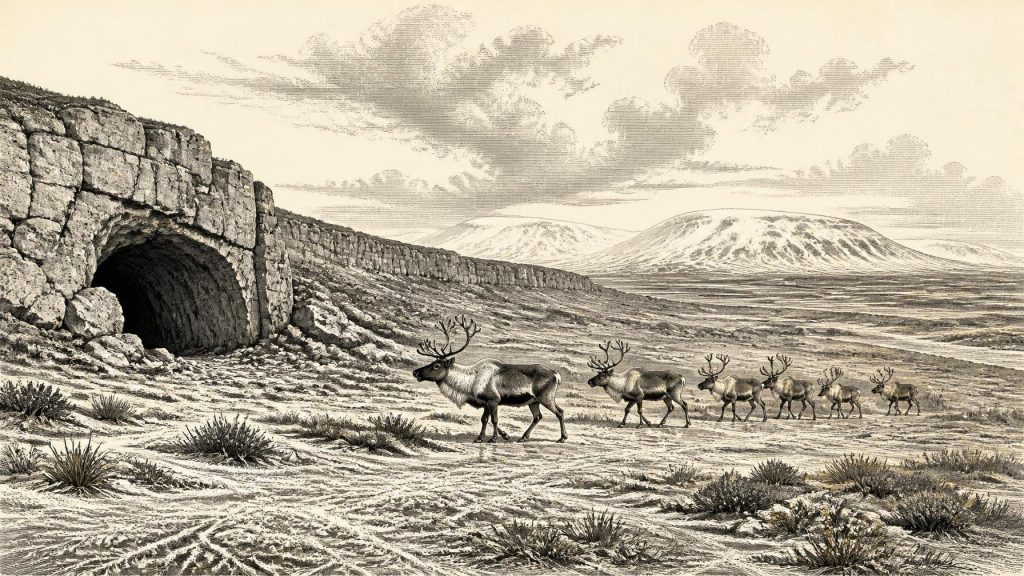
Around 31,974 BCE, Ireland was entering an unstable, increasingly severe phase of the last glacial cycle, though conditions varied regionally and cannot be reconstructed for a single year. Ice had not yet reached its maximum extent, but landscapes, coastlines and routes of access were changing as sea levels fell. Cave finds show cold, open environments supporting reindeer, bears, mammoth and other fauna. At Castlepook Cave, County Cork, a reindeer femur possibly cut with a stone tool, dated about 33,000 years ago, may represent Ireland’s earliest human activity. It proves neither settlement nor hunting. Later glaciation obscured evidence; occupation came post-glacially.
Dateline
The label 31,974 BCE is a modern way of placing a very remote point in time, not a date that people then used or could have recorded. In archaeological terms it corresponds approximately to 33,900 calendar years before present (where “present” conventionally means AD 1950). No evidence can identify an occurrence in this particular calendar year. The responsible question is therefore what Ireland was like within a broad interval around c. 34,000 calibrated years ago, in the Late Pleistocene, and what the fragmentary evidence can—and cannot—say about human activity.
This was a world long before written history, farming, permanent villages, metalworking, named peoples or political institutions in Ireland. It lay within the Midlandian cold stage, the Irish expression of the last glacial cycle. Around this date, the island’s landscape was entering a climatically unstable and increasingly severe phase before the Last Glacial Maximum. Ireland’s later Ice Age landscape, its soils, drainage and coastal shape would be profoundly altered by the advancing and retreating ice, but the precise condition of each district in 31,974 BCE cannot be reconstructed with calendar-year certainty.
Dating a Landscape, Not a Year
Archaeologists and Quaternary scientists use several clocks. Radiocarbon dates on bone are calibrated against changing atmospheric carbon levels and normally produce date ranges rather than a single exact year. Luminescence dating estimates when sediment was last exposed to light, while cosmogenic dating measures how long rock surfaces have been exposed to cosmic rays. Each method has uncertainties, and the evidence is unevenly distributed. A bone date records the death of an animal, not automatically the arrival of people; a glacial deposit can show that ice passed through an area, but not the weather on a particular day.
This caution matters especially in Ireland. Later glaciers eroded, transported and buried much of the earlier record. Many surviving Pleistocene animal bones were recovered from caves during nineteenth- and early twentieth-century excavations, often before modern recording standards. Cave sediments may have been disturbed by water, animals, earlier digging and later human activity. Consequently, the evidence is exceptionally valuable but must be read critically. Absence of a hearth, stone tool or dwelling may reflect destruction and discovery bias as much as the absence of people.
An Island Approaching Full Glaciation
At roughly 34,000 calibrated years ago, Ireland stood close to an important transition. Research on trimlines, glacially transported boulders, sediments and exposure ages indicates that parts of north-central Ireland remained ice-free until at least about 34 ka. The large BRITICE-CHRONO reconstruction begins at 31 ka because earlier constraints are sparse; at that later benchmark it models ice accumulation centres in Northern Ireland as the British–Irish Ice Sheet was developing. These findings do not justify a simple map coloured either wholly “ice” or wholly “ice-free” for 31,974 BCE. They instead show a changing mosaic in which uplands, local ice, open ground, snowfields and marine margins may have differed sharply across short distances.
The fully developed Last Glacial Maximum came later. Current syntheses place the greatest extent of Irish and British ice broadly around 27,000–23,000 cal BP, although individual ice lobes reached their maxima at different times. At that point ice covered Ireland and much of its continental shelf, in places extending to the Atlantic shelf edge. The scene around 31,974 BCE was therefore not the familiar post-glacial Ireland of lakes, blanket bog and woodland. It was part of the build-up to a much harsher glacial regime, with the scale and timing of ice advance still debated in detail.
Sea level was lower than today because vast quantities of water were stored in global ice sheets. The outline of the Irish landmass and its surrounding shelves was consequently different, but routes between Ireland, Britain and continental Europe are not safely reducible to a single “land bridge” story. Relative sea level depended on both global ocean volume and the rise or depression of the Earth’s crust under ice loading. Models and geological interpretations differ over precisely when dry, walkable links existed. What is clear is that the geography of access, animal movement and possible human travel was changing, and that sea, lowlands, ice and exposed shelf formed a dynamic rather than modern map.
The Castlepook Clue
The closest known evidence relevant to this broad period comes from Castlepook Cave, near Doneraile in north County Cork. Its old cave collections, now associated with the National Museum of Ireland, include abundant Late Pleistocene animal remains. A reindeer femur bearing a mark interpreted as having been made by a sharp stone implement has been publicised as dating to about 33,000 years ago, or approximately 31,000 BCE. That makes it potentially close in time to the year represented here and potentially the earliest evidence of human action in Ireland.
The wording is important. The bone supports neither a named community nor a settled population. It does not establish that hunters lived at Castlepook, that they occupied the cave, or even that the animal was killed there. The bone could have been processed elsewhere and its remains later carried into the cave by scavengers or water. No securely associated stone-tool assemblage, hearth, built shelter or human remains presently provides a fuller account of these possible visitors. Recent excavations and research projects have sought such contextual evidence, precisely because the historic collections alone cannot resolve every question.
Nevertheless, the marked reindeer bone is significant. If the mark is correctly identified as butchery and is contemporary with the dated bone, it indicates practical engagement with animal carcasses by people using a sharp tool. Such an episode would fit the wider European Late Upper Palaeolithic world, in which highly mobile hunter-gatherers moved through cold environments and exploited large mammals. It would not, however, licence assigning Ireland to an Aurignacian or Gravettian culture: those labels depend on distinctive artefact assemblages, and none has yet been securely recovered from this Irish context.
Cold Country and Mobile Fauna
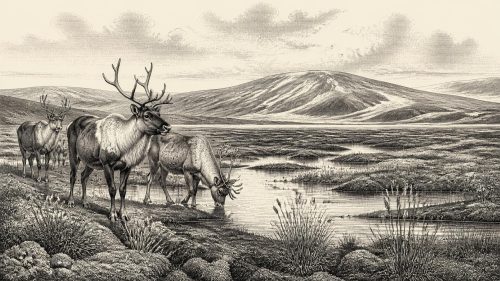
Castlepook and other Irish cave collections demonstrate that Late Pleistocene Ireland could support a striking, if changing, fauna. Reindeer, brown bear, giant deer, wolf, Arctic fox, lemmings, mountain hare, mammoth and spotted hyaena occur in the wider pre-Last Glacial Maximum record, though they were not necessarily all present in every locality or at the same moment. Improved radiocarbon pretreatment has revised some old dates substantially, underlining why a species list must not be treated as a photograph of a single year.
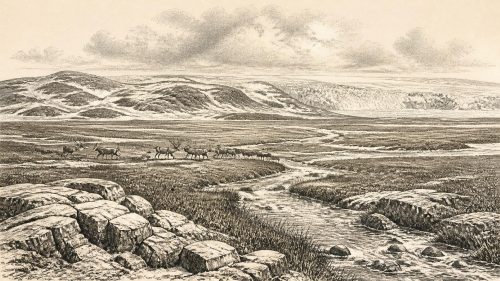
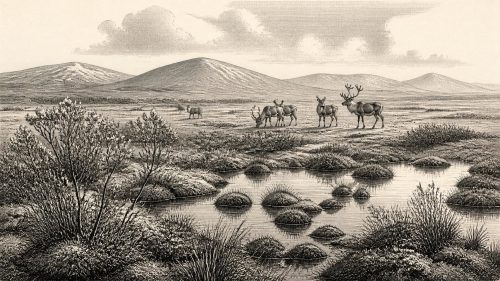
The most defensible broad environmental image is an open, cold landscape with grassland, herb-rich tundra or steppe-tundra vegetation rather than the closed forest often imagined for Ireland. Such terrain could sustain grazing and browsing animals, while caves offered denning places and places where bones accumulated. Frost weathering, seasonal snow, wind and increasingly extensive ice shaped the ground. Yet even this picture should be held at regional scale: local shelter, altitude, moisture, proximity to ice and changing climate would have created varied habitats.
Animals could have moved through this landscape in ways that people might follow, but fossils do not prove organised hunting. A cut-marked reindeer bone permits the narrower conclusion that carcass processing is plausible. Hunting, scavenging and the use of meat, hide, sinew, marrow or bone are reasonable possibilities, not documented facts for Ireland at this date. There is no direct evidence for food storage, clothing manufacture, fire-making practices or a seasonal round on the island, although all are known possibilities among contemporary hunter-gatherers elsewhere in Europe.
No Polities, No Recorded Diplomacy
Nothing supports claims about Irish kingship, tribes, warfare, treaties, religion or language in 31,974 BCE. There were no inscriptions and no indigenous oral traditions that can be traced securely to this depth of time. Nor are there monuments, burials or art in Ireland that can be assigned to this period. It would be misleading to describe a political map or a religious system simply because modern readers expect each year of history to have leaders and events.
If people did reach Ireland during this phase, the evidence best suits small, mobile groups rather than a state or a permanent village. Their social relationships, identities and beliefs are archaeologically invisible. Contact with groups in Britain or continental north-west Europe is conceivable because human populations there had sophisticated stone technologies and broad networks of movement; it is not demonstrated for Castlepook. Likewise, “trade” cannot responsibly be inferred without non-local materials or identifiable exchange goods. The likely economy, if humans were present, was direct use of local animal and plant resources rather than farming, markets or long-distance commerce known from later prehistory.
What This Distant Date Means
The chief development illuminated by 31,974 BCE is not a dated battle or foundation but a threshold: Ireland was moving towards extensive glaciation while retaining, at least in some places and times, environments used by Ice Age animals. The possible humanly modified reindeer bone from County Cork raises the prospect that people reached this north-western edge of Europe far earlier than the once-standard story of post-glacial settlement allowed. It is a powerful clue, but only a clue.
Later evidence is firmer. A butchered brown-bear bone from Alice and Gwendoline Cave, County Clare, has calibrated dates around 12,810–12,590 cal BP, and sustained Mesolithic settlement is documented only after the final retreat of the ice. Those much later milestones should not be projected backwards. For the time represented by 31,974 BCE, Ireland’s history is principally a history of ice, land, animals and a tantalising possibility of transient human presence—an evidence-based beginning rather than a fully recoverable human story.
Primary Sources
- Growth and retreat of the last British–Irish Ice Sheet, 31,000 to 15,000 years ago: the BRITICE-CHRONO reconstruction
- Trimlines, blockfields and the vertical extent of the last ice sheet in southern Ireland
- Late Pleistocene chronostratigraphy and ice sheet limits, southern Ireland
- A reconsideration of the radiocarbon dating of the Marine Isotope Stage 3 fauna from southern Ireland
- The Irish Quaternary Fauna Project
- First evidence of a Late Upper Palaeolithic human presence in Ireland
- New insights on the fauna of Ireland's Younger Dryas and Early Holocene from Alice & Gwendoline Cave
- The colonization of Ireland: A human ecology perspective
- Deglaciation, Earth crustal behaviour and sea-level changes in the determination of insularity: A perspective from Ireland
- The Island of Ireland: Drowning the Myth of an Irish Land-bridge?
- Ireland: Submerged Prehistoric Sites and Landscapes
- Quaternary
- Geology of Ireland
- Geological Mapping Programme
- Themes: Quaternary
- Archaeology Research Excavation Grant 2022: Final Report
- Heritage Artefacts of County Cork
- 2022:564 – Castlepook Cave, Castlepook South, Cork
- What was on the menu in prehistoric Ireland?
- Maximum extent and dynamic behaviour of the last British–Irish Ice Sheet west of Ireland
- Timing and pace of ice-sheet withdrawal across the marine–terrestrial transition west of Ireland during the last glaciation
- The deglaciation of the western sector of the Irish Ice Sheet from the inner continental shelf to its terrestrial margin