Castlepook Reindeer Marks31998 BCE
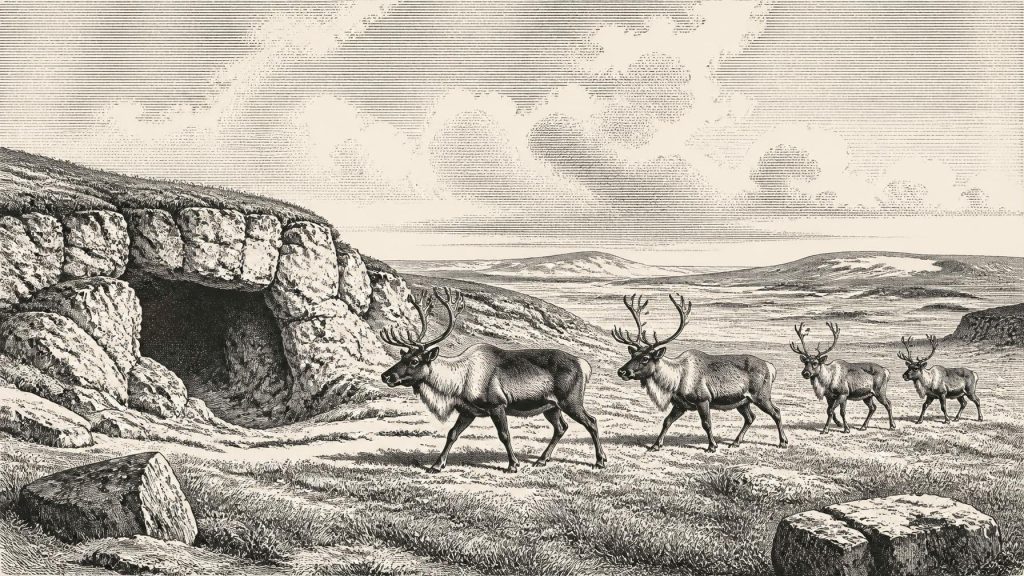
Approximately 34,000 years ago, Ireland was a cold, unstable Late Pleistocene landscape of open tundra-steppe, changing sea routes and advancing glaciation. Castlepook Cave, County Cork, preserves Ireland’s richest pre-Last Glacial Maximum vertebrate assemblage, accumulated over millennia and disturbed by natural processes and excavation. Its remains include mammoth, giant deer, reindeer, bears, hyaenas and other cold-adapted fauna, demonstrating episodic animal occupation rather than a single ecosystem. A reindeer femur bearing possible stone-tool cut marks may indicate a brief Upper Palaeolithic human visit around 33,000 years ago, but cannot prove settlement. Further research is needed; secure Irish occupation appears much later substantially.
Dateline
31,998 BCE is not a date that can be matched to a recorded Irish event. It is a modern calendar label applied to a time deep in the Late Pleistocene, long before writing, states, named peoples or even securely documented settlement on the island. Calendar-year precision is therefore unavailable. Indeed, 31,998 BCE is approximately 33,947 years before the radiocarbon convention of AD 1950, while archaeological ages are normally expressed as radiocarbon years or calibrated years BP (‘before present’). The responsible approach is to consider a broad window around 34,000 calibrated years ago, within Marine Isotope Stage 3, rather than imagine happenings on a particular day or in a particular year.
For Ireland, this is a threshold period: a cold, changing north-western landscape that still supported large mammals, but was moving towards the vastly more severe glaciation of the Last Glacial Maximum. The most directly relevant evidence comes from caves, especially Castlepook Cave near Doneraile in north County Cork. It provides a rare, incomplete and exceptionally important record of animals living in Ireland before the ice sheet reached its later maximum extent. It also contains a provocative possible trace of human activity. That trace deserves attention, but not certainty beyond what the evidence can bear.
A Landscape in Transition
Around this broad date Ireland lay at Europe’s Atlantic north-western edge. Sea level was much lower than today because immense quantities of water were locked in continental ice sheets. The present coastline, Irish Sea and continental shelf cannot simply be projected backwards: exposed plains, changing channels and ice barriers altered routes between Ireland, Britain and continental Europe. Whether a particular crossing was practicable depended not only on distance, but on season, weather, sea ice, rivers and the advance of glaciers. Later reconstructions show Ireland becoming fully engulfed at the Last Glacial Maximum, conventionally placed around 27,000–23,000 calibrated years BP; that maximum lay in the future of the date considered here.
The onset, extent and rhythm of ice growth remain active subjects of research. Some syntheses describe much of Ireland as ice-free until about 32,000 calibrated years BP, while newer reviews stress evidence for earlier, spatially varied glaciation and the difficulty of reconstructing a mobile British–Irish Ice Sheet. Thus it is unsafe to picture all of Ireland at 31,998 BCE as either a single unbroken ice cap or a hospitable, wholly ice-free plain. What can be said is that the climate was markedly colder than today, vegetation was open rather than wooded, and conditions were becoming more unstable and demanding.
In such a setting, ‘Ireland’ did not look like the green, hedged and wooded island familiar now. There were no oak forests, fields, bog-cut roads or settled coasts. Sparse grassland, herb-rich tundra-steppe vegetation, exposed limestone, river valleys and patches of bare or frost-shattered ground would have varied locally with altitude and proximity to ice. These are reconstructions from geological landforms, sediments, pollen and animal remains, not a view of one unchanging national landscape. Cold-stage environments could be productive for grazing animals in favourable seasons, yet they were vulnerable to abrupt climatic shifts.
Castlepook and the Animal Evidence
Castlepook Cave is central because it is Ireland’s richest known cave archive for vertebrate life leading up to the Last Glacial Maximum. Excavations conducted in the early twentieth century recovered more than 2,000 bones from its narrow galleries and chambers. Subsequent radiocarbon work indicates that the cave accumulated mammal remains over a very long span, approximately 45,700 to 19,950 years BP. That range is crucial: the assemblage is not a neatly sealed snapshot of a single year, generation or even millennium. Water disturbance, carnivore activity and antiquarian excavation have mixed and obscured parts of its history.
Nevertheless, the fauna establishes that Ice Age Ireland supported a striking range of mammals at different points in that long interval. Castlepook has yielded woolly mammoth, giant deer, reindeer, brown bear and spotted hyaena, with Arctic fox, wolf and lemmings represented in later cold-phase deposits. Reindeer and mammoth bones speak to open grazing landscapes; hyaena and wolf bones to formidable predators and scavengers. They do not prove that every species met at one place or one moment. Cave assemblages are shaped by how carcasses arrived, which animals used a cave, and which bones survived. At Castlepook, hyaena use is especially relevant: a carnivore den can collect prey remains without any human involvement.
The presence of this fauna matters for Irish history even where no people are demonstrable. It shows that the island was not simply an empty block of ice throughout the Late Pleistocene. Animals colonised or re-colonised changing landscapes, following ecological corridors that later vanished under sea or ice. Their populations were probably fragmented and repeatedly pressured by climate change. The later fate of Irish brown bears illustrates the point: modelling suggests that a small southern refugium would have been unlikely to sustain them through the Last Glacial Maximum, although the question has been debated through fossil and genetic evidence.
A Possible Human Visit
Public reporting in 2021 drew attention to a reindeer femur fragment from Castlepook Cave that had been recovered in 1972. Ruth Carden identified deep marks said to be consistent with butchery by a broad stone or flint tool, and radiocarbon dating was reported as placing the bone about 33,000 years ago. If the marks are confirmed as human-made and contemporaneous with the animal’s death, the find would provide evidence that Upper Palaeolithic people reached Ireland far earlier than the formerly accepted late-glacial evidence. It would fit broadly with a period in which modern humans were present elsewhere in north-west Europe and depended heavily on large game, including reindeer.
But the wording matters. A cut-marked bone is evidence for an action on an animal carcass, not evidence for a village, a permanent population or a named cultural group. No securely associated hearth, stone-tool assemblage, dwelling floor, burial, artwork or human bone has yet established a 32nd-millennium BCE community in Ireland. The Castlepook human interpretation has not displaced the need for further peer-reviewed publication, re-excavation and securely stratified finds. Its archaeological setting is difficult precisely because the cave deposits have a long, disturbed history. The scientifically sound conclusion is that a short hunter-gatherer incursion is possible, perhaps to exploit reindeer, but sustained settlement remains unproven.
This distinction also prevents anachronism. These people, if present, cannot responsibly be called Irish in an ethnic, linguistic or political sense. There is no evidence for kingdoms, chiefs, tribal names, diplomacy, warfare, law, agriculture, trade networks or social institutions on the island at this date. Nor is there Irish evidence for religious ceremony, formal learning, monuments or art of this antiquity. Upper Palaeolithic societies elsewhere in Europe made sophisticated tools and powerful art, but similarities beyond Ireland cannot fill the evidential gap here. They offer context, not proof of equivalent activities at Castlepook.
Everyday Life: What May Be Inferred
If a small party did enter the island during this phase, its life would have been mobile and organised around survival in a cold open environment. Reindeer would have offered meat, fat, hide, sinew, bone and antler; stone tools could have served in dismembering and processing a carcass. Groups would have required detailed environmental knowledge, clothing, fire-making skills and social cooperation. Yet these are cautious inferences from the practical demands of Upper Palaeolithic hunting and the possible modification of the Castlepook bone, not observations of an excavated Irish camp.
Nor should the cave itself automatically be imagined as a home. Caves preserve bones well, but they may be places where carnivores dragged prey, water washed sediment, or people briefly sheltered. Castlepook’s galleries were part of a karst system in limestone lowland, not a ready-made record of ordinary domestic life. The bones tell us more securely about Ice Age animal communities and palaeoecology than about human households. The lack of a surviving settlement record may reflect genuine rarity of human visits, but it also reflects later erosion, glacial scouring, rising seas and the uneven survival of evidence.
Why This Distant Moment Matters
31,998 BCE therefore belongs less to conventional narrative history than to the preconditions of Irish history. It captures Ireland before permanent settlement, when climate and geography repeatedly remade the possibilities for animals and people. In the following millennia, the advancing ice sheet would erase or bury much of this earlier landscape. Far later, after deglaciation and renewed environmental change, a securely dated butchered brown-bear patella at Alice and Gwendoline Cave in County Clare dates to about 12,810–12,590 calibrated BP, and substantial Mesolithic settlement is evident only by about 8000 BCE.
The lesson is not that Ireland has a continuous human story stretching back to this exact calendar year. It is that the island’s deep past is still being recovered from cave collections, re-dating programmes and environmental science. Castlepook’s reindeer bone may eventually revise the chronology of first human contact; for now, it most responsibly signals a compelling possibility amid a well-attested Ice Age world of reindeer, mammoth, predators and approaching ice.
Primary Sources
- Castlepook Cave, County Geological Site Report
- A Reconsideration of the Radiocarbon Dating of the Marine Isotope Stage 3 Fauna from Southern Ireland
- The Irish Quaternary Fauna Project
- First Evidence of a Late Upper Palaeolithic Human Presence in Ireland
- New Insights on the Fauna of Ireland’s Younger Dryas and Early Holocene from Alice & Gwendoline Cave
- The Colonization of Ireland: A Human Ecology Perspective
- Maximum Extent and Dynamic Behaviour of the Last British–Irish Ice Sheet West of Ireland
- Pattern and Timing of Retreat of the Last British–Irish Ice Sheet
- Growth and Retreat of the Last British–Irish Ice Sheet, 31,000 to 15,000 Years Ago: The BRITICE-CHRONO Reconstruction
- Dimensions and Chronology of the Last Ice Sheet in Western Ireland
- Trimlines, Blockfields and the Vertical Extent of the Last Ice Sheet in Southern Ireland
- Ireland: Submerged Prehistoric Sites and Landscapes
- Could Brown Bears (Ursus arctos) Have Survived in Ireland During the Last Glacial Maximum?
- Genetic Turnovers and Northern Survival During the Last Glacial Maximum in European Brown Bears
- Anthropogenic Changes to the Holocene Nitrogen Cycle in Ireland
- The Mesolithic in Ireland: When Was It?
- Reindeer Bone Found in Cork Cave Shows Human Activity in Ireland 33,000 Years Ago
- The Exploration of Castlepook Cave, Co. Cork
- New Data for the Last Glacial Maximum in Great Britain and Ireland
- The Timing and Magnitude of the British–Irish Ice Sheet Between Marine Isotope Stages 5d and 2