Before Maximum Ice31950 BCE
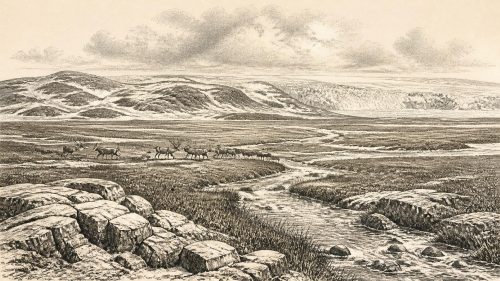
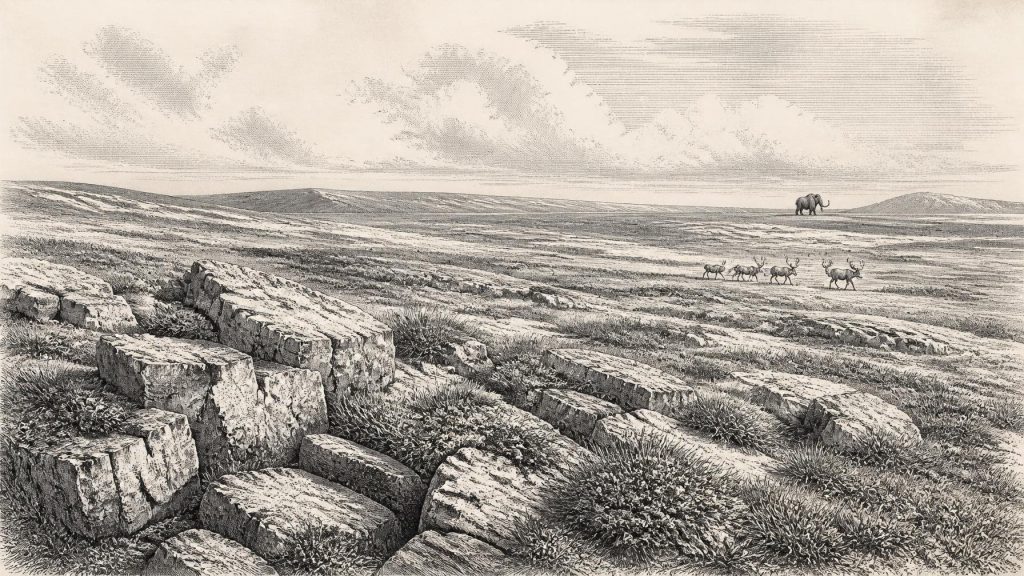
Around 31,950 BCE, Ireland lay within the Midlandian cold stage of the Late Pleistocene, before the Last Glacial Maximum. Its treeless, periglacial landscapes comprised tundra, grasses, sedges, dwarf shrubs, unstable rivers and frost-shattered ground, while lowered seas altered coastlines without necessarily providing easy land routes. Cave deposits, especially Castlepook in Cork, preserve evidence of mammoth, reindeer, giant deer, predators and Arctic-adapted mammals, though accumulated remains cannot reconstruct one ecosystem. A possibly cut-marked reindeer bone, dated near 33,000 years ago, may indicate human butchery. Yet no settlement, tools, hearths or continuous occupation are established. It represents environmental change and tentative presence.
Dateline
31,950 BCE is not a year for which Irish history can be written in the ordinary sense. It is a modern, backward-counted calendar label, roughly 33,900 years before the conventional radiocarbon reference year of AD 1950, not a date that can be matched to an Irish event, ruler, settlement or season. No written record exists; no named person can be recovered; and neither archaeological nor geological dating can normally resolve Ireland’s Late Pleistocene past to a single calendar year. The responsible frame is therefore a span around this nominal date, expressed through radiocarbon determinations, calibrated ranges where available, and the broader Late Pleistocene sequence.
In archaeological terms, this was the Upper Palaeolithic, within the last cold stage of the Pleistocene. In Irish glacial terminology it falls in the Midlandian; in the wider North Atlantic chronology it belongs to Marine Isotope Stage 3, before the Last Glacial Maximum. That maximum was later: research places the greatest expansion of the British–Irish Ice Sheet broadly between about 27,000 and 19,000 years ago, although its timing and shape varied by region. Around 31,950 BCE, Ireland was moving through a harsh, unstable Ice Age world whose landscapes, coastlines, plants and animal communities were very different from those of the modern island.
A Date Beyond Calendar Precision
It is important not to turn the number 31,950 BCE into false precision. Radiocarbon laboratories report ages in radiocarbon years before present, with statistical uncertainty; calibration against independently dated records translates these into calendar ranges that can be broad, especially this far back. Geological evidence is often less precise still, dating an advance, retreat, sediment layer or exposed rock surface within centuries or millennia. Consequently, “Ireland in 31,950 BCE” means Ireland in the vicinity of a notional point in time, not a documented year.
The evidence is also uneven. The last ice sheet removed, reworked and buried much of the older ground surface. Later erosion, rising seas and the acidic conditions that commonly destroy bone and wood on open land have reduced what survives. Limestone caves are exceptional because they can preserve animal remains and sediments. Yet cave deposits have their own difficulties: bones may have been dragged in by predators, washed through passages, disturbed by later animals, or excavated before modern recording standards existed. The absence of an open-air camp from this period cannot prove that no human ever entered Ireland; equally, it cannot be used to invent a settled population.
A Cold, Open Landscape
The most secure picture is environmental. Inland Ireland was not the wooded country familiar today. Evidence from Derryvree in south Fermanagh, where freshwater silts and sands produced a radiocarbon age of 30,500 ± 1,170/1,030 BP, indicates open tundra vegetation and periglacial conditions in a comparable part of the middle Midlandian cold phase. Plant remains and pollen point to sparse herbaceous ground cover, mosses, sedges and grasses, with dwarf shrubs and willows in suitable niches. Pollen from trees can travel great distances, so isolated grains of pine or hazel do not demonstrate local woodland.
This evidence should not be stretched into a detailed weather report for every county in 31,950 BCE. Conditions differed with altitude, exposure, drainage and the changing position of ice. Nevertheless, a generally treeless mosaic of tundra, steppe-like grassland, bare sediment, frost-shattered slopes and wet ground is a more defensible image than forest or permanent agricultural pasture. Winter cold, strong winds and short productive seasons would have constrained animals and people alike. Rivers carried glacial sediment, while repeated freezing and thawing broke rock and moved soil downslope.
Ireland was also geographically unlike its present form. Global sea level was lower because vast quantities of water were stored in ice sheets, exposing portions of the continental shelf. But low sea level did not automatically make a simple dry route from Ireland to Britain or continental Europe. Irish Sea bathymetry, changing ice margins, glacio-isostatic movements of the land and marine channels made connectivity complicated. The long-standing assumption of an easy Irish land bridge has been challenged by marine and sea-level research. At this date, travel between landmasses cannot responsibly be described as a straightforward walk; water, ice and dangerous coastal terrain could all have been formidable barriers.
Animals of the Ice Age
Irish cave collections demonstrate that this was a land capable, at least at intervals, of supporting a striking cold-climate fauna. Castlepook Cave, near Doneraile in north County Cork, is especially important. Material recovered there includes remains attributed to woolly mammoth, reindeer, giant deer (Megaloceros giganteus), brown bear, wolf, Arctic fox, mountain hare, lemmings and spotted hyaena. The giant deer is often called the “Irish elk”, but that popular name is misleading: it was neither confined to Ireland nor a close relative of modern elk.
These finds do not establish that all those species stood together outside the cave at one moment. Castlepook accumulated remains over a long period, and carnivores were major agents in the formation of bone deposits. Spotted hyaenas, in particular, could transport carcass parts and leave material in dens. A mammoth bone, a hyena jaw and a reindeer limb may represent different episodes separated by very long intervals. What the assemblage securely shows is the existence of an Ice Age animal world in Ireland before the later maximum glaciation, rather than a single perfectly reconstructable ecosystem.
For animals, as for people, regional change was decisive. Ice-sheet reconstructions show that expansion did not occur as one uniform white blanket advancing everywhere at once. Some uplands may have retained cold-based ice or exposed summits, while other sectors were overtaken by erosive, moving ice. The western, southern, central and Irish Sea sectors have produced evidence that has prompted competing reconstructions. By the Last Glacial Maximum, much or all of Ireland was substantially covered by ice, and the ice sheet extended beyond the modern shoreline in several directions. That later expansion destroyed or concealed much of the landscape relevant to this earlier period.
The Fragile Human Trace
The question of people is the most compelling and the least secure. Castlepook has yielded a reindeer femur fragment reported to bear chop marks consistent with cutting by a sharp stone tool and to date to about 33,000 years ago. If the marks are correctly identified as anthropogenic and the dated bone belongs to the same episode of modification, the find offers evidence of human handling of a reindeer remarkably close to the nominal date considered here. It would push possible human activity in Ireland far earlier than the formerly accepted Late Upper Palaeolithic evidence from County Clare.
Its significance demands caution rather than certainty. The fragment comes from an old cave collection and is not part of a modern, tightly excavated activity floor. No securely associated hearth, dwelling, human burial, stone-tool assemblage or butchery area of the same age has yet been recovered. A cut-marked bone can suggest an encounter, a kill-site visit or carcass processing; it cannot establish a village, continuous residence, population size, language, kinship system or migration route. It is therefore best treated as a potentially momentous but very small human footprint.
That distinction matters because Upper Palaeolithic people elsewhere in north-west Europe were highly capable hunters and makers of sophisticated stone, bone and antler equipment, but Ireland need not have shared every feature of their lives simply because it lay at the edge of their world. If people reached southern Ireland around this time, they may have been mobile foragers exploiting seasonal opportunities, perhaps focused on large game and familiar with hides, meat, marrow, sinew and bone. That is an inference from the practical requirements of cold-climate hunting and from the possible reindeer processing at Castlepook, not direct evidence for an Irish camp or household.
No Polities, No Trade Networks
There were no demonstrable political affairs in Ireland at this date. Archaeology supplies no chiefs, tribes, territories, alliances, wars or diplomatic encounters. Nor is there evidence for farming, herding, metallurgy, pottery, monuments, formal burial rites, ritual structures, art or literacy. It would be misleading to fill these absences with imagined Ice Age clans or religious ceremonies. The archaeology is simply not rich enough.
The same restraint applies to economy and trade. A single possible butchered bone does not reveal exchange networks or regular commerce. Hunting and scavenging, if people were present, would have been forms of subsistence rather than an economy documented by stores, settlements or traded goods. Any connection with Britain or mainland Europe remains a hypothesis about movement across a changing glacial seascape, not evidence for sustained contact. At most, the wider European Upper Palaeolithic provides a comparative context showing that human groups elsewhere possessed the knowledge to travel, cooperate and process animal resources under severe conditions.
What This Year Represents
The historical importance of 31,950 BCE lies not in an event but in a threshold of possibility. Ireland was an Arctic-fringed, open and changing land before the greatest advance of the last ice sheet. Its caves preserve proof of animals now absent from the island, while Fermanagh sediments preserve a rare glimpse of tundra vegetation. Castlepook Cave may preserve an even more consequential clue: a reindeer bone that could record human butchery at roughly this remote time.
For now, however, the evidence supports neither a founding population nor a continuous Irish occupation. It supports a landscape of cold, mobile ice and open ground; an intermittent fauna of mammoth, reindeer, giant deer, predators and small Arctic-adapted mammals; and the possibility of brief human presence at Europe’s western edge. Future cave excavation, microscopic study of bone modification, improved radiocarbon pretreatment, ancient DNA and submerged-landscape research may change that picture. The honest story of Ireland around 31,950 BCE is therefore one of deep time, severe environment and a tantalising trace rather than a named chapter of human history.
Primary Sources
- The Irish Quaternary Fauna Project
- Radiocarbon, Volume 16, Number 1: Geological Samples, including Castlepook Cave
- Last Glacial Maximum Cirque Glaciation in Ireland and Implications for Reconstructions of the Irish Ice Sheet
- Dimensions and Chronology of the Last Ice Sheet in Western Ireland
- Trimlines, Blockfields and the Vertical Extent of the Last Ice Sheet in Southern Ireland
- Late Pleistocene Chronostratigraphy and Ice Sheet Limits, Southern Ireland
- Timing and Pace of Ice-Sheet Withdrawal across the Marine–Terrestrial Transition West of Ireland During the Last Glaciation
- Stratigraphic and Palaeo-Geomorphological Evidence for the Glacial-Deglacial History of the Last British-Irish Ice Sheet in the North-Western Irish Sea
- Pattern and Timing of Retreat of the Last British-Irish Ice Sheet
- Radiocarbon Constraints on the Age of the Maximum Advance of the British-Irish Ice Sheet in the Celtic Sea
- Maximum Extent and Readvance Dynamics of the Irish Sea Ice Stream and Irish Sea Glacier Since the Last Glacial Maximum
- Palaeoecology: The Middle Midlandian Palaeoenvironment of South Fermanagh
- Landscapes and Environments of the Last Glacial-Interglacial Transition: A Time of Amazingly Rapid Change in Ireland
- Deglaciation of the Burren Glacio-Karst, Western Ireland, During Termination 1
- The Problem of a Late Quaternary Landbridge Between Britain and Ireland
- The Island of Ireland: Drowning the Myth of an Irish Land-Bridge?
- Ireland: Submerged Prehistoric Sites and Landscapes
- Prehistoric Details
- Learn About: The Ice Age
- The Mesolithic in Ireland: When Was It?
- First Evidence of a Late Upper Palaeolithic Human Presence in Ireland
- New Insights on the Fauna of Ireland's Younger Dryas and Early Holocene from Alice & Gwendoline Cave