Crag Cave Interstadial31,949 BCE
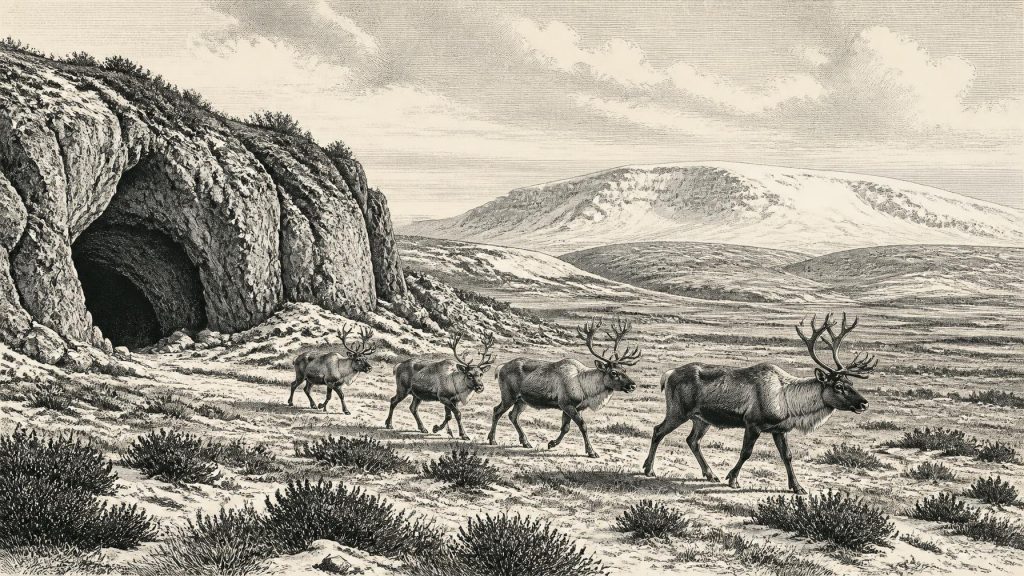
The label 31,949 BCE offers a useful point on a modern chronological scale, but it must not be mistaken for a date that Ice Age people in Ireland could have recognised, or that archaeologists can identify as a discrete historical year. There were no written records, named communities, calendars, states or documented events on the island. In archaeological terms, this notional year falls broadly around 34,000 calibrated years before present (cal BP; “present” conventionally means 1950), within the Late Pleistocene and Marine Isotope Stage 3. At this depth of time, calibration ranges and regional environmental sequences are more responsible than a claim about one particular year.
At the Edge of a Changing Ice Age
Ireland lay on Europe’s Atlantic north-western fringe during a climatically unstable phase of the last Ice Age. It was not yet the fully ice-covered landmass of the Last Glacial Maximum, generally placed at about 26,000–19,000 cal BP, but the conditions that would produce that maximum were gathering strength. Research on the British–Irish Ice Sheet indicates that ice expansion was already under way in parts of the wider archipelago by about 31,000 years ago. Its precise limits earlier in the sequence are uncertain, and Ireland’s conditions were not uniform. Uplands, northern districts, Atlantic margins and lower southern landscapes could have had sharply different local histories.
The best interpretation for a point around 31,949 BCE is therefore neither a wholly frozen Ireland nor a mild, wooded one. Southern Ireland appears to have retained ice-free ground during portions of late Marine Isotope Stage 3, while glaciers and ice caps were developing elsewhere. Speleothem evidence from Crag Cave in County Kerry supports phases suitable for cave-calcite formation between roughly 38,000 and 34,000 years ago and again between 32,000 and 30,000 years ago. Such evidence does not produce a weather report for a single day or season, but it shows that southern Irish environments were changing rapidly rather than remaining locked in one immutable condition.
Sea level was considerably lower than today because immense quantities of water were stored in continental ice sheets. Reconstructions for about 31,000 years ago suggest levels broadly 50–100 metres below the modern shoreline around Britain and Ireland. The coastlines were consequently displaced, with wider coastal plains in some areas. Yet it would be rash to draw a simple road map between Ireland, Britain and continental Europe. The shape, width and passability of sea passages altered through time, and no Irish evidence from this period demonstrates the route by which animals—or any people—might have reached the island.
Castlepook and the Animal World
The most important Irish archive for this remote interval is Castlepook Cave, also called Mammoth Cave or Doneraile Cave, near Doneraile in north County Cork. Excavations and later investigations recovered a remarkable collection of Pleistocene animal remains. Geological Survey Ireland describes it as Ireland’s richest known vertebrate-fauna site for the period leading towards the Last Glacial Maximum. The wider cave record includes reindeer, woolly mammoth, giant deer, brown bear, wolf, Arctic fox, mountain hare, collared lemming, Norwegian lemming and spotted hyaena.
That list needs careful handling. The cave contains deposits formed across a long span, not a sealed snapshot of life in 31,949 BCE. Some bones were excavated in the late nineteenth and early twentieth centuries, when recording standards were unlike those now expected; later work has also shown that old radiocarbon determinations may need revision. Water, sediment movement, scavenging animals and previous excavation can mix material within caves. A mammoth bone, a lemming jaw and a reindeer limb recovered from Castlepook should not automatically be imagined as parts of one herd, one season or one human encounter.
Even so, the fauna securely establishes the kind of ecological world that could exist in Ireland during the broader pre-maximum interval. Reindeer and lemmings point towards cold-adapted, open habitats. Mammoth and giant deer indicate that, at intervals, the landscape could sustain very large grazers and browsers. Wolves and spotted hyaenas reveal a food web in which carcasses might be hunted, scavenged, dragged into caves and gnawed by predators. Open grassland, herb-rich steppe-tundra and patchy vegetation are better-supported descriptions than later images of dense Irish woodland. Local sheltered valleys and limestone country would nevertheless have differed greatly from exposed uplands or ground near advancing ice.
The Question of Human Presence
Castlepook has become central to discussion of the earliest possible human activity in Ireland. A reindeer femur from the cave has been reported as approximately 33,000 years old and as carrying marks interpreted as resulting from butchery with a sharp stone tool. If that interpretation is sustained by continued study, it would carry the Irish human story far beyond the formerly accepted Late Upper Palaeolithic evidence and make a brief human presence conceivable in the period surrounding this article’s notional year.
It is an important claim, but it is not the same as proof of an established population. The bone derives from an old cave collection rather than a modern excavation of an intact living floor. No securely associated hearth, stone-tool assemblage, dwelling, human burial or repeatedly used animal-processing area of comparable age has been recovered from Castlepook. The scientific date measures when the reindeer died, within an uncertainty range; the identification of a surface mark as a human tool cut is a separate taphonomic judgement. The responsible conclusion is that the specimen may record a human visit or butchery episode, not that Ireland possessed a permanent settlement in 31,949 BCE.
This distinction matters because Ireland’s better-established early human evidence is much later. At Alice and Gwendoline Cave in County Clare, a brown-bear kneecap bearing fresh butchery marks has been independently dated to 12,810–12,590 cal BP and 12,810–12,685 cal BP. That find provides strong evidence for people on the island after the severe glacial phase. It also illustrates the standard Castlepook must meet: direct dating, close study of the marks, and a transparent account of context. Further excavation and redating at Castlepook may clarify the earlier claim, but archaeology should preserve the difference between a promising indication and a demonstrated settlement history.
Society Without a Settlement Record
Nothing in the Irish record allows named leaders, tribes, political territories, diplomatic relations or battles to be assigned to this time. There is no evidence for organised government, formal boundaries, warfare or alliances on the island. Nor can the presence of large animals be turned into a story of human hunting: hyaenas, wolves, bears, natural deaths and water transport all help explain why bones accumulated in caves.
If people did reach Ireland, comparison with Upper Palaeolithic groups in neighbouring north-west Europe suggests that they would most likely have travelled in small, mobile foraging parties, making flexible decisions around weather, prey and safe routes. This is an inference, not an Irish discovery. The roughly contemporary burial at Paviland in south Wales, dated to about 33,000–34,000 years ago, includes ochre, perforated shells and worked mammoth ivory. It demonstrates that communities in the surrounding region could make ornaments and attach social or ceremonial importance to the dead. It cannot, however, prove that visitors to County Cork used the same objects, held the same beliefs or maintained direct contact with Paviland.
Accordingly, religion, art, language, learning and trade remain unknown for Ireland itself. No cave art, figurine, burial, pigment, ornament, worked bone or imported stone of this age has been securely identified on the island. There is likewise no evidence for farming, herding, permanent houses, fields, boats or exchange networks. The only plausible economy that can be cautiously envisaged, if the Castlepook marks are anthropogenic, is opportunistic use of wild animal resources by highly mobile people. Whether a reindeer was killed locally, scavenged, processed at the cave entrance or transported there cannot presently be decided.
A Landscape Before Recorded Ireland
The greatest development around 31,949 BCE was environmental rather than political: the transition towards harsher glacial conditions that would later erase or bury much of the physical record. Ice and later erosion make the survival of archaeological sites exceptionally unlikely. Caves such as Castlepook are therefore disproportionately valuable, but they are also difficult archives whose deposits require painstaking separation and dating. Their evidence reveals an Ireland intermittently capable of supporting Ice Age mammals and perhaps visited by people, while leaving open the larger question of whether human occupation occurred at all.
This is not an empty chapter in Irish history; it is a chapter written chiefly in bones, cave sediments, ice-sheet reconstructions and calibrated probabilities. Around this notional year, Ireland was a changing cold-world landscape on the verge of profound glaciation. Its most compelling human story is not yet a secure narrative of settlement, but a carefully tested possibility: that a small number of Upper Palaeolithic people may have reached its southern edge long before the island’s later, demonstrable recolonisation.
Primary Sources
- The Irish Quaternary Fauna Project
- A Reconsideration of the Radiocarbon Dating of the Marine Isotope Stage 3 Fauna from Southern Ireland
- Castlepook Cave, County Geological Site Report
- Castlepook Cave, Co. Cork: Excavation Report 2022
- The Exploration of Castlepook Cave, Co. Cork. With 3 Plates
- The Exploration of Castlepook Cave, County Cork, Being the Third Report from the Committee Appointed to Explore Irish Caves
- New Insights on the Fauna of Ireland's Younger Dryas and Early Holocene from Alice & Gwendoline Cave
- First Evidence of a Late Upper Palaeolithic Human Presence in Ireland
- First Evidence of a Late Upper Palaeolithic Human Presence in Ireland (PDF)
- Growth and Retreat of the Last British-Irish Ice Sheet, 31,000 to 15,000 Years Ago: the BRITICE-CHRONO Reconstruction
- Growth and Retreat of the Last British-Irish Ice Sheet, 31,000 to 15,000 Years Ago: the BRITICE-CHRONO Reconstruction
- Anthropogenic Changes to the Holocene Nitrogen Cycle in Ireland
- Stratigraphic and Palaeo-Geomorphological Evidence for the Glacial-Deglacial History of the Last British-Irish Ice Sheet in the North-Western Irish Sea
- The IntCal20 Northern Hemisphere Radiocarbon Age Calibration Curve (0–55 cal kBP)
- OxCal
- Radiocarbon
- The 'Red Lady' of Paviland
- The 'Red Lady' Ages Gracefully: New Ultrafiltration AMS Determinations from Paviland
- The Mesolithic in Ireland: When Was It?
- The Archaeological Heritage of County Cork