Glacial Erosion Legacy31945 BCE
About 31,945 BCE is a retrospective label, not a dateable Irish event; evidence concerns the climatically variable later Ice Age before the Last Glacial Maximum. Expanding ice and later erosion destroyed or disturbed much evidence, explaining Ireland’s sparse Palaeolithic record. Southern caves, particularly Castlepook, preserve bones accumulated over millennia, documenting mammoths, giant deer, reindeer, bears, hyenas and other cold-adapted fauna. A possibly tool-marked reindeer bone may indicate a brief human visit, but lacks secure context or supporting artefacts and cannot demonstrate settlement. Environmental change later transformed habitats. Subsequent recolonisation produced Palaeolithic and Mesolithic evidence, without proving continuity from earlier visitors.

Dateline
The label “31,945 BCE” should not be mistaken for a date at which an Irish event can be placed. It is a modern, retrospective calendar expression, not a year recorded or experienced by people in Ice Age Ireland. Archaeologists and palaeoecologists instead work with radiocarbon ages and calibrated ranges, normally expressed as years before present (BP, where “present” is AD 1950). In simple arithmetic, 31,945 BCE lies about 33,895 years before 1950, but that conversion does not create year-level precision. At this depth of time, calibrated ages carry substantial ranges, deposits may be disturbed, and evidence often describes millennia rather than a single season. The responsible subject is therefore Ireland during the later part of the last Ice Age, within Marine Isotope Stage 3, rather than an invented occurrence in one numbered year.
An Island in the Last Ice Age
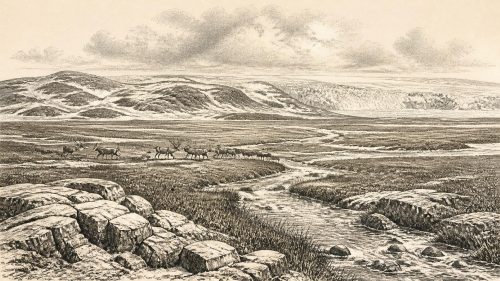
At roughly 34,000 calendar years before present, the land now called Ireland lay in a climatically unsettled phase before the Last Glacial Maximum. The maximum expansion of the British–Irish Ice Sheet came later, broadly between about 26,500 and 19,000 calibrated years BP, although ice had already been growing and advancing within the wider region. Reconstructions based on landforms, offshore sediments and dating are excellent for broad changes in ice-sheet extent, but they cannot give a weather report for 31,945 BCE. Nor do they justify imagining a uniformly frozen island at every moment before the maximum. Conditions varied over long and shorter climatic oscillations, while ice, snowfields, exposed ground, rivers and coastal margins changed their positions.
The eventual ice sheet profoundly shaped what can now be known. Moving ice eroded, transported and buried earlier sediments across much of Ireland. Later meltwater, changing coastlines, acidic soils and human disturbance removed or altered further traces. This is why the Irish Palaeolithic record is so sparse in comparison with parts of Britain and continental Europe. The scarcity is evidence about preservation as well as about past population. Absence of hearths, tools and camps cannot, by itself, prove that no person ever visited Ireland; equally, it cannot be used to conjure a settled population where the archaeological record does not support one.
Caves and a Lost Fauna
The strongest direct evidence for this broad period comes not from houses or graves but from animal remains, especially those recovered from limestone caves in southern Ireland. Castlepook Cave, near Doneraile in County Cork, is central. Excavations there in the early twentieth century produced more than 2,000 bones, and subsequent radiocarbon work has shown that individual specimens span a very long interval, from roughly 45,700 to 19,950 BP. It is therefore not a single sealed Ice Age floor. Rather, the cave accumulated remains over many thousands of years, through processes that included animal activity, water movement, sediment transport and earlier excavation.
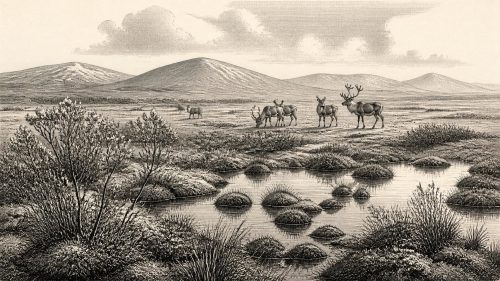
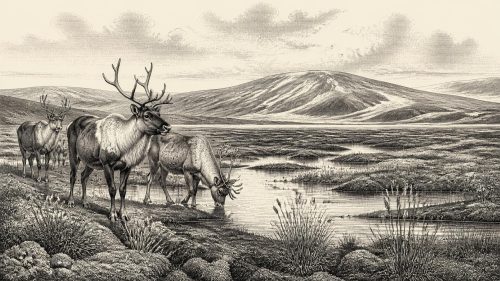
That qualification matters, but Castlepook still reveals an extraordinary Pleistocene fauna. Its collections include woolly mammoth, giant deer, reindeer, brown bear and spotted hyena, while other dated remains include wolves, Arctic foxes, mountain hares and lemmings. Such animals did not necessarily all live together in one local landscape or in one generation. The secure conclusion is more modest and more important: during different parts of the middle and later Ice Age, Ireland supported, or was reached by, animal communities far richer and colder-adapted than those of the modern island.
Other southern cave sites add depth to this picture. Re-dating of faunal material has pushed some Irish mammal evidence farther back into Marine Isotope Stage 3 and has shown why old radiocarbon determinations require critical reassessment. For example, published calibrated ranges for pre-Last Glacial Maximum red-deer specimens from Shandon and Ballynamintra caves fall between about 32,930 and 29,594 cal BP. This range is later than the notional year under discussion, but it demonstrates that the cave record preserves evidence from the same broad pre-maximum world. Mammoth, reindeer and giant deer fossils imply open or broken landscapes with extensive grazing opportunities; they do not supply a detailed map of vegetation, rainfall or seasonality for every Irish region.
The Question of People
The possibility of human activity around this remote horizon is particularly intriguing but must be stated with care. A reindeer bone from the Castlepook collection has been reported as bearing a mark interpreted as having been made by a sharp stone tool during butchery, and it has been presented publicly as evidence of human activity in Ireland around 33,000 BCE. If that interpretation is sustained, it would place a human visit to Ireland far earlier than the well-established terminal Palaeolithic evidence from County Clare, dating to about 12,810–12,590 cal BP. It would be an important discovery, but it is not evidence for a permanent settlement, a village or an unbroken ancestry to later Irish communities.
There are substantial limits. The relevant bone derives from an older cave collection rather than a modern excavation with a fully recorded stratigraphic context. No associated stone-tool assemblage, hearth, dwelling, human burial or securely contemporary group of butchered animals has yet provided a fuller social setting. Recent investigations at Castlepook have sought surviving Pleistocene deposits, illustrating both the site’s importance and the difficulty of recovering undisturbed context after earlier digging and natural disturbance. The prudent wording is that a modified reindeer bone may indicate a brief human presence in pre-maximum Ice Age Ireland; it does not tell us how many people arrived, where they came from, how long they stayed, or whether they returned.
Life Beyond the Evidence
For this reason, there is no responsible account of Irish political affairs in 31,945 BCE. No rulers, territories, laws, alliances, diplomatic contacts or named peoples are known. There is also no direct evidence for war, organised conflict, religious practice, language, art, schooling, trade or exchange networks in Ireland at this time. These are not omissions to be filled with romantic images of “tribes”. A single possible butchery mark cannot reveal authority, belief or identity. Even assigning visitors a particular archaeological culture known from Britain or mainland Europe would exceed the evidence unless diagnostic tools or securely dated sites are found.
Some carefully bounded inferences are possible. Any humans who reached Ireland in this cold, changeable world would have been mobile hunter-gatherers, dependent on knowledge of terrain, animal behaviour, weather and safe routes. A reindeer carcass, if indeed butchered by people, would have offered meat, fat, hide, sinew, bone and antler: useful materials in Upper Palaeolithic lifeways elsewhere in north-west Europe. But whether butchery happened at the animal’s death site, during a short stop, or before the bone entered the cave is unknown. It is also unknown whether travel occurred across exposed landscapes, sea ice, short water crossings, or some combination of routes. Lower sea level altered the geography of the Irish Sea, but the existence and timing of usable connections remain debated and cannot be assumed for this precise period.
Regional Change and Historical Meaning
The period’s greatest historical force was environmental change. The expansion that later produced the Last Glacial Maximum would erase habitats, disrupt animal ranges and make long-term human occupation increasingly difficult or impossible over much of Ireland. After the ice retreated, plants, animals and eventually people recolonised a drastically altered landscape. The best-attested later Palaeolithic sign of people is the cut-marked brown-bear kneecap from Alice and Gwendoline Cave, County Clare; sustained evidence for communities is later still, in the Mesolithic after about 10,000 BP. These later discoveries should not be projected backwards to create continuity where none is demonstrated.
Yet the sparse evidence before the deep freeze changes the scale of Ireland’s past. It shows that the island was not simply an empty stage awaiting Holocene settlement. At intervals, it formed part of a wider north-west European ecological world in which mammoths, reindeer, giant deer, carnivores and perhaps very occasional human visitors reached its western edge. Castlepook’s bones are not a national origin story, nor proof of a lost Ice Age society. They are a fragile, scientifically revisable record of movement, survival and disappearance. Around 31,945 BCE, that is the most compelling history available: not a dated event, but a changing Ice Age landscape whose traces survived against considerable odds.
Primary Sources
- The IntCal20 Northern Hemisphere Radiocarbon Age Calibration Curve (0–55 cal kBP)
- A Reconsideration of the Radiocarbon Dating of the Marine Isotope Stage 3 Fauna from Southern Ireland
- The Irish Quaternary Fauna Project
- The History of Red Deer in Ireland: A Multidisciplinary Approach
- Castlepook Cave
- 32564: Castlepook Cave, Castlepook South, Co. Cork
- Archaeology Research Excavation Grant 2022: Final Report
- First Evidence of a Late Upper Palaeolithic Human Presence in Ireland
- New Insights on the Fauna of Ireland’s Younger Dryas and Early Holocene from Alice & Gwendoline Cave
- Growth and Retreat of the Last British–Irish Ice Sheet, 31,000 to 15,000 Years Ago: The BRITICE-CHRONO Reconstruction
- Pattern and Timing of Retreat of the Last British-Irish Ice Sheet
- Maximum Extent and Dynamic Behaviour of the Last British–Irish Ice Sheet West of Ireland
- Stratigraphic and Palaeo-geomorphological Evidence for the Glacial-deglacial History of the Last British-Irish Ice Sheet in the North-western Irish Sea
- The Timing and Magnitude of the British–Irish Ice Sheet Between Marine Isotope Stages 5d and 2
- The Island of Ireland: Drowning the Myth of an Irish Land-Bridge?
- Ireland: Submerged Prehistoric Sites and Landscapes
- The Mesolithic in Ireland: When Was It?
- Anthropogenic Changes to the Holocene Nitrogen Cycle in Ireland
- Radiocarbon Dates from the Oxford AMS System: Archaeometry Datelist 31
- First Evidence of a Late Upper Palaeolithic Human Presence in Ireland
- Growth and Retreat of the Last British–Irish Ice Sheet, 31,000 to 15,000 Years Ago: The BRITICE-CHRONO Reconstruction
- Pleistocene Vertebrates in the British Isles