The Doneraile Reindeer Clue31889 BCE
Around 31,889 BCE, Ireland lay in an unstable Late Pleistocene landscape, as cold intensified and the British–Irish Ice Sheet expanded. Derryvree sediments in Fermanagh reveal open, treeless tundra wetlands supporting grasses, sedges, mosses and grazing animals, although evidence is fragmentary. Castlepook Cave in Cork preserves remains of reindeer, mammoth, giant deer and other cold-stage fauna, but disturbed deposits prevent simple reconstructions. A marked reindeer femur, dated about 33,000 years ago, may record stone-tool butchery and a fleeting Upper Palaeolithic visit. It cannot demonstrate permanent settlement, precise travel routes, or tools, hearths, dwellings or social institutions. Ireland’s human presence remains uncertain.
Dateline
The label “31,889 BCE” gives a useful point of orientation for a modern chronological series, but it must not be mistaken for an excavated date or a year in which an identifiable Irish event occurred. It corresponds roughly to 33,839 years before AD 1950, the conventional present used in archaeological dating. At this depth of time, radiocarbon measurements require calibration and normally produce ranges rather than single calendar years. The responsible subject is therefore Ireland in the later part of Marine Isotope Stage 3, broadly around 34,000 calibrated years ago, not a precisely dated episode on a particular day.
A Landscape Before the Ice Maximum
Ireland was then in the Late Pleistocene, within a long and unstable cold phase of the last Ice Age. This was not yet the Last Glacial Maximum, the period when the British–Irish Ice Sheet reached its greatest known extent, broadly between 27,000 and 21,000 years ago. Nor was it a stable prelude to that maximum. Climate, sea level, ice extent, vegetation and animal distributions changed repeatedly over millennia. The evidence for the exact position of Irish ice margins before about 31,000 years ago remains sparse; it cannot justify a map showing every coast, valley or upland as either certainly ice-covered or certainly open at this notional date.
The best modern reconstructions indicate growth of the British–Irish Ice Sheet after roughly 35,000–32,000 years ago. At around 31,000 years ago, ice was accumulating over high ground in northern Ireland and in parts of southern Ireland, while the wider ice complex was expanding. That makes 31,889 BCE a time of worsening cold and advancing ice, but not necessarily one when the entire island lay beneath a single, continuous ice cover. Southern and lowland areas may have retained ice-free ground for a time. Such possibilities matter because the surviving evidence for animals, and perhaps people, comes chiefly from southern Irish caves.
Derryvree and the Open North
One of the clearest environmental archives is Derryvree near Maguiresbridge, County Fermanagh. There, roadworks exposed freshwater silts and fine sands trapped between two sheets of glacial till. The organic deposits produced a radiocarbon determination of 30,500 years BP, with a substantial uncertainty, and must be calibrated before comparison with calendar dates. They are not a record of 31,889 BCE itself. Nevertheless, they illuminate a closely relevant phase of the Middle Midlandian cold period.
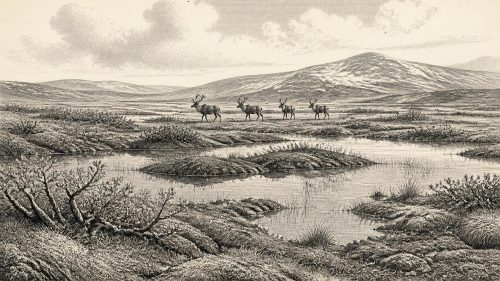
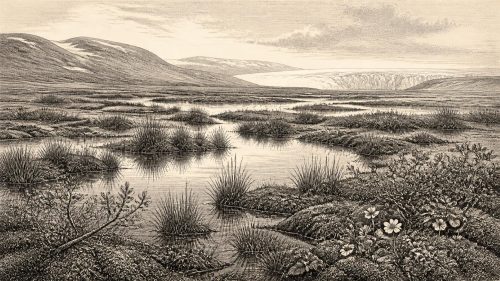
Pollen, plant macrofossils, mosses, insects and other remains from Derryvree point to open, treeless tundra or muskeg rather than woodland. Grasses, sedges, herbs and dwarf shrubs could exploit short summers; waterlogged hollows supported specialised moss communities. Periglacial conditions—freeze-thaw, seasonal snow, frozen ground and sparse vegetation—shaped the terrain. This was a demanding setting, but not a lifeless white desert. Its patchwork of wet ground, herb-rich turf, gravelly exposed surfaces and sheltered valleys could sustain grazing animals and the predators that followed them.
Derryvree also demonstrates a central difficulty of Ice Age history. The deposits survive because they were later sealed beneath glacial sediments. Much evidence from exposed landscapes was eroded, reworked or buried as ice advanced. Archaeologists are thus not reading a complete national archive. They are working from rare sediments, cave assemblages and objects removed long ago, often before modern excavation methods existed. Absence of a camp, hearth or tool from Ireland is not proof that no person ever visited; equally, it is not evidence for a settled population.
Castlepook’s Animal World
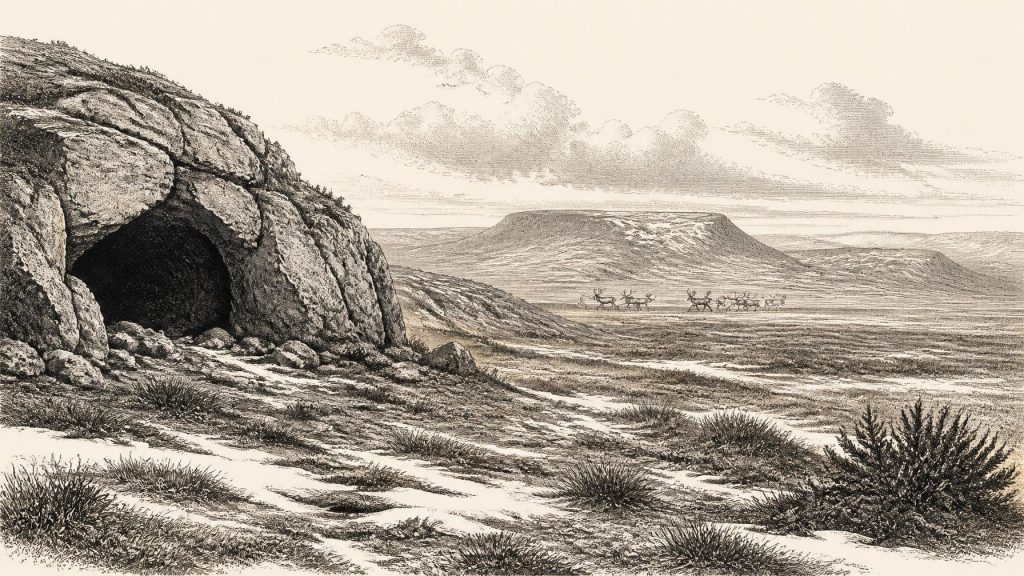
The most important Irish evidence for this broader period comes from Castlepook Cave near Doneraile in north County Cork, historically called Mammoth Cave because of its remarkable animal remains. Antiquarian excavators recovered bones there in the early twentieth century, and later examination and radiocarbon dating have made the collection central to the study of Irish Pleistocene fauna. The cave contains material from more than one period, however, and its sediments have been disturbed by water, scavengers, older digging and natural movement. Individual finds cannot automatically be treated as the remains of one moment or one intact occupation floor.
Even with that caution, the faunal record is powerful. Revised dating has placed some Castlepook mammals in Marine Isotope Stage 3, and wider work on Irish cave assemblages shows that Ireland supported a varied cold-stage fauna before the glacial maximum. Reindeer, woolly mammoth, giant deer, brown bear, wolf, Arctic fox, hare, collared lemming and spotted hyaena are among the animals recorded from relevant Irish deposits, though not all need have lived at Castlepook at precisely the same time. “Irish elk”, often used for giant deer, is a traditional name for Megaloceros giganteus; it was not an animal confined to Ireland.
The combination suggests a broad northern European grassland-tundra ecology. Reindeer were especially well suited to seasonal open landscapes, while mammoth and giant deer required substantial plant resources. Hyaenas and wolves were both predators and scavengers. A cave might therefore be a carnivore den, a sheltering place, a trap for animal remains, or a destination for bones carried in by water and scavengers. Castlepook tells us decisively that Ice Age animals reached Ireland. It does not, by itself, allow a reconstruction of a permanent human settlement beside the cave.
The Marked Reindeer Femur
A reindeer femur fragment in the Castlepook collection has made this period newly significant. Re-examined by zooarchaeologist Ruth Carden, it bears deep marks interpreted as consistent with cutting or chopping by a stone tool during butchery. Accelerator radiocarbon dating has been reported as placing the bone at about 33,000 years ago, and a County Cork heritage publication gives the find a broad date of about 31,000 BC. These expressions are approximations using different chronological conventions, not a means of placing butchery in the calendar year 31,889 BCE.
If the marks are confirmed as anthropogenic, the femur is evidence that a person processed a reindeer in Ireland during the Upper Palaeolithic, far earlier than the island’s previously accepted post-glacial human record. It would imply a brief visit or a small-scale hunting episode, perhaps by people moving through the north-west European world with access to game and seasonal routes. The bone need not mean that the animal was killed inside Castlepook. A plausible interpretation is that a butchered remnant entered the cave later, possibly carried by a carnivore. That distinction is crucial: a modified bone is direct evidence of contact between people and an animal, but indirect evidence for where the encounter occurred.
The interpretation remains important but limited. No securely associated stone tool, hearth, dwelling, human bone, food-preparation area or stratified campsite of this age has yet been recovered at Castlepook. Early cave excavation also weakened the original context. Modern fieldwork has sought intact deposits in previously unexcavated parts of the cave system, precisely because a stratified sequence could test the old collections against their geological setting. Until such work produces corroborating evidence, the most careful conclusion is that Castlepook offers a persuasive but still incomplete clue to transient Palaeolithic activity.
People Without Polities
There is no basis for discussing kingdoms, chiefs, diplomacy, laws, named communities or warfare in Ireland at this date. No writing existed, and the archaeological record does not identify a political institution, a burial tradition, a settlement hierarchy or even a securely demonstrated resident population. Nor can religion be reconstructed from the Castlepook femur or from the Derryvree sediments. Caves acquired ritual importance in some much later Irish societies, but projecting that meaning back more than thirty millennia would turn possibility into fiction.
Society and economy can be described only at the scale of survival. Should the reindeer marks prove to be human-made, they indicate knowledge of sharp stone implements and the practical extraction of meat, marrow or hides from a large animal. Such activity would have depended on mobility, co-operation and intimate knowledge of animal behaviour, weather and safe routes. These are reasonable inferences from Upper Palaeolithic hunting elsewhere in north-west Europe, not demonstrated details of an Irish household. There is no evidence for farming, pottery, metalworking, livestock, permanent villages, formal trade networks or seafaring around Ireland at this point.
Low sea levels exposed far more continental shelf than today, altering the geography between Ireland, Britain and mainland Europe. Yet it is unsafe to picture a simple, permanent dry-land bridge across the Irish Sea in 31,889 BCE. Palaeogeographical models show that connections changed with sea level, crustal movement and the growth of ice, while major ice masses and cold marine waters could themselves obstruct travel. The potential movement of animals or people into Ireland is therefore plausible, but its route and frequency remain unresolved.
A Brief Window of Possibility
The Ireland glimpsed around 31,889 BCE was not an ancestral nation awaiting recorded history. It was a changing Ice Age landscape, increasingly constrained by cold and by the expansion of the British–Irish Ice Sheet. Open tundra wetlands in Fermanagh and the large mammals represented in Cork caves provide tangible evidence for its ecology. Castlepook’s marked reindeer femur raises the striking possibility that hunters also entered that landscape, perhaps only fleetingly. The most important historical fact is not a supposed event in a numbered year, but the scale of uncertainty: Ireland may have been visited by people before the ice maximum, yet the durable, well-documented human occupation of the island belongs to a far later world.
Primary Sources
- A Reconsideration of the Radiocarbon Dating of the Marine Isotope Stage 3 Fauna from Southern Ireland
- The Irish Quaternary Fauna Project
- Growth and Retreat of the Last British–Irish Ice Sheet, 31 000 to 15 000 Years Ago: The BRITICE-CHRONO Reconstruction
- Extent and Timing of the Last Glacial Maximum (LGM) in Britain and Ireland: A Review
- Maximum Extent and Dynamic Behaviour of the Last British–Irish Ice Sheet West of Ireland
- The Timing and Magnitude of the British–Irish Ice Sheet Between Marine Isotope Stages 5d and 2: Implications for Glacio-Isostatic Adjustment, High Relative Sea Levels and ‘Giant Erratic’ Emplacement
- Middle Midlandian Freshwater Series at Derryvree, Maguiresbridge, County Fermanagh, Northern Ireland
- Landscapes and Environments of the Last Glacial-Interglacial Transition: A Time of Amazingly Rapid Change in Ireland
- The Island of Ireland: Drowning the Myth of an Irish Land-Bridge?
- The IntCal20 Northern Hemisphere Radiocarbon Age Calibration Curve (0–55 cal kBP)
- The Exploration of Castlepook Cave, County Cork, Being the Third Report from the Committee Appointed to Explore Irish Caves
- Occurrence of Mammalia Relicts at Site Castlepook Cave
- Heritage Artefacts of County Cork
- 2022:564 – Castlepook Cave, Castlepook South, Cork
- Archaeology Research Excavation Grant 2022
- The Archaeology of Caves in Ireland
- New Insights on the Fauna of Ireland's Younger Dryas and Early Holocene from Alice & Gwendoline Cave
- The Colonization of Ireland: A Human Ecology Perspective
- Ireland's Palaeolithic Archaeology – Fleeting Footprints in a Frozen Land
- Cenozoic: Tertiary and Quaternary