Castlepook’s Fading Fauna31854 BCE
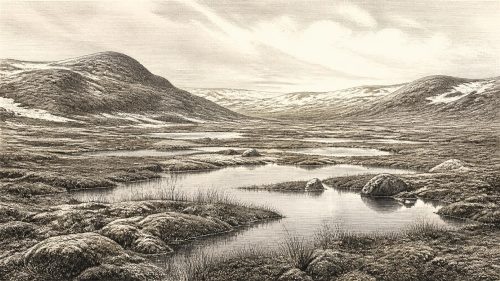
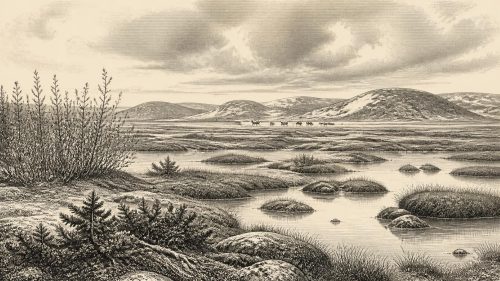
Around 33,800 calendar years BP (31,854 BCE), Ireland stood near an advancing phase of the Midlandian glaciation, although it was not necessarily ice-covered. Climate was cold, open, wet and largely treeless, with tundra habitats evidenced at Derryvree, Fermanagh. Expanding ice, lowered seas and periglacial processes reshaped terrain and obscured earlier deposits. Castlepook Cave in north Cork preserves remains of reindeer, giant deer, mammoth, predators and other Pleistocene fauna, indicating cold-stage environments, but not a single contemporary community. Human occupation remains unproven: a possibly cut-marked reindeer bone may suggest brief Upper Palaeolithic visitation. Fragmentary evidence permits environmental reconstruction, not social history.

Dateline
The numbered year 31,854 BCE cannot be treated as a date at which a recorded Irish event occurred. No written record, named community, ruler, battle or settlement belongs to it, and modern calendar-year precision is not available for this depth of prehistory. Converted only approximately into the archaeological convention of years before AD 1950, it falls around 33,800 calendar years BP. Even that conversion must not disguise the uncertainty: radiocarbon determinations require calibration, their ranges may span centuries, and deposits can record material accumulated over long intervals. The responsible subject is therefore Ireland during the later part of Marine Isotope Stage 3, before the full Last Glacial Maximum.
At this time the island’s story is principally one of climate, ice, animals and changing terrain rather than human institutions. The evidence is uneven. Caves in north Cork have preserved bones; buried sediments in Fermanagh preserve plants and insects; landforms, offshore sediments and exposure dating help reconstruct the advance of the British–Irish Ice Sheet. None offers a diary entry for one notional year. Together, however, they show an island near a major environmental threshold.
A Date on the Edge of the Ice
About 33,800 years ago, Ireland was in the Midlandian glacial stage, the Irish expression of the last glacial cycle. It was not yet necessarily the uniformly ice-covered island of the Last Glacial Maximum. Recent ice-sheet syntheses show that the growth, maximum extent and retreat of the British–Irish Ice Sheet were asynchronous: different sectors advanced and later withdrew at different times. Broad reconstructions place substantial build-up after roughly 35,000–32,000 years ago, while maximum ice extent in many sectors came appreciably later, around 27,000–23,000 years ago.
This means that it would be misleading to colour the whole island white on a map labelled 31,854 BCE. Ice may already have been expanding from upland and northern centres, while some southern or peripheral landscapes still supported exposed ground and animal life. The exact extent at this moment remains debated because deposits of the relevant age are scarce, later glaciers eroded or buried earlier surfaces, and dates from separate regions do not necessarily describe a single island-wide episode. The better conclusion is that Ireland was entering a period in which glaciers increasingly determined the possibilities of life and the preservation of evidence.
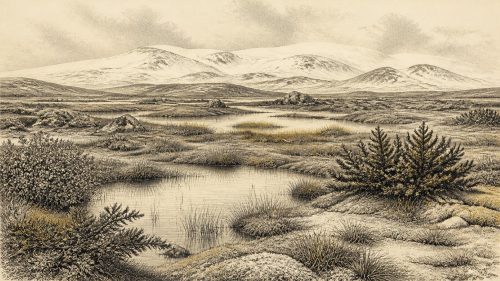
Climate records from Greenland show that the last glacial period was not a single unchanging freeze. Abrupt warm and cold phases occurred on timescales far shorter than traditional archaeological periods. Ireland lay at the Atlantic edge of Europe, exposed to westerly weather systems and to changes in North Atlantic circulation. Local conditions would have varied with altitude, distance from ice and season, but a cold, open and largely treeless environment is the defensible broad picture. It was not the later familiar green island, nor a settled landscape awaiting the arrival of farmers or Celtic-speaking peoples many millennia in the future.
Open Country and Moving Ice
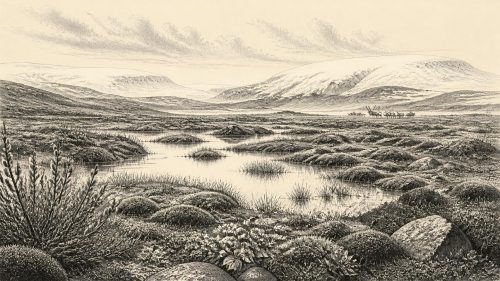
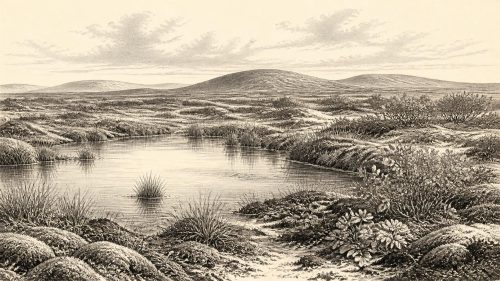
Evidence beneath drumlins at Derryvree, near Maguiresbridge in County Fermanagh, is particularly valuable because it preserves organic sediments sealed below glacial till. Pollen, plant remains and beetles from such deposits have been interpreted as evidence for a treeless, wet tundra or muskeg environment during an earlier part of the last glacial cycle. Mosses, sedges, dwarf shrubs and sparse herbs could survive in wet ground, while periglacial processes repeatedly froze, thawed and disturbed exposed soils. The sequence is not a precise weather report for north Cork or for this calendar-labelled year; it instead establishes what kinds of cold-stage habitats could occur in Ireland before later ice overrode the land.
Glacial geology supplies the other half of the picture. Ice did not merely sit upon the country. It excavated bedrock, transported boulders and sediment, moulded drumlins, reshaped valleys and pushed across the continental shelf. Lower global sea levels also altered the outline of the land and exposed wider coastal shelves than exist today. Yet lowered sea level should not automatically be turned into a claim of an easy land bridge or regular migration route. The geography of the Irish Sea, shifting ice margins and the lack of securely associated archaeological sites make any human crossing at this date unproven.
The environmental legacy was immense. The ice and meltwater of the following millennia would help create many of the physical frameworks of modern Ireland: streamlined lowlands, till-covered terrain, lake basins, altered drainage and coastal shelves. But those are long-term geological consequences, not contemporary social choices. Around 33,800 calendar years BP, regional change was driven above all by climate and ice-sheet dynamics.
The Cave Record at Castlepook
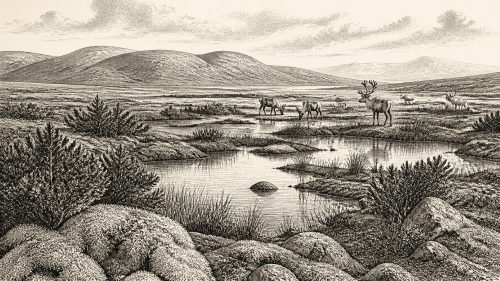
Castlepook Cave, near Doneraile in north Cork, offers the most evocative evidence relevant to this part of the Irish Pleistocene. Antiquarian excavations recovered a remarkable assemblage attributed to animals including reindeer, giant deer, brown bear, wolf, Arctic fox, hare, lemmings, spotted hyaena and woolly mammoth. The Irish Quaternary Fauna Project demonstrated more broadly that a varied mammal fauna reached Ireland between at least about 45,000 and 20,000 years ago. This establishes that parts of the island could at times sustain or receive cold-adapted and open-country animals before the full glacial maximum.
These animals should not be imagined as one harmonious herd present at one instant. Cave collections often combine material deposited across centuries or millennia, and old excavations did not always record exact layers to modern standards. Some bones may have been carried in by predators, others by water or slope movement; cave entrances also changed through time. The faunal list is therefore evidence for a long and complicated ecological history, not a census for 31,854 BCE. Even so, reindeer and lemmings point towards cold open habitats, while hyaena, wolf and bear remind us that carnivores as well as herbivores used Irish landscapes and caves.
The mammoth evidence has special force because it makes the scale of this lost world immediately visible. Woolly mammoths required extensive forage and movement across broad landscapes; their presence, where securely dated, is inconsistent with a permanently forested or wholly ice-covered Ireland. Giant deer likewise belonged to a Pleistocene fauna very different from that of later historic Ireland. Their survival depended on ecological connections with Britain and continental Europe at particular times, yet fossil occurrence alone cannot tell us how continuous those connections were or how long individual populations lasted.
People: A Possibility, Not a Population
Human history must be written with exceptional restraint. Ireland has no securely documented resident Upper Palaeolithic population at about 33,800 calendar years BP. No house, hearth, lithic workshop, burial ground or stratified hunting camp of that age has been established on the island. The National Museum of Ireland has long emphasised the absence of clear Palaeolithic evidence, while the first substantial evidence for enduring settlement belongs to the Mesolithic, after the last ice had retreated and environments had changed fundamentally.
There is, however, a significant and unresolved development in the Castlepook material. A reindeer bone has been reported with a possible cut mark and an age in the broad vicinity of 33,000 years ago. If microscopic assessment and contextual work ultimately confirm that the mark was made by a human tool, it would indicate a fleeting Upper Palaeolithic human presence rather than an established society. It would not establish a village, a continuous occupation or a named people. Recent excavation has sought surviving undisturbed deposits precisely because the older collections cannot answer all these questions by themselves.
The distinction matters. A single modified bone could represent one episode of carcass processing by a very small visiting party; it might also be affected by natural damage or uncertain association. The evidence presently supports neither political affairs nor diplomacy, warfare, territorial lordship, trade networks or organised religion in Ireland at this date. Those categories require people and patterns of activity that the archaeological record has not demonstrated. It is more accurate to say that Ireland lay within the wider ecological and geographical world through which Upper Palaeolithic people moved elsewhere in north-west Europe, while direct evidence of their presence here remains tentative.
What Cannot Yet Be Recovered
Accordingly, everyday life cannot responsibly be reconstructed as an Irish campfire scene. There is no basis for asserting what language anyone spoke, what kin groups existed, whether boats were used, what rituals were practised, or how food was shared. Nor is there evidence for agriculture, domestic animals, metalworking, monuments, pottery or trade. If people did reach an Irish landscape around this time, they would have encountered a demanding cold-stage environment and animal resources familiar to Upper Palaeolithic hunter-gatherers elsewhere; that is an inference from the wider European record, not a demonstrated Irish social history.
What the evidence does reveal is a country in transition. Open, wet and treeless habitats survived somewhere beyond or between expanding ice; Pleistocene mammals ranged across at least parts of Ireland; caves could serve as dens, traps, shelters or repositories of bone; and ice was beginning to erase as well as create the archive by which this world can be known. The apparent silence of Ireland at 31,854 BCE is therefore not proof that nothing happened. It is the consequence of a fragmentary record, later glacial destruction and the impossibility of reducing deep time to a modern calendar day.
Castlepook and Derryvree are valuable precisely because they resist easy storytelling. They preserve traces rather than chronicles: a bone, a pollen grain, a beetle fragment, a sediment layer, a scar on a landscape. Read cautiously, those traces place Ireland close to the advance of the great ice sheet and within a vanished Atlantic fauna. They do not yet yield a year-by-year human narrative. For this date, that uncertainty is not a deficiency to be filled with invention; it is the most important historical fact.
Primary Sources
- Growth and retreat of the last British–Irish Ice Sheet, 31,000 to 15,000 years ago: the BRITICE-CHRONO reconstruction
- Extent and timing of the Last Glacial Maximum (LGM) in Britain and Ireland: a review
- Pattern and timing of retreat of the last British-Irish Ice Sheet
- New data for the Last Glacial Maximum in Great Britain and Ireland
- Late Pleistocene chronostratigraphy and ice sheet limits, southern Ireland
- Dimensions and chronology of the last ice sheet in Western Ireland
- Radiocarbon constraints on the age of the maximum advance of the British–Irish Ice Sheet in the Celtic Sea
- Character of advance and retreat of the southwest sector of the British-Irish Ice Sheet during the last glaciation
- Stratigraphic and palaeo-geomorphological evidence for the glacial-deglacial history of the last British-Irish Ice Sheet in the north-western Irish Sea
- Early deglaciation of the British-Irish Ice Sheet on the Atlantic shelf northwest of Ireland
- The colonization of Ireland: A human ecology perspective
- The Irish quaternary fauna project
- New insights on the fauna of Ireland's Younger Dryas and Early Holocene from Alice & Gwendoline Cave
- Palaeoecology
- Prehistoric Details
- Stone Age
- Who lived in Ireland before Neolithic times?
- Archaeological Heritage of County Cork
- Castlepook Cave, Co. Cork: excavation report 2022
- Ireland: Submerged Prehistoric Sites and Landscapes
- The IntCal20 Northern Hemisphere Radiocarbon Age Calibration Curve (0–55 cal kBP)
- IntCal Publications
- Radiocarbon Dating and Chronological Modelling: Radiocarbon Dating
- Reconstruction of human dispersal during Aurignacian on pan-European scale