Silts Under a Drumlin31853 BCE
31,853 BCE represents an approximate point within Marine Isotope Stage 3, not a precisely documented Irish year. Before the Last Glacial Maximum, parts of Ireland were ice-free, as Derryvree sediments in Fermanagh show, preserving freshwater, tundra and periglacial conditions later sealed beneath glacial till. Castlepook Cave fauna demonstrate connections with wider north-west European cold-climate ecosystems, though dates and depositional contexts require caution. No secure evidence establishes human settlement or activity; a possibly cut-marked reindeer bone remains inconclusive. Ireland’s record for this period concerns changing ice, lowered seas, vegetation and animal movement, emphasising a fragmentary environmental archive rather than historical events.
Dateline
The label “31,853 BCE” gives an appearance of precision that the evidence cannot sustain. There is no Irish written record, settlement sequence or securely dated human event that can be assigned to this single modern calendar year. In archaeological terms it corresponds only approximately to 33,800 calibrated years before present (cal BP, with “present” conventionally fixed at 1950), within Marine Isotope Stage 3, a long and climatically variable part of the last Ice Age. Radiocarbon determinations from so deep in time must be calibrated and expressed as probability ranges, not converted into annual anniversaries. The responsible history of Ireland at this horizon is therefore a history of sediments, animal bones, ice margins and uncertainty.
A Landscape Between Glaciations
At about 33,800 cal BP, Ireland had not yet reached the Last Glacial Maximum, when the British–Irish Ice Sheet would cover all or almost all low ground on the island. That maximum expansion came substantially later, broadly between c. 27,000 and 21,000 years ago, with major ice-sheet growth and shifting margins rather than one simple, uniform advance. Around the date represented by 31,853 BCE, parts of Ireland were demonstrably ice-free, although the geography of ice, exposed land and sea changed repeatedly over centuries and millennia.
The strongest local environmental evidence comes from Derryvree near Maguiresbridge in County Fermanagh. Roadworks there revealed freshwater silts and fine sands trapped between two separate sheets of glacial till within a drumlin. The organic sediments produced a radiocarbon determination of 30,500 radiocarbon years BP, subsequently understood to calibrate broadly within a range of about 31,700–36,900 cal BP. That span includes the approximate horizon represented by 31,853 BCE. It does not mean that the Derryvree deposit records one year, nor that every layer accumulated continuously. It does establish that north-eastern Ireland experienced an interval of non-glacial, freshwater and periglacial conditions before a later ice advance buried the evidence.
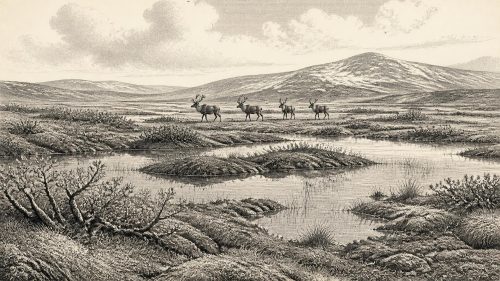
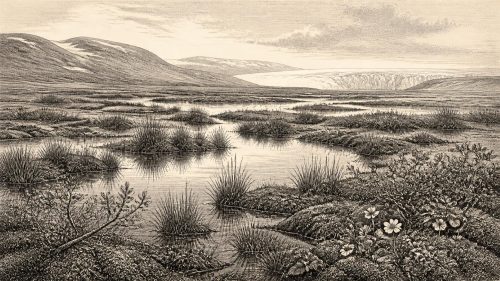
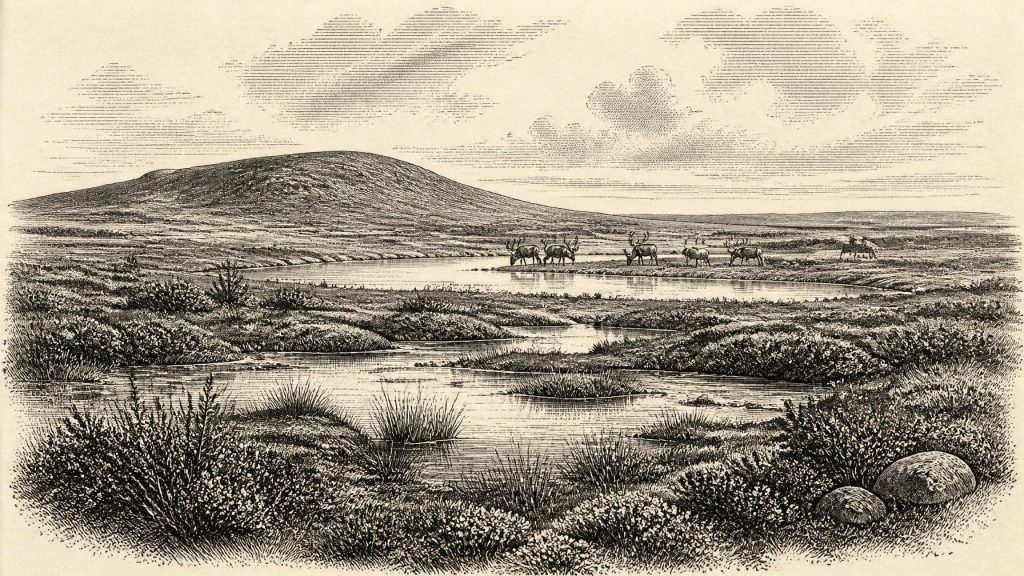
The Derryvree sequence is especially valuable because later ice sheets destroyed or disturbed much of Ireland’s earlier Pleistocene record. Its pollen, plant and animal traces point to open tundra rather than forest: a cold, treeless landscape of grasses, sedges, herbs, mosses and low shrubs, with shallow water, wet ground and seasonally frozen soils. The precise mixture of plants would have varied with local drainage, altitude and climate. This was not a blank white wilderness. In favourable summer months, herb-rich ground and wetland margins could be biologically productive, even though winters were severe and the growing season short.
Caves and Cold-Climate Animals
Southern Irish caves provide a second, complementary record. Castlepook Cave near Doneraile in north County Cork has yielded remains of reindeer, giant deer, brown bear, spotted hyaena, woolly mammoth and smaller cold-adapted mammals. These finds show that Ireland was at times part of a wider north-west European ecological zone in which large herbivores and their predators could move through changing landscapes. Ireland was not then the familiar Atlantic island of later prehistory. Lower sea levels placed coasts far beyond their modern lines, exposing extensive parts of the Irish and Celtic Sea shelves. Exactly which crossings were dry, marshy, marine or blocked by ice at particular moments remains a matter for reconstruction rather than a fact observable in the cave deposits themselves.
The animal assemblage must nevertheless be read cautiously. A cave bone proves that an animal, or material derived from it, reached the cave; it does not automatically prove that all recorded species lived together, that they formed a stable local community, or that a cave was a den, kill-site or human camp. Many Irish cave collections were excavated in the nineteenth and early twentieth centuries, before modern recording standards. Bones could have been moved by carnivores, water, sediment collapse, later disturbance or the excavation process itself. Recent re-dating and improved chemical pretreatment have shown that some earlier Irish radiocarbon dates were substantially too young.
That revision matters particularly at Castlepook. Modern work has pushed several faunal dates back into MIS 3 and suggests that giant deer and spotted hyaena may have disappeared locally before about 40,000 cal BP, well before the ice sheet’s maximum extent. Thus they belong to the broader environmental background of Middle Midlandian Ireland, but cannot responsibly be placed in the precise year 31,853 BCE. Reindeer and other cold-country grazers are more useful as indicators of the kind of open, seasonal terrain available during parts of this period, not as a guarantee that a herd stood at any named Irish location in that particular year.
The Human Question
There is no secure evidence for a settled human population in Ireland around 31,853 BCE. There are no accepted houses, hearths, stone-tool floors, burials, cemeteries, fields, monuments or durable cultural traditions from this horizon. Consequently, it is not possible to describe Irish political affairs, diplomacy, social hierarchy, religious practice, learning, trade networks or domestic life as though an identifiable community were present. Such language would turn silence in the record into fiction.
A potentially important but unresolved clue has come from Castlepook: a reindeer femur from an old collection has been reported as bearing a mark consistent with cutting by a sharp stone tool, and its date has been discussed as roughly 33,000 years old. If future work demonstrates beyond doubt that the mark is anthropogenic, that would indicate a brief Upper Palaeolithic human encounter with animal carcass material in Ireland, perhaps butchery by highly mobile visitors. It would not, by itself, establish permanent occupation, a settlement, a named people or an annual event. Natural damage and excavation history can imitate or obscure tool marks; context is crucial. The lack of an associated, undisturbed lithic assemblage or hearth is why this claim remains a subject for careful testing rather than a foundation for a populated national narrative.
The distinction is important because the closest securely documented human traces in Ireland belong much later. Evidence from Alice and Gwendoline Cave in County Clare has demonstrated human modification of a brown-bear bone early in the Younger Dryas, around 12,900–12,700 cal BP. Later still, Early Mesolithic communities left unequivocal archaeological signatures after the final retreat of the ice. These episodes cannot be projected backwards by more than twenty millennia. They show that people could reach and use Irish landscapes under challenging conditions, but they do not settle the question of human presence during MIS 3.
Movement Without States
If people did enter Ireland during the Derryvree-Castlepook interval, their most plausible social setting would be small, mobile Upper Palaeolithic foraging groups, comparable in broad economic logic to communities elsewhere in north-west Europe. Such groups would have depended on knowledge of animal movement, seasonality, shelter, fuel and routes across a rapidly changing physical world. Their “economy” would have centred on hunting, scavenging, gathering and the use of portable materials, rather than farming, markets, coinage or long-lived settlements. This is an interpretation drawn from wider European archaeology, not direct evidence for a specific Irish group.
Nor should mobility be confused with trade in the later sense. A person, animal or raw material might have crossed exposed shelves or narrow waters, but there is no Irish evidence at this date for exchange institutions, political alliances or territorial borders. Conflict is equally unknowable. Large carnivores, harsh weather, unreliable food supplies and difficult travel were real constraints on survival, yet they are ecological pressures rather than evidence of warfare. The only defensible “regional change” is geological and environmental: ice was building within the British–Irish Ice Sheet system, sea level was lower than today, and habitats were repeatedly rearranged by climate.
What This Year Can Mean
For Ireland, 31,853 BCE is best understood not as a year of recorded action but as a point within an interstadial world that was soon to be transformed. Freshwater sediments at Derryvree preserve evidence of an open, periglacial landscape in Fermanagh. Cave faunas, especially in Cork, demonstrate that Pleistocene Ireland supported a richer and stranger range of mammals than later historical Ireland. The archaeological question of whether people briefly visited remains open, and its answer depends on the microscopic analysis of bone surfaces, rigorous dating and the discovery of undisturbed evidence.
Nothing in the surviving record supports kings, tribes, rituals, battles or settlements for this date. Yet the absence of those familiar subjects is itself historically significant. Ireland’s deep past was shaped first by ice, water, vegetation and animal movement. The drumlin at Derryvree, built from layers laid down before and after a freshwater interval, is a reminder that the archive of this period is both precious and fragmentary: a brief record of living tundra sealed beneath the later force of an advancing ice sheet.
Primary Sources
- Middle Midlandian Freshwater Series at Derryvree, Maguiresbridge, County Fermanagh, Northern Ireland
- Early Midlandian–Middle Midlandian, Pleistocene, Northern Ireland
- Palaeoecology
- The Irish Quaternary Fauna Project
- A Reconsideration of the Radiocarbon Dating of the Marine Isotope Stage 3 Fauna from Southern Ireland
- New Insights on the Fauna of Ireland's Younger Dryas and Early Holocene from Alice & Gwendoline Cave
- Dimensions and Chronology of the Last Ice Sheet in Western Ireland
- Trimlines, Blockfields and the Vertical Extent of the Last Ice Sheet in Southern Ireland
- Extent and Deglacial Chronology of the Last British–Irish Ice Sheet: Implications of Exposure Dating Using Cosmogenic Isotopes
- Pattern and Timing of Retreat of the Last British-Irish Ice Sheet
- Growth and Retreat of the Last British–Irish Ice Sheet, 31,000 to 15,000 Years Ago: the BRITICE-CHRONO Reconstruction
- Stratigraphic and Palaeo-Geomorphological Evidence for the Glacial-Deglacial History of the Last British-Irish Ice Sheet in the North-Western Irish Sea
- Late Pleistocene Chronostratigraphy and Ice Sheet Limits, Southern Ireland
- New Data for the Last Glacial Maximum in Great Britain and Ireland
- The IntCal20 Northern Hemisphere Radiocarbon Age Calibration Curve (0–55 cal kBP)
- IntCal Publications
- IntCal History
- Radiocarbon Dating and Chronological Modelling
- Ireland's Palaeolithic Archaeology – Fleeting Footprints in a Frozen Land
- Archaeological Heritage of County Cork