
Elephant Hall’s Tundra Fauna31855 BCE
Around 31,855 BCE, Ireland formed a variable Late Pleistocene, Marine Isotope Stage 3 landscape rather than a uniformly ice-covered island. Derryvree sediments in Fermanagh record an ice-free, treeless, wet tundra of grasses, sedges, herbs, juniper, mosses and beetles, later overridden by glaciers. Castlepook Cave in Cork preserves bones accumulated over long periods, including mammoth, giant deer, reindeer, bear, wolf and hyaena, demonstrating wider European faunal connections but not coexisting assemblages. A possibly cut-marked reindeer bone suggests early human activity, yet settlement remains unproven. Lower sea levels aided animal dispersal, while evidence for trade, agriculture, politics, ritual or continuous occupation absent.
Dateline
Modern calendar-year precision is not available for Ireland in 31,855 BCE. This numbered year is best treated as a point within a much broader Late Pleistocene interval, conventionally placed in Marine Isotope Stage 3. Radiocarbon ages from this depth of time require calibration and carry sizeable ranges; deposits may also contain material moved by water, animals, frost or earlier excavation. The responsible question, therefore, is not what happened in Ireland in one exact year, but what the physical and biological evidence can reveal about the island around the later 30,000s years before present.
An Island in a Changing Cold Stage
Ireland was then in the last Ice Age, but it was not simply a country buried beneath an unchanging white sheet. The climate of Marine Isotope Stage 3 swung repeatedly between relatively milder interstadials and severe cold phases. Ice expanded and contracted across the wider British–Irish region over long timescales, while the extent of ice within Ireland varied by region and remains an active subject of research. The great ice-sheet maximum lay later, broadly during the period after c. 27,000 years ago, rather than providing a fixed setting for every earlier millennial moment.
Evidence from Derryvree near Maguiresbridge in County Fermanagh gives an important northern perspective. There, organic-rich freshwater silts and fine sands lay between separate till sheets: a record that the locality was ice-free when sediment, plant remains and insects accumulated, before later glacier ice overrode it. A radiocarbon determination of 30,500 BP, now conventionally calibrated to a broad range of roughly 36,900–31,700 cal BP, is not a date for a single landscape day. It does, however, place a treeless, periglacial environment in north-central Ireland within the broad interval relevant to 31,855 BCE.
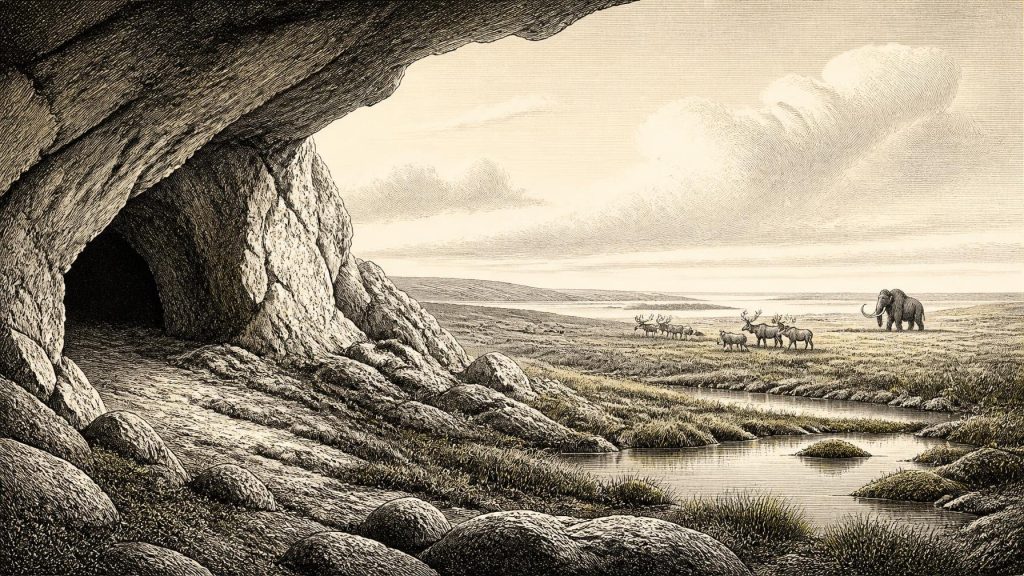
The Derryvree evidence points to open ground rather than forest. Pollen, moss macrofossils and beetle remains indicate a cold, wet tundra or muskeg landscape, with pools, plant-rich water and mossy surfaces. Grasses, sedges, herbs and juniper are more appropriate images than oaks or hazel woods. Winters were severe and growing seasons short. Yet this was not necessarily a lifeless desert: low vegetation could sustain grazing animals, small mammals, birds and predators, and freshwater hollows preserved a detailed environmental archive that ordinary dry ground did not.
Castlepook’s Bone Archive
The most vivid evidence from southern Ireland comes from Castlepook Cave, also called Mammoth or Doneraile Cave, on limestone farmland near Doneraile in north County Cork. Its narrow passages and chambers, including the evocatively named Elephant Hall and Hyena Hall, yielded more than two thousand bones during excavations in the early twentieth century. The cave is Ireland’s richest known archive for vertebrate life before the Last Glacial Maximum. Its faunal list includes woolly mammoth, giant deer, reindeer, brown bear, wolf and spotted hyaena, with later cold-stage deposits also producing Arctic fox and lemmings.
That list must not be read as a photograph of one simultaneous herd. Castlepook accumulated bones over a long span. Modern dating and reassessment place individual remains across tens of thousands of years; the Geological Survey of Ireland gives a range of about 45,700 to 19,950 years BP for dated material. Water movement, disturbed deposits and the methods of the original excavators further complicate associations between bones and layers. A mammoth bone, hyaena bone and reindeer bone from the cave may demonstrate that each species occurred in Ice-Age Ireland, but they do not automatically prove that all stood outside the entrance in the same season.
Even with that caution, the cave makes clear that parts of Ireland could belong to a wider north-west European fauna during this period. Reindeer imply open, cold country and seasonal grazing opportunities. Woolly mammoth and giant deer suggest a landscape with substantial forage, while hyaenas and wolves reveal a predator and scavenger guild capable of exploiting carcasses and hunting vulnerable prey. Brown bears added another large omnivore to that world. Castlepook was likely not a domestic animal shelter; caves can collect bones brought in by carnivores, animals dying naturally, water, and people. Its value lies precisely in preserving traces that the exposed landscape has largely lost.
The Human Question
The possibility of people in Ireland at this time is important, but it must be expressed with restraint. A reindeer femur from Castlepook has been reported as bearing an incision interpreted as a possible stone-tool cut mark, and the bone has been associated in public reporting with an age of around 33,000 years ago. If that interpretation and chronological association are sustained by further study, it would point to very early human activity on the island, perhaps the processing of an animal carcass by Upper Palaeolithic hunters.
It would not, by itself, establish a settlement, a permanent population, a named culture, or continuous occupation. No securely associated Palaeolithic house, hearth, stone-tool assemblage, burial, art panel or human skeleton is presently available for Ireland around 31,855 BCE. Recent archaeological work at Castlepook was undertaken in part because surviving undisturbed deposits could test such questions; it also underlined how difficult the cave’s history is to disentangle. The strongest conclusion is that human contact with Ireland during the wider period is a serious possibility, not a foundation for a detailed social narrative.
Accordingly, no political order, diplomacy or organised warfare can be recovered for this date. There were no states, kingdoms, written laws or historical names. Predation and competition among animals should not be mistaken for evidence of human conflict. If small groups of modern humans did reach Ireland, their decisions would have concerned mobility, weather, safe routes, fuel, shelter and access to animal resources. Those are reasonable inferences from comparable Upper Palaeolithic lifeways elsewhere in north-west Europe, but they remain interpretations rather than observations from an excavated Irish camp.
Movement, Not Proven Trade
Sea level was much lower than today during the Ice Age, altering the outlines of the Irish Sea basin and exposing broad shelf landscapes beyond modern coasts. This helped create changing ecological connections between Ireland, Britain and continental Europe, but it does not license a simple map of a permanent land bridge or an easy crossing. The precise configuration of ice, sea and habitable ground changed through time. The presence of large mammals in Ireland proves repeated dispersal was possible; it does not tell us whether a particular human group walked, travelled by water, or never arrived at all.
There is equally no evidence for trade in the usual historical sense. No imported ornaments, exchange networks, stores of grain or managed livestock can be assigned to Ireland at this date. The only defensible economic picture is ecological: wild animals converted tundra vegetation into meat, fat, hides, bone and antler; carnivores and scavengers competed for carcasses; and, if people were present, a cut-marked bone would suggest the opportunistic acquisition and processing of game. Agriculture, pottery, metalworking and settled village life lay many millennia in the future.
Silence on Belief and Learning
Religion, language, music, kinship and teaching undoubtedly mattered to any human beings who may have entered this landscape, but Irish evidence cannot identify them. There are no objects from around 31,855 BCE that responsibly demonstrate ritual practice or symbolic culture in Ireland. Nor is there a basis for attaching later Gaelic tradition, Celtic identities or modern regional communities to these Pleistocene traces. The proper historical achievement is more modest and more remarkable: cave bones, freshwater silts, pollen, mosses and beetles allow a fragmentary reconstruction of an Irish environment far older than written memory.
For 31,855 BCE, then, Ireland is not yet a narrated human society but a changing Ice-Age habitat. Around its cave mouths and wet hollows lay open, cold country inhabited by large herbivores and formidable predators, while glaciers were growing across the wider region without yet producing one uniform Irish landscape. Castlepook and Derryvree do not provide an annual chronicle. They provide something rarer: securely physical evidence, and a reminder that the earliest Irish past must be written from traces whose uncertainty is part of their meaning.
Primary Sources
- A reconsideration of the radiocarbon dating of the Marine Isotope Stage 3 fauna from southern Ireland
- Castlepook Cave: Cork County Geological Site Report
- A Middle Midlandian Freshwater Series at Derryvree, Maguiresbridge, County Fermanagh, Northern Ireland
- Trimlines, blockfields and the vertical extent of the last ice sheet in southern Ireland
- Growth and retreat of the last British–Irish Ice Sheet, 31,000 to 15,000 years ago: the BRITICE-CHRONO reconstruction
- Behavioural tendencies of the last British–Irish Ice Sheet revealed by data–model comparison
- Pattern, style and timing of British–Irish Ice Sheet advance and retreat over the last 45,000 years: evidence from NW Scotland and the adjacent continental shelf
- Early deglaciation of the British–Irish Ice Sheet on the Atlantic shelf west of Ireland driven by oceanographic change
- The Irish Quaternary Fauna Project
- Occurrence of mammalia relicts at site Castlepook Cave
- Castlepook Cave, Castlepook South, Cork: 2022 excavation report
- Palaeoecology: Irish Quaternary Association Field Guide 16
- The Subdivision of the Quaternary Period in Ireland: Irish Quaternary Association Field Guide 17
- Advances in Irish Quaternary Studies
- First evidence of a Late Upper Palaeolithic human presence in Ireland
- First evidence of a Late Upper Palaeolithic human presence in Ireland: open-access manuscript
- New insights on the fauna of Ireland’s Younger Dryas and Early Holocene from Alice & Gwendoline Cave
- Sedimentary ancient DNA reveals Late Pleistocene faunal connectivity between Ireland and Eurasia
- Ireland’s Palaeolithic Archaeology – Fleeting Footprints in a Frozen Land
- Archaeological Heritage of County Cork