Derryvree’s Freshwater Window31843 BCE
About 31,843 BCE, Ireland lay within the climatically unstable Late Pleistocene, before the last British–Irish Ice Sheet reached its maximum. Freshwater sediments at Derryvree, County Fermanagh, dated broadly to this period, preserve evidence of ice-free wet tundra, mosses, sedges and herbaceous vegetation between glacial advances. Cave records and faunal collections indicate fluctuating milder phases and varied mammals, including reindeer, mammoth and hyaena, although deposits cannot reconstruct single communities. Possible cut marks on a Castlepook reindeer bone suggest a human visit, not settlement. Subsequent ice expansion destroyed or buried much evidence, leaving fragmentary environmental archives rather than a documented human society.

Dateline
The label 31,843 BCE is a modern chronological convenience, not a year that anyone then living in Ireland could have named, recorded or experienced as a calendar date. It corresponds only roughly to 33,800 calibrated years before present, conventionally counted from 1950. At this depth of time, even excellent scientific dating normally produces ranges rather than a single year. The responsible history of Ireland at this point is therefore not a story of a particular ruler, battle or settlement, but of a changing Ice Age landscape reconstructed from buried sediments, cave deposits, animal bones and regional ice-sheet models.
A Date Within a Range
This was the later part of Marine Isotope Stage 3, a long and climatically unstable interval of the Late Pleistocene. Ireland was approaching, but had not yet reached, the fullest expansion of the last British–Irish Ice Sheet. Modern reconstructions show that ice growth and retreat were uneven between regions rather than one simple island-wide advance. The principal maximum came later, broadly between about 27,000 and 23,000 calibrated years before present, although individual sectors behaved differently. Around the notional year in question, ground in some areas was still available to plants and animals, while glaciers and ice masses were expanding elsewhere.
The closest particularly informative Irish evidence comes from Derryvree, near Maguiresbridge in County Fermanagh. Road works there exposed organic freshwater silts and fine sands trapped between two layers of glacial till within a drumlin. The sequence produced a radiocarbon determination of 30,500 ± c. 1,100 radiocarbon years BP. Calibration gives a broad range of approximately 36,900–31,700 calendar years BP: in BCE terms, roughly 34,950–29,750 BCE. The nominated year lies within that span, but the deposit cannot identify conditions in precisely that one year. It nevertheless offers an unusually valuable window on north-central Ireland during the general period.
A Treeless Freshwater Landscape
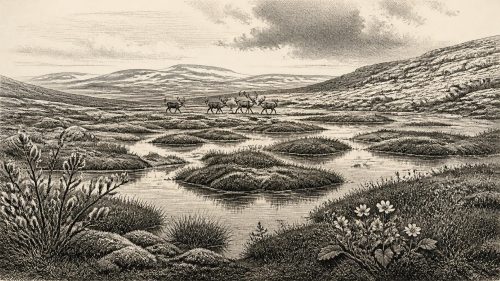
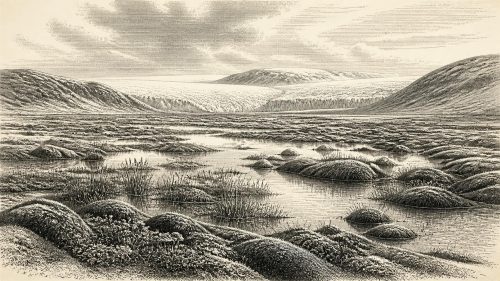
Derryvree was not a familiar green Ireland. Pollen, plant macrofossils and animal remains from the organic beds point to an open, cold landscape with tundra-like vegetation and periglacial conditions. Mosses survived around freshwater and wet ground; herbaceous plants dominated the pollen record. Sparse vegetation may have occupied drier surfaces, but there is no basis for imagining extensive woodland. The deposit is often described as indicating muskeg or wet tundra: a setting of sedges, mossy ground, shallow water, seasonally active soils and exposed mineral surfaces.
This evidence is local, not a complete map of the island. It cannot tell us that every valley, coast and upland looked identical. Yet it decisively demonstrates that this part of Fermanagh supported a freshwater environment before later ice buried it. Its position between tills is crucial: the lower till records an earlier glacial episode, the organic bed an interval when water and vegetation returned, and the upper till the subsequent advance that sealed the evidence. Derryvree is thus both a landscape archive and a warning against treating the Ice Age as a single unchanging freeze.
Crag Cave in County Kerry provides complementary evidence for climatic fluctuation rather than a direct scene at Derryvree. Uranium-thorium dates on cave calcite show episodes of speleothem growth during Marine Isotope Stage 3. Because calcite deposition in this shallow cave required liquid water and conditions sufficiently mild for it to circulate, these phases support the wider conclusion that glacial Ireland experienced pronounced, repeated shifts rather than uninterrupted extreme cold. They do not prove identical weather in Fermanagh, but they strengthen the case for regionally variable and rapidly changing conditions.
Animals Before the Ice Peak
Irish cave collections show that sizeable mammals reached the island during parts of the pre-Last Glacial Maximum period. Castlepook Cave, near Doneraile in north County Cork, is especially important. Its old collections include bones attributed to mammoth, spotted hyaena, reindeer, giant deer, brown bear, wolf, fox and lemmings. The Irish Quaternary Fauna Project used accelerator radiocarbon dating to show that a broad range of mammals occurred in Ireland between at least about 45,000 and 20,000 years ago, though individual cave deposits are often disturbed and cannot always be read as intact living communities.
That qualification matters. A cave is not necessarily a campsite, nor even a natural sample of every creature outdoors. Carnivores may have dragged carcasses inside; animals may have died in fissures; water, collapse and excavation can mix material of different ages. The Castlepook bones reveal that Ice Age fauna existed in Ireland over a lengthy period, but they do not establish that mammoth, hyaena, reindeer and every other recorded species stood together in one herd at 31,843 BCE. Nor should animal abundance in a bone deposit be translated automatically into abundance across the landscape.
Even so, the faunal evidence makes clear that Ireland was not biologically empty. Reindeer and cold-adapted small mammals are consistent with open country, while mammoth and hyaena demonstrate connections with wider north-west European faunal worlds during favourable intervals. Later genetic and morphological reassessment has also shown why identification must remain careful: several supposed pre-Last Glacial Maximum red-deer specimens proved to be reindeer. The distinction changes interpretations of habitat and movement, and illustrates how conclusions improve when old collections are re-examined with new methods.
The Human Question
There is no securely dated house, hearth, stone-tool assemblage, burial, human skeleton or settlement in Ireland that can be assigned to this calendar label. There were no known political territories, rulers, diplomatic relations or institutions. It would be misleading to write of an Irish people, tribe, religion, language or economy in the usual historical sense. The evidence does not support them.
A reindeer femur from Castlepook has nevertheless made the question of human presence more complicated. Ruth Carden identified a deep mark on the bone as consistent with cutting or chopping fresh bone using a sharp stone tool, and public heritage accounts have associated the specimen with a date of around 33,000 years ago. If that interpretation is sustained, it may indicate an Upper Palaeolithic human visit or episode of carcass processing in Ireland during this broad period. It would be an important discovery, but it is not proof of permanent occupation. The specimen comes from an old cave collection, without a securely associated occupation floor, hearth or tool-kit. The animal’s radiocarbon date establishes when it died, not automatically when a mark was made or how long people may have remained nearby.
The most responsible conclusion is therefore deliberately narrow. Small groups may have reached Ireland, perhaps following animal resources or moving through a wider, low-sea-level north-west European landscape. But such a possibility cannot demonstrate a stable population, a migration route, regular trade, social hierarchy or cultural tradition on the island. Low sea levels exposed wide areas of the surrounding continental shelf, altering coastlines and potential routes, but relative sea level, ice cover and the practical availability of a land connection varied through time and remain subjects of specialist modelling.
Life Without a Recorded Society
If humans did visit, their subsistence would have depended on immediate opportunities: animals, freshwater, fuel, raw stone and shelter. This is an inference from hunter-gatherer lifeways elsewhere in Upper Palaeolithic Europe, not direct evidence from an Irish camp. The Derryvree wetlands could have offered water and plant cover; open terrain could have made grazing animals visible; limestone caves provided protected spaces but also attracted predators and trapped bones. None of this establishes a local settlement, seasonal round or exchange network.
There is likewise no evidence for ceremonial places, art, formal burial, farming, herding, pottery, metalworking or written learning in Ireland at this time. Religion and culture cannot responsibly be reconstructed beyond the universal observation that any visiting people would have brought knowledge, skills and social practices with them. Archaeology can sometimes recover actions—such as the deposition of a bone or the growth of cave calcite—without recovering the beliefs behind them. Silence in the record is not proof that people lacked culture; it is a limit on what Ireland’s surviving evidence can reveal.
An Approaching Transformation
The larger development was environmental. In the millennia after this horizon, the last Irish ice sheet expanded greatly. Offshore and onshore evidence indicates major advances to the Atlantic and Celtic Sea shelf margins by about 27,000–25,000 years ago, while the timing and thickness of ice varied substantially by sector. The advancing ice eroded older landforms, reworked sediments and destroyed or concealed much of the surface evidence that might otherwise have survived from early human activity.
That later glaciation helps explain why the record is so fragmentary. Derryvree survived because younger till protected its freshwater beds; cave crevices protected selected bones; offshore cores preserve traces of ice movement long after the ice vanished. Around 31,843 BCE, Ireland’s story is consequently a story of survival in the archaeological sense: not a documented society surviving against the cold, but scattered environmental records surviving the erosive power of the ice that followed.
What Can Be Said Securely
Ireland around this notional date belonged to a severe but changeable Late Pleistocene world. Fermanagh preserves direct evidence for ice-free freshwater conditions and treeless, wet tundra within a calibrated range that includes this point. Cave collections demonstrate the presence of varied large and small mammals during the wider pre-maximum interval. The possibility of an early human encounter at Castlepook is significant but remains far too slight to carry a narrative of settlement. Political history begins here only in the loosest sense: landscapes, animals, ice and possible human movement were creating the constraints from which all later Irish history would eventually emerge.
Primary Sources
- A Middle Midlandian Freshwater Series at Derryvree, Maguiresbridge, County Fermanagh, Northern Ireland
- Trimlines, Blockfields and the Vertical Extent of the Last Ice Sheet in Southern Ireland
- Exploring Controls of the Early and Stepped Deglaciation on the Western Margin of the British Irish Ice Sheet
- Growth and Retreat of the Last British–Irish Ice Sheet, 31,000 to 15,000 Years Ago: the BRITICE-CHRONO Reconstruction
- BRITICE-CHRONO Maps and GIS Data of the Last British-Irish Ice Sheet 31 to 15 ka
- The Island of Ireland: Drowning the Myth of an Irish Land-Bridge?
- Postglacial Relative Sea-Level Observations from Ireland and Their Role in Glacial Rebound Modelling
- The Irish Quaternary Fauna Project
- Irish Pleistocene Biostratigraphy
- Phylogeographic, Ancient DNA, Fossil and Morphometric Analyses Reveal Ancient and Modern Introductions of a Large Mammal: the Complex Case of Red Deer (Cervus elaphus) in Ireland
- Episodic Speleothem Deposition Tracks the Terrestrial Impact of Millennial-Scale Last Glacial Climate Variability in SW Ireland
- Last Glacial Maximum Cirque Glaciation in Ireland and Implications for Reconstructions of the Irish Ice Sheet
- A Late Pleistocene Channelized Subglacial Meltwater System on the Atlantic Continental Shelf South of Ireland
- Timing and Pace of Ice-Sheet Withdrawal Across the Marine–Terrestrial Transition West of Ireland During the Last Glaciation
- Ice Sheet Extension to the Celtic Sea Shelf Edge at the Last Glacial Maximum
- Advance and Retreat of the Marine-Terminating Irish Sea Ice Stream into the Celtic Sea During the Last Glacial: Timing and Maximum Extent
- The IntCal20 Northern Hemisphere Radiocarbon Age Calibration Curve (0–55 cal kBP)
- The Archaeological Heritage of County Cork: An Introduction
- Heritage Artefacts of County Cork
- Palaeoecology: Irish Quaternary Association Field Guide