The Doneraile Limestone Assemblage31825 BCE
31,825 BCE is a reference point, not a recoverable Irish year. During climatically unstable Marine Isotope Stage 3, Ireland contained expanding regional ice, while ice-free areas were open, treeless, cold environments and coastlines differed under lower sea levels. Castlepook Cave, County Cork, preserves a long, disturbed assemblage of mammoth, reindeer, giant deer, hyaena and other fauna, demonstrating intermittent animal occupation rather than a single community. Revised radiocarbon dating places remains earlier in MIS 3. A possibly cut-marked reindeer bone suggests a human visit around 33,000 years ago, but no secure settlement evidence exists. Uncertainty remains central to interpreting this period.
Dateline
The label 31,825 BCE is a modern chronological convenience, not a year that can be recovered from Ireland’s Ice-Age record. It represents roughly 33.8 millennia before the conventional radiocarbon reference year of 1950, within the Late Pleistocene and broadly within Marine Isotope Stage 3 (MIS 3). There were no written calendars, named communities or datable events on the island. Nor can archaeology isolate an occurrence to this particular twelve-month interval. The responsible history of Ireland at this point is therefore a history of dated ranges, environmental proxies and carefully qualified possibilities.
The nearest relevant evidence comes chiefly from southern Irish caves, particularly Castlepook Cave near Doneraile in north County Cork. Its animal remains and sediments illuminate a long span before the Last Glacial Maximum, rather than a single moment. Improved radiocarbon methods have shown that several bones formerly thought younger belong substantially earlier in MIS 3. Taken together, the cave record indicates that animals occupied parts of Ireland during intervals between at least about 45,000 and 20,000 radiocarbon years BP, although individual specimens must be assessed separately and calibrated calendar ranges are often broad. Around the notional date of 31,825 BCE, Ireland was not the familiar green, wooded island of later millennia, nor yet necessarily an island completely engulfed by the last great ice sheet.
A Date Range, Not a Recorded Year
Radiocarbon ages are not themselves calendar dates. The concentration of carbon-14 in the atmosphere has changed through time, so laboratory measurements require calibration against internationally maintained curves. At this depth of time, calibration carries wider uncertainties than it does for later prehistory. A result should therefore be read as a probability range, not as an anniversary. The phrase “around 31,825 BCE” is useful only as a point on a modern timeline against which to set evidence dated in radiocarbon years BP or calibrated years BP.
MIS 3, conventionally extending approximately from 57,000 to 29,000 years ago, was climatically unstable. Greenland ice-core records show abrupt shifts between colder stadial and relatively milder interstadial conditions over centuries and millennia. Ireland’s local response depended upon altitude, exposure to the Atlantic, the growth of ice in neighbouring regions, sea level and the changing geometry of the British–Irish Ice Sheet. It would be misleading to imagine one unchanging “Ice Age climate” across the whole island.
At about 31,000 years BP, reconstructions suggest that substantial ice already occupied north-western Ireland, with a major ice cap spanning high ground from the Derryveagh Mountains towards the Sperrins. Smaller ice fields or glaciers are modelled in several upland areas, including the Wicklow Mountains, Mournes, Dartry Mountains, MacGillycuddy’s Reeks and Knockmealdown Mountains. Yet the ice sheet was still growing and its margins differed greatly by region. Its maximum volume came later, around 23,000 years BP in the latest BRITICE-CHRONO reconstruction, while individual sectors advanced and retreated at different times. A map for this period is consequently an evidence-based reconstruction with uncertainty bounds, not a photograph of a fixed landscape.
Cold Ground and Changing Coasts
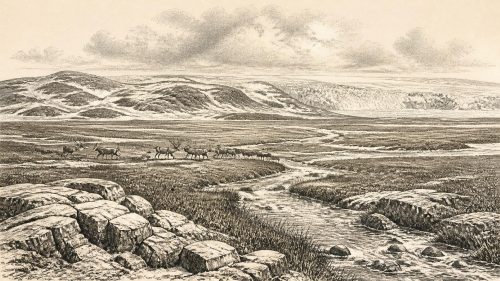
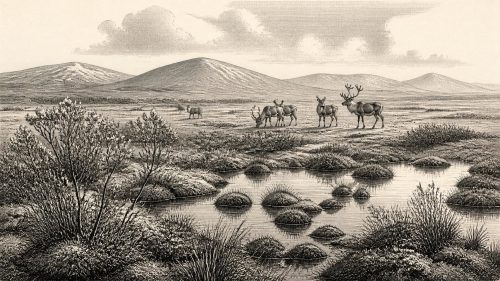
Where land was ice-free, the probable setting was open, cold and wind-exposed. Plant evidence from Irish sediment sequences of comparable Ice-Age age points to treeless or sparsely shrubby landscapes in cold phases, with grasses, sedges, herbs, mosses and dwarf shrubs rather than closed forest. Permafrost and repeated freezing and thawing would have altered soils and slopes. Streams could be seasonally vigorous, while hollows and lake margins preserved pollen, plant macrofossils and insects only in rare favourable deposits. Much of the later Irish landscape has been scoured, buried or rearranged by ice, leaving an exceptionally fragmentary archive.
Sea level was lower than today because large quantities of water were held in continental ice sheets. The outlines of Ireland and the Celtic Sea shelf therefore differed markedly from modern maps. Low sea level may have enlarged coastal plains and shortened some sea crossings, but it does not licence a simple claim that there was a continuous, usable land bridge linking Ireland to Britain or continental Europe at this exact time. Relative sea level around Ireland was also affected by the weight of growing ice and movement of the Earth’s crust. Animal dispersal demonstrates that routes existed at some points during the wider period; it does not identify the route, season or precise date of every arrival.
Such environmental change was the decisive regional force. It shaped what plants could grow, which animals could find forage, whether caves were accessible and where water, shelter and carrion accumulated. It also created the geological legacy visible today: glacially smoothed rock, tills, drumlins, altered drainage and submerged shelf landscapes. These are not monuments made by Ice-Age Irish communities. They are the physical conditions under which any animal or human visitor would have moved.
Castlepook’s Faunal Evidence
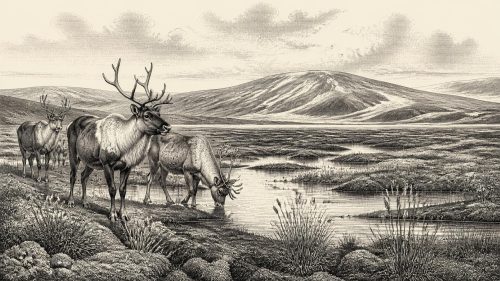
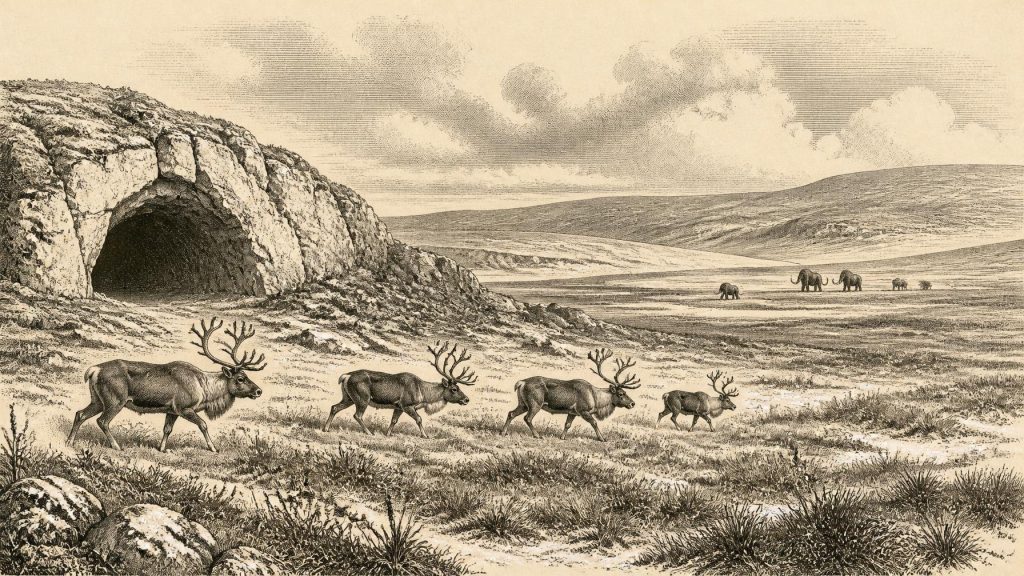
Castlepook Cave is crucial because it is Ireland’s richest known assemblage of vertebrate remains from the period leading towards the Last Glacial Maximum. Excavations begun in the early twentieth century recovered more than 2,000 bones from galleries given memorable names such as Hyaena Hall and Elephant Hall. The collection includes remains attributed to woolly mammoth, reindeer, giant deer, brown bear, wolf, Arctic fox, mountain hare, lemmings and spotted hyaena. Not every one of these animals need have been present together, and the species list represents a long accumulation rather than a single living community. Nonetheless, it establishes that Ireland could support a varied cold-stage fauna during parts of the wider MIS 3 interval.
The assemblage should not be treated as a straightforward census of a Cork valley. Carnivores could drag prey or scavenged carcasses into caves; hyaenas in particular may have used the system as a den. Water could move bones between passages, roof collapse could break them, and early excavators worked before modern standards of stratigraphic recording. Recent work has therefore emphasised taphonomy: the study of how remains entered a site, were disturbed and survived. A mammoth bone in a cave proves neither a herd outside the entrance on one particular day nor human hunting of mammoths.
Redating has nevertheless transformed the importance of southern Irish cave material. Carden, Higham and Woodman demonstrated that several Castlepook determinations were thousands of radiocarbon years older than earlier measurements suggested. Their study places important elements of the fauna firmly in MIS 3 and indicates that species including giant deer and spotted hyaena may have disappeared locally before the later maximum of glaciation. The result is a more securely ancient faunal horizon, but also a reminder that the chronology of individual finds can change as laboratory treatment improves.
The Human Question
This date has special archaeological interest because a reindeer femur from Castlepook has been interpreted as bearing a cut mark made by a sharp stone edge during butchery. If that interpretation and its association are upheld, it may indicate a human visit to Ireland around 33,000 years ago, much earlier than the formerly accepted terminal-Pleistocene evidence. It is an important proposition, not a licence to write a settled human history for 31,825 BCE.
The distinction matters. A directly dated animal bone can establish when the animal lived or died; identifying a groove as a human cut mark requires separate microscopic and taphonomic judgement. Even a genuine cut mark would show the processing of one animal, not the location of a camp, the size of a group, their language, their route of arrival or a permanent population. No securely stratified stone-tool assemblage, hearth, dwelling, burial or human bone from this particular early horizon has yet been published. Current excavation at Castlepook is directed precisely towards finding undisturbed deposits that might test these questions.
The better-established evidence for Palaeolithic activity in Ireland is considerably later: a cut-marked brown-bear kneecap from Alice and Gwendoline Cave in County Clare has two calibrated ranges of approximately 12,810–12,590 and 12,810–12,685 cal BP. That later evidence demonstrates the value of revisiting old cave collections with modern dating and analysis. It does not fill the long chronological gap between the end of MIS 3 and the terminal Pleistocene, nor does it confirm a continuous human presence.
No Politics, but a Living Landscape
There is no evidence at this date for Irish political affairs, diplomacy, organised warfare, settlements, religion, formal learning, trade networks or a domestic economy. These categories belong to societies represented by people, artefacts, structures or texts; none can responsibly be projected onto a possible brief Palaeolithic visit. If people did reach southern Ireland during this period, their immediate concerns were likely practical ones shared by mobile hunter-gatherers elsewhere in Ice-Age Europe: shelter, fuel, weather, safe movement and access to animal food. That is an informed comparison, however, rather than a direct observation from Ireland.
Nor should the cave fauna be converted into a romantic scene of hunters pursuing every large animal in sight. Reindeer, giant deer and mammoth were possible resources, but the evidence cannot tell whether humans encountered them, hunted them, scavenged them or never met them at all. Spotted hyaena, wolves and bears make equally clear that any human visitors would have entered a landscape inhabited by competing carnivores. The most defensible picture is of ecological opportunity constrained by cold, distance, unstable climate and an expanding ice sheet.
For Ireland, then, 31,825 BCE marks neither a king’s reign nor a battle, but a threshold of knowledge. Cave bones, sediments, ice-sheet models and calibration curves show an island—or changing landmass at the Atlantic edge—where Ice-Age animals moved through open environments as glaciation intensified. A disputed modified reindeer bone raises the possibility that people also arrived. Future excavation, direct dating and taphonomic analysis may strengthen, revise or reject that claim. The uncertainty is not a deficiency to be concealed: it is the central historical fact of Ireland at this extraordinary depth of time.
Primary Sources
- A reconsideration of the radiocarbon dating of the Marine Isotope Stage 3 fauna from southern Ireland
- The Irish Quaternary Fauna Project
- Growth and retreat of the last British–Irish Ice Sheet, 31,000 to 15,000 years ago: the BRITICE-CHRONO reconstruction
- BRITICE-CHRONO Maps and GIS Data of the Last British-Irish Ice Sheet 31 to 15 ka
- Castlepook Cave: County Geological Site Report
- 2022:564 – Castlepook Cave, Castlepook South, Cork
- New Insights on the Fauna of Ireland’s Younger Dryas and Early Holocene from Alice & Gwendoline Cave
- First Evidence of a Late Upper Palaeolithic Human Presence in Ireland
- The IntCal20 Northern Hemisphere Radiocarbon Age Calibration Curve (0–55 cal kBP)
- IntCal History
- Extent and Timing of the Last Glacial Maximum (LGM) in Britain and Ireland: A Review
- The Timing and Magnitude of the British–Irish Ice Sheet Between Marine Isotope Stages 5d and 2
- Could Brown Bears Have Survived in Ireland During the Last Glacial Maximum?
- Landscapes and Environments of the Last Glacial-Interglacial Transition: A Time of Amazingly Rapid Change in Ireland
- Advances in Irish Quaternary Studies
- Irish Cave Exploration
- The Dungarvan Valley Caves Project: Second Interim Report
- The Marine δ18O Record Overestimates Continental Ice Volume During Marine Isotope Stage 3
- Dansgaard–Oeschger Events in Climate Models: Review and Baseline Marine Isotope Stage 3 Protocol
- Dimensions and Chronology of the Last Ice Sheet in Western Ireland
- A Critical Review and Re-investigation of the Pleistocene Deposits Between Cranfield Point and Kilkeel, Northern Ireland
- Stratigraphic and Palaeo-geomorphological Evidence for the Glacial-deglacial History of the Last British-Irish Ice Sheet in the North-western Irish Sea