
Tundra Before the Ice31808 BCE
The reference year 31,808 BCE introduces Ireland’s Late Pleistocene tundra environments while acknowledging that no event can be dated precisely to it. Environmental deposits, cave faunas and glacial evidence cover long periods. Cold grassland, sedges, herbs and low vegetation persisted where expanding ice had not overridden the ground. Fermanagh freshwater deposits demonstrate biological activity, while Castlepook Cave preserves remains of reindeer, mammoth, giant deer, bear, wolf and spotted hyaena. These assemblages connect Ireland to wider northwestern European ecology. The article interprets scattered evidence cautiously, separating an annual archive marker from the broader chronological ranges that scientific reconstruction can actually support.
Dateline
31,808 BCE is an archive reference year within the Late Pleistocene. Ireland preserves no event that can be dated to this exact year. The period is reconstructed instead from environmental deposits, cave faunas and glacial evidence that span long ranges of time.
Open Ground in a Cold World
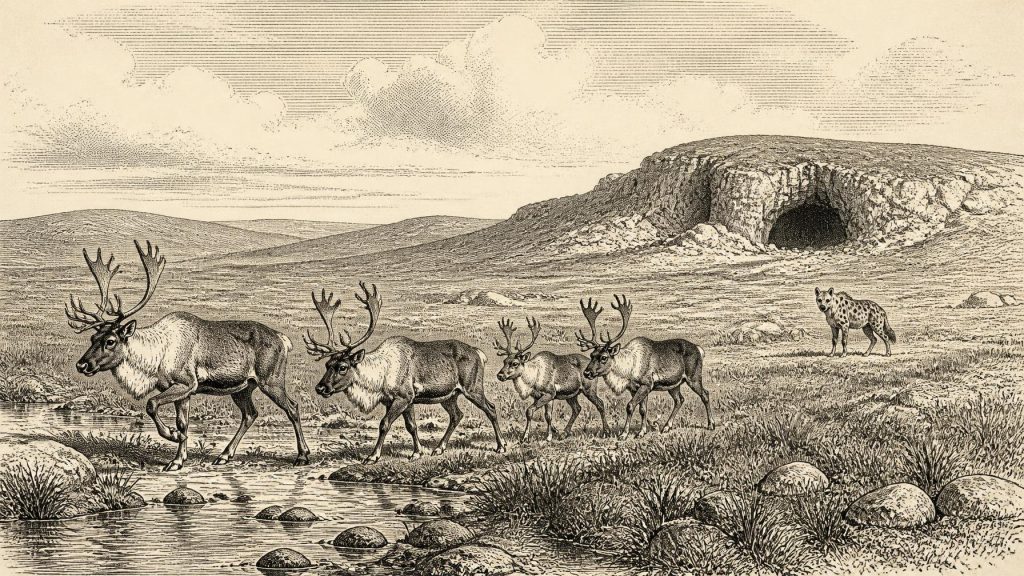
Cold grassland, sedges, herbs and low tundra vegetation could survive in places not yet overridden by expanding ice. Freshwater deposits from County Fermanagh demonstrate that biologically active landscapes persisted during intervals of severe climate.
Animals Before Maximum Glaciation
Castlepook Cave in County Cork preserves a mixed Ice Age fauna including reindeer, mammoth, giant deer, bear, wolf and spotted hyaena. These remains accumulated over extended periods but show that Ireland belonged to the wider Late Pleistocene ecological world of north-west Europe.
Limits of the Record
Possible human visits remain uncertain and no securely excavated settlement of this age is known. The most defensible account of 31,808 BCE therefore emphasises environment, animals and the approach of larger-scale glaciation.
Primary Sources
Sources include National Museum of Ireland collections, Castlepook excavation reports, Cork heritage studies, Derryvree inter-till research, BRITICE-CHRONO, Quaternary Science Reviews, Boreas studies and IntCal20 calibration research.


