
Doneraile’s Scored Reindeer Femur31723 BCE
31,723 BCE is an approximation within unstable Marine Isotope Stage 3, not a datable Irish event. Before the Last Glacial Maximum, parts of Ireland remained ice-free, supporting treeless periglacial wetlands, tundra vegetation and cold-adapted animals. Deposits at Derryvree and Greenagho demonstrate changing environments, while Castlepook Cave preserves faunal remains accumulated over millennia, including mammoth, reindeer and hyaena. A scored reindeer femur, dated broadly to about 33,000 years ago, may indicate Upper Palaeolithic butchery. However, disturbed cave contexts and absent associated tools or settlements prevent proof of permanent occupation. Glaciation and sea-level rise destroyed evidence; Ireland’s human presence therefore remains uncertain.
Dateline
The label 31,723 BCE is a modern chronological convenience, not a year that anyone in Ireland could have named, recorded or experienced as a fixed point in a calendar. At this depth of time, archaeology cannot identify an Irish event, ruler, battle or generation for one particular year. The responsible approach is to place it within a broad environmental and archaeological horizon: about 33.7 thousand calendar years before AD 1950, during Marine Isotope Stage 3 (MIS 3), a climatically unstable interval of the last Ice Age.
This is also an age at which precision has firm limits. Radiocarbon measurements are not calendar dates; they must be calibrated against changing past levels of atmospheric carbon-14, and the resulting ranges may be wide. Cave deposits and glacial sediments add further complications because bones, water-laid material and sediments may have been moved after their original deposition. Therefore, 31,723 BCE should be read as a position within a long span, not as the date of a recoverable occurrence.
An Island Before the Ice Peak
Ireland was not yet at the Last Glacial Maximum, the later interval, broadly c. 26,500–19,000 years ago, when the British–Irish Ice Sheet reached its greatest overall extent. It was, however, moving through the long approach to that maximum. The growth of the last Irish Ice Sheet was uneven in time and place. Reconstructions differ in detail, but evidence from Irish deposits indicates that extensive ice cover did not simply descend upon the whole island at once. Around the notional year in question, areas of Ireland could still sustain terrestrial animal life and wetland vegetation, even as colder conditions and expanding ice were becoming increasingly consequential.
County Fermanagh provides one of the most valuable windows onto this wider period. At Derryvree, near Maguiresbridge, organic-rich silts lay between glacial tills. A radiocarbon determination from the sediments has been reported in later syntheses as 36.9–31.7 thousand calibrated years before present. That range encompasses the broad chronological position represented by 31,723 BCE. The deposit does not reveal what happened on a particular day or in a particular year. It does show, however, that north-central Ireland contained an ice-free landscape before the later overriding and burial of the site by glacier ice.
Greenagho, also in Fermanagh, supplies a comparable warning against imagining an island already uniformly entombed beneath ice. Organic material from lake deposits beneath till has produced a calibrated range of roughly 37.2–35.7 thousand years before present. Such dates are not a continuous weather diary, and the sites are not interchangeable. Together, though, they support a picture of changing, locally habitable ground in parts of Ireland during MIS 3, followed by the much more extensive glacial expansion of the later last glaciation.
Treeless Ground and Shallow Water
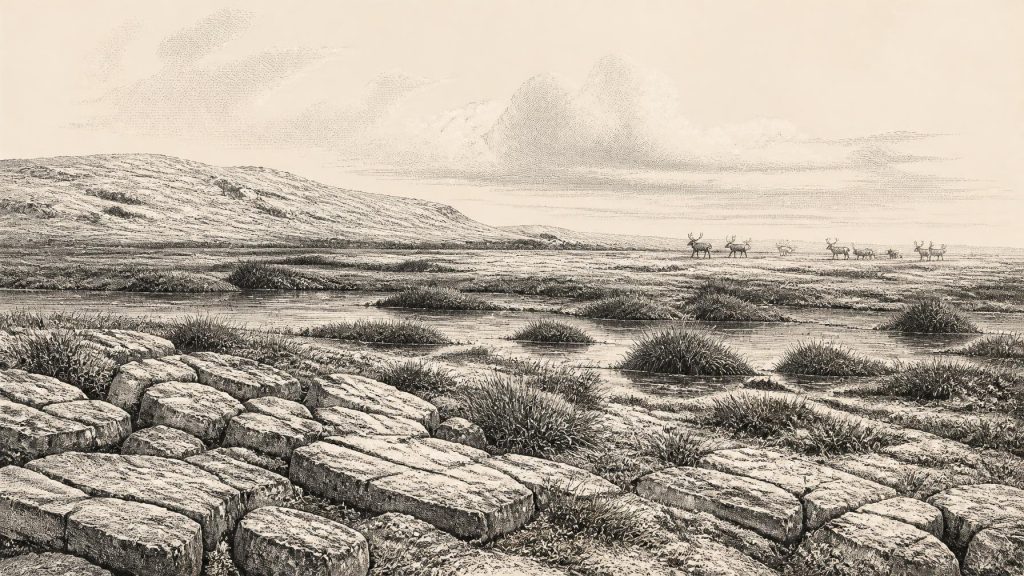
The Derryvree evidence is especially important because it includes biological remains as well as sediment. Pollen, plant macrofossils and insect evidence have been interpreted as indicating an open, treeless muskeg or sedge-rich wetland under periglacial conditions. “Periglacial” does not mean that the ground was necessarily covered by a glacier. It describes a cold environment shaped by frost, seasonal thaw, sparse vegetation and processes associated with land near ice or persistent frozen ground.
For a visitor standing in such a landscape, Ireland would not have resembled the familiar green, wooded island of later millennia. Trees were absent from the Derryvree setting. Wet hollows, pools, sedges, mosses and low-growing tundra plants could occupy sheltered ground, while exposed surfaces were vulnerable to wind, frost-shattering and seasonal instability. The character of any one valley, limestone hollow or upland slope would have depended on drainage, altitude, aspect and the shifting regional climate. It is safer to describe a mosaic of open ground and wetlands than to give the entire island one uniform appearance.
Rivers and ponds were not merely scenery. They concentrated plant growth, attracted animals and preserved pollen, insects and organic sediment. They also became archives. Most evidence for this period is indirect in exactly this way: a buried bed of silt, a beetle fragment, a seed, a pollen grain, a bone recovered from a cave. These surviving traces permit environmental reconstruction, but they do not disclose names, languages or social identities.
Castlepook’s Animal Archive
In north Cork, Castlepook Cave near Doneraile is the outstanding Irish faunal site for the period leading towards the Last Glacial Maximum. The cave’s galleries acquired evocative names during early exploration, including Hyenahall and Elephant Hall. Excavations between 1904 and 1918, followed by later investigations, produced a large collection of animal remains. Modern re-dating has demonstrated that the cave archive is chronologically complex: individual bones span a long period rather than representing one short-lived animal community.
Its Ice Age fauna includes woolly mammoth, giant deer, reindeer, brown bear and spotted hyaena; later parts of the collection include Arctic fox, wolf and lemmings. The list is powerful evidence that animals adapted to cold, open environments reached Ireland. It should not be treated as a roll-call of creatures all standing together outside the cave in 31,723 BCE. Individual specimens can differ markedly in age, and cave deposits can combine bones brought in by carnivores, moved by water, left by dying animals or disturbed by excavation.
That distinction matters particularly at Castlepook. A cave is not automatically a human home. Hyaenas and other carnivores could drag bones underground; scavenging, trampling, water movement and later digging could alter their original positions. Geological Survey Ireland describes Castlepook as a repository for mammal remains over many millennia and notes that water disturbance has obscured part of the evidence. The cave therefore illuminates the ecological possibilities of Ice Age Ireland more securely than it yields a simple settlement story.
The Reindeer Femur
One bone has transformed the discussion. A reindeer femur from the Castlepook collection bears a deep score interpreted by zooarchaeologist Ruth Carden as damage made by a sharp stone implement during butchery. It has been reported as dating to about 33,000 years ago, and County Cork heritage material places it broadly around 31,000 BC. It is directly relevant to the chronological world represented by 31,723 BCE, although its reported age is necessarily approximate and should not be converted into an exact anniversary.
If the score is correctly identified as a cut or chopping mark, the femur is evidence that people handled a reindeer carcass in Ireland during the Upper Palaeolithic. It would be an exceptionally early indication of human activity on the island. A reindeer’s leg provides meat, marrow, hide and sinew in addition to bone; the mark is therefore compatible with practical carcass processing by mobile hunter-gatherers. But compatibility is not proof of a fully documented hunting camp.
The limits are as significant as the discovery. The femur came from an old cave collection, rather than a modern excavation of a sealed occupation surface. No securely associated hearth, dwelling, stone-tool assemblage, human burial or food-preparation area of the same age has been identified at Castlepook. The radiocarbon result dates the animal’s death, not automatically the moment of butchery, the location of the kill or the length of a human visit. The score itself remains a specialist interpretation of bone-surface evidence. It is sound to call the femur a potentially momentous trace of Palaeolithic butchery; it is not sound to claim a permanent Irish population from one marked bone.
People Without Polities
There is no evidence at this date for political institutions, rulers, diplomacy, territorial states, formal warfare or religious monuments in Ireland. Nor is there evidence for farming, villages, craft workshops, long-distance trade networks or writing. Those absences are not trivial gaps in an otherwise complete record. They define the historical situation. Any humans represented by the Castlepook femur were likely to have belonged to small, highly mobile foraging groups, but even that is an inference from wider Upper Palaeolithic lifeways rather than a demonstrated social map of Ireland.
Such groups elsewhere in north-western Europe used stone technology, possessed sophisticated knowledge of animal behaviour and seasonal terrain, and relied on co-operation to travel and obtain food in demanding conditions. If people reached Ireland, they would have needed comparable practical knowledge: where animals gathered, how weather changed, which waters and coastlines could be crossed, and how to make temporary use of a cold landscape. Nothing in the Irish evidence presently permits statements about their language, kinship rules, ceremonies, art or collective memory.
Likewise, “economy” in this context can only mean subsistence, movement and the use of natural materials, not commerce in the later sense. Reindeer and other large mammals could have supplied food and useful tissues. Yet Castlepook has not produced the securely associated implements needed to reconstruct methods of hunting, transport, hide-working or exchange. There is no responsible basis for identifying trade or diplomatic contact across the Irish Sea.
Changing Coasts, Vanishing Evidence
Lower global sea levels altered the margins of north-west Europe, but they did not make movement to Ireland simple or certain. The form of coastlines, channels, sea ice and exposed shelf changed through time. Marine-shell dates from Glenulra in the west indicate open water in adjacent Donegal Bay during much of the wider pre-maximum interval. That is a useful corrective to easy assumptions about a permanent land bridge. Routes available to animals or people at one stage may have been blocked, submerged, hazardous or absent at another.
The later Irish Ice Sheet also helps explain why the record is so thin. Glacial erosion removed older surfaces, while till buried or displaced sediments and archaeological traces. Rising seas after the Ice Age then drowned former coastal landscapes, where early human evidence might once have been concentrated. The absence of campsites is therefore not proof that nobody ever arrived, but neither does it justify filling the silence with imagined settlements.
For 31,723 BCE, the central historical fact is uncertainty disciplined by evidence. Ireland was part of a cold, fluctuating MIS 3 world in which open wetlands and tundra supported animal life in at least some regions before the later ice maximum. Castlepook preserves a remarkable faunal archive and a reindeer femur that may record human butchery. It offers the prospect of fleeting Palaeolithic visitation, not yet a known society. Future excavation, re-analysis of museum collections and improved dating may refine that conclusion; for now, restraint is part of accuracy.
Primary Sources
- A reconsideration of the radiocarbon dating of the Marine Isotope Stage 3 fauna from southern Ireland
- The Irish quaternary fauna project
- Castlepook Cave, County Geological Site report
- Heritage Artefacts of County Cork
- Spotted Hyena Skull
- Trimlines, blockfields and the vertical extent of the last ice sheet in southern Ireland
- Extent and timing of the Last Glacial Maximum (LGM) in Britain and Ireland: a review
- Late Pleistocene chronostratigraphy and ice sheet limits, southern Ireland
- Reconstructing the last Irish Ice Sheet 2: a geomorphologically-driven model of ice sheet growth, retreat and dynamics
- Dimensions and chronology of the last ice sheet in Western Ireland
- Deglaciation chronology of the Donegal Ice Centre, north-west Ireland
- New data for the Last Glacial Maximum in Great Britain and Ireland
- Pattern and timing of retreat of the last British-Irish Ice Sheet
- Vertical dimensions and age of the Wicklow Mountains ice dome, Eastern Ireland, and implications for the extent of the last Irish Ice Sheet
- Figure 6: The subdivision of the Quaternary Period in Ireland
- Palaeoecology
- The IntCal20 Northern Hemisphere Radiocarbon Age Calibration Curve (0–55 cal kBP)
- The colonization of Ireland: A human ecology perspective
- The Mesolithic in Ireland: when was it?
- New insights on the fauna of Ireland's Younger Dryas and Early Holocene from Alice & Gwendoline Cave
- Reindeer bone found in Cork cave shows human activity in Ireland 33,000 years ago
- What was on the menu in prehistoric Ireland?