Elephant Hall’s Reindeer Femur31722 BCE
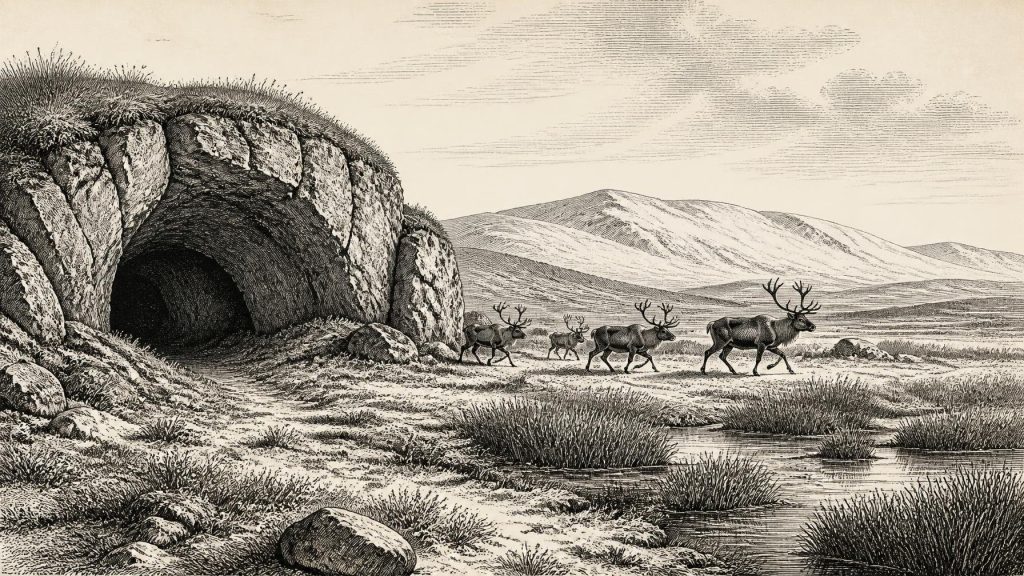
Around 31,722 BCE, Ireland lay within the cold, unstable Marine Isotope Stage 3, before maximum glaciation. Lower sea levels altered surrounding landscapes, though animal and possible human routes remained uncertain. Castlepook Cave, County Cork, preserves evidence of reindeer, mammoth, giant deer, hyaena and other cold-stage fauna, demonstrating intermittent habitability. A reindeer femur bearing a possible stone-tool cut mark may indicate fleeting human activity, but cannot prove settlement or permanent occupation. Complex cave deposits and revised radiocarbon dating require caution. Wetland and pollen records suggest varied open tundra, sedges and river corridors. Ireland’s deepest past is reconstructed from fragmentary environmental evidence.
Dateline
“31,722 BCE” is a modern label, not a date that people or animals in Ice-Age Ireland could have recognised. At this depth of time, calendar-year precision is unavailable. The label falls about 33,700 years before AD 1950 in simple calendar arithmetic, but archaeological and environmental evidence is dated in radiocarbon years, calibrated ranges and broad climatic phases, each with margins of uncertainty. The responsible subject is therefore not an event in a single year, but Ireland during the later part of Marine Isotope Stage 3: a cold, variable interval before the fullest expansion of the last British–Irish Ice Sheet.
A Landscape Before Full Glaciation
Ireland was not yet the wholly ice-buried land often imagined from the phrase “Ice Age”. The British–Irish Ice Sheet grew and changed over a long period, with maximum extent reached later and at different times in different sectors. Large parts of Ireland would eventually be transformed by moving ice, but the evidence from caves, buried wetland sediments and glacial landforms shows that there were earlier phases when animals could occupy portions of the island. Around the notional date represented here, the climate was cold and sharply seasonal, but conditions were neither uniform nor permanently fixed.
Marine Isotope Stage 3, conventionally spanning roughly 57,000 to 29,000 years ago, contained repeated abrupt shifts between colder and somewhat milder conditions recorded especially clearly in Greenland ice cores. Irish deposits cannot always be tied securely to one of these short-lived oscillations. They are fragmentary, often disturbed by later ice or water, and frequently lack material suitable for modern dating. What can be said is that the island’s habitable ground expanded and contracted in response to temperature, snowfall, ice advance, vegetation and access from neighbouring lands.
Sea level was far lower than today because immense quantities of water were locked in northern ice sheets. The outlines of Ireland, Britain and the continental shelf were consequently different. Yet low sea level must not be turned into a simple map of an easy “land bridge”. Ice margins, lakes, rivers, sea channels, exposed sediment plains and seasonal weather mattered as much as distance. The routes by which animals, and perhaps people, could enter Ireland remain a major research question rather than an established prehistoric road.
What the Caves Preserve
The most important Irish evidence relevant to this period comes from Castlepook Cave, near Doneraile in north County Cork, within the Awbeg Valley. This limestone maze contains chambers named by nineteenth-century investigators, including Elephant Hall and Hyaena Hall. Excavations in the early twentieth century recovered thousands of bones, while later reassessment and new fieldwork have demonstrated both the exceptional importance and the difficulty of the archive. A cave is not a time capsule: bones can be dragged in by carnivores, washed through fissures, redeposited by sediment movement, or mixed by excavation.
Nevertheless, Castlepook establishes a crucial point. Ireland supported a much richer cold-stage mammal fauna before the Last Glacial Maximum than its later insular fauna would suggest. The identified animals include reindeer, woolly mammoth, giant deer, brown bear, wolf, Arctic fox, hare, lemmings and spotted hyaena. Not every species belonged to one moment, one herd or even one climatic episode. Direct dates from individual bones span a substantial interval, and the assemblage must be read as a sequence of presences over time. It does, however, show that southern Ireland could at intervals sustain large herbivores, predators and scavengers in an open Ice-Age environment.
Reindeer are especially evocative because they imply extensive grazing country, but they should not be made into a complete reconstruction of the landscape. Reindeer can range through varied northern habitats. Mammoth and giant deer likewise signal productive terrain somewhere within reach, while hyaenas point to carcasses, prey and sheltered denning spaces. Hyaenas may have been active agents in building the cave bone collection: tooth marks, broken bones and the selective transport of parts of carcasses can record their feeding and denning behaviour rather than human hunting.
The Femur and Its Limits
A reindeer femur associated with Castlepook has attracted particular attention because it bears a deep mark interpreted as having been made by a sharp stone tool during carcass processing. Public reporting placed the bone at about 33,000 years ago, close in broad terms to the date represented by this article. If the modification is confirmed as anthropogenic and securely connected with the age of the bone, it would be extraordinary: evidence that people reached Ireland tens of millennia before the well-established terminal-Pleistocene traces in County Clare.
That conditional language is essential. The modified reindeer bone is not a settlement, a hearth, a stone-tool assemblage or a human skeleton. It does not identify a named population, prove a permanent colony, or allow us to describe a camp at Castlepook in 31,722 BCE. The bone’s older excavation history and the complex processes that accumulated the cave deposits restrict what can be inferred. A cut-like groove may be highly suggestive, but its interpretation must be tested against microscopic study, taphonomy, secure dating and comparison with carnivore damage, sediment abrasion and other natural alterations.
Recent work has also changed the chronology of Irish cave fauna. Improved collagen preparation, including ultrafiltration, can remove contaminants that made some older radiocarbon results appear too young. Re-dating of selected southern Irish material showed that previously published dates required serious revision, in some instances by thousands of radiocarbon years. This is not a technical footnote. It is why a precise BCE heading cannot be used to fasten every Castlepook bone, or every mark on a bone, to a single point in time. The evidence is real; the chronological and behavioural interpretation remains under active refinement.
No Politics, but Ecological Pressures
There is no evidence for political institutions, diplomacy, warfare, leaders, territories or organised religion in Ireland at this date. Nor is there evidence for farming, pottery, metalworking, villages, monuments, writing, formal trade networks or a settled economy. To supply them would be invention. If people did reach the island during this part of the Upper Palaeolithic, they would have been small, mobile hunter-gatherer groups operating at the extreme north-west of Europe, dependent on knowledge of weather, animal movement, fuel, shelter and safe routes. But even this is a regional inference, not an excavated Irish social world.
The more secure history is ecological. A human visitor, if present, would have entered a landscape in which food was mobile and seasonal. Reindeer and other herbivores could offer meat, fat, hide, sinew, antler and bone; stone tools could be used to divide carcasses efficiently. Predators were competitors as well as dangers. Cave spaces might provide short-term shelter or a place to process a carcass, but they also belonged to bears and hyaenas. The surviving Castlepook record therefore describes a contested animal landscape, not a human homeland.
There is no Irish evidence from which to infer ceremonial practice or learning at Castlepook. Elsewhere in north-west Europe, people of broadly comparable Upper Palaeolithic antiquity made sophisticated stone and bone objects, wore ornaments and sometimes treated the dead in striking ways. The Paviland burial in south Wales, dated to roughly 33,000–34,000 years ago, is an important reminder that such cultural capacities existed within the wider region. It cannot, however, be projected across the water into Ireland. Similar age does not demonstrate direct contact, shared identity or Irish ritual.
Wetlands, Tundra and Change
Irish palaeoenvironmental sites offer the wider setting. Organic sediments beneath and between glacial deposits in Ulster, including records at Derryvree, Hollymount, Greenagho and Aghnadarragh, preserve pollen, plant remains and insects from different parts of the last cold stage. Some indicate cold, open, treeless ground, sedge-rich wetlands and muskeg-like vegetation; an earlier interstadial at Aghnadarragh preserves evidence for cool-temperate woodland. These sites do not deliver a weather report for north Cork in one numbered year. Together, they show just how rapidly Ireland could move between more hospitable and more severe environments.
For the period closest to 31,722 BCE, the most supportable visualisation is therefore not a frozen white wilderness. It is a patchwork: exposed grass- and herb-rich ground, dwarf shrubs and sedges, wet hollows, river corridors, bare mineral soil, limestone shelter and distant snow or ice. The precise balance varied regionally and through time. Such country could support grazing mammals, but it was vulnerable to climatic deterioration. As ice expanded towards its later maximum, habitats were erased, animal movements were disrupted and any short-lived human use of Ireland may have ended without leaving an easily recognisable archaeological signature.
A Fragile Beginning
This date belongs to a period before Ireland’s documented human story, yet not outside the range of responsible historical enquiry. Castlepook Cave makes clear that late Ice-Age Ireland was sometimes biologically connected to wider north-west European worlds. Its animals prove access and habitability; its reindeer femur raises the possibility of a fleeting human encounter. Neither proves an enduring population. The lasting lesson is methodological as much as dramatic: Ireland’s deepest past is reconstructed from bones, silts, pollen and ice-sculpted landforms, and every new date or re-examination can alter the map of what was possible.
Primary Sources
- Castlepook Cave, County Geological Site Report
- A reconsideration of the radiocarbon dating of the Marine Isotope Stage 3 fauna from southern Ireland
- The Irish Quaternary Fauna Project
- Preliminary assessment of the archive of faunal remains from excavated Irish cave sites
- Growth and retreat of the last British–Irish Ice Sheet, 31,000 to 15,000 years ago: the BRITICE-CHRONO reconstruction
- Pattern and timing of retreat of the last British-Irish Ice Sheet
- Early deglaciation of the British-Irish Ice Sheet on the Atlantic shelf northwest of Ireland driven by glacioisostatic depression and high relative sea level
- Landscapes and environments of the last glacial-interglacial transition: a time of amazingly rapid change in Ireland
- Figure 6.— The subdivision of the Quaternary Period in Ireland
- Quaternary Site Descriptions
- Quaternary
- Geology of Ireland
- Ireland through geological time
- Outreach and Education Resources
- The colonization of Ireland: A human ecology perspective
- New insights on the fauna of Ireland’s Younger Dryas and Early Holocene from Alice & Gwendoline Cave
- Excavation at Castlepook Cave, Castlepook South, County Cork
- Archaeological Heritage of County Cork
- AMS Radiocarbon Dating of Ancient Bone Using Ultrafiltration
- AMS radiocarbon dating of Middle and Upper Palaeolithic bone in the British Isles: improved reliability using ultrafiltration
- The IntCal20 Northern Hemisphere Radiocarbon Age Calibration Curve (0–55 cal kBP)
- A stratigraphic framework for abrupt climatic changes during the Last Glacial period based on three synchronized Greenland ice-core records: refining and extending the INTIMATE event stratigraphy
- The ‘Red Lady’ of Paviland
- Investigating seasonal mobility in Irish giant deer Megaloceros giganteus through strontium isotope analysis