
Hyenahall’s Mammoth Toothmarks31748 BCE
31,748 BCE is a nominal modern date within Marine Isotope Stage 3, not a precisely recoverable Irish event. Derryvree deposits indicate intermittent ice-free, treeless environments of sedges, grasses, juniper, wetlands and severe cold, between glacial advances. Ireland was approaching, rather than experiencing, the Last Glacial Maximum, with variable ice, coastlines and animal access. Castlepook Cave preserves mixed remains of mammoth, reindeer, giant deer, hyaena and other cold-adapted fauna, demonstrating episodic viable food webs. A reindeer femur possibly bears a butchery mark, suggesting transient Upper Palaeolithic human activity, but not settlement. Evidence supports environmental reconstruction, while year-specific narratives remain fundamentally impossible.
Dateline
A Date Beyond Annals
31,748 BCE is not a year that can be recovered from an Irish chronicle, a royal list or an archaeological diary. It is a modern calendar label, equivalent to roughly 33,700 years before AD 1950, the conventional “present” used in radiocarbon science. At this depth of time, precision to a single calendar year is unavailable. The responsible approach is to place the date within broad calibrated ranges, archaeological phases and environmental sequences. Around this point Ireland belonged to Marine Isotope Stage 3, part of the last cold stage known locally as the Midlandian. It was a world before Irish farming, monuments, metalworking, writing or any demonstrable political community.
The closest Irish chronological anchor is the freshwater deposit exposed beneath a drumlin at Derryvree, near Maguiresbridge in County Fermanagh. Organic silts and sands, trapped between two tills, produced a radiocarbon determination of 30,500 +1,170/−1,030 BP. Later calibration places the deposit broadly around 31.7–36.9 thousand calibrated years BP. That is a wide span, approximately 34,950–29,750 BCE, but it includes 31,748 BCE. Derryvree therefore illuminates the kind of environment that may have existed in parts of Ireland around this nominal date; it does not prove what occurred in any particular season or valley in 31,748 BCE.
An Unstable Cold World
Ice-Age Ireland was neither permanently frozen nor uniformly habitable. Greenland ice cores show that the North Atlantic climate of MIS 3 changed abruptly and repeatedly between comparatively milder interstadials and colder stadials, often on timescales far shorter than conventional historical periods. Irish evidence is much patchier than the Greenland record, because later glaciers eroded, buried and rearranged older deposits. Yet Derryvree’s silts, together with organic deposits at places such as Greenagho and Aghnadarragh, demonstrate that ice-free episodes and freshwater habitats existed between advances of glacier ice.
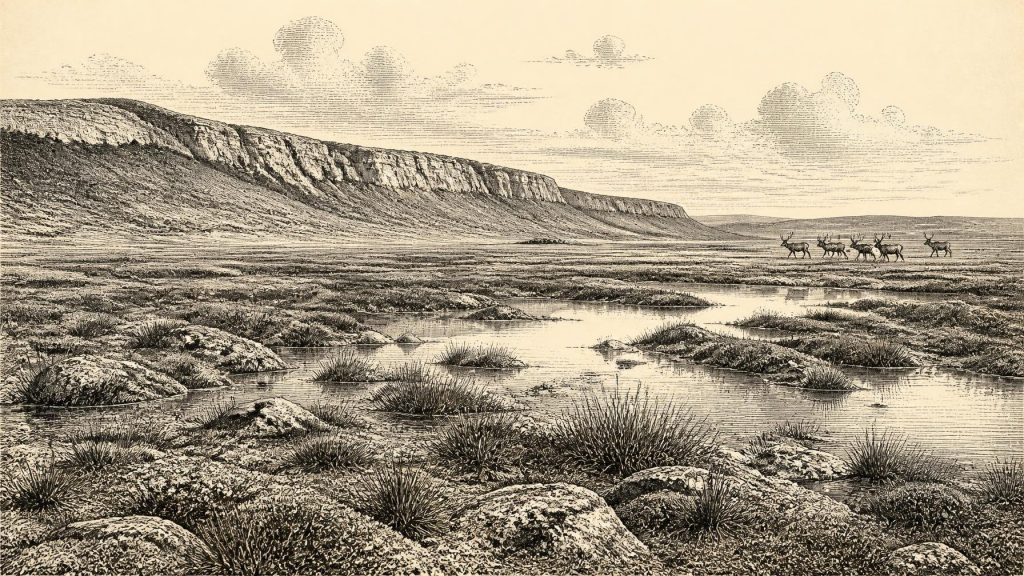
At Derryvree, pollen, plant macrofossils, mosses and insects point towards open, treeless country. Grasses, sedges, herbs and juniper formed a low, discontinuous vegetation, while mossy ground and plant-rich pools occupied wet hollows. The term muskeg, used by researchers for this waterlogged setting, should not suggest a familiar Irish bog under modern woodland and rainfall. This was a cold, exposed landscape with severe winters, short growing seasons and frozen or seasonally frozen ground. Insects associated with pools and wet vegetation are important precisely because they make the reconstruction more secure than a picture based on pollen alone.
Such evidence supports an image of varied local habitats rather than an empty white wilderness: sedge marshes, shallow freshwater, mineral ground, sparse shrubs and open slopes. It does not support an exact temperature for Ireland on this date. Nor should the Derryvree sequence be treated as a map of the entire island. Ireland’s coasts, uplands, interior basins and glacier margins would have differed markedly. The island’s later familiar pattern of dense hedgerows, woodland and peatland had not yet developed.
Ice Building Towards Its Maximum
This was also a time of growing glacial power. Syntheses of the British–Irish Ice Sheet place major build-up after about 35–32 thousand years ago, with maximum extent later, broadly between 27 and 21 thousand years ago. More recent reconstructions show that different sectors advanced, peaked and retreated at different times. Thus 31,748 BCE lay near the onset of the long approach to the Last Glacial Maximum, not at its climax. It would be misleading to say simply that all Ireland was ice-covered, or that all was open ground, in this one notional year.
The deposits at Derryvree make the point physically. Freshwater sediments are enclosed by tills: layers of debris laid down by ice. They record a habitable interval between glacial episodes, then its destruction or burial as ice returned. Across Ireland, later ice moulded bedrock, transported stones, altered drainage and helped create the drumlin landscapes now especially characteristic of the north and midlands. Those prominent landforms are the distant legacy of ice movement, but they cannot be assigned to 31,748 BCE alone.
Lower global sea levels exposed more continental shelf than exists today, changing the outline of coasts and the routes available to animals. Whether there was a practicable continuous dry land connection between Ireland and Britain at particular phases remains a complex question of ice, sea level and local topography. Scholarship has challenged simple land-bridge narratives. For people or terrestrial animals, access may instead have involved shifting coastal plains, ice-linked northern routes, islands, crossings over water, or combinations that cannot now be reconstructed securely. Mobility was possible; the precise route is not known.
Castlepook’s Cave Archive
The strongest evidence for the animal world near this broad interval comes from Castlepook Cave, also called Mammoth Cave or Doneraile Cave, in north County Cork. Excavations conducted between 1904 and 1918 recovered a remarkable collection of bones from chambers given vivid names including Hyenahall and Elephant Hall. Geological Survey Ireland regards Castlepook as Ireland’s richest vertebrate-fauna site for the period leading towards the Last Glacial Maximum. More than 2,000 bones have been recovered, although water movement, early excavation methods and the mixing of deposits mean that the collection is not a single undisturbed moment in time.
Its fauna includes woolly mammoth, reindeer, giant deer, brown bear and spotted hyaena, as well as wolf, Arctic fox, mountain hare and lemmings in deposits of different ages. These creatures demonstrate that Ireland could at times sustain a substantial cold-stage food web. Reindeer and giant deer browsed or grazed the open landscape; mammoths imply access to extensive productive vegetation; wolves and hyaenas were predators and scavengers. A mammoth bone bearing paired damage consistent with hyaena teeth offers a vivid indication of carnivore activity. But it does not prove that a hyaena killed a mammoth at the cave entrance, still less that either animal was alive in 31,748 BCE.
Re-dating has sharpened this caution. Improved collagen pretreatment and ultrafiltration have shown that several earlier radiocarbon results from Castlepook and other southern Irish caves were thousands of years too young. The 2020 reassessment placed significant elements of the Castlepook fauna firmly in MIS 3 and suggested that giant deer and spotted hyaena may have disappeared locally before the later glacial maximum. This is a major result, but it also shows why older cave collections require continual reassessment. A cave is a repository: bones may be carried in by carnivores, water or gravity, then moved again long after the animal died.
A Possible Human Signal
The most consequential, and most limited, human evidence connected with this era is a reindeer femur fragment from Castlepook. Zooarchaeologist Ruth Carden identified a deep mark interpreted as having been made by a sharp stone tool during butchery. Public heritage accounts have associated the specimen with about 31,000 BCE, making it potentially far older than the formerly accepted evidence for people in Ireland. If that interpretation and dating are upheld, it indicates that one or more people processed at least part of a reindeer carcass during a cold-stage visit.
Its implications must remain proportionate to the evidence. No securely associated hearth, stone-tool assemblage, dwelling, human bone, burial or occupation floor has yet been reported from Castlepook for this time. The bone does not identify the hunters’ language, group name, kinship rules, clothing, beliefs or length of stay. It cannot establish a permanent settlement, much less an Irish population. Nor can it demonstrate that people hunted the reindeer rather than found and butchered a carcass. A cautious formulation is therefore best: the marked bone is important possible evidence of Upper Palaeolithic human activity in Ireland, rather than proof of continuous colonisation.
By this period, any human visitors in north-west Europe would most probably have been Homo sapiens, but the Castlepook evidence is an animal bone rather than a human fossil. Their practical knowledge, if present, would have had to be formidable: reading animal movement, finding fuel and shelter, producing cutting edges from stone, preserving food and negotiating sudden shifts in weather. These are reasonable inferences from the environmental challenge and wider Upper Palaeolithic record, not directly recovered facts about an Irish camp.
No Politics, No Proven Institutions
There is no evidence for political affairs, diplomacy, warfare between organised Irish polities, formal religion, trade networks or institutions in Ireland at this date. There were no farms, fields, ports, roads, mines or known settled villages. The appropriate history is environmental and archaeological: movements of ice, plants and animals; the formation of sediments; and perhaps fleeting human use of the landscape. Any claim to identify tribes, chiefs, rituals or territorial boundaries would be invention.
Economy and everyday life, if people were present, are visible only at their most elementary scale: the potential procurement and cutting of animal resources. A reindeer femur with a putative tool mark is a clue to subsistence, not evidence for commerce. Likewise, a cave full of animal remains was not necessarily a home. Hyenas may have used parts of Castlepook, while water and repeated disturbance affected deposits. The cave’s importance lies in its archive of evidence, not in a story of continuous cohabitation by people and Ice-Age animals.
What This Year Can Mean
For 31,748 BCE, Ireland should be understood as a fluctuating northern edge of opportunity. In favourable intervals it contained wetlands, tundra vegetation and enough forage to support large herbivores and their predators. In worsening phases those opportunities contracted beneath advancing ice and deepening cold. Derryvree preserves one environmental window; Castlepook preserves a time-mixed faunal archive and a potentially transformative trace of butchery. Together they replace the old image of an entirely lifeless Ice-Age island with a more demanding one: a landscape intermittently viable, constantly changing, and only imperfectly known.
The decisive lesson is methodological. The calendar year is precise, while the evidence is not. Calibrated ranges, stratigraphy, palaeoecology and taphonomy provide the real chronology. They allow a responsible account of an Ireland inhabited by cold-adapted animals, shaped by an expanding ice sheet, and possibly visited by people. They do not permit a year-specific narrative. At this distance, uncertainty is not a defect to be concealed; it is part of the history itself.
Primary Sources
- A reconsideration of the radiocarbon dating of the Marine Isotope Stage 3 fauna from southern Ireland
- The Irish Quaternary Fauna Project
- Castlepook Cave, County Cork: County Geological Site Report
- The exploration of Castlepook Cave, County Cork
- A Middle Midlandian Freshwater Series at Derryvree, Maguiresbridge, County Fermanagh, Northern Ireland
- Landscapes and environments of the last glacial-interglacial transition: a time of amazingly rapid change in Ireland
- Episodic speleothem deposition tracks the terrestrial impact of millennial-scale last glacial climate variability in SW Ireland
- Extent and timing of the Last Glacial Maximum (LGM) in Britain and Ireland: a review
- Growth and retreat of the last British–Irish Ice Sheet, 31 000 to 15 000 years ago: the BRITICE-CHRONO reconstruction
- Maximum extent and dynamic behaviour of the last British–Irish Ice Sheet west of Ireland
- New data for the Last Glacial Maximum in Great Britain and Ireland
- The problem of a late quaternary landbridge between Britain and Ireland
- European vegetation during Marine Oxygen Isotope Stage-3
- The IntCal20 Northern Hemisphere Radiocarbon Age Calibration Curve (0–55 cal kBP)
- Data – Ice Samples – Software
- Prehistoric Details: Mell Flint Flake
- Pleistocene vertebrates in the British Isles
- Mammoth Cave
- New insights on the fauna of Ireland’s Younger Dryas and Early Holocene from Alice & Gwendoline Cave
- The Late Quaternary history of east-central Ireland
- Irish Pleistocene biostratigraphy
- The Geological Heritage of Waterford