

Rangifer at Doneraile31631 BCE
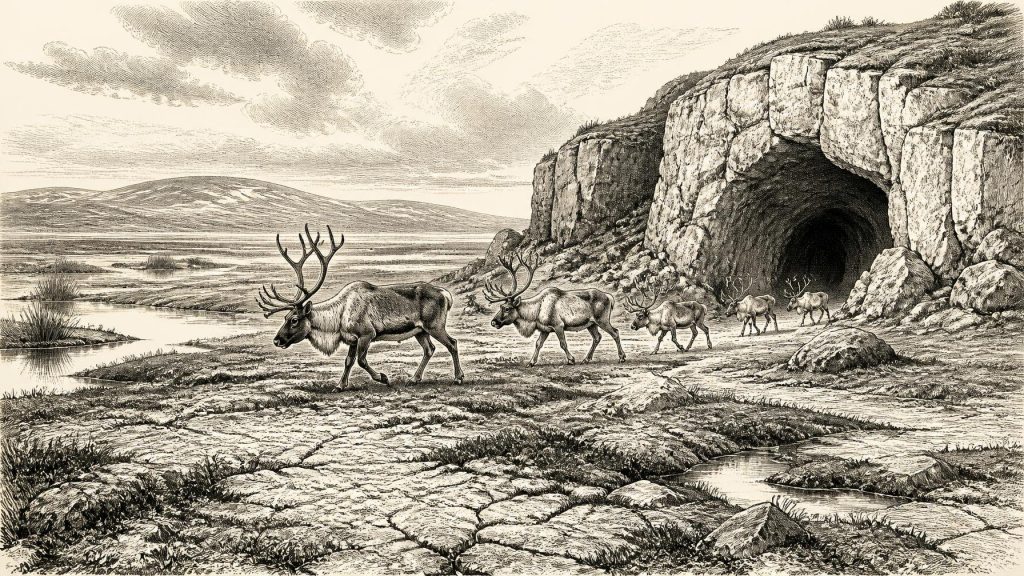
Around 31,631 BCE, Ireland lay in the unstable later Marine Isotope Stage 3, before the Last Glacial Maximum. Cold, open, largely treeless habitats supported reindeer, mammoth, giant deer, bears and hyaenas, although advancing ice and changing seas made access uncertain. Castlepook Cave near Doneraile preserves a long, disturbed faunal record. A reindeer femur, dated about 33,000 years ago, bears a possible stone-tool butchery mark, suggesting fleeting human activity but not settlement or continuous occupation. Derryvree sediments in Fermanagh record cold tundra wetland conditions between ice advances. Together, these fragmentary archives indicate active landscapes and possible human visitation before widespread glaciation.
Dateline
The label 31,631 BCE is a modern chronological convenience, not a year that anybody in Ireland could have named or recorded. At this depth of time, apparent calendar precision is misleading: the date falls roughly 33,600 calendar years before AD 1950, but archaeology and palaeoclimate research work with ranges, uncertainties and correlations rather than a single season or event. The most responsible setting is the later part of Marine Isotope Stage 3 (MIS 3), an unstable interval of the last Ice Age. For Ireland, the evidence consists chiefly of animal bones, cave deposits, buried freshwater sediments, glacial landforms and radiocarbon measurements. It does not supply a political narrative, a named population or a map of settlement.
A Landscape Before Maximum Ice
At this broad horizon, Ireland was approaching the major expansion of the last Irish Ice Sheet, but was not yet necessarily engulfed by the continuous ice cover associated with the Last Glacial Maximum. Syntheses of glacial evidence suggest that much of Ireland may have remained ice-free until about 32,000 calendar years ago, after which ice thickened and spread across the island’s uplands. That conclusion is itself a reconstruction, not a photograph of one moment. Ice growth was spatially uneven, and the evidence is better for some districts than for others. The later maximum, conventionally dated to about 27,000–23,000 calibrated years before present, would radically rework landscapes and destroy or disturb older deposits.
The Ireland of this period was consequently neither the familiar green island nor simply an unbroken white ice sheet. Open, cold country could occur beyond advancing ice margins: a periglacial world of frost-shattered ground, sparse vegetation, seasonal meltwater and exposed mineral soils. Sea levels were lower than today because vast quantities of water were stored in northern ice sheets. Yet it would be careless to turn that fact into a confident picture of an easy land bridge from Ireland to Britain or continental Europe. The changing shape of ice, sea and shallow shelf created complicated routes and barriers. Any human or animal movement into Ireland depended upon conditions that are not recoverable in year-by-year detail.
Castlepook’s Faunal Archive
The clearest Irish evidence relevant to this distant period comes from Castlepook Cave, near Doneraile in north County Cork, also known as Mammoth Cave. Its limestone passages yielded more than two thousand bones during excavations in the early twentieth century. Later radiocarbon work has shown that the assemblage spans a long interval, with dated individual remains falling broadly between about 45,700 and 19,950 years before present. The cave is therefore not a single event deposit. It is a time-averaged archive formed through repeated animal deaths, carnivore activity, sediment movement and later disturbance.
Nevertheless, Castlepook demonstrates beyond doubt that large mammals occupied southern Ireland during MIS 3. Its fauna includes woolly mammoth, reindeer, giant deer, brown bear and spotted hyaena, alongside smaller cold-adapted animals in later deposits. This is significant evidence for an Ice Age ecological community, but each species must be interpreted carefully. A bone in a cave need not mean that the animal lived there permanently; hyaenas and other carnivores could carry prey or scavenged carcass parts underground. Water could also redistribute material. The cave shows a regional faunal landscape, not a neat census of a single valley.
Reindeer are especially important for the date in question. They are well suited to open northern environments and their presence fits an interpretation of broad, treeless terrain rather than closed woodland. Mammoth and giant deer likewise point towards a richer large-mammal fauna than historic Ireland possessed. Spotted hyaena is a reminder that the cave itself could have been part of a carnivore’s territory. Such animals were not merely background scenery for possible people; they were competitors, scavengers and hazards within an ecosystem structured by mobility, weather and seasonal resources.
The Reindeer Femur and Human Possibility
One Castlepook reindeer femur has altered discussion of Ireland’s earliest human past. The bone has been reported as about 33,000 years old and bears a deep mark interpreted by the palaeozoologist Ruth Carden as an incision made on fresh bone with a sharp stone implement, probably during butchery. If that diagnosis is sustained, it is evidence that people reached Ireland during MIS 3, many millennia before the better-established post-glacial occupation of the island. It is an arresting possibility precisely because the Irish Palaeolithic record is so slight.
The distinction between evidence and interpretation matters here. The directly dated reindeer bone is evidence. The mark on it is evidence. Its identification as a human-made cut or chop mark is a specialist taphonomic interpretation, assessed from its form, depth and position rather than assumed from its existence. No securely associated stone tool, hearth, dwelling floor, human skeleton or stratified camp has yet been tied to that one act at Castlepook. The femur therefore supports a cautious claim of human activity or visitation, not proof of a settled population, a named culture, or continuous occupation across Ireland.
Nor can the bone tell us whether the person who made the mark was a recent arrival, how many companions were present, or whether the animal had been hunted rather than found dead or scavenged. Butchery of a carcass could have yielded meat, marrow, hide, sinew and bone; these are reasonable possibilities, not recoverable facts in this instance. A sharp stone edge would imply practical lithic knowledge, but the tool itself is absent. The scale of the evidence should govern the scale of the story: Castlepook permits a glimpse of a human encounter with an animal, not a reconstruction of a village.
Fermanagh’s Buried Wetland
Environmental evidence from Derryvree near Maguiresbridge, County Fermanagh, helps to illuminate the wider Irish world, although it cannot be assigned precisely to 31,631 BCE. There, a freshwater series of silts and fine sands was found between two thick till sheets within a drumlin. Radiocarbon determinations centred on about 30,500 radiocarbon years before present, with substantial uncertainty; calibration places the deposit broadly in the same later MIS 3 environmental neighbourhood, measured in millennia rather than years. The stratigraphy is valuable because the sediments survived between advances of ice that later reshaped the region.
Plant macrofossils, pollen, insects and mosses from Derryvree indicate a cold, open, treeless wetland or muskeg landscape. Sedges, dwarf shrubs and herbaceous tundra plants, with shallow pools and waterlogged ground, supplied the material record. The picture is not of empty frozen desert. It is of a harsh but biologically active mosaic in which vegetation varied with drainage, snow cover, exposure and the short growing season. The evidence is local to the basin, however. It should not be inflated into a uniform description of every part of Ireland, still less a claim that Castlepook and Derryvree were occupied simultaneously.
Life Without Institutions
There is no evidence from Ireland at this date for political institutions, warfare, diplomacy, formal religion, writing, monuments or long-distance trade networks. Those subjects cannot responsibly be filled with imagined chieftains, rituals or tribal territories. If humans were present, their social world was more likely organised through small, mobile foraging groups than permanent settlements, as is broadly consistent with Upper Palaeolithic lifeways elsewhere in north-west Europe. But that is comparative interpretation, not a fact demonstrated by an excavated Irish camp.
Everyday survival would have required extensive environmental knowledge: reading animal movements, finding shelter, managing warmth and maintaining portable tools in a severe climate. Caves such as Castlepook could offer temporary shelter or a place to process an animal, but the available evidence also shows their use by carnivores and repeated natural processes. The absence of known houses is not proof that no people ever camped in the open; later glaciation, erosion and rising seas have removed or buried many likely traces. It is, however, a strong reason not to claim settlement where none has been found.
A Fragile Beginning
The principal development illuminated around this date is therefore ecological and evidential. Ireland contained, at least in some regions and intervals, habitable cold-country environments supporting reindeer and other Pleistocene mammals. Castlepook preserves the strongest presently known suggestion that people may have entered that world and butchered one of its animals. Derryvree preserves a different but complementary record of tundra wetland beneath later glacial deposits. Together they replace the older image of pre-ice-age Ireland as a blank on the human map, while also insisting on restraint.
For 31,631 BCE, the honest historical conclusion is not that an Irish society did a known thing in a known year. It is that the island’s deep past contained episodes of open, cold habitat, mobile fauna and perhaps fleeting human presence before the last ice sheet became dominant. Future excavation, improved dating and microscopic reassessment may strengthen, qualify or overturn particular interpretations. For now, a reindeer bone in a Cork cave remains the most vivid witness: not a chronicle, but a small and difficult trace of lives lived at the edge of an advancing Ice Age.
Primary Sources
- A Reconsideration of the Radiocarbon Dating of the Marine Isotope Stage 3 Fauna from Southern Ireland
- Castlepook Cave: Cork County Geological Site Report
- A Middle Midlandian Freshwater Series at Derryvree, Maguiresbridge, County Fermanagh, Northern Ireland
- The Last Irish Ice Sheet: Extent and Chronology
- Late Pleistocene Chronostratigraphy and Ice Sheet Limits, Southern Ireland
- Response of the Irish Ice Sheet to Abrupt Climate Change During the Last Deglaciation
- Trimlines, Blockfields and the Vertical Extent of the Last Ice Sheet in Southern Ireland
- Timing and Pace of Ice-Sheet Withdrawal Across the Marine–Terrestrial Transition West of Ireland During the Last Glaciation
- The Deglaciation of the Western Sector of the Irish Ice Sheet from the Inner Continental Shelf to its Terrestrial Margin
- Oscillating Retreat of the Last British-Irish Ice Sheet on the Continental Shelf Offshore Galway Bay, Western Ireland
- Ireland: Submerged Prehistoric Sites and Landscapes
- The Island of Ireland: Drowning the Myth of an Irish Land-Bridge?
- The IntCal20 Northern Hemisphere Radiocarbon Age Calibration Curve (0–55 cal kBP)
- A 60,000 Year Greenland Stratigraphic Ice Core Chronology
- North GRIP – Greenland Ice Core Chronology 2005 (GICC05) 60,000 Year, 20 Year Resolution
- First Evidence of a Late Upper Palaeolithic Human Presence in Ireland
- New Insights on the Fauna of Ireland's Younger Dryas and Early Holocene from Alice & Gwendoline Cave
- Irish Quaternary Vertebrates
- The Human Colonisation of Ireland in Northwest European Context
- Palaeoecology