

Castlepook’s Cave Fauna31630 BCE
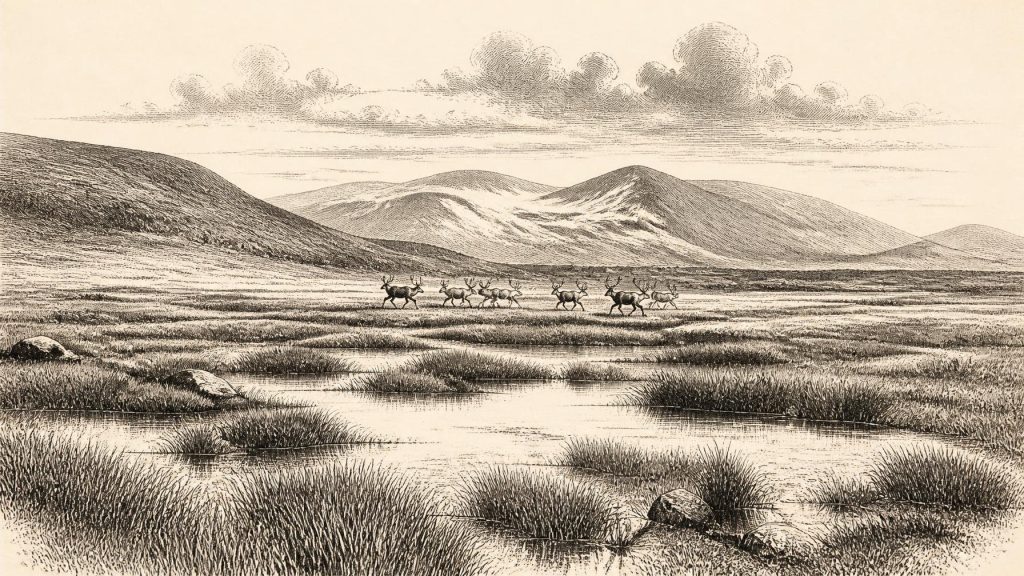
Around 31,630 BCE, Ireland lay within an unstable Ice Age interstadial, before the Last Glacial Maximum but amid shifting ice margins, low seas and varied regional conditions. Cave remains at Castlepook, County Cork, document Late Pleistocene fauna including mammoth, reindeer, giant deer, bears, wolves and hyaenas, indicating episodic open, cold-steppe habitats, though not a single contemporaneous ecosystem. Buried sediments at Derryvree, County Fermanagh, reveal treeless periglacial wetlands with grasses, sedges, herbs and mosses. Human occupation remains unproven: a possibly cut-marked reindeer bone may suggest visitors, but lacks secure context. Later glaciation destroyed evidence, leaving changing environments rather than social history.
Dateline
The label 31,630 BCE is a modern device, not a date anyone in prehistoric Ireland could have known or recorded. It should not be treated as the year of a named event, a ruler, a battle or a migration. At this depth of time, the responsible unit is a broad environmental and archaeological interval. Converting the date mechanically places it about 33,580 years before AD 1950, but even that calculation must not create false precision: radiocarbon determinations have to be calibrated, their ranges can be wide, and deposits in caves or beneath glacial sediments are rarely neat annual archives.
In the North Atlantic climatic sequence, this notional point falls near the beginning of Greenland Interstadial 6, conventionally dated to roughly 33,740–33,360 years before AD 2000. An interstadial was a relatively milder episode within the last Ice Age, not a modern-style warm period. Its effects varied greatly across regions. Ireland lay on the north-western edge of Europe, exposed to rapid climatic shifts, changing ice margins and low sea levels. The island’s evidence is too fragmentary to reconstruct weather, seasons or human activity for one numbered year, but it can illuminate the kind of country Ireland may have been during this unstable phase.
An Island Before Maximum Ice
31,630 BCE came long before the Last Glacial Maximum, the later phase in which the British–Irish Ice Sheet reached its greatest overall extent, broadly between about 26,500 and 19,000 years ago. That does not mean Ireland was comfortably ice-free. Ice had advanced and retreated repeatedly during the Pleistocene, and the build-up to the last major glaciation was neither uniform nor simultaneous across the island. Reconstructions differ over the scale and timing of earlier ice, because subsequent glaciers removed, mixed and buried much of the relevant evidence.
There are nevertheless grounds for seeing substantial parts of Ireland as not yet overwhelmed by the final ice-sheet expansion. Exposure-age evidence from north-central Ireland indicates ice-free conditions there until at least about 34,000 years ago. Other work suggests that the last Irish Ice Sheet expanded materially after this time and that Ireland was largely glaciated by about 32,000 years ago. The apparent tension is useful rather than fatal: it shows why a single all-Ireland description is unsafe. Around the date in question, different districts may have experienced very different realities—open ground, advancing local ice, periglacial frost action, ice-dammed water or terrain already modified by older glaciers.
For people today, “Ireland” naturally suggests an island with familiar coastlines. That image is misleading for the Ice Age. Global sea levels were lower than now, exposing parts of the continental shelves around north-west Europe. Yet lower seas do not automatically prove a walkable land bridge from Ireland to Britain. The Irish Sea basin, local topography, glacial loading and changing water levels made connections complex and temporary. It is therefore prudent neither to picture a permanent land route nor to assume that any animal or person reaching Ireland must have crossed open sea in the modern sense.
What the Caves Preserve
The most important Irish evidence for this broad period comes from limestone caves, particularly Castlepook Cave near Doneraile in north Cork. Caves are powerful but difficult archives. They can shelter animals, trap remains, receive washed-in sediment and later be disturbed by collapse, excavation or scavenging. A bone from a cave establishes that an animal died or was deposited there; it does not, by itself, identify the landscape immediately outside, prove that species lived there year-round, or reveal a single moment of human activity.
Even so, Castlepook preserves an exceptional record of pre-Last Glacial Maximum fauna. Re-dating has revised the chronology of several southern Irish cave collections and demonstrated that certain bones are significantly older than formerly thought. The implications are substantial. Mammoth, reindeer, giant deer, brown bear, wolf, spotted hyaena and smaller cold-adapted mammals occur within the wider Irish Late Pleistocene record. These finds reveal that Ireland was at times part of a broader north-west European ecological world in which large herbivores and carnivores could move through suitable habitats.
That list must not be converted into a census for 31,630 BCE. The dated bones have separate ages, uncertainties and archaeological contexts. Some species may have overlapped; others may represent different episodes spanning many millennia. Carden, Higham and Woodman’s reassessment suggests, for example, that giant deer and spotted hyaena may already have disappeared locally by around 40,000 calibrated years ago, well before the Last Glacial Maximum. Reindeer is especially evocative because it indicates open, cold-country habitats, but a reindeer bone is not proof of a continuously occupied reindeer plain at the exact point represented by this article.
The cave fauna nevertheless permits a careful environmental interpretation. Ireland’s landscapes included open country capable, at least at intervals, of supporting grazing animals. The presence of mammoth and reindeer in the wider record is consistent with a mosaic often described as mammoth-steppe or tundra-steppe: largely treeless ground with grasses, herbs, sedges and patches of wetter vegetation. Carnivores such as hyaenas and wolves would have followed prey, competed for carcasses and used sheltered sites. Brown bears may have used caves, complicating any attempt to treat caves as human places by default.
Fermanagh’s Buried Wetlands
Evidence from Derryvree near Maguiresbridge, County Fermanagh, offers a different but complementary view. Road works exposed fine sands and organic silts caught between two layers of glacial till within a drumlin. The organic deposit produced a radiocarbon determination of about 30,500 radiocarbon years before present, with a large uncertainty; calibration places it broadly in the same late Marine Isotope Stage 3 world as the date considered here, rather than securely in one calendrical year. Its position between tills is as significant as its date: it records an interval of non-glacial or less intensely glacial conditions between major episodes of ice deposition.
The Derryvree plant and insect evidence indicates a treeless, periglacial wetland or muskeg landscape. Grasses, sedges, herbs, juniper and mosses point to saturated ground, shallow pools and open vegetation rather than woodland. This was not an empty white wilderness. In summer, low plants, wet hollows and standing water could support insects, waterbirds and herbivores; in winter, severe frost and snow would have imposed formidable constraints. Such environments could change quickly as temperature, precipitation, wind exposure and ice margins shifted. The local evidence is valuable precisely because it gives texture to a period otherwise known mostly through glacial landforms and cave bone.
There is no responsible basis for describing fields, villages or a settled Irish population in this landscape. No securely stratified dwelling, hearth, stone-tool assemblage, burial or repeated occupation surface has been identified in Ireland for around 31,630 BCE. Ireland has yielded securely dated evidence of Late Upper Palaeolithic human activity much later, at Alice and Gwendoline Cave in County Clare, where a butchered brown-bear patella dates to roughly 12,810–12,590 calibrated years before present. That important discovery confirms that hunter-gatherers eventually reached the island, but it cannot be projected backwards by another twenty thousand years.
People: Possibility and Silence
Claims of much earlier human activity require especially cautious wording. A reindeer femur from Castlepook has been presented publicly as bearing a deep modification interpreted as a sharp-tool cut, and as dating to about 33,000 years ago. If specialist analysis ultimately confirms both the mark’s human origin and its association with the bone’s age, it would be major evidence for Upper Palaeolithic visitors processing an animal in Ireland during this broad period. It would still not demonstrate a permanent colony, continuous occupation, named community or ancestral link to later inhabitants.
The limitations are fundamental. The specimen derives from an old cave collection, not from a modern excavation of an intact camp floor with associated tools, fire residues and food waste. Radiocarbon dating establishes when the animal lived, not automatically when a mark was made, where it was killed or how long humans may have remained nearby. Natural abrasion, carnivore damage, excavation history and post-depositional movement must all be excluded before a mark can bear historical weight. The most defensible conclusion for 31,630 BCE is therefore that human presence in Ireland remains unproven, though the question is now more open than it once was.
This evidential silence sets strict limits on social and political history. There were no known polities, chiefs, diplomatic relations, territorial institutions or wars in Ireland that archaeology can place here. If people did enter the island, they would have belonged to mobile Upper Palaeolithic hunter-gatherer worlds documented elsewhere in Europe, where small groups relied on detailed knowledge of animals, raw materials, routes and seasonal resources. But that is a regional comparison, not direct Irish evidence. It must not be mistaken for proof that Irish groups made similar tools, exchanged objects, practised particular rituals or spoke any identifiable language.
No Calendar, No Kingdoms
Religion, culture and learning are likewise beyond direct recovery for this date in Ireland. There are no Irish cave paintings, portable artworks, graves or ceremonial structures securely attributable to this time. Nor is there evidence for trade in the ordinary sense: no local assemblage proves exchange networks, imported stone or the movement of crafted goods. The absence of evidence is partly historical and partly geological. Later ice sheets eroded surfaces, redistributed sediments and lowered the likelihood that temporary camps on exposed ground would survive. Former coastal landscapes, meanwhile, lie beneath modern seas.
The real history of Ireland around 31,630 BCE is thus one of changing habitats and incomplete archives. It was a land approaching a major glacial transformation, yet one that still supported, at intervals, a distinctive cold-climate fauna and wetland vegetation. Castlepook’s bones and Derryvree’s buried silts do not supply an annual chronicle. They do something more fundamental: they show that Irish history begins not with kings or monuments, but with difficult evidence for life at the edge of ice—animals moving through open country, plants persisting in wet ground, and landscapes repeatedly altered by climate before any durable human record survived.
Primary Sources
- A reconsideration of the radiocarbon dating of the Marine Isotope Stage 3 fauna from southern Ireland
- Trimlines, blockfields and the vertical extent of the last ice sheet in southern Ireland
- Dimensions and chronology of the last ice sheet in Western Ireland
- Last Glacial Maximum cirque glaciation in Ireland and implications for reconstructions of the Irish Ice Sheet
- Pattern, style and timing of British–Irish Ice Sheet advance and retreat over the last 45,000 years: evidence from NW Scotland and the adjacent continental shelf
- A Middle Midlandian Freshwater Series at Derryvree, Maguiresbridge, County Fermanagh, Northern Ireland
- Figure 6.— The subdivision of the Quaternary Period in Ireland
- The Quaternary of Fermanagh: Field Guide
- The Irish Quaternary Fauna Project
- The Archaeology of Caves in Ireland
- First evidence of a Late Upper Palaeolithic human presence in Ireland
- New insights on the fauna of Ireland's Younger Dryas and Early Holocene from Alice & Gwendoline Cave
- Prehistoric Details
- The Mesolithic in Ireland: when was it?
- A stratigraphic framework for abrupt climatic changes during the Last Glacial period based on three synchronized Greenland ice-core records: refining and extending the INTIMATE event stratigraphy
- Data – icesamples – software
- The IntCal20 Northern Hemisphere radiocarbon age calibration curve (0–55 kcal BP)
- The problem of a late quaternary landbridge between Britain and Ireland
- Deglaciation, Earth crustal behaviour and sea-level changes in the determination of insularity: A perspective from Ireland
- The Island of Ireland: Drowning the Myth of an Irish Land-Bridge?