Maguirebridge’s Frostbound Waters31610 BCE
31,610 BCE denotes a Late Pleistocene interval, rather than a datable event. At Derryvree, County Fermanagh, organic freshwater sediments between glacial tills record an ice-free, periglacial wetland during MIS 3, with tundra vegetation, insects and seasonal cold. Other evidence confirms uneven ice-sheet growth before its later maximum. Castlepook Cave, County Cork, preserves remains of mammoth, giant deer, reindeer and predators, although its deposits span multiple periods. A possibly cut-marked reindeer bone suggests a brief Upper Palaeolithic human visit, not settlement. No evidence supports claims about politics, culture, trade or permanent population. Ireland was environmentally dynamic, biologically inhabited and increasingly glaciated.
Dateline
“31,610 BCE” is a useful modern label, not a date at which an event in Ireland can be identified. No inhabitants of the island recorded years, named rulers or left written accounts at this depth of time. In archaeological terms the point falls about 33,560 years before AD 1950, within the Late Pleistocene and Marine Isotope Stage 3 (MIS 3). Radiocarbon dates from so far back must be calibrated and expressed as probability ranges; they cannot distinguish one modern calendar year from the next. The responsible subject is therefore an interval of environmental change rather than an Irish year of politics or biography.
That interval was significant. Ireland had not yet reached the greatest expansion of the last British–Irish Ice Sheet, but it was moving towards a colder, more unstable glacial world. Evidence from County Fermanagh and from cave deposits in the south shows that parts of the island could support tundra vegetation and sizeable mammals during this broader period. It also raises, without conclusively answering, the question of whether small groups of Upper Palaeolithic people ever reached Ireland before the ice expanded again.
Evidence Between the Tills
The clearest Irish environmental archive relevant to this date is at Derryvree, near Maguiresbridge in County Fermanagh. Roadworks in 1969 cut through a drumlin and revealed a remarkable sequence: freshwater silts and fine sands, rich in organic material, lay between two thick and distinct layers of glacial till. The lower till testified to an earlier advance of ice; the upper till showed that ice later returned and buried the wetland deposit. Between them survives a brief geological window onto an ice-free, intensely cold landscape.
The Derryvree organic sediments produced the conventional radiocarbon determination Birm-166, 30,500 radiocarbon years BP, with a large uncertainty of +1,170/−1,030 years. Published calibration estimates place the deposit broadly around c. 36,900–31,700 calibrated years BP. That span includes the approximate horizon represented by 31,610 BCE, but it must not be mistaken for a date on a single layer, season or event. The sediments accumulated over time; later glacial action affected their setting; and radiocarbon calibration itself is refined as reference curves improve. What Derryvree securely demonstrates is that north-central Ireland experienced non-glacial freshwater and periglacial conditions during part of MIS 3, before the main late-glacial ice-sheet build-up.
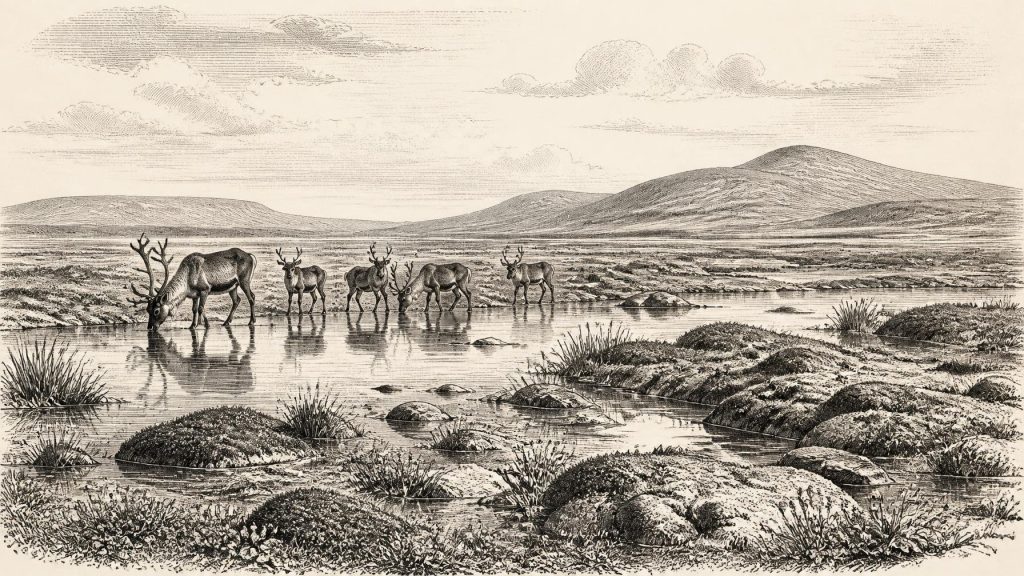
The fossils make the point more vividly. Poorly preserved pollen was dominated by herbaceous plants, while plant macrofossils included mosses and water-associated species. Insect remains added evidence for cold conditions. Taken together, they support the interpretation of open tundra or muskeg-like wetland: wet, mossy and sedgy ground, shallow freshwater, sparse vegetation on drier surfaces, and a climate with severe winters and a short growing season. A few pollen grains from trees do not establish local woodland. They may have travelled far, been redeposited, or represent vegetation beyond the immediate basin. The landscape was not a familiar Irish countryside of oak woods, hedges and pasture.
An Island of Open Ground
“Ice Age” should not suggest an unbroken white sheet covering every place at every moment. Around this broad horizon, the evidence points instead to a changing mosaic. Low vegetation could colonise exposed ground; wetlands and pools persisted where drainage and local relief allowed; and frost processes shaped soils. In summer, herb-rich patches, sedge margins and open water could have been productive. In winter, wind, prolonged freezing and restricted plant growth imposed a much harsher rhythm. The exact balance differed from one region to another and shifted over centuries or millennia as temperature, snowfall and ice margins changed.
Derryvree cannot stand for the entire island. It is a northern inland locality, and its sediments tell us most directly about their own catchment. Yet other Irish records reinforce the wider conclusion that the last ice sheet did not simply arrive everywhere at once. Organic deposits at Greenagho, also in Fermanagh, and marine evidence from the western seaboard are among the records used to reconstruct intervals of ice-free ground or open water before the later major advance. Modern reconstructions of the British–Irish Ice Sheet describe growth as asynchronous and dynamic. By roughly 27,000 years ago the ice sheet had expanded far more widely; its maximum volume came later, around 23,000 years ago. At 31,610 BCE that transformation was approaching, not complete.
Sea level was much lower than it is now because immense quantities of water were locked in continental ice sheets. But it does not follow that Ireland was joined to Britain by a simple, walkable land bridge at this exact date. The geography of the Irish Sea basin, glacier margins, coastlines and marine passages changed repeatedly. Animal movement into Ireland demonstrates ecological connection at some points in the Late Pleistocene, but not the precise route, season or conditions of every crossing. Any reconstruction of a fixed highway across the sea is more confident than the evidence permits.
Castlepook’s Animal World
The best evidence for large animals comes from caves, especially Castlepook Cave near Doneraile in north County Cork, long known as Mammoth Cave. Excavations from the early twentieth century recovered an exceptional collection including woolly mammoth, giant deer, reindeer, brown bear, wolf, Arctic fox, mountain hare, lemmings and spotted hyaena. This was a community of open, cold-country animals unlike anything now living in Ireland. Reindeer and hare evoke tundra grasslands and scrub; lemmings and Arctic fox indicate severe conditions; hyaenas, wolves and bears remind us that caves were used by animals as dens, feeding places and shelters rather than as straightforward human sites.
There is an essential chronological warning. Castlepook’s historic collections were gathered before modern excavation standards, and the cave deposits have complex histories. Bones from the site do not necessarily belong to one moment, one landscape or one animal community living side by side. The Irish Quaternary Fauna Project showed the value of directly dating specimens, while more recent work has demonstrated that improved pretreatment can substantially revise older bone dates. Castlepook is therefore an archive of repeated animal deposition across a long phase of the Late Pleistocene, not a snapshot of a single hunt or a single year.
Nevertheless, fauna directly relevant to the wider MIS 3 interval establishes that Ireland was not biologically empty. Mammoths and giant deer required substantial forage; reindeer could exploit more open vegetation; large predators followed prey and competed for carcasses. Their presence suggests seasonal movement through suitable habitats, though it cannot yield precise herd numbers, migration routes or population sizes. A bone in a cave may have been carried there by a carnivore, washed in with sediment, or left after an animal died nearby. Taphonomy—the study of what happened to remains after death—is as important as species identification.
The Human Question
One Castlepook reindeer femur has made this period unusually important for Irish archaeology. It has been reported as carrying an incision consistent with cutting by a sharp stone tool, and has been presented in public heritage interpretation as dating to roughly 33,000 years ago. If specialist examination ultimately confirms that the mark was made by a person while the bone was fresh, it would be evidence that someone processed a reindeer in Ireland during the Upper Palaeolithic. That would extend the possible human story of the island much further back than the long-accepted late Upper Palaeolithic evidence from County Clare.
The claim must, however, remain carefully limited. A directly dated animal bone does not by itself date a human visit with annual precision. A single mark is not equivalent to a hearth, stone-tool scatter, dwelling floor, burial, art panel or settlement. Cut marks must be distinguished from carnivore scoring, trampling, sediment abrasion, breakage, excavation damage and later handling through their form, position and microscopic features. Nor can an old cave collection furnish the secure stratigraphic context expected from a modern excavation. Recent work at Castlepook has sought undisturbed Pleistocene deposits precisely because these questions require better context.
The most cautious interpretation is therefore that a short human visit is possible, not that Ireland possessed a permanent population in 31,610 BCE. If people did reach the island, they may have come as highly mobile hunter-gatherers exploiting animal resources at the north-western edge of Upper Palaeolithic Europe. Processing a carcass could have supplied meat, fat, marrow, hide, sinew and bone; but even this is an inference from one potentially modified specimen, not a recovered camp scene. There is no basis for naming an Irish cultural group, tracing descent to later communities, or imagining a settled Palaeolithic society.
What Cannot Be Recovered
Political affairs, diplomacy and formal warfare cannot responsibly be described for Ireland at this date. There are no named communities, territories, leaders, treaties, weapons caches or fortifications. Likewise, no evidence identifies religious practices, language, music, clothing styles, kinship rules or systems of learning. Caves might look symbolically suggestive to modern observers, but the Castlepook evidence does not establish ritual use by people. The absence of evidence is especially acute because later ice movement eroded, buried and redistributed much of the older landscape.
Economy and trade must be treated with the same restraint. No Irish exchange network, imported object or quarry-to-camp trail has been securely demonstrated for this horizon. If visitors processed a reindeer, that would imply subsistence activity rather than trade. A mobile group could have carried stone tools into Ireland, yet no securely associated Upper Palaeolithic lithic assemblage has been recovered. The later Mesolithic record, beginning many millennia after the final ice retreat, offers the first substantial evidence for enduring settlement on the island; it must not be projected backwards onto this much older and more uncertain world.
The enduring importance of 31,610 BCE lies in that contrast. The island was a changing cold-stage environment, not an empty page but not yet a documented human homeland. Freshwater silts beneath a Fermanagh drumlin preserve mosses, sedges, insects and the conditions of a frost-bound wetland. Cork caves preserve the traces of powerful Ice Age animals and a provocative possibility of human contact. Together they show an Ireland of exposed ground, seasonal life and impending glaciation—an archaeological landscape whose evidence is real, but whose calendar-year precision and human stories remain beyond recovery.
Primary Sources
- A Middle Midlandian Freshwater Series at Derryvree, Maguiresbridge, County Fermanagh, Northern Ireland
- Early Midlandian–Middle Midlandian, Pleistocene, Northern Ireland
- Palaeoecology
- Middle Midlandian Interstadial Deposits at Greenagho, Near Belcoo, County Fermanagh, Northern Ireland
- Irish Pleistocene Biostratigraphy
- A Reconsideration of the Radiocarbon Dating of the Marine Isotope Stage 3 Fauna from Southern Ireland
- The Irish Quaternary Fauna Project
- New Insights on the Fauna of Ireland’s Younger Dryas
- First Evidence of a Late Upper Palaeolithic Human Presence in Ireland
- Trimlines, Blockfields and the Vertical Extent of the Last Ice Sheet in Southern Ireland
- Growth and Retreat of the Last British–Irish Ice Sheet, 31,000 to 15,000 Years Ago: the BRITICE-CHRONO Reconstruction
- Pattern and Timing of Retreat of the Last British-Irish Ice Sheet
- Dimensions and Chronology of the Last Ice Sheet in Western Ireland
- Exploring Controls of the Early and Stepped Deglaciation on the Western Margin of the British Irish Ice Sheet
- Maximum Extent and Dynamic Behaviour of the Last British–Irish Ice Sheet West of Ireland
- Extent and Deglacial Chronology of the Last British–Irish Ice Sheet: Implications of Exposure Dating Using Cosmogenic Isotopes
- Deglaciation Chronology of the Donegal Ice Centre, North-West Ireland
- The IntCal20 Northern Hemisphere Radiocarbon Age Calibration Curve (0–55 cal kBP)
- Heritage Artefacts of County Cork
- Archaeological Heritage of County Cork
- Spotted Hyena Skull, Castlepook Cave
- Castlepook Cave, County Cork, 2022 Excavation Report