
The Fermanagh Sedge Basin31593 BCE
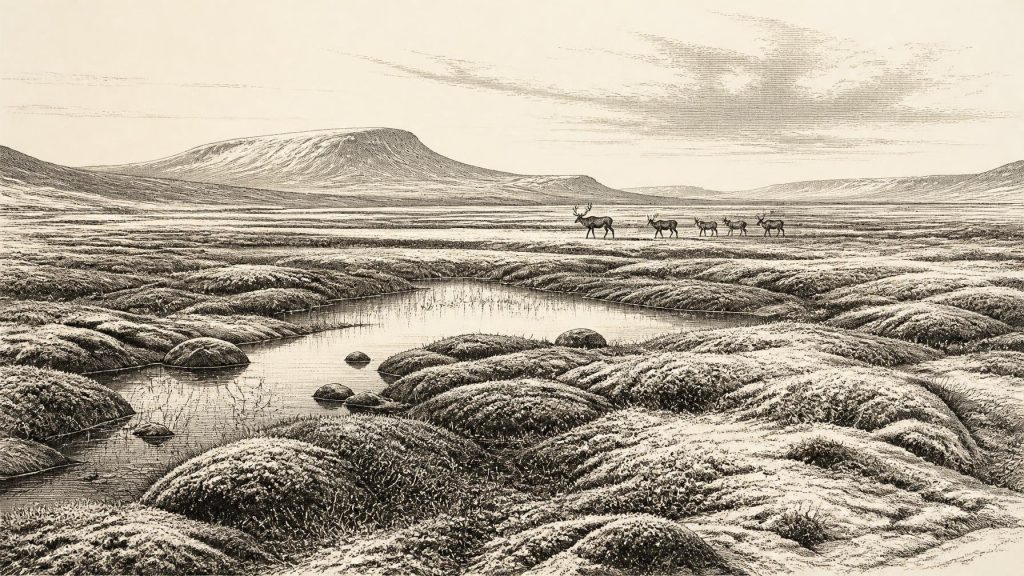
31,593 BCE is a notional point within the climatically unstable Late Pleistocene, when Ireland’s ice cover and environments varied regionally and remain uncertain. Organic deposits at Derryvree, County Fermanagh, preserved between tills, indicate cold, open wetlands containing sedges, mosses, aquatic plants and northern insects during a non-glacial interval. Castlepook Cave, County Cork, preserves fauna including reindeer, mammoth, hyaena and other open-country animals, demonstrating ecological connections with north-west Europe. A cut-marked reindeer bone may indicate early human activity, but lacks secure archaeological context. Evidence supports no settlements, politics, ritual or trade, only a landscape shaped by ice, water and animal movement.
Dateline
The label 31,593 BCE is a modern way of pointing to a very remote moment, not a date that prehistoric Ireland can be resolved into with calendar-year accuracy. Counted back from the conventional radiocarbon reference year of AD 1950, it lies roughly 33,540 years ago. That places it broadly within the later part of Marine Isotope Stage 3 (MIS 3), an unstable interval of the Late Pleistocene conventionally dated at about 59,000–28,000 calibrated years before present. Irish deposits of this antiquity are sparse, discontinuous and often disturbed by later ice. They can illuminate environments and animal communities, but they cannot identify what happened in one named year, let alone provide a political or personal narrative.
A Landscape Between Ice Advances
For Ireland, the central historical fact of this broad period is not a kingdom, migration chronicle or battle: it is climatic volatility. The island was in the last cold stage, known in Irish stratigraphy as the Midlandian. Yet this did not mean that every part of Ireland was permanently buried under a single unchanging ice sheet. Cold phases, episodes of local or wider glaciation, and intervals of ice-free periglacial terrain succeeded one another. The great British–Irish Ice Sheet reached its maximum much later, around 27,000–23,000 years before present in many reconstructions. Around the notional year in question, the island was approaching, rather than living through, that later maximum.
The exact disposition of ice in Ireland at c. 33,500 years ago remains debated. Evidence for pre-Last Glacial Maximum ice growth exists, but its timing, extent and regional pattern are less securely known than the ice sheet’s later advance and retreat. This is a vital qualification. A map that paints all Ireland white with ice, or alternatively depicts a wholly open island, would claim more certainty than the evidence permits. The responsible picture is of a changing north-west European margin, in which some Irish landscapes could support plants and animals during cold, non-glacial intervals while glaciers and ice caps expanded elsewhere or returned later.
The Derryvree Evidence
The most revealing Irish environmental archive for a period broadly close to this point lies at Derryvree, near Maguiresbridge in County Fermanagh. There, organic-rich freshwater deposits survived between older and younger tills: layers laid down in a wet landscape, then sealed beneath the products of renewed glaciation. Their very survival is exceptional. Ice commonly erodes or remoulds older ground, so the deposits offer a rare, incomplete window into an Irish landscape that later ice did not wholly destroy.
Derryvree’s plant and insect evidence indicates open, cold country with wet hollows, shallow freshwater and moss- and sedge-rich vegetation. Fossil remains include freshwater mosses and sedges, while the insect fauna has northern, cold-climate affinities. A fossil seed of bogbean, Menyanthes trifoliata, was recovered from the deposit, which has produced a radiocarbon determination of about 30,500 radiocarbon years before present. That laboratory age is not identical to a calendar age: radiocarbon measurements require calibration, and calibration becomes especially complex this far back. It nevertheless shows why the Derryvree sequence belongs in discussion of Ireland around the middle-to-late MIS 3 cold world.
It would be wrong, however, to turn this evidence into a photograph of the whole island in 31,593 BCE. Derryvree records one locality and a sedimentary episode, not every season or region. Pollen can travel far; plant remains may have been moved by water; and deposits accumulated over time. The sound inference is modest but valuable: parts of northern Ireland contained tundra-like or muskeg-like wetland habitats during a cold, non-glacial interval. There is no support for imagining dense forests, fields, permanent villages or a familiar modern Irish countryside.
Animals in the Southern Caves
South-west of Fermanagh, limestone caves near Doneraile in north County Cork preserve another kind of evidence. Castlepook Cave, also called Mammoth Cave, yielded a remarkable Pleistocene bone collection during excavations undertaken mainly between 1904 and 1908. Reindeer, brown bear, hare, fox, lemming, woolly mammoth and spotted hyaena occur among the wider assemblage. The National Museum of Ireland describes Castlepook as Ireland’s most important site for mammal remains from the last cold stage; it is also the island’s only confirmed spotted-hyaena locality.
Re-dating has transformed the significance of this old collection. A modern reassessment found that several earlier dates from southern Irish fauna needed revision because radiocarbon pretreatment methods had improved. In broad terms, Castlepook’s hyaenas and associated fauna indicate that cold-adapted and open-country animals reached southern Ireland between roughly 45,000 and 30,000 years ago. That calibrated span is far wider than a single year, but it overlaps the chronological horizon considered here. Reindeer are particularly apt evidence for an open, cold landscape with seasonal grazing opportunities; hyaenas indicate a carnivore guild capable of exploiting large animal carcasses.
A cave bone assemblage does not automatically reveal a living landscape outside its entrance. Carnivores can drag prey underground; water, collapse and later excavators can rearrange material; and animals may have died at different times. Castlepook should therefore be read as evidence for animals moving through, feeding in or using a regional landscape, not as a census of creatures standing together on one day. Its value lies in demonstrating that Late Pleistocene Ireland was, at intervals, ecologically connected enough to receive a diverse fauna from the wider north-west European world.
The Human Question
The most consequential uncertainty concerns people. A reindeer femur from Castlepook has been reported as about 33,000 years old and bears a deep linear mark interpreted by zooarchaeologist Ruth Carden as damage from a sharp stone tool, perhaps made while processing fresh bone. If that interpretation is confirmed, it would be evidence that a person or very small group handled a reindeer in Ireland during MIS 3, tens of millennia before the securely substantial Mesolithic archaeological record. It would not demonstrate a settled population, a named culture, or continuous occupation.
Caution is essential because the specimen came from an antiquarian cave collection, rather than from a modern excavation of an intact occupation floor containing tools, hearths and precisely mapped bones. No securely associated lithic assemblage, dwelling surface, fireplace, human burial, ornament or art is known from Ireland at this age. Recent licensed work at Castlepook has sought undisturbed, fossil-bearing deposits precisely because new stratified evidence could test the implications of the older finds. For now, the femur is an important possible sign of human activity, not a licence to populate Ireland with Upper Palaeolithic communities.
No Politics, No Proven Ritual
Accordingly, political affairs, diplomacy and organised conflict cannot responsibly be reconstructed for Ireland around this time. There are no rulers, tribal names, territories, monuments or written traditions. Nor is there evidence for religion, formal burial custom, language, learning, art or ritual in Ireland at this chronological horizon. Such absences do not prove that visiting people possessed no beliefs, social ties or knowledge; all human groups do. They mean only that Irish evidence does not allow those aspects of life to be described.
The same limit applies to economy and trade. If people did briefly reach Ireland, comparative Upper Palaeolithic archaeology makes hunting, carcass processing, hide-working and the use of portable stone tools plausible activities. But these are inferences from neighbouring regions, not excavated Irish camps. There is no basis for claiming a trade network, regular sea route, market exchange or permanent settlement. Lower sea levels altered coastlines and may have changed the difficulty of movement between Ireland, Britain and continental Europe, but the precise routes available at any particular MIS 3 moment remain uncertain.
An Environmental History
The best year-by-year account for 31,593 BCE is therefore an environmental history with carefully marked limits. Ireland was part of a cold and fluctuating Late Pleistocene world. In Fermanagh, freshwater sediments preserve evidence of sedges, mosses, aquatic plants and cold-adapted insects in an open wetland landscape. In Cork, cave collections demonstrate that reindeer and formidable carnivores, alongside other Ice Age mammals, reached the island during the broad period. A marked reindeer bone raises the possibility of an exceptionally early human visit, but it remains a question for ongoing fieldwork rather than a settled chapter of national history.
What survives is fragmentary, yet it matters. The sedge basin, the cave bone and the till above them show that Ireland’s deep past was not an empty prologue before later settlement. It was a place repeatedly reshaped by ice, water, vegetation and animal movement. Around this notional date, the evidence supports a cold, open and changeable Irish landscape—and asks us to distinguish that solid conclusion from the more tantalising, unproven possibility of the first people at its edge.
Primary Sources
- The IntCal20 Northern Hemisphere Radiocarbon Age Calibration Curve (0–55 cal kBP)
- Ice-core data used for the construction of the Greenland Ice-Core Chronology 2005 and 2021 (GICC05 and GICC21)
- Landscapes and environments of the last glacial-interglacial transition: a time of amazingly rapid change in Ireland
- Early Midlandian–Middle Midlandian, Pleistocene, Northern Ireland
- Figure 6.— The Subdivision of the Quaternary Period in Ireland
- Quaternary Site Descriptions
- BSBI: Menyanthes trifoliata
- The Irish Quaternary Fauna Project
- A Reconsideration of the Radiocarbon Dating of the Marine Isotope Stage 3 Fauna from Southern Ireland
- Spotted Hyena Skull
- 2022:564 – Castlepook Cave, Castlepook South, Cork
- Heritage Artefacts of County Cork
- Archaeological Heritage of County Cork
- The Colonization of Ireland: A Human Ecology Perspective
- Ireland: Submerged Prehistoric Sites and Landscapes
- First Evidence of a Late Upper Palaeolithic Human Presence in Ireland
- New Insights on the Fauna of Ireland's Younger Dryas and Early Holocene from Alice & Gwendoline Cave
- The Timing and Magnitude of the British–Irish Ice Sheet Between Marine Isotope Stages 5d and 2
- Timing and Pace of Ice-Sheet Withdrawal Across the Marine–Terrestrial Transition West of Ireland During the Last Glaciation
- Stratigraphic and Palaeo-Geomorphological Evidence for the Glacial-Deglacial History of the Last British-Irish Ice Sheet in the North-Western Irish Sea
- Mammoth and Musk Ox ESR-Dated to the Early Midlandian at Aghnadarragh, County Antrim, Northern Ireland, and the Age of the Fermanagh Stadial
- Growth and Retreat of the Last British-Irish Ice Sheet, 31,000 to 15,000 Years Ago